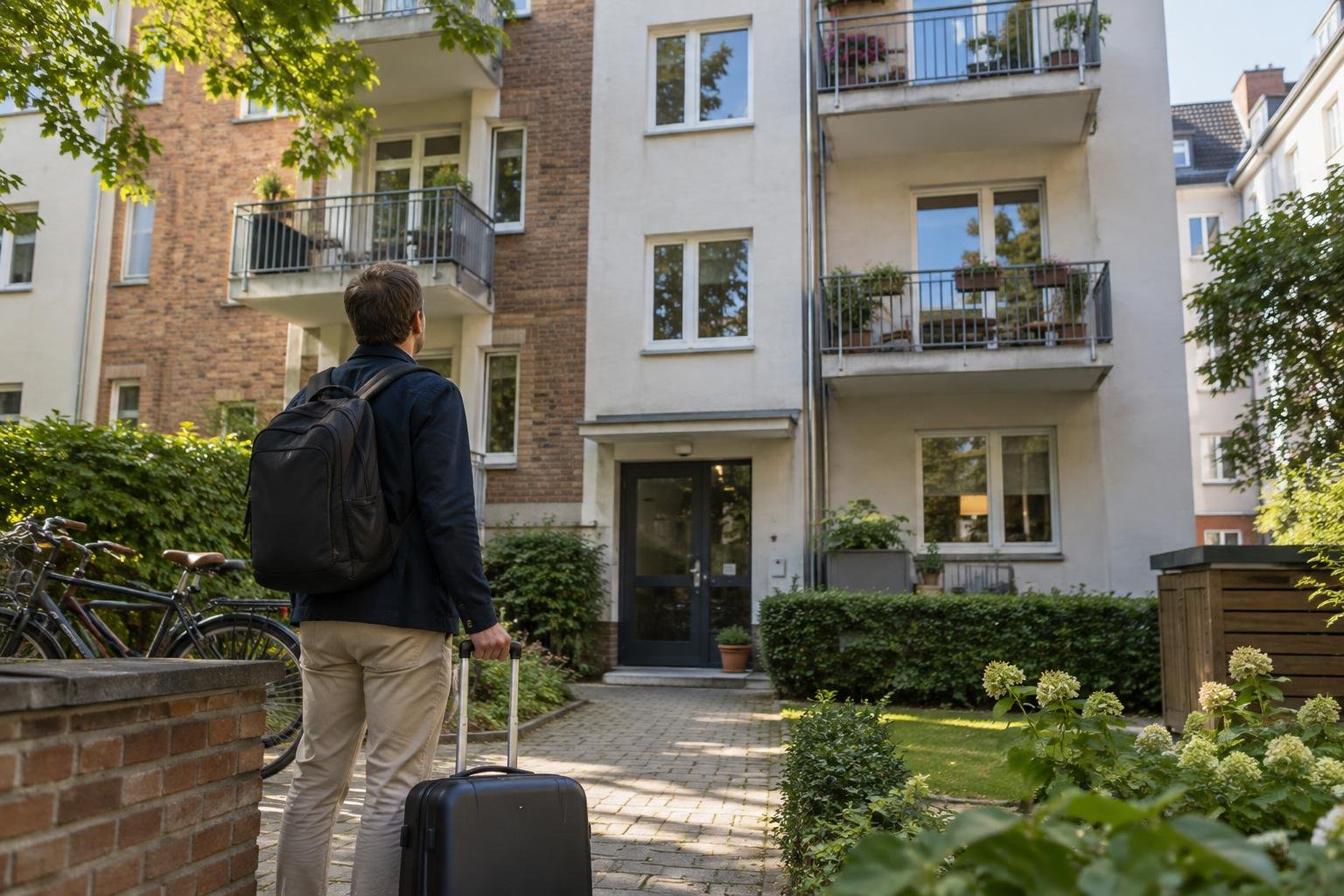
Buy a Rental Property Outright or Borrow? The Numbers
You could buy the flat without a loan. We compare the same property under both approaches and explain how liquidity, tax assumptions and leverage interact.
 Nadeem Shahid
Investment Advisor at InvestImmo
You have inherited money, received a redundancy payment or sold another property. You have €253,000 available for the purchase, in addition to a separate cash reserve. That would allow you to buy the rental flat considered here without borrowing. No mortgage instalment, no lending bank and no loan debt.
Leverage and tax-deductible interest are often put forward as arguments for borrowing. We examine what those arguments mean in this example, starting before tax.
01Buying outright does not mean paying in banknotes
People searching for a property purchase “in cash” usually mean buying without a loan. The purchase price is paid by bank transfer, normally after the notary issues a notice that payment is due. Payment in physical cash has been prohibited for property purchases in Germany since 1 April 2023 under section 16a of the German Money Laundering Act. Gold and cryptoassets must not be used as payment either.
Depreciation of the building element of a rental property may generally be available under either financing approach. One difference concerns interest: borrowing interest attributable to letting may qualify as deductible income-related expenses under section 9(1), sentence 3, no. 1 of the German Income Tax Act. This does not automatically make borrowing the more economical choice. Discuss the allocation for tax purposes with your tax adviser.
02Calculating the same flat twice
Peter is 52, single and has taxable income of €70,000 before the rental result considered here. Peter is a fictitious person; the figures are a simplified illustrative calculation, not a forecast. He buys an existing rental flat for €230,000, or €253,000 including incidental acquisition costs. Rent excluding service charges [Kaltmiete] is €800 a month. Management and maintenance cost him €1,400 a year.
For this calculation, the entire €1,400 is assumed to consist of management expenses and maintenance expenditure incurred during the year and eligible for immediate deduction. It excludes contributions to the owners’ association maintenance reserve [Erhaltungsrücklage]: these are not immediately tax-deductible. Only actual expenditure qualifying for tax relief can be recognised. Nor is the entire owners’ service charge [Hausgeld] automatically deductible.
Option A: he pays entirely from his own funds. Option B: he contributes €53,000, covering incidental acquisition costs and part of the price, and borrows €200,000 at 3.8% interest with an initial annual principal repayment rate of 1.5%. The remaining €200,000 stays in his bank account. A separate cash reserve is assumed in both options. Returns and taxes on the retained €200,000 are excluded.
The annual calculation is simplified: interest and principal repayments are calculated on the initial loan amount. It is not a monthly repayment schedule reflecting a declining balance during the year. No further financing costs, additional rental losses or extra repairs are included.
| A: outright purchase | B: with borrowing | |
|---|---|---|
| Rent excluding service charges | €9,600 | €9,600 |
| Management and maintenance | −€1,400 | −€1,400 |
| Interest | €0 | −€7,600 |
| Principal repayments | €0 | −€3,000 |
| Cash flow before tax | +€8,200 | −€2,400 |
Before tax, buying outright generates €8,200 a year under these assumptions. With borrowing, Peter contributes the equivalent of €200 a month.
Now consider tax. In both options, Peter claims depreciation of 2% on the building element, amounting to €3,795 a year. This assumes a depreciable building cost of €189,750: 75% of the total €253,000 acquisition cost, including the corresponding allocation of incidental acquisition costs. The remaining 25% relates to land, which is not depreciable. The example assumes a building completed between 1925 and 2022 that qualifies for 2% straight-line depreciation. The property-specific purchase price allocation and the statutory requirements for depreciation are decisive. With borrowing, the simplified model adds €7,600 of rental-related interest as deductible expenses.
For the after-tax comparison, we apply a simplified, uniform tax effect of 42% to the positive or negative rental result. The solidarity surcharge and church tax are excluded. Any loss is assumed to be fully offset against other positive income in the same year. This is a model calculation, not an individual calculation applying the income tax tariff to Peter’s income. The calculation treats the tax effect as a payment in the same year; actual payment timing may differ. Euro amounts are rounded to whole euros, while returns are calculated using unrounded amounts. Ask your tax adviser to assess the purchase price allocation, depreciation and individual tax effect.
| A: outright purchase | B: with borrowing | |
|---|---|---|
| Cash flow before tax | +€8,200 | −€2,400 |
| Taxable rental result | +€4,405 | −€3,195 |
| Tax effect at an assumed 42% | −€1,850 | +€1,342 |
| Cash flow after tax | +€6,350 | −€1,058 |
| Debt reduction through principal repayments | €0 | +€3,000 |
| Increase in net wealth during the year | +€6,350 | +€1,942 |
| Own funds invested | €253,000 | €53,000 |
| Return on own funds | 2.51% | 3.66% |
Under these assumptions, the return on the funds directly invested is 3.66% with borrowing and 2.51% when buying outright. Different equity contributions can amplify or reduce returns: this is known as the leverage effect.
But where does the difference come from? After the specified costs, the property returns 3.24% on total acquisition cost, while borrowing costs 3.8% before tax. Borrowing therefore reduces the return on equity before tax. After tax, the property’s return must be compared with the effective interest cost after tax relief. Depreciation and interest deductions affect this comparison. Principal repayments, however, do not create an additional return: they were previously deducted as a cash outflow and are added back as debt reduction when calculating the change in net wealth.
A higher return on equity does not automatically mean a greater overall increase in wealth. With no return on the retained €200,000, the annual increase in net wealth in this example is only €1,942 with borrowing, compared with €6,350 when buying outright. A complete comparison must include an alternative use of the available capital and its risks, costs and taxes. A lower tax rate or a higher illustrative interest rate, such as 4.2%, requires a fresh calculation.
„“
What would an outstanding loan mean for my heirs? A rental flat and its associated outstanding debt can form part of an estate. Anyone aiming to pass on a debt-free property can buy without borrowing or plan repayments around a target date for clearing the loan. Discuss questions about succession, liability and contractual arrangements with a qualified lawyer.

03Leverage works both ways
So far, we have assumed that the flat retains its value. What happens if its value rises or falls by 1% during the year? On €230,000, that is a €2,300 increase or decrease in notional wealth, whether Peter bought outright or borrowed. Its impact relative to the funds invested is very different. This change in value is not ongoing cash flow; selling costs and any tax on a sale are excluded.
| Change in the flat’s value during the year | A: outright purchase (€253,000) | B: with borrowing (€53,000) |
|---|---|---|
| −1% | 1.60% | −0.68% |
| unchanged | 2.51% | 3.66% |
| +1% | 3.42% | 8.00% |
Under the stated tax assumptions, a rise in value substantially increases the return on equity with borrowing. A 1% fall makes the change in net wealth negative for the financed purchase, while it remains positive for the outright purchase. The assumed change in value alone does not alter ongoing cash flow.
A 1% change in value is not a limit on the risk. In a further simplified illustrative calculation, a 5% price decline would mean a loss in this flat’s value of €11,500, regardless of the financing approach. This is another numerical scenario, not a forecast.
04Arguments for buying outright
- No financing-related interest rate risk. There is no refinancing that could become more expensive in ten years’ time.
- More ongoing liquidity without loan repayments. Cash flow is positive in the example. However, vacancy and unexpected costs can make it negative even without borrowing.
- No dependence on a lending bank. Credit assessments, loan conditions and refinancing are avoided. For a financed purchase, retirement income and the planned repayment schedule may be particularly relevant; this does not establish a general age limit.
- No purchase-related loan debt for heirs. This purchase leaves no outstanding loan balance.
- No mortgage instalment in difficult years. Lost rent or an extraordinary contribution still affect liquidity, but there is no debt service to meet as well.
05Arguments against buying outright
- Substantial capital is tied up in one flat. If the remaining reserve is insufficient, selling or borrowing against the property may become necessary. Both take time, can involve costs and may not be available on the desired terms.
- No deduction for borrowing interest. Depreciation and other eligible rental expenses may still be deductible. The absence of an interest deduction is not, by itself, an economic disadvantage: without a loan, there is no interest cost either.
- Concentration risk. Investing €253,000 in a single flat creates concentration risk. Borrowing leaves funds available for a reserve or a second flat in another location. Additional purchases also bring further obligations and risks.

06The middle ground: partial borrowing
There are many options between buying without a loan and financing the entire purchase. Option B already involves partial financing, with €53,000 of equity. Three possible approaches are:
- 01A substantial equity contribution
You pay, for example, 50–60% of the total acquisition cost yourself. This may make better borrowing terms available and reduces debt service, all else being equal. Whether cash flow becomes positive needs to be calculated.
- 02Borrowing while retaining a reserve
You borrow as in option B and set aside some of the available funds for repairs, lost rent and, where the contract permits, additional principal repayments.
- 03A shorter repayment period
You choose a sufficiently high repayment rate and suitable contractual terms to repay the loan as planned by a particular age, such as retirement. Instalments increase, while the outstanding balance falls faster. An example appears in the guide to property investment from age 50.
07Which approach may suit you?
- You do not want to take on further debt, perhaps with retirement in mind.
- Your tax rate is low or may fall, for example in retirement, and the overall calculation favours buying outright.
- You have sufficient reserves beyond the purchase price and incidental acquisition costs.
- You have a high income, and borrowing remains viable after costs, taxes and risks.
- You want to retain liquidity or spread investment across two locations.
- Your income and reserves can cover additional contributions and periods of financial pressure.
08Risks in both cases
Loss of value. Falling prices have the same euro impact in both options, but a greater proportional impact on the equity invested when borrowing is used.
Interest rate changes. These affect the borrowing option. Higher refinancing rates can increase the cash contribution required; the remaining balance and agreed repayment rate also matter.
Unpaid rent and vacancy. Both options lose rental income. With borrowing, loan instalments still have to be paid.
Maintenance. Roofs, heating systems and pipework cost money under either approach. Reserves may be insufficient after an outright purchase if too much cash has been committed to the acquisition. For a flat, assess the building’s condition, planned works and possible extraordinary contributions as well as the existing maintenance reserve.
Tied-up capital. A single flat cannot readily be sold in parts. An outright buyer can release capital principally by selling or borrowing against the property; both involve conditions and costs. See borrowing against a property.
FAQFrequently asked questions
Can you pay cash for a property in Germany?
You can buy without a loan, but not with physical cash. Since 1 April 2023, paying the purchase price of a property in Germany in physical cash has been prohibited. Payment is made by bank transfer, usually after the notary issues the notice that payment is due.
Is it better to buy an investment property outright or borrow?
That depends on borrowing costs, rental surplus, taxes, liquidity needs and investment horizon. If borrowing costs exceed the property’s return after ongoing expenses, leverage works against you before tax. The relationship may change after tax. A complete comparison must also consider how the capital retained when borrowing would be used.
Can I obtain tax relief when buying outright?
Even without borrowing, building depreciation and eligible rental expenses may reduce the taxable result. There is no interest deduction because no interest is incurred. Contributions to the owners’ association maintenance reserve are not immediately deductible; only actual expenditure qualifying for tax relief can be recognised. A taxable rental profit is generally subject to income tax. Discuss the deductions available in your circumstances with your tax adviser.
Can I take out a loan after buying outright?
Borrowing against the property later may be possible, depending on factors including creditworthiness, property value and lending terms. Interest deductibility depends on the demonstrable use of the loan for an income-producing activity, not simply on a rental flat providing security. Interest on funds used privately is not deductible against rental income. A qualified tax adviser should assess the specific allocation.
At what age does buying outright make sense?
There is no fixed age threshold. What matters is your target date for becoming debt-free, current and future income, borrowing terms and remaining reserves. If you want a debt-free retirement, you could consider buying outright, contributing more equity or choosing a repayment plan aligned with that goal.
How much should I retain as a reserve after buying outright?
Base the reserve on potential rental losses, ongoing commitments and foreseeable repairs. A few months’ rent alone may not cover major damage. For a flat, assess the building’s condition, planned works and possible extraordinary contributions as well as the size of the owners’ association maintenance reserve.
09Further reading
- Glossary: leverage and return on equity
- Property investment from age 50
- Borrowing against a property
- Deducting borrowing interest on rental property
- Calculator: property cash flow
- Calculator: loan repayment schedule
10Sources
- Section 9 of the German Income Tax Act (borrowing interest as deductible income-related expenses)
- Section 7 of the German Income Tax Act (subsection 4: 2% straight-line depreciation for the residential buildings considered here, completed between 1925 and 2022)
- Section 16a of the German Money Laundering Act (prohibition of physical cash payments for property acquisitions)
- Financing assumptions for the illustrative calculation: a €200,000 loan, 3.8% annual interest and an initial principal repayment rate of 1.5%. The interest rate is illustrative, not a market quotation.
- Tax assumptions for the simplified illustrative calculation: a uniform tax effect of 42% on the rental result, excluding the solidarity surcharge and church tax, with full loss offset in the same year. Euro amounts are rounded to whole euros; returns use unrounded amounts.
Note: This guide provides general information and does not replace individual tax, legal or investment advice. The calculations are based on the stated assumptions and are not a forecast. Discuss your individual tax and legal circumstances with a tax adviser or lawyer.
Writes about Investment properties, New builds and renovation and Financing.
Nadeem is a qualified insurance and finance merchant, spent around eight years self-employed in the insurance and finance industry and has specialised in investment property since 2024. He writes about new builds, renovation, financing and the running costs of rented property.
This guide does not replace tax or legal advice. All figures are example calculations with disclosed assumptions.