Investment Property in Marl: Prices, Locations and Cash Flow
Understand official market figures, assess letting risks and calculate the monthly funding requirement realistically.
 Andriy Bezborodko
Managing Director of the InvestImmo Group
01Assessing investment property in Marl
Marl is in the district of Recklinghausen in the northern Ruhr region. The chemical park shapes the local economy, while the A43 and A52 connect the town to the regional road network. For a buy-to-let flat, however, this location profile is not enough: accessibility, the immediate surroundings, running costs and the condition of the building all influence its appeal to tenants.
The market figures suggest a price-to-rent relationship worth investigating. At the same time, the district’s population projection and labour market conditions call for cautious budgeting. Neither a low purchase price nor a high gross yield replaces property-level due diligence.
02Marl in figures: distinguish the town from the district
| Indicator | Value | Context and reference date |
|---|---|---|
| Population of Marl | 86,899 | Federal Statistical Office, 31 December 2025 |
| Single-person households in Marl | 43.4% | Share of households, 2022 Census |
| Housing vacancy in Marl | 2.8% | Census reference date: 15 May 2022 |
| Average rent under existing tenancies in Marl | €6.09/m² | Rent excluding service charges and heating, 2022 Census |
| Market rent in the flat sample | €7.60/m² | Local property valuation committee, 2025 analysis |
| Adjusted purchase price in the sample | €1,910/m² | Local property valuation committee, 126 sales in 2025 |
| Unemployment rate in Recklinghausen district | 8.7% | Annual average for 2025, Federal Employment Agency via Deutschlandatlas |
| Population projection for Recklinghausen district | −5.4% | Change from 2023 to 2050, IT.NRW |
These figures describe different dates, geographical areas and market segments. The Census rent for existing tenancies is not a current new-letting rent. The valuation committee’s sample does not establish the achievable rent for every flat. Nor can a district-level projection be applied unchanged to Marl or individual streets.
The vacancy rate of 2.8% is a historical snapshot. It neither guarantees successful letting today nor establishes demand for a particular flat. Likewise, the proportion of small households does not, by itself, justify recommending small flats: layout, total rent including running costs and local competition remain important.
The economy and long-term demand
The chemical park is an important economic anchor. Proximity to employment can support letting prospects, but a strong focus on one industry also creates concentration risk. Consider whether the flat would also appeal to people working for other employers and to other types of household.
The projected population decline in the district is a risk indicator, not a certain outcome. Alongside population size, household formation, age structure, migration and the quality of the housing stock are particularly relevant to long-term demand.
03Purchase prices and rental yields in Marl
The 2026 property market report from the joint valuation committee for Dorsten, Gladbeck and Marl gives the following average flat prices for sales in 2025. Large residential complexes from the 1970s are treated separately as a special market segment.
| Year of construction | Average purchase price | Number of sales |
|---|---|---|
| 1950–1959 | €1,730/m² | 7 |
| 1960–1969 | €1,430/m² | 18 |
| 1970–1979 | €1,560/m² | 27 |
| 1980–1989 | €1,760/m² | 28 |
| 1990–1999 | €2,150/m² | 31 |
Some of the samples are small, limiting what can be inferred from them. Construction year alone does not explain the price: refurbishment, energy performance, tenancy arrangements, the immediate location and the financial position of the owners’ association can make a substantial difference. The single new-build sale recorded for 2025 does not provide a reliable average new-build price.
What the calculated 4.77% means
For the separate sample used to derive property capitalisation rates, the valuation committee reports averages of 82 m² of living space, an adjusted purchase price of €1,910/m² and monthly rent excluding service charges and heating of €7.60/m².
These averages produce the following calculation:
- Annual rent per square metre: €7.60 × 12 = €91.20.
- Gross rental yield: €91.20 ÷ €1,910 × 100 = 4.77%.
- Purchase price multiple: €1,910 ÷ €91.20 = 20.94.
This is a calculation using average figures, not the average yield of the individual properties. The separately published gross income multiplier of 21.7 is not interchangeable with this ratio.
Gross rental yield takes no account of acquisition costs, owner expenses, lost rent, financing or tax. Lower purchase prices for older buildings only translate into higher yields if the assumed rent is actually achieved and additional costs do not absorb the advantage.
04Neighbourhoods: assess letting prospects street by street
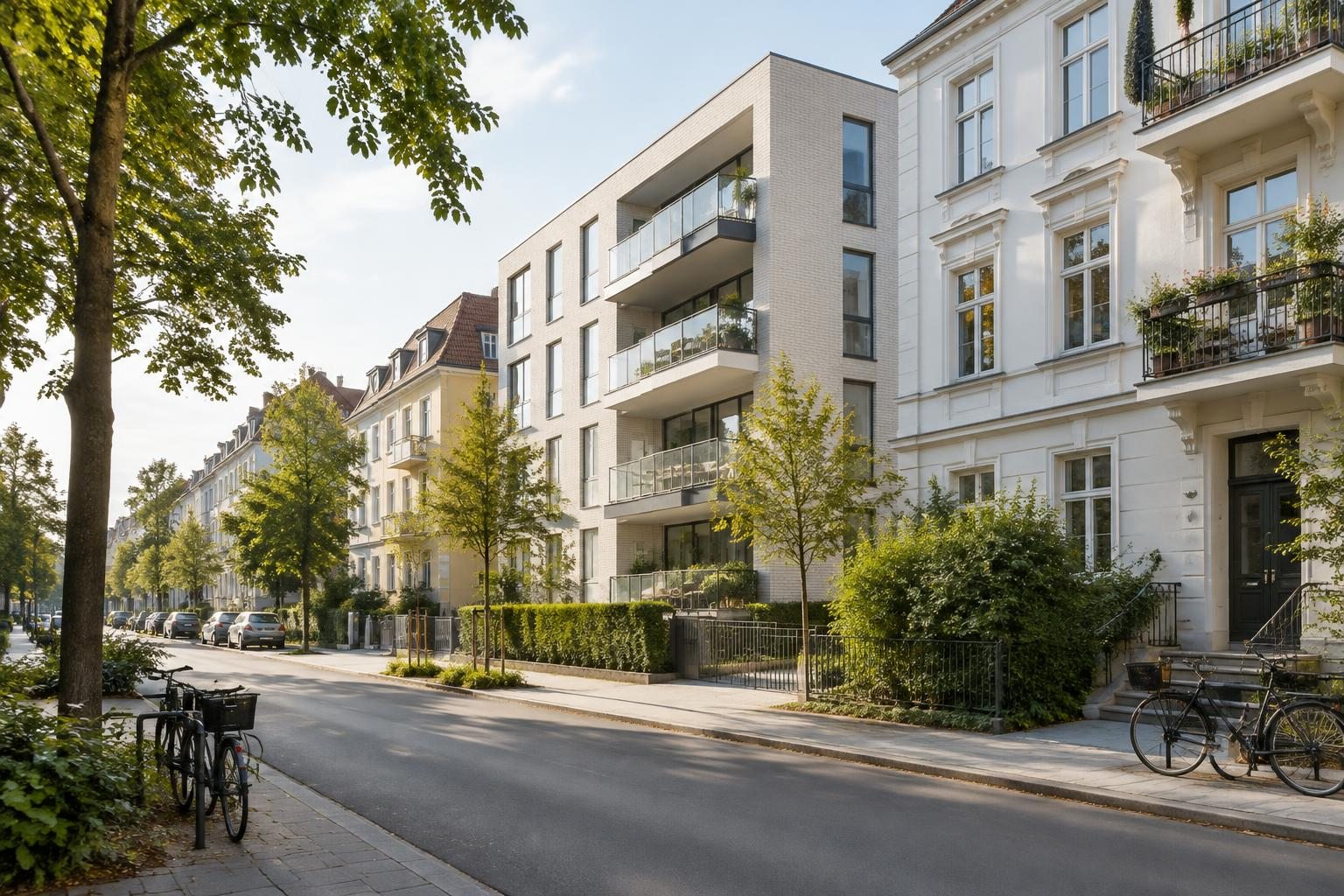
The following descriptions are starting points for a property search, not a ranking or a promise of demand. Reliable neighbourhood-level purchase prices cannot be derived from the town-wide averages cited above.
| Area | Starting point for a property search | Particular checks on site |
|---|---|---|
| Marl-Mitte and Drewer | Central amenities and blocks of flats | Accessibility, lifts, physical barriers and ongoing building costs |
| Hüls | Residential areas connected to the industrial employment market | Actual commuting routes, traffic and environmental exposure |
| Brassert and Alt-Marl | Older residential developments and mixed building types | Refurbishment, layout and immediate surroundings |
| Sinsen-Lenkerbeck | Areas with rail access and housing for different household types | Distance to the station, noise and everyday amenities |
| Polsum | Village-like residential surroundings | Transport needs, infrastructure and demand for the specific flat size |
The owners’ association deserves particular attention in large residential complexes. High service charges, payment arrears or forthcoming refurbishment can offset a low purchase price. Conversely, smaller buildings are not automatically low-risk: major works are shared between fewer owners.
05Tenancy law and purchase costs
Rent controls and rent increases
As at October 2026, Marl is not designated as an area subject to the German new-letting rent cap, the Mietpreisbremse, under North Rhine-Westphalia’s tenant protection regulation. The rule generally limiting a new tenancy’s rent to 10% above the local comparable rent therefore does not apply here. Other restrictions, particularly those addressing excessive rents and rent usury, continue to apply where their respective legal requirements are met.
For increases up to the local comparable rent under section 558 of the German Civil Code, the following generally applies:
- In Marl, the cap on increases is 20% within three years.
- The local comparable rent must not be exceeded.
- When the increase takes effect, the rent must generally have remained unchanged for 15 months; a request for an increase can be made no earlier than one year after the previous increase.
- Requirements concerning justification, form and other statutory conditions must be met. Special rules apply to index-linked and stepped rents.
The percentage cap is not an automatic entitlement to increase the rent. Check the tenancy agreement and the relevant comparable-rent information, such as the local rent index. Buying a tenanted flat generally leaves the existing tenancy in place.
Acquisition costs in North Rhine-Westphalia
Property transfer tax in North Rhine-Westphalia is 6.5%. Notary and land registry fees are payable in addition, along with any estate agent’s fee. Notary and land registry costs depend on the transactions required, including whether a land charge is registered; a percentage allowance is only a budgeting tool.
The model below expressly assumes €3,027 for these costs. This is not a fee calculation for an individual transaction.
06Worked example: 82 m² with the entire purchase price financed
All amounts below are model assumptions or results calculated from them. The floor area, price per square metre and rent are based on the sample averages cited above. The model is neither a specific property offer nor a mortgage offer.
It assumes a full year of letting, unchanged rent and no initial refurbishment. No estate agent’s fee is included. The loan finances only the purchase price; transaction costs are paid from the buyer’s own funds. Whether a bank would offer this financing depends particularly on creditworthiness and its valuation of the property.
Purchase and financing
| Item | Calculation or assumption | Amount |
|---|---|---|
| Purchase price | 82 m² × €1,910/m² | €156,620.00 |
| Property transfer tax | 6.5% of the purchase price | €10,180.30 |
| Notary and land registry, including the land charge | Assumption | €3,027.00 |
| Acquisition and financing transaction costs | Excluding an estate agent | €13,207.30 |
| Total initial capital requirement | Excluding an additional cash reserve | €169,827.30 |
| Loan | Entire purchase price | €156,620.00 |
| Buyer’s own funds invested | Only the transaction costs listed | €13,207.30 |
The first year assumes 3.8% interest and 1.5% principal repayment. For simplicity, a payment at year-end is assumed. Monthly mortgage payments would change the split between interest and principal repayment.
Cash flow in the first full year
Non-recoverable ongoing owner costs, including management, are assumed to be €1,056 annually, with a further €600 contributed to the owners’ association’s maintenance reserve. Together, these represent a cash outflow of €1,656. Actual amounts must be taken from the association’s budget and accounts.
| Item | Per year | Monthly average |
|---|---|---|
| Rent excluding service charges and heating: 82 × €7.60 × 12 | €7,478.40 | €623.20 |
| Interest: €156,620 × 3.8% | −€5,951.56 | −€495.96 |
| Principal repayment: €156,620 × 1.5% | −€2,349.30 | −€195.78 |
| Non-recoverable ongoing costs | −€1,056.00 | −€88.00 |
| Contribution to the maintenance reserve | −€600.00 | −€50.00 |
| Cash flow before tax | −€2,478.46 | −€206.54 |
Monthly figures are rounded separately. Recoverable operating costs and the corresponding tenant advance payments are assumed to balance. Lost rent, special levies and further repairs are not yet included and must be allowed for separately when assessing an actual purchase.
Even before principal repayment, the model has an annual shortfall of €129.16. Rent therefore does not fully cover interest, the assumed ongoing owner costs and the reserve contribution. Principal repayment reduces the outstanding loan, but it is not spendable income. The buyer needs a cash reserve in addition to the funds invested at purchase.
Stress tests rather than a single yield figure
Each of the following variations is calculated separately against the base model. They show the change before tax as a monthly average.
| Alternative assumption | Change in monthly cash flow |
|---|---|
| Interest rate 1 percentage point higher | −€130.52 |
| Interest rate 1 percentage point lower | +€130.52 |
| Two months without rental income | −€103.87 |
| Rent of only €6.09 rather than €7.60/m² | −€123.82 |
The interest-rate variations concern alternative financing arrangements or later refinancing, not a change to an existing fixed rate during its agreed term. Vacancy may also leave the owner bearing additional operating costs. The €6.09/m² scenario uses the historical Census figure solely as a calculation assumption, not as a current rental forecast.
07Tax: distinguish reserves, principal repayments and depreciation
Negative cash flow is not the same as a tax loss. For a rented flat, the following distinctions are particularly important:
- Principal repayments are generally not deductible rental expenses.
- Loan interest can generally be deductible where it is economically connected with the letting activity.
- Contributions to the owners’ association’s maintenance reserve are not deductible merely when paid into the reserve. The association’s subsequent use of the funds is generally decisive; the nature of the work determines the tax treatment.
- Depreciation generally applies to the building, including attributable incidental acquisition costs, but not to the land. An assumed building share of 80% is not an established purchase price allocation.
- Land charge costs incurred to secure the loan must be distinguished from incidental acquisition costs and may generally qualify as financing expenses where connected with the letting activity.
For buildings completed from 1925 to 2022, the standard straight-line building depreciation rate is generally 2% annually. Whether this rate applies, and the appropriate depreciation basis, must be established for the individual property.
No specific tax saving is therefore included in the model. Any relief depends on factors including deductible expenses, the purchase price allocation, personal income and acceptance of the tax treatment. A possible tax refund also does not automatically fund monthly payment obligations.

08Pre-purchase checklist
The flat and tenancy
- Check the tenancy agreement, amendments, deposit and actual rent receipts.
- Compare floor area, layout and condition with the documentation.
- Distinguish actual rent from a rent merely expected on reletting.
- Assess total rent including running costs, the energy performance certificate, heating system and potential modernisation.
- Evaluate demand using comparable flats and the immediate location.
The building and owners’ association
- Read the declaration of division, community rules and register of resolutions.
- Review meeting minutes, the annual budget and accounts.
- Split the owners’ service charge into recoverable costs, owner costs and reserve contributions.
- Check the reserve balance, payment arrears and special levies already approved or foreseeable.
- Include the roof, façade, windows, pipework and heating in a planned works schedule.
09Conclusion: the individual flat is decisive
Based on the sample cited, Marl offers a price-to-rent relationship worth investigating. This does not imply positive cash flow or guaranteed capital growth. The district’s population projection, the industrial character of the economy and potential refurbishment liabilities belong in a long-term assessment.
The example shows that even a gross rental yield of 4.77% can leave a monthly shortfall. A purchase only makes sense if the actual rent is dependable, the property’s technical and financial condition is satisfactory, and less favourable years remain affordable.
This information is general and does not replace individual legal, tax or mortgage advice. As at October 2026.
10Free initial consultation
A free initial consultation allows you to discuss the requirements an investment property in Marl should meet for your budget and the documents needed for further property assessment.
Arrange a free initial consultation
FAQFrequently asked questions
Is a flat in Marl a worthwhile investment?
That depends on the actual rent, purchase price, building condition and financing. In the assumptions-based model presented, the gross rental yield is 4.77%, but there is still a monthly shortfall of €206.54 before tax, including principal repayments. A sufficient cash reserve is therefore important.
What rental yield can property in Marl generate?
A purchase price of €1,910/m² and monthly rent excluding service charges and heating of €7.60/m² produce a calculated gross rental yield of 4.77%. These figures come from the valuation committee’s sample for 2025. The ratio of these averages is neither a guaranteed property yield nor the average yield of the individual properties.
How much does a flat in Marl cost?
For the published construction-year groups from 1950 to 1999, the 2026 property market report gives average purchase prices ranging from €1,430 to €2,150/m² for sales in 2025. Large residential complexes from the 1970s are assessed separately. Condition, the immediate location and the owners’ association can substantially affect an individual purchase price.
Does the Mietpreisbremse apply in Marl?
As at October 2026, Marl is not designated as an area subject to the new-letting rent cap under North Rhine-Westphalia’s tenant protection regulation. Increases under section 558 of the German Civil Code are generally capped at 20% within three years and must also stay within the local comparable rent. Other statutory conditions and rent restrictions must still be observed.
Which neighbourhoods in Marl should property investors consider?
Marl-Mitte, Drewer, Hüls, Brassert, Alt-Marl, Sinsen-Lenkerbeck and Polsum offer different residential settings. A blanket ranking would not be useful. Pay particular attention to amenities, commuting routes, traffic noise, total rent including running costs and demand for the specific flat size.
What additional purchase costs apply in Marl?
Property transfer tax in North Rhine-Westphalia is 6.5%. Notary, land registry and any estate agent’s fees are additional. For a purchase price of €156,620, the model assumes €3,027 for notary and land registry costs including the land charge, giving total transaction costs of €13,207.30 without an estate agent.
Can a contribution to the owners’ association’s maintenance reserve be deducted immediately for tax?
No. Although the contribution is a cash outflow, it is not yet a deductible rental expense. The subsequent use of the funds by the owners’ association is generally decisive. Whether the expenditure is immediately deductible or receives different tax treatment depends on the work financed.
Writes about Taxes, AfA (depreciation), Financing and Investment concept.
Andriy is Managing Director of the InvestImmo Group and has been an entrepreneur in the property industry since 2020. His experience in estate agency, property marketing and his own investments shapes his view on property selection and long-term investment concepts. His team handles the personal advice for investors.
This guide does not replace tax or legal advice. All figures are example calculations with disclosed assumptions.