Subdividing a German Apartment Building: Costs, Rights and Tax
A practical guide to permissions, investment economics and long-term planning
 Kevin Celentano
Investment Advisor at InvestImmo
01Dividing an apartment building: flexibility before profit
Selling apartments individually may be more attractive than selling an entire building. Do not assume a price premium, however. Check permissions, tenant protection, building condition and financing before deciding whether subdivision supports your investment strategy. This guide concerns German condominium ownership, not a physical division of the land.
02What changes legally?
Each apartment combines individual ownership with a share of common property. The land, roof and structural components remain jointly owned. Separate register entries replace the original property entry, allowing units to be sold, mortgaged or transferred individually in principle. WEG, sections 5–8.
The owners’ association already exists when the apartment registers are created—even while you own every unit. It does not begin with the first sale. Additional owners make shared decisions, service charges, reserves and management more consequential. Section 9a WEG.
03Five practical steps
- Check eligibility. Establish which permission requirements apply to the address. Discuss future releases of individual apartments from existing loan security with your lender.
- Commission the plan. Identify numbered units, allocated storage rooms, parking arrangements and common areas unambiguously.
- Obtain the certificate. Submit the required drawings to the competent authority after checking access, separation and sanitary facilities.
- Prepare the declaration. Have a notary address ownership shares, use rights, cost allocation, management and the necessary formalities.
- Register the subdivision. Separate apartment registers complete the legal process. See sections 7–8 WEG and the official registration guidance.
04Permissions depend on the address
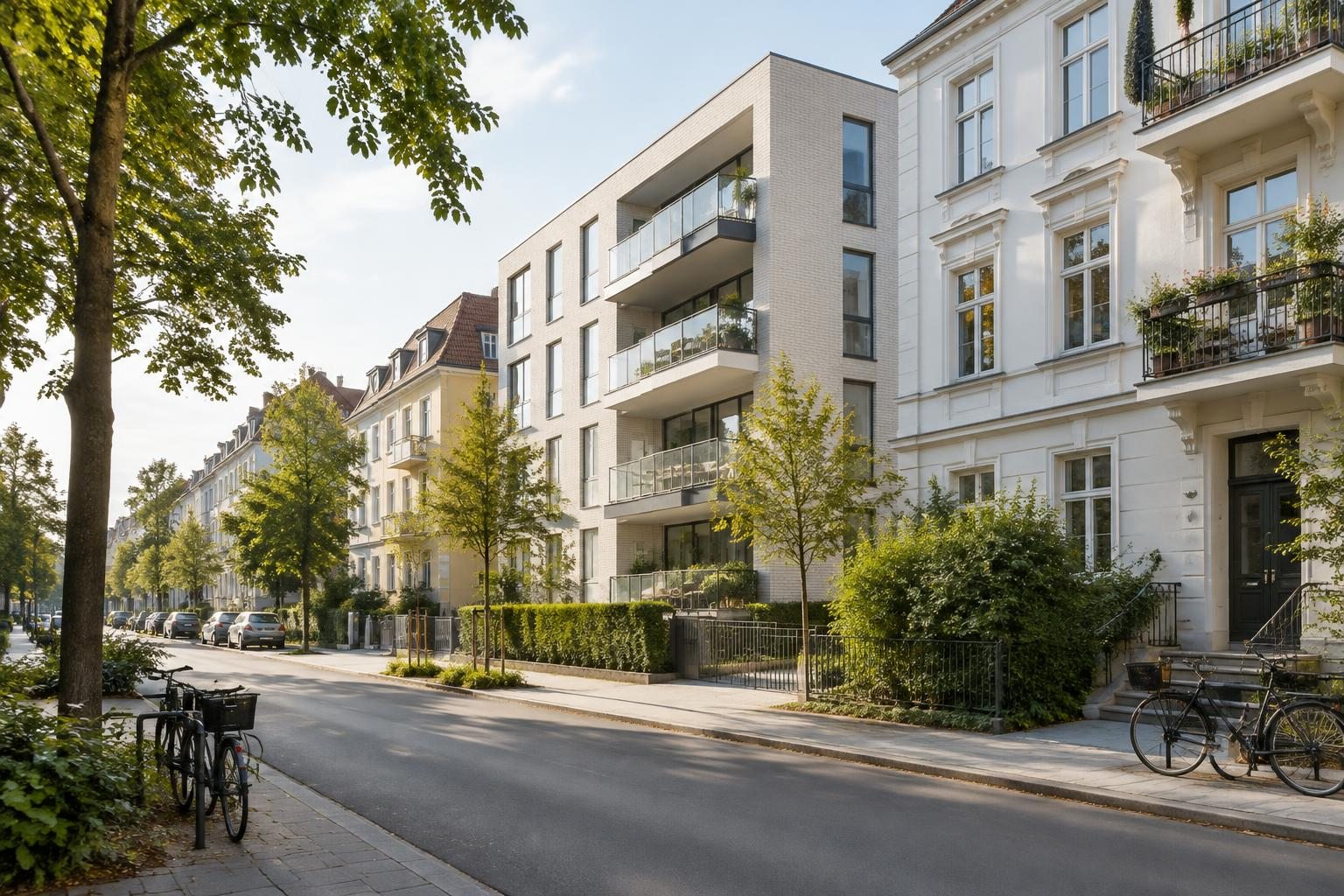
Section 250 BauGB allows permission requirements for existing residential buildings in designated areas. Federal legislation exempts buildings containing no more than five apartments, but states may alter that exemption threshold. Check the applicable boundaries, building reference date, apartment count and regulation expiry.
Qualifying estate divisions and sales for occupation by family members or at least two-thirds of tenants can establish entitlement to permission. Other applications are not automatically prohibited: refusal must be necessary to maintain an adequate rental housing supply. Section 250(3)–(5) BauGB.
In designated neighborhood social-preservation areas, section 172 BauGB can also apply. One permission route involves selling only to tenants for seven years, with specific consequences for termination protection. Section 250 generally takes precedence where its permission requirement applies; smaller exempt buildings may still fall under section 172.
05Tenant rights shape the sales strategy
A sale does not end an existing tenancy. Where condominium ownership was established after the tenant took possession, a third-party sale may trigger a statutory pre-emption right. The tenant must receive the contract information and notice of that right. Certain family and household sales are exempt. Section 577 BGB.
Section 577a BGB generally blocks owner-occupation and certain economic-use terminations for three years, extended to as much as ten years in designated areas. The relevant starting point is generally ownership transfer following conversion, not merely signing the contract. Ordinary termination requirements still apply afterward.
Wanting to sell converted apartments more profitably does not justify the corresponding economic-use termination. Section 573 BGB. Value occupied apartments rather than assuming future vacant possession.
06Costs: an illustration, not a quotation
Assumed property: six apartments and a developed-property value of €860,000. This value determines the fee basis under section 42 GNotKG. The relevant Table B band gives a full fee of €1,575. All non-statutory budgets below are assumptions.
| Assumed item or procedure | Amount |
|---|---|
| Subdivision drawings, assumed final price | €6,000.00 |
| Authority charge, assumption | €600.00 |
| Notarial recording: 1.0 fee × 1.19 | €1,874.25 |
| Land register: 1.0 fee | €1,575.00 |
| Additional services and expenses, assumed budget | €1,000.00 |
| Total | €11,049.25 |
The assumed fee procedures correspond to items 21200 and 14112 in the GNotKG fee schedule. Different arrangements and additional services change the bill. Building works are excluded. Obtain a scope-specific estimate rather than treating this total as a standard conversion price.
07Separate sale economics from cash flow
Further assumptions: 420 m² of saleable residential floor area, acquisition including transaction costs of €946,602, and seller-paid commission of 3.57% including VAT. The prices below are scenarios, not market evidence.
| Item | €2,300/m² | €2,500/m² | €2,700/m² |
|---|---|---|---|
| Sale proceeds | €966,000.00 | €1,050,000.00 | €1,134,000.00 |
| Commission | −€34,486.20 | −€37,485.00 | −€40,483.80 |
| Subdivision | −€11,049.25 | −€11,049.25 | −€11,049.25 |
| Acquisition including transaction costs | −€946,602.00 | −€946,602.00 | −€946,602.00 |
| Simplified pre-tax result | −€26,137.45 | €54,863.75 | €135,864.95 |
Calculation: proceeds less commission, subdivision and acquisition expenditure. Under these assumptions, each €200/m² price movement changes the result by exactly €81,001.20.

08Tax requires two separate assessments
Subdivision without an ownership transfer is not itself a sale. Sales of privately held rental property within ten years of acquisition can fall under section 23 EStG. Taxable profit does not necessarily equal the table: previously deducted depreciation can increase it.
Commercial property trading is a separate question. More than three disposals in a close temporal relationship, generally around five years, are an important indicator; individual condominiums generally count separately. This is neither an automatic classification nor a safe harbor below four sales. Commercial treatment can bring income tax and trade tax, without protection from the private ten-year rule. See the Finance Ministry guidance and Federal Fiscal Court ruling.
09Suitability, risks and checklist
Subdivision can support long-term ownership, selective disposals and succession planning. Compare it with retaining or selling the entire building. Include pricing uncertainty, construction expenditure, delays and shared-management disagreements in your assessment.
- [ ] Confirm address-specific permissions and tenant protections.
- [ ] Reconcile approved plans, actual condition and necessary works.
- [ ] Agree lender releases and a liquidity reserve.
- [ ] Obtain valuations reflecting existing tenancies.
- [ ] Plan association rules, reserves and management.
- [ ] Review disposal timing and tax treatment beforehand.
10Conclusion
Subdivision creates options, not guaranteed value. Proceed only when legal feasibility, realistic sale scenarios and complete costs align. A rapid sale of every apartment needs particularly careful tax and liquidity planning; a higher headline price alone is insufficient.
FAQFrequently asked questions
Must I sell the apartments after subdivision?
No. You may retain every unit. Subdivision creates separate ownership titles and the option of selling or transferring individual apartments later.
Which documents are needed?
The main documents are a subdivision plan, a certificate of self-containment and a declaration suitable for land-register entry. Depending on the location, permission or evidence that permission is unnecessary may also be required.
What does subdividing a six-apartment building cost?
The assumed example totals €11,049.25 before building works. This is not a standard quotation. Property value, planning work, authority charges and additional notarial services determine the actual amount.
When does the owners’ association come into existence?
Under section 9a WEG, it exists once the apartment registers are created. This also applies when one person initially owns all the apartments.
Can a buyer immediately terminate a tenancy for personal occupation?
Where section 577a BGB applies, the basic protection period is three years and can extend to ten years in designated areas. Special provisions and ordinary termination requirements must also be considered.
Are sales always tax-free after ten years?
No. The ten-year rule concerns private disposals. Commercial property trading and other tax classifications can produce a different outcome. Obtain tax advice on the planned sequence of sales before committing.
11Further reading
Subdivision declaration · Self-containment certificate · WEG · Owners’ association · Holding period · Three-property threshold · Tenancies after sale.
12Sources
Official legislation: WEG, BauGB, BGB, GNotKG, EStG section 23. Additional official guidance and case law are linked alongside the relevant explanations.
General information only; not individual legal, tax or investment advice.
Writes about Purchase process, Notary and land registry and Letting.
Kevin combines twelve years of sales experience with nine years specialising in property and more than 500 consultations. He writes about property quality, location risks and a safe path from the first comparison to completion.
This guide does not replace tax or legal advice. All figures are example calculations with disclosed assumptions.