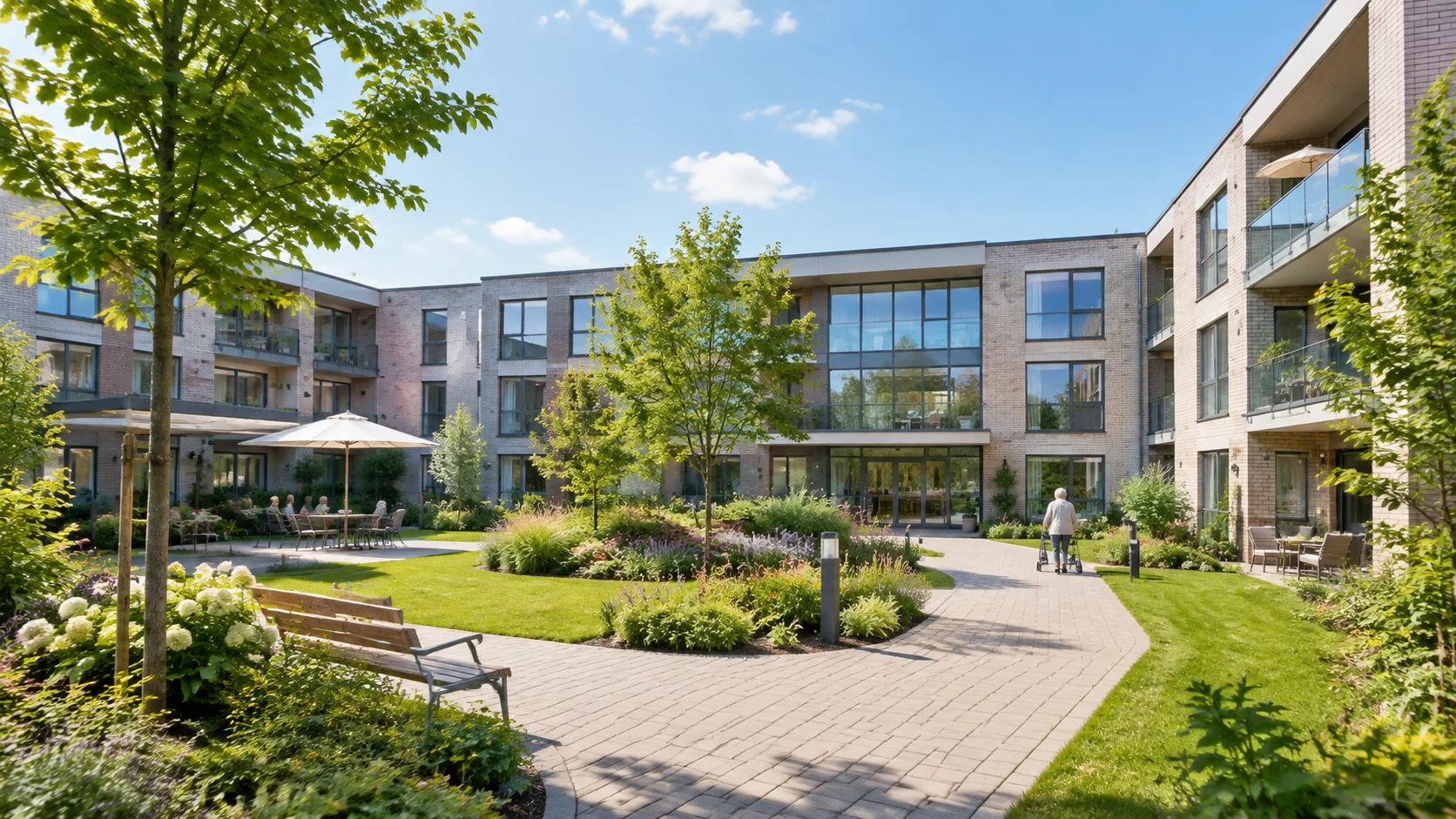
Buying a Care-Home Unit in Germany: Process, Checklist and Costs
From the initial offer to ownership: the documents to review, costs to calculate separately and investment risks to assess.
 Kevin Celentano
Investment Advisor at InvestImmo
01What you acquire when buying a care-home unit
Under the model discussed here, you acquire separate ownership of a defined unit together with a co-ownership share in common property. Check the land register, declaration of division and plans to establish whether the unit is classified as Wohnungseigentum, residential unit ownership, or Teileigentum, ownership of non-residential premises, and which areas belong to it. Section 1 WEG, the German Condominium Act, provides the definitions. A room used communally is not automatically common property merely because of that use.
The purchase contract requires notarisation. Signing it does not itself make you the owner: the required agreement to transfer ownership and registration in the Grundbuch, Germany’s land register, are material to the transfer. See section 311b BGB and section 873 BGB of the German Civil Code.
Do not compare the price per square metre of the resident’s room with an ordinary apartment without examining the area definitions. Request a separate breakdown of the room, other allocated areas and co-ownership shares. Then assess the total price, sustainable rental income, ongoing owner expenses and potential capital expenditure. Shared facilities do not, by themselves, justify any asking price.
02Eight steps from an offer to ownership
- Request a complete offer. Obtain the price, all acquisition costs, contractual rent, Hausgeld, the owners’ association charge, reserve contributions and the assumptions behind the financial projection. Separate cash payments from tax effects.
- Investigate the operator and location. Identify the precise contracting company, not just the brand. Request financial statements, current financial information, occupancy and staffing figures, and available inspection reports. Examine competing facilities, accessibility and local demand.
- Have the operator agreement reviewed. Read the rental or lease agreement, including schedules and amendments: term, rent adjustments, renewal options, termination, repairs, equipment, operating expenses and operator replacement. Establish who is the landlord and who receives payments.
- Examine security arrangements. Establish the beneficiary, security provider, coverage, duration and conditions for making a claim. Check whether any security has actually been agreed.
- Confirm financing before committing. Obtain confirmation of the loan amount, drawdown conditions, fixed-interest period, repayments, commitment interest and required equity. Budget a separate liquidity reserve. Do not rely on a general financing assurance from the sales agent.
- Review the notarial draft in good time. For covered consumer property contracts, the officiating notary or an associated notary should normally provide the intended contract text two weeks beforehand. Reasons for a shorter period should be recorded. This is not an unconditional minimum for every purchase: section 17(2a) BeurkG, the German Notarisation Act. Ask whether the rule applies to your transaction.
- Resolve questions before notarisation. Do the purchase agreement, operator agreement and declaration of division match? Are verbal promises reflected in the relevant documents? You can also ask questions during the appointment; time pressure should not override unresolved issues.
- Coordinate payment, handover and rent entitlement. Have payment maturity, possession, the transfer of economic benefits and burdens, title registration and your entitlement to rent explained separately. For an operating property, request evidence of actual rent payments and arrears.

03Checklist: eight document groups to review before committing
Request these documents before a paid reservation where possible, leaving sufficient review time before notarisation. This is an editorial due-diligence checklist, not an exhaustive statutory list.
| Document group | Questions to investigate |
|---|---|
| Operator agreement and amendments | Who owes rent to whom? What conditions, adjustments, options and termination rights apply? |
| Agreed security documents | Who is protected? Which claims, amounts and periods are covered? What happens on sale or operator replacement? |
| Operator information | Which company is liable? How current and informative are its accounts, liquidity information, occupancy figures and staffing plans? |
| Land register, declaration of division, community rules and plans | What exactly are you buying? What charges, permitted uses, voting rights and cost allocations apply? |
| Annual budget, accounts and reserve statements | Which costs remain with you? What reserves exist, and what work is planned? |
| Draft purchase agreement and schedules | When is payment due? How are handover, rent entitlement and title transfer handled? What defect provisions apply? |
| Construction and condition records | New build: specification, deadlines and payment conditions. Existing property: technical assessment, maintenance needs and available approval documents. |
| Resolution records and meeting minutes for existing properties | Are there special assessments, arrears, disputes, major works or previous operator changes? |
The Teilungserklärung is the declaration dividing the property into units; the Gemeinschaftsordnung sets out the community’s governing arrangements. For new developments, historical accounts and owners’ meeting minutes may not yet exist. Request a substantiated opening budget and clearly labelled assumptions instead. An unavailable document that does not yet exist is different from an existing document being withheld.
04The operator agreement and security: essential questions
Do not treat a long contractual term as evidence that payments will be made. In particular, investigate:
- Is rent fixed, or does it depend on occupancy or other conditions?
- What triggers and limits apply to rent adjustments?
- Who pays for the roof, façade, building services, internal fittings and replacement equipment?
- What rights apply to defects, operational interruption and contractual breaches?
- How would operator replacement and continuity of operations be organised?
German Mietvertrag and Pachtvertrag are not legally identical. A Pachtvertrag includes the right to derive proceeds from the leased asset in addition to using it; section 581 BGB also refers to rental-law provisions. Have the agreement’s actual structure assessed rather than relying on its title.
05Assessing the purchase price and rent
Purchase-price multiple and gross rental yield
Useful starting calculations are:
- Purchase-price multiple = purchase price ÷ annual contractual rent.
- Gross rental yield = annual contractual rent ÷ purchase price × 100.
Illustrative assumptions only: a €240,000 price and €9,600 annual rent produce a multiple of 240,000 ÷ 9,600 = 25 and a gross rental yield of 9,600 ÷ 240,000 × 100 = 4.0%. These calculations exclude acquisition costs, owner expenses, financing, rent losses and taxes. They describe neither an actual offer nor a typical market return.
Use the rental yield calculator as a calculation aid, not a substitute for property and contract due diligence.
What income can support the operator’s rent?
Section 82 SGB XI, part of Germany’s Social Code governing long-term care insurance, separates care remuneration and accommodation and catering charges from specified investment expenditure. Subject to the statutory conditions, investment expenditure, including certain rental and lease expenses, can be charged separately. Public funding and state law matter, with different provisions for funded and non-funded facilities.
The practical implication for due diligence is to request an explanation of the facility’s own funding and investment-cost calculation. A nationwide average cannot replace an assessment of that facility and does not guarantee the property owner’s rent. Do not equate residents’ charges directly with the rent payable for one investment unit.
Also request evidence of completed resales of comparable units. Distinguish documented transaction prices from asking prices and account for differences in operator, remaining lease term, condition and owner expenses.
Model cash flow before tax
Start with rent actually expected to be received, then deduct the ongoing expenses you must pay, reserve contributions, interest and principal repayments. Avoid double counting reserves already included in the owners’ association charge. Test additional scenarios involving no rent, a special assessment, more expensive refinancing or a lower resale price. State each stress scenario’s duration and amounts explicitly as assumptions.

06Acquisition costs: calculate tax and fees separately
German property transfer tax, Grunderwerbsteuer, depends on the state where the property is located. The four states below are comparison examples only. Assumption: taxable consideration is exactly €240,000, with no exemption or additional taxable consideration.
| State and official source | Tax rate | Illustrative calculation |
|---|---|---|
| Bavaria: BayernPortal | 3.5% | €240,000 × 0.035 = €8,400 |
| Lower Saxony: finance ministry, section 4.6 | 5.0% | €240,000 × 0.05 = €12,000 |
| Saxony: section 1 of the state tax-rate act | 5.5% | €240,000 × 0.055 = €13,200 |
| North Rhine-Westphalia: enacted tax-rate amendment | 6.5% | €240,000 × 0.065 = €15,600 |
The tax difference alone between Bavaria and North Rhine-Westphalia is €15,600 − €8,400 = €7,200 in this example. These are not total acquisition costs. The table does not incorporate proposed tax reductions.
Notarial and land-registry fees depend on transaction values and the applicable statutory fee items, rather than a single statutory percentage of the purchase price. See sections 3 and 34 GNotKG, Germany’s Court and Notary Costs Act. Request a transaction-specific breakdown including expenses, VAT where applicable and separate financing-security costs.
Also establish any brokerage commission, independent due-diligence charges and financing costs. Budget acquisition costs separately from your ongoing liquidity reserve. The acquisition costs calculator can support planning; check its inputs and results against your actual documents.
Avoid blanket tax assumptions
Property transfer tax and purchase-related notarial and land-registry expenses generally form part of acquisition cost. Only the portion allocated to the depreciable building feeds into building depreciation; the land portion does not. Costs of registering a Grundschuld, a German land charge used as loan security, must be distinguished. The North Rhine-Westphalia tax authority’s depreciation guidance explains this allocation.
Financing costs connected with income generation may qualify as Werbungskosten, deductible income-related expenses. Eligibility and allocation require an individual assessment; an unconditional promise of immediate deductibility would be too broad. See section 9 EStG, Germany’s Income Tax Act. Have the tax projection prepared separately from the cash-flow calculation.
07Risks and decision criteria
Operator insolvency. Where the insolvent operator is the tenant or lessee, section 109 InsO, the German Insolvency Code, allows the insolvency administrator to terminate with three months’ notice to month-end, unless a shorter period applies, despite a longer contractual commitment. Model the possibility of a replacement agreement on less favourable terms. Read more: care-home operator insolvency.
Developer and start-up risks. Investigate the payment schedule, completion safeguards, consequences of delay and financing of an interruption. A construction-stage payment plan is not a completion guarantee. Further reading: reviewing a developer contract.
Maintenance and special assessments. Obtain an independent assessment of building condition and contractual cost allocation. Do not assume that the operator will bear every future expense. A Sonderumlage is an additional contribution levied through the owners’ association.
Influence over decisions. Examine your voting rights and the balance of votes. The statutory starting point is one vote per owner and a majority of votes cast; review the community rules as part of the assessment. See section 25 WEG.
Occupancy and staffing. Investigate how staff shortages, competition or lower occupancy could affect the operator’s ability to pay. A contractually fixed rent does not replace that financial assessment.
Resale. Assume neither a quick sale nor a particular price. Investigate potential buyers, holding costs during marketing and usability by another operator. Read more: selling a care-home unit.
| A purchase may merit consideration when … | Pausing or declining is sensible when … |
|---|---|
| Documents have been reviewed and material questions resolved. | Contracts remain missing or inconsistent. |
| You can absorb rent losses and additional expenses. | Affordability depends entirely on tax benefits or uninterrupted rent. |
| You can invest for the longer term and accept an uncertain exit. | You need the capital back on a fixed date in the near future. |
| The operator, building and price each withstand scrutiny. | Time pressure is displacing independent due diligence. |
08Conclusion: documents first, commitment second
Do not assess the purchase contract or operator agreement in isolation. A sound decision requires their combined assessment alongside the ownership structure, building condition, financing and cost allocation. Record unresolved issues and address them before making an economically binding commitment. A projected tax benefit replaces neither liquidity nor a sustainable tenancy.
FAQFrequently asked questions
How does buying a care-home unit in Germany work?
Assess the offer, operator, contracts and building, confirm financing and review the notarial draft. The purchase contract is notarised; ownership requires the necessary transfer declarations and registration in the Grundbuch, Germany’s land register. Review payment, handover and rent entitlement separately.
Which documents should I review before buying?
Request the operator agreement and amendments, agreed security documents, operator information, land-register and division documents, budget and reserve records, draft purchase agreement, and construction or condition records. Existing properties also require review of resolutions and meeting minutes. For new developments, request substantiated plans where historical records do not yet exist.
What acquisition costs should I budget for?
Calculate property transfer tax, notarial and land-registry fees, and any brokerage, financing and due-diligence charges separately. Illustratively, €240,000 taxable consideration in Bavaria produces €240,000 × 3.5% = €8,400 property transfer tax. This is not the total acquisition cost.
Can I inspect the care-home unit before buying?
Arrange a viewing with the seller and operator while respecting residents’ privacy. Where possible, combine it with an independent technical assessment. For a new development, a show room or reference facility does not replace reviewing the actual project, construction specification and contracts.
Do I need equity?
Obtain a transaction-specific financing decision confirming your required equity contribution. Budget acquisition costs and a separate reserve for rent losses and additional expenses. Do not assume that the lender will finance the full purchase price or every acquisition cost.
How long should I allow before the notarial appointment?
For covered consumer property contracts, the notarial text should normally be available two weeks beforehand; a shorter period should be justified. This is not a universal fixed minimum. Allow additional time for independent review.
09Further reading
- Care-home property as an investment: structure and calculations
- Care-home property: disadvantages and risks
- The property purchase process
- Notarial costs when buying property
- Acquisition costs calculator
10Sources
Opened and used for this revision on 29 October 2026. These references support the linked subject matter; they do not constitute verification of a specific investment offer. Sources are in German.
- Section 1 WEG: ownership categories and section 25 WEG: voting.
- Section 311b BGB: notarisation, section 873 BGB: ownership transfer and section 581 BGB: leases.
- Section 17 BeurkG: notarial duties and normal review period.
- Section 3 MaBV: safeguards for developer payments.
- Section 82 SGB XI: care-facility funding.
- Section 109 InsO: termination by an insolvency administrator.
- BayernPortal: property transfer tax.
- Lower Saxony finance ministry: information booklet, section 4.6.
- Saxony property transfer tax-rate act.
- North Rhine-Westphalia: enacted amendment to 6.5%.
- GNotKG: particularly sections 3 and 34.
- North Rhine-Westphalia tax authority: depreciation basis.
- EStG: particularly section 9.
General information about buying property in Germany, not individual legal, tax or investment advice. The tax discussion concerns German rules, not an investor’s tax position in another country.
Writes about Purchase process, Notary and land registry and Letting.
Kevin combines twelve years of sales experience with nine years specialising in property and more than 500 consultations. He writes about property quality, location risks and a safe path from the first comparison to completion.
This guide does not replace tax or legal advice. All figures are example calculations with disclosed assumptions.