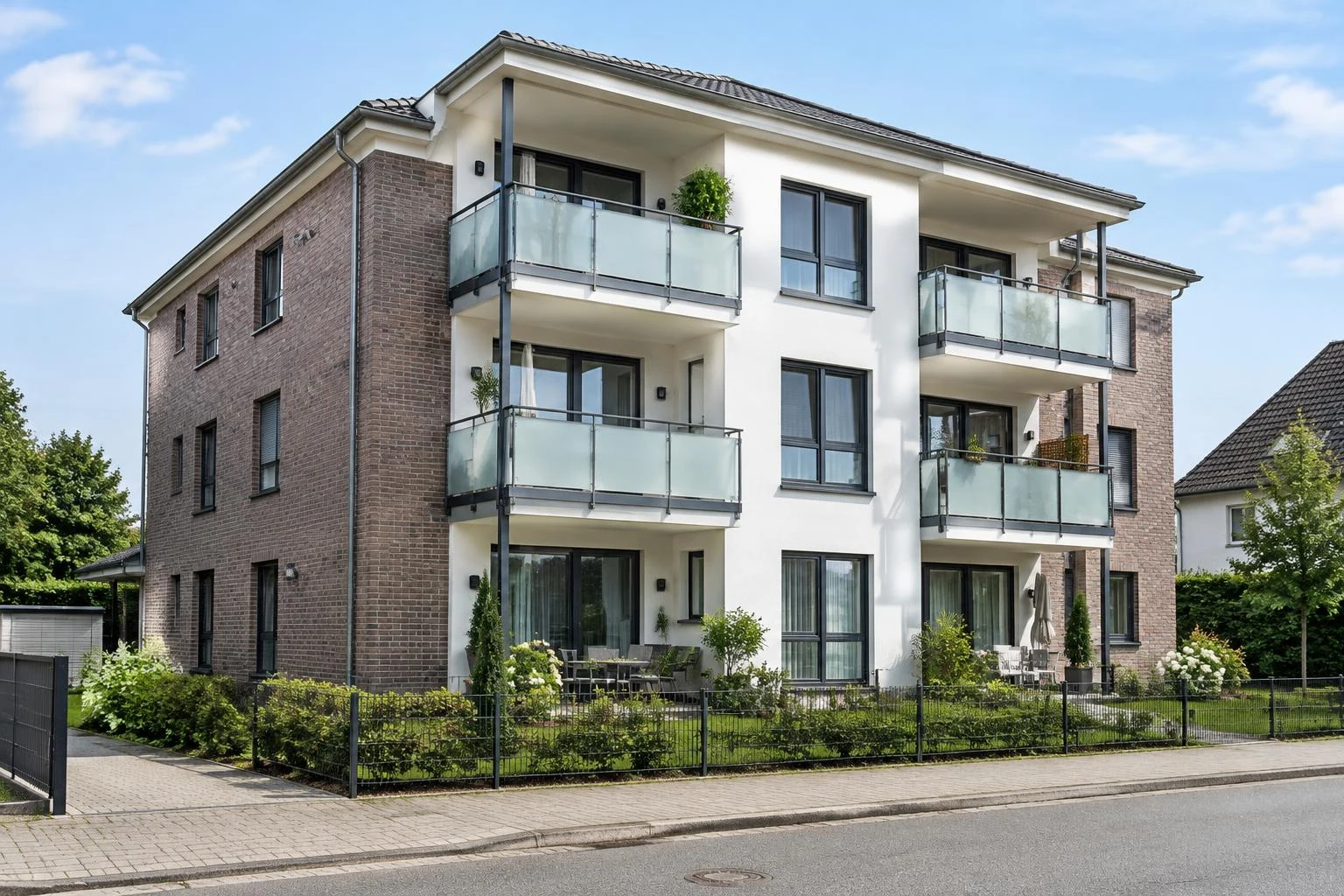
Saving equity for a flat as a rental investment
Plan your purchase costs, cash reserves and saving period with a transparent mortgage comparison.
 Andriy Bezborodko
Managing Director of the InvestImmo Group
01How much equity does a rental investment require?
A good income alone does not tell you whether a rental flat fits your budget. What matters is how much equity the lender requires and how much cash remains available after the purchase.
There is no universal minimum percentage. Some lenders will finance the entire purchase price if your creditworthiness and the property's value are sufficient; others require you to contribute towards the price. Financing the purchase costs may also be possible, but places greater demands on the financing arrangement. This does not mean that a rental investment necessarily requires less equity than an owner-occupied home.
Separate three amounts in your planning:
- Your contribution to the purchase: Purchase costs and, where required, a contribution towards the purchase price.
- Property reserve: Money for lost rent, repairs and possible special levies.
- Personal emergency fund: An additional reserve for personal expenses and interruptions to your income.
Money intended to remain in your account as a reserve cannot also be used to pay the purchase price.
02Calculating purchase costs and your savings target
Purchase costs principally include property transfer tax, notary and land registry fees, and any estate agent's commission payable by the buyer. Financing costs or immediately necessary work on the property may add to the total.
Example: a €220,000 flat in North Rhine-Westphalia
The following calculation is an illustrative model based on assumptions, not a market valuation or financing commitment. It uses North Rhine-Westphalia's property transfer tax rate of 6.5%. Notary and land registry fees are estimated at 1.5% for simplicity; actual costs depend on statutory fees and the transactions required. The buyer's commission of 3.57% is an illustrative assumption, not a statutory maximum.
| Item | Without an estate agent | With assumed buyer's commission |
|---|---|---|
| Purchase price | €220,000 | €220,000 |
| Property transfer tax: 6.5% | €14,300 | €14,300 |
| Notary and land registry: assumed 1.5% | €3,300 | €3,300 |
| Buyer's commission: assumed 3.57% | €0 | €7,854 |
| Purchase costs | €17,600 | €25,454 |
| Assumed property reserve | €5,000 | €5,000 |
| Savings target without a contribution towards the purchase price | €22,600 | €30,454 |
These savings targets do not include your personal emergency fund. Any contribution towards the purchase price required by the lender and additional initial investment would also need to be added.
Property transfer tax depends on the federal state. For a €220,000 property in Bavaria, for example, the 3.5% rate produces a tax bill of €7,700. The costs of your specific purchase therefore matter more than a general equity percentage. Read more about budgeting for fees in Notary costs when buying property.
Why a €5,000 reserve may not be enough
The reserve in the example is an illustrative assumption. Whether it is sufficient depends on factors including the building's condition, the size of the flat, costs that cannot be passed on to tenants and work planned by the owners' association.
When buying a flat within an owners' association, check its annual budget, annual accounts, record of resolutions and maintenance reserve. The association's reserve is not freely available money in your own account and does not replace your personal cash reserve.

03How long does saving take?
Without starting capital or interest, the calculation is:
Savings target ÷ monthly contribution = months required, rounded up to whole months.
The table uses the two savings targets from the example. It assumes constant monthly contributions, no withdrawals and no interest. Changes in purchase costs are not included.
| Monthly contribution | To €22,600 without an estate agent | To €30,454 with assumed buyer's commission |
|---|---|---|
| €400 | 57 months | 77 months |
| €600 | 38 months | 51 months |
| €800 | 29 months | 39 months |
| €1,000 | 23 months | 31 months |
At €600 a month, you have €22,200 after 37 months and €22,800 after 38 months. This is the first point at which you have reached the €22,600 target.
Existing savings and one-off contributions shorten the saving period. Subtract these amounts from the target and divide the remaining amount by your monthly contribution. Only firmly include a bonus or tax refund once its amount and availability are reasonably certain.
Interest can help, but rates on easy-access savings accounts can change. A calculation without interest income provides a useful basis for planning.
04How equity affects your monthly mortgage payment
More equity reduces the amount you need to borrow and may improve the terms offered. The size of the effect depends on the individual offer.
For a consistent comparison, we use the flat without an estate agent. In one case, the €17,600 purchase costs are paid from savings; in the other, they are borrowed in full. Both options assume that the illustrative €5,000 property reserve remains separately available.
Two financing options using illustrative assumptions
The model assumes repayment mortgages with monthly payments, a ten-year fixed-interest period and an initial annual principal repayment rate of 2%. The interest rates are purely calculation assumptions, not current market rates or bank offers. Additional financing costs are excluded.
| Item | Purchase costs paid from savings | Purchase costs financed |
|---|---|---|
| Purchase price | €220,000 | €220,000 |
| Purchase costs paid from savings | €17,600 | €0 |
| Loan | €220,000 | €237,600 |
| Loan as a percentage of purchase price | 100% | 108% |
| Assumed annual borrowing rate | 3.8% | 4.2% |
| Initial annual principal repayment rate | 2.0% | 2.0% |
| Monthly mortgage payment | €1,063.33 | €1,227.60 |
The monthly payment is calculated here as loan × (borrowing rate + initial principal repayment rate) ÷ 12. Using unrounded inputs, the difference is €164.27 a month, rounded.
Part of the difference results from the larger loan, and part from the assumed higher interest rate on the entire borrowing. The second option finances 108% of the purchase price in this example, not 110%. The lender's lending ratio may also differ because it uses its own mortgage lending value.
The monthly payment is not a complete assessment of the investment's viability. You also need to account for achievable rent excluding service charges, costs that cannot be passed on to tenants, maintenance and lost rent. Principal repayments reduce debt but are not freely available income.
Tax considerations
Interest on borrowing for a rental flat may be deductible against rental income to the extent that the loan is economically attributable to the rental activity. Principal repayments are not deductible. Where borrowing has mixed uses, an appropriate allocation is required.
A potential tax benefit does not make additional interest free. Its amount and timing depend on your personal tax position. Your financing should therefore leave sufficient liquidity even before any potential tax refund.
For more background, see Buying property without equity.
05Where should you keep your equity before buying?
Money needed on a particular date within the next few years should not depend on short-term stock market movements. Shares or equity funds may suit long-term wealth building, but are risky for money earmarked for a purchase in the near future.
| Savings option | Suitability for the target | What to check |
|---|---|---|
| Easy-access savings account | Regular saving and short-notice access | Variable interest rate, conditions and deposit protection |
| Fixed-term deposit | Money not needed before maturity | Maturity before the purchase; early access is usually unavailable |
| Existing German home savings scheme balance | May be usable as your own funds | Availability, cancellation conditions and effects on the contract |
A loan under a German home savings scheme, or Bausparvertrag, remains borrowing. Similarly, a securities portfolio does not automatically count at its full value as immediately available equity; lenders may apply discounts when valuing collateral.
Deposit protection and tax on interest
Statutory deposit protection generally covers eligible deposits up to €100,000 per depositor per credit institution. Multiple accounts at the same bank are added together. Different brands may belong to the same credit institution. For foreign banks, check which protection scheme applies.
Interest is investment income. The German saver's allowance is €1,000 per person, or €2,000 for jointly assessed spouses or registered civil partners. It applies to the relevant investment income in total, not separately to each account. An exemption instruction, known as a Freistellungsauftrag, allows the bank to take the allowance into account when withholding tax.
Taxable investment income is generally subject to 25% investment income tax, plus the solidarity surcharge and church tax where applicable. Your personal tax assessment may produce a different result.

06Six steps to building your equity
- Set your savings target: Add the specific purchase costs, any required contribution towards the purchase price and a property-related reserve. Keep your personal emergency fund separate.
- Review your household budget: Track how much reliably remains after regular and irregular expenses over several months.
- Automate saving: Use a separate account and a standing order. Your contribution must remain affordable in financially weaker months.
- Use additional income: Available one-off payments can shorten the remaining saving period.
- Document the source of funds: Keep bank statements and, where relevant, gift agreements. Disclose existing loans to the lender.
- Seek an early financing assessment: Establish what contribution the lender expects for your circumstances and the planned property. An initial assessment is not a binding lending commitment.
For an overview, see Documents needed for a mortgage.
How to treat money from parents
A documented gift provided permanently can serve as equity. Gift tax allowances, earlier gifts and any notification requirements should be considered.
A loan from parents, by contrast, is a liability. Under certain contractual conditions, such as subordination accepted by the bank, it may receive more favourable treatment in the financing assessment. That does not turn it into a gift. Temporarily borrowed money must not be presented as unencumbered equity.
07Save first or buy sooner?
Continuing to save makes sense if you do not yet have an emergency reserve, a higher mortgage payment would put significant pressure on your budget, or the lender requires a larger contribution.
An earlier purchase may be worth examining if a lender offers the financing, your income is stable and adequate reserves remain after completion. Also allow for vacancy, repairs, a special levy and higher interest rates when refinancing.
Waiting is neither automatically cheaper nor automatically more expensive. Property prices, interest rates, rents and your personal circumstances may change while you save. Buying later means not only that rental income and principal repayments start later, but also that interest payments and ownership costs begin later.
The aim is therefore not to save for the shortest possible time, but to make a purchase that suits your budget and capacity to bear risk. This guide provides general information and does not replace individual financing, tax or legal advice.
08Free initial consultation on planning your equity
In a free initial consultation, we discuss your budget, expected purchase costs and the cash buffer you need. This helps identify a suitable savings target and the financing options worth exploring.
Arrange a free initial consultation
FAQFrequently asked questions
How much equity do I need for a rental flat?
There is no universal minimum percentage. Start by budgeting for the specific purchase costs and a separate cash reserve. Depending on your creditworthiness and the property, the lender may also require a contribution towards the purchase price. In the example of a €220,000 flat in North Rhine-Westphalia, purchase costs without an estate agent are €17,600. An assumed €5,000 property reserve brings the savings target to €22,600.
How long does it take to save the equity?
Without starting capital or interest, divide the savings target by your monthly contribution and round up to whole months. To save €22,600, you need 38 months at €600 a month or 23 months at €1,000 a month. Existing savings and additional contributions shorten the saving period.
Where should I keep my equity before buying?
Easy-access savings accounts and fixed-term deposits that mature at a suitable time are options for money needed in the near future. Check access conditions and deposit protection. Statutory protection generally covers eligible deposits up to €100,000 per depositor per credit institution. Highly volatile investments are risky when the purchase date is fixed and approaching.
Does a German home savings contract count as equity?
An available savings balance in a Bausparvertrag can be used as equity. Check cancellation conditions, availability and any consequences for the contract. A loan under the scheme remains borrowing. The lender decides how the contract is treated in the financing assessment.
Do I have to use my equity or simply prove that I have it?
That depends on the agreed financing. If equity is intended to reduce the borrowing required, it must be used for the purchase accordingly. Some lenders also finance purchase costs while requiring evidence of additional reserves or collateral. Money cannot be spent and remain available as a cash reserve at the same time.
Does money from parents count as equity?
A documented gift provided permanently can count as equity. Any gift tax obligations must be considered. A loan from parents remains a liability, even if the lender treats it more favourably under an accepted subordination arrangement. Repayment obligations must be disclosed.
Writes about Taxes, AfA (depreciation), Financing and Investment concept.
Andriy is Managing Director of the InvestImmo Group and has been an entrepreneur in the property industry since 2020. His experience in estate agency, property marketing and his own investments shapes his view on property selection and long-term investment concepts. His team handles the personal advice for investors.
This guide does not replace tax or legal advice. All figures are example calculations with disclosed assumptions.