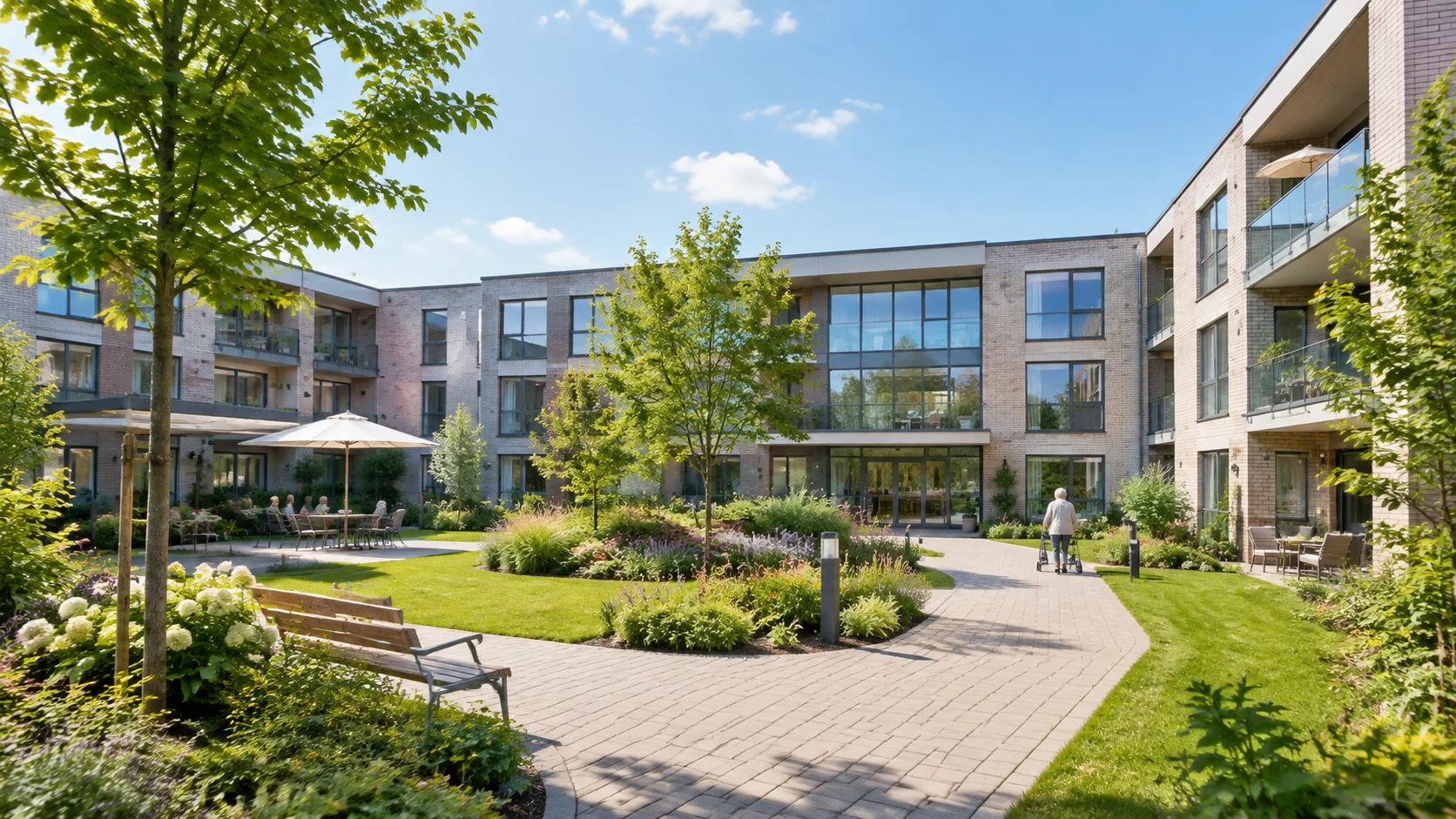
Investment property for nursing and care staff: what can you afford?
Shift work, tax-free premiums and part-time hours: available income, financing and an affordable contribution matter. We explain the assumptions in a worked example.
 Herbert Gotschy
Investment Advisor at InvestImmo
You work in a hospital or in elderly care, alternating between early, late and night shifts. Perhaps you hear a colleague suggest that a purchased apartment “pays for itself through rent and tax savings”. You wonder whether that could work on your salary too.
The honest answer is: it can, but only after examining the figures. A lower personal marginal tax rate means less relief from deductible losses than a higher rate. Shift premiums and part-time working can also matter for financing. We set out the assumptions and the monthly cost.
01What nursing and care staff earn in 2026
Nursing and care staff employed by public-sector organisations bound by the relevant collective agreement may be covered by the German public-sector collective agreement [Tarifvertrag für den öffentlichen Dienst, TVöD], which includes a separate nursing pay scale. Your basic salary in 2026 depends particularly on your pay group, step, working hours and the pay scale applicable to your employer. Private and church-run employers may use different collective agreements or employment guidelines.
The following worked example shows how different working-hour percentages affect an assumed gross monthly salary. The full-time salaries are illustrative assumptions, not TVöD pay-scale figures. Allowances, premiums and special payments are excluded; gross salary is assumed to change in proportion to working hours.
| Salary scenario | 100% | 90% | 75% | 60% | 50% |
|---|---|---|---|---|---|
| Example A | €3,500 | €3,150 | €2,625 | €2,100 | €1,750 |
| Example B | €4,000 | €3,600 | €3,000 | €2,400 | €2,000 |
| Example C | €4,500 | €4,050 | €3,375 | €2,700 | €2,250 |
For qualified nursing and care professionals with three years of training, P 7 or P 8 may be applicable, depending on their duties and the classification criteria. Specialist training or management responsibilities may support a higher classification, subject to the relevant requirements. Annual special payments, allowances and premiums for unsocial hours may be paid in addition.
For tax purposes, what matters is not simply gross salary but taxable income. A range of, for example, €38,000 to €42,000 serves here as a planning scenario, not as a forecast for a particular pay group. Deductible pension and insurance contributions, work-related expenses [Werbungskosten] and other personal circumstances affect the figure. It may be lower with part-time work. Your tax assessment notice [Steuerbescheid] shows the figure for the most recently assessed year; purchase planning must also account for subsequent changes.
02Tax-free shift premiums: more take-home pay, less tax relief
Premiums for night, Sunday and public holiday work actually performed may be tax-free within specified limits under section 3b of the German Income Tax Act [Einkommensteuergesetz, EStG], provided its conditions are met. They must be paid in addition to basic pay. A general shift allowance is not tax-free merely because of its name. Exemption from income tax does not automatically mean exemption from social insurance contributions.
| as a percentage of basic hourly pay | |
|---|---|
| Night work (20:00 to 06:00) | 25% |
| Night work from 00:00 to 04:00, if the shift began before midnight | 40% |
| Sunday work | 50% |
| Statutory public holidays, 31 December from 14:00 | 125% |
| 24 December from 14:00, 25 and 26 December, 1 May | 150% |
Simplified worked example: we assume qualifying basic pay of €24 an hour for the premium calculation. This cannot be derived unambiguously from a monthly salary without knowing the agreed working hours and relevant pay components. If you work 80 qualifying night hours in a month and your employer pays a 20% premium, the calculation is 80 × €24 × 20% = €384. That premium may be tax-free if the conditions are met.
For an investment property, this has two sides. Tax-free premiums increase your available income without themselves increasing taxable income. They do not, however, reduce the tax rate on your other income. Tax relief from a property depends on your overall tax position. A calculation using a 42% marginal tax rate is appropriate only if that rate genuinely applies to your circumstances.

03How banks assess nursing and care staff
Pay under a collective agreement can make income easier to assess. It does not replace a sustainable household budget or an assessment of the property. The decision depends on the lender and the individual application.
- Shift premiums may count only in part. A lender may require an average for variable premiums or exclude them partly or entirely. Ask about its specific criteria. Your basic salary is one starting point for the household affordability assessment.
- Part-time work. At 75% of full-time hours, the corresponding basic salary may be 75% of the full-time amount. Net income need not change in the same proportion because of tax and changes in premiums. Use your actual expected take-home pay, not an increase in hours that has yet to happen.
- Fixed-term contracts and probation. A fixed-term contract or a change of employer shortly before buying may make financing harder.
- Existing loans. A car loan costing €300 a month reduces the amount available each month by €300.
- Your own capital. Financing that also covers purchase costs cannot be taken for granted. Your own capital can reduce the borrowing required and improve financing options.
The guide How much can I borrow? explains how banks assess affordability and what loan amount may be realistic.
„Will I need to contribute money each month?“
You should answer this question before buying. In the following example, the answer is yes. The contribution depends on factors including rent, costs, financing and your own capital. The calculation shows the cost under the stated assumptions.
04Worked example: an apartment on a nursing salary
Sarah is a fictional qualified nurse working full-time, single and paid at P 8, step 4. The calculation assumes taxable income of €40,000 before the rental result. She buys a rented studio apartment in an existing building. The name and case are fictional; the figures are an illustration, not a forecast.
The apartment costs €150,000, with purchase costs of €15,000. Sarah borrows both amounts: €165,000 at an assumed interest rate of 3.8% and an initial principal repayment rate of 1.5%. Rent excluding service charges [Kaltmiete] is €520 a month, and ongoing costs that cannot be passed on to the tenant total €1,000 a year. These financing terms are modelling assumptions, not a loan offer.
The tax calculation assumes that all €1,000 consists of immediately deductible ongoing rental expenses. It excludes contributions to the maintenance reserve [Erhaltungsrücklage] of the community of apartment owners [Wohnungseigentümergemeinschaft, WEG]. Such contributions are not immediately tax-deductible; only actual use of the money for eligible expenditure may permit a deduction. Nor is the entire owners’ service charge [Hausgeld] automatically deductible. Additional reserve contributions would reduce available cash flow and must be included separately.
| Amount | |
|---|---|
| Rent excluding service charges (12 × €520) | +€6,240 |
| Interest (3.8% of €165,000) | −€6,270 |
| Principal repayments (1.5% of €165,000) | −€2,475 |
| Ongoing costs not recoverable from the tenant | −€1,000 |
| Cash flow before tax | −€3,505 |
| per month | −€292 |
The tax calculation includes rental income, deductible interest and costs, and depreciation [Absetzung für Abnutzung, AfA]; principal repayments are not deductible. The model assumes that all €15,000 of purchase costs form part of the acquisition cost and contain no financing costs requiring separate treatment. Allocating an assumed 80% of the total €165,000 to the building gives a depreciation basis of €132,000. If annual depreciation of 2% is permissible for the building under section 7(4) of the Income Tax Act, the full-year deduction is €2,640. This rate does not automatically apply to every existing building; the completion date and tax classification are particularly relevant. Discuss the allocation of acquisition costs and depreciation for your property with your tax adviser.
These assumptions produce a tax loss of €6,240 − €6,270 − €1,000 − €2,640 = −€3,670. In the example, the loss is offset in full against other income. Taxable income therefore falls from €40,000 to €36,330. Under the 2026 basic income tax schedule in section 32a of the Income Tax Act, income tax is €7,209 before and €6,071 after deducting the loss: a saving of €1,138 a year. The model assumes individual assessment with no special tax circumstances and excludes church tax and the solidarity surcharge.
In this worked example, Sarah’s after-tax contribution is roughly equal to her principal repayments. She reduces her debt, but commits her own money and continues to bear costs and property risks. The apartment does not pay for itself.
What changes with your own capital or part-time work
| Scenario | Monthly cash flow before tax | Annual income tax saving | Monthly cash flow after tax |
|---|---|---|---|
| Full-time, fully financed, taxable income of €40,000 | −€292 | +€1,138 | −€197 |
| Part-time, taxable income of €30,000 | −€292 | +€1,012 | −€208 |
| Full-time, €30,000 of own capital, taxable income of €40,000 | −€160 | +€790 | −€94 |
The taxable income stated for each scenario is before the rental result. In the own-capital scenario, Sarah pays €30,000 of the total cost herself, reducing the loan to €135,000. The interest rate and initial principal repayment rate remain unchanged for comparison. This gives modelled interest of €5,130, principal repayments of €2,025 and cash flow before tax of −€1,915 a year, or around −€160 a month. The depreciation basis is unchanged.
With her own capital, the deductible rental loss is €2,530. Taxable income falls from €40,000 to €37,470, and income tax from €7,209 to €6,419. The saving is therefore €790. In the part-time scenario without own capital, the loss of €3,670 reduces taxable income from €30,000 to €26,330. Income tax falls from €4,217 to €3,205, a saving of €1,012. The same tax modelling assumptions apply to all scenarios.
Your own capital reduces the ongoing contribution in this model, but ties up €30,000 that is no longer available as a cash buffer. The contribution after income tax falls from around €197 to €94. The part-time scenario merely assumes lower taxable income; it is not a complete revised salary calculation and household budget. You need a separate calculation to establish whether the purchase remains affordable with less household income. Discuss the personal tax implications with your tax adviser.
Enter the purchase price, rent and interest rate to compare the monthly cost. After-tax figures also depend on the tax assumptions. Discuss your personal calculation with your tax adviser.

05Five steps before you enquire
- 01Find your tax assessment notice
Check your taxable income and allow for foreseeable changes. Your household budget also needs your available take-home pay.
- 02Build a reserve
Three to six monthly loan payments in an instant-access savings account may be a starting point, but this is not a universally sufficient reserve. Also plan for vacancy, repairs, special levies and personal emergencies.
- 03Pay down consumer loans
Existing loan instalments put pressure on your household budget and may reduce the amount you can borrow.
- 04Test the monthly contribution
Transfer €300 to a separate account of your own for three months. This is an initial affordability test, not proof of long-term sustainability. Also test higher costs, delayed or absent tax refunds and lower income.
- 05Gather your documents
Payslips for the last three months, your December payslip, employment contract and evidence of your own capital. Additional or different documents may be required. See Documents for a mortgage application.
06Who this may suit
- You have a permanent employment contract and are no longer on probation.
- You have a cash reserve and can consistently spare, for example, €150 to €300 a month; you have also allowed for a higher contribution.
- You have at least some capital of your own for the purchase costs.
- You are thinking over a 20- to 30-year horizon and want to build wealth alongside your pension.
- Your account regularly runs low at the end of the month.
- Existing loan instalments or overdraft debt leave you with little financial flexibility.
- You are planning parental leave, further study or a move abroad in the next few years without having considered the financing implications.
- You expect the tenant and the tax office to pay for the apartment in full.
07Risks you should understand
Contributions over decades. The calculation above is a simplified annual model, not a forecast for the entire loan term. With an unchanged interest rate, the interest component of a level-payment repayment mortgage falls as principal is repaid; the agreed payment generally remains unchanged during the relevant contractual period. Rent may rise, but so may costs. Rent increases are not guaranteed.
Vacancy and unpaid rent. If the apartment stands empty for three months at a monthly rent of €520, you lose €1,560 in rent. If a tenant does not pay, the loss may last longer. That requires a reserve; ongoing costs may still fall due.
Maintenance. An existing building may require repairs and special levies [Sonderumlagen] imposed by the community of apartment owners. Before buying, check meeting minutes, planned works and the maintenance reserve balance. Reserve contributions reduce your available cash without creating an immediate tax deduction merely through payment into the reserve.
Interest rates after the fixed-rate period. With a repayment mortgage at 3.8% interest, an initial principal repayment rate of 1.5% and unchanged monthly payments, around 18% of the loan would be repaid after ten years. This is a separate amortisation illustration, not an extension of the simplified annual split above. Higher refinancing rates may increase the required payment; the remaining balance, new terms and repayment target determine the outcome.
Life plans. Children, part-time work, further training or a move may reduce your income. Your contractual loan payment does not automatically fall as a result. Buy only if the apartment would remain affordable in a leaner year.
FAQFrequently asked questions
Can I afford an investment property on a nursing or care salary?
That depends on your available income, outgoings, reserves, own capital and the property. In the simplified example, the monthly contribution before tax is around €292 with full financing or around €160 with €30,000 of your own capital. After income tax, the figures are around €197 and €94 respectively under the modelling assumptions, with taxable income of €40,000 before the rental result. The lender decides on financing after assessing the individual application. Discuss your personal tax position with your tax adviser.
Will the bank count night and Sunday shift premiums?
That depends on the lender’s criteria and the evidence available for your premiums. A lender may require an average or exclude variable premiums partly or entirely. Ask how your specific income will be assessed before making plans.
Are shift premiums tax-free?
Not every shift allowance is tax-free. Premiums paid in addition to basic pay for night, Sunday and public holiday work actually performed may be tax-free within the limits of section 3b of the German Income Tax Act (Einkommensteuergesetz, EStG). The standard limit is 25% for night work and 50% for Sunday work; up to 40% is possible for certain night hours. Basic hourly pay is capped at €50 for this calculation. Exemption from income tax does not automatically mean exemption from social insurance contributions. Discuss the details of your tax treatment with your tax adviser.
Is an apartment worthwhile if I work part-time?
Part-time working alone does not determine that. Your actual take-home pay, ongoing commitments and adequate reserves matter. In the simplified example without own capital, the annual income tax saving under the 2026 basic schedule is €1,138 at taxable income of €40,000 before the rental result, or €1,012 at €30,000. The monthly contribution after income tax is therefore around €197 or €208 respectively. Fewer working hours do not automatically mean a proportional fall in take-home pay. Discuss your personal tax position with your tax adviser.
Do I need capital of my own?
Financing without your own capital is not ruled out, but it is not guaranteed. In the example, €30,000 of your own capital reduces the loan from €165,000 to €135,000 and the monthly contribution before tax from around €292 to €160. After income tax, it falls from around €197 to €94 under the modelling assumptions, with taxable income of €40,000 before the rental result. Your contribution should not use up your entire emergency reserve. Read more in the guide ‘Buying without your own capital’. Discuss your personal tax position with your tax adviser.
What if I work fewer hours later?
Your contractual loan payment does not automatically fall, while your available income may decline. Plan so that the contribution remains affordable on a lower income, or wait to buy until your life plans are clearer.
08Further reading
- Investing in property with little money
- How much can I borrow?
- Buying without your own capital: 110% financing
- Marginal tax rate 2026
- Calculator: property cash flow
09Sources
- TVöD-P public-sector nursing pay scales and collective agreement information (oeffentlicher-dienst.info)
- Section 3b of the Income Tax Act (tax-free premiums for Sunday, public holiday or night work)
- Section 32a of the Income Tax Act (2026 income tax schedule)
- Section 7 of the Income Tax Act (depreciation)
- Section 505b of the German Civil Code (Bürgerliches Gesetzbuch, BGB) (creditworthiness assessment)
- Worked examples: own calculations using the stated assumptions; income tax under the 2026 basic schedule in section 32a of the Income Tax Act, excluding church tax and the solidarity surcharge
This guide provides general information and does not replace tax, legal or investment advice tailored to individual circumstances. The examples use the stated modelling assumptions and do not guarantee returns or financing. Discuss tax questions with your tax adviser and legal questions with your lawyer.
Writes about Investment properties, Purchase decisions and Financial viability.
Herbert has invested in property himself since 2023 and has worked in the property industry since 2024. His advice combines an investor’s perspective with clear explanations and an open assessment of opportunities and risks.
This guide does not replace tax or legal advice. All figures are example calculations with disclosed assumptions.