Property investment in Ratingen: prices, districts and cash flow
What the 2025 market data shows, which rental rules apply and how much cash existing and new-build flats require in the model.
 Eduard Winter
Investment Advisor at InvestImmo
01Property investment in Ratingen: assessing location and demand
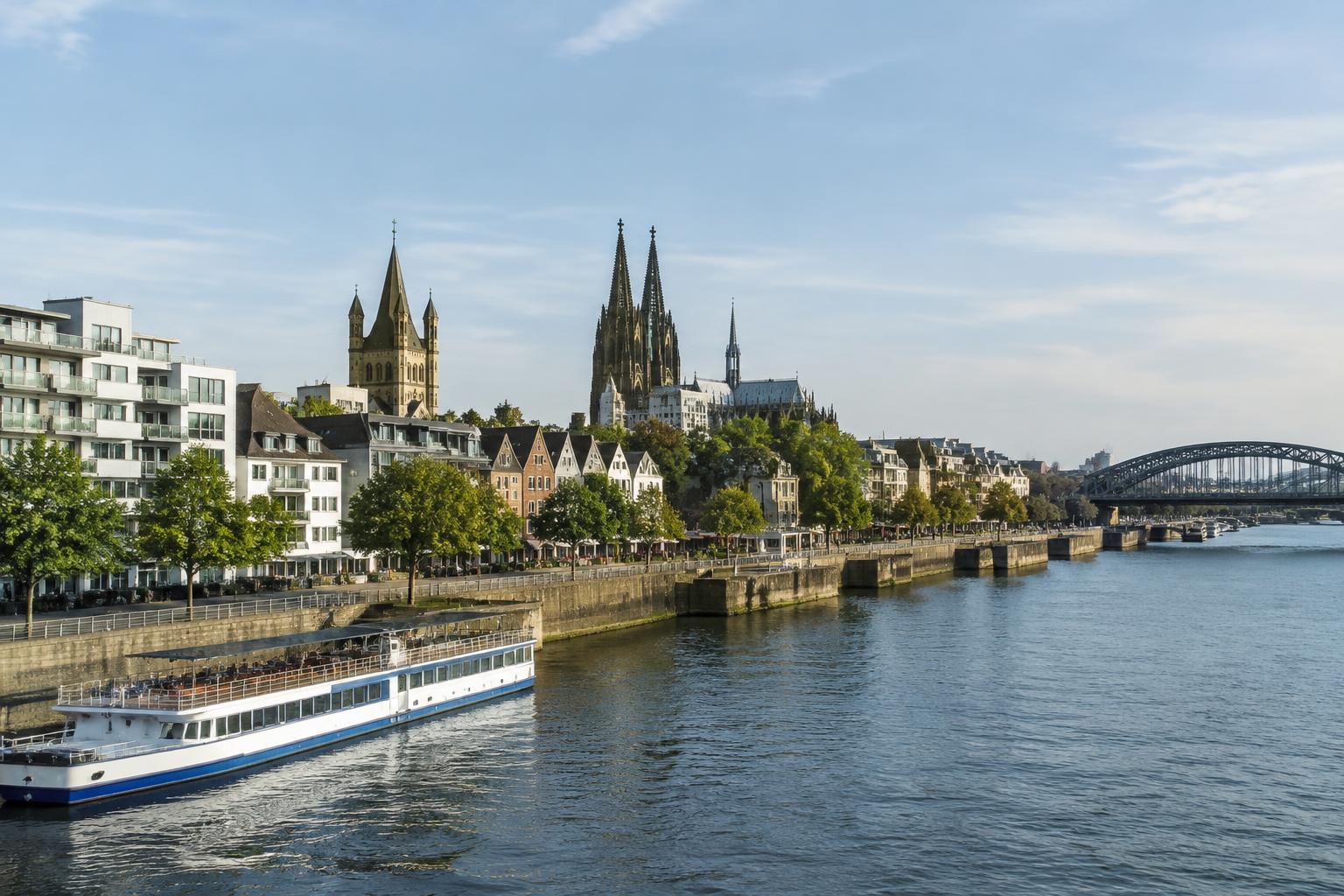
Ratingen is immediately adjacent to Düsseldorf and close to the airport. Access to the A3, A44 and A52 motorways, together with the S-Bahn connection at Ratingen Ost, may appeal to commuters. Whether this translates into demand for a particular flat depends on its immediate surroundings, specification and rent. Proximity to the airport can be an advantage, but you should also check potential aircraft and traffic noise in person.
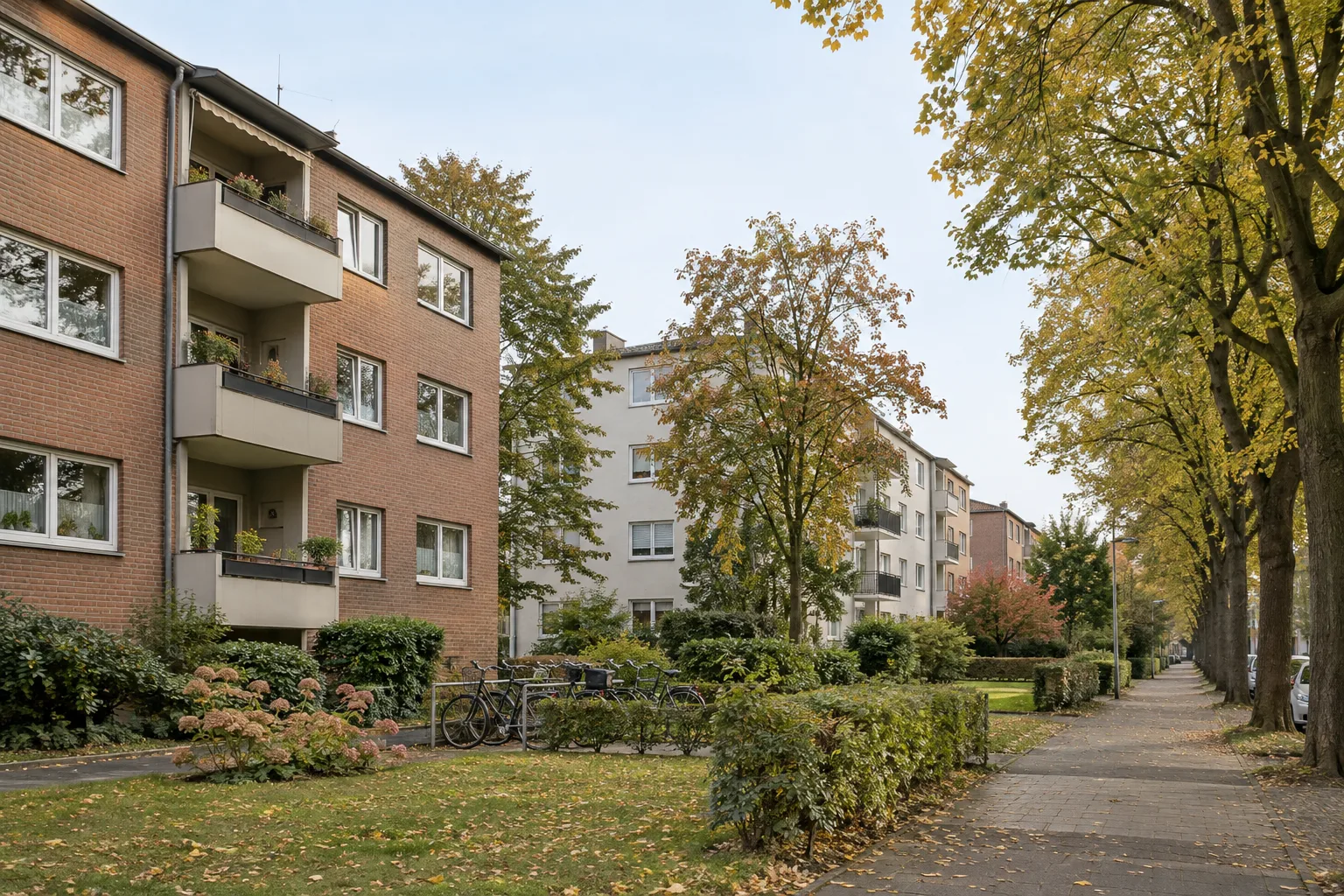
The town comprises distinct residential areas: central neighbourhoods in Mitte, larger residential developments in West and separate districts such as Lintorf, Hösel and Homberg. A blanket assessment of Ratingen cannot adequately reflect these differences.
Which local figures help with an investment decision?
| Indicator | Figure | Geographical scope and date |
|---|---|---|
| Population | 88,914 | Ratingen, official municipality register, 31 December 2025 |
| Households | 43,326 | Ratingen, 2022 Census |
| Single-person households | 43.6% | Ratingen, 2022 Census |
| Residential vacancy rate | 2.4% | Ratingen, Census, 15 May 2022 |
| Municipal tax revenue capacity per resident | €2,556 | Ratingen, BBSR/Deutschlandatlas, 2024 |
| Unemployment rate | 7.2% | Mettmann district, annual average 2025 |
| Population projection | −4.2% by 2050 | Mettmann district, IT.NRW, base year 2023 |
The vacancy rate is a historical snapshot, not a measure of how long it takes to let a property in October 2026. Strong municipal tax revenue capacity also establishes neither individual tenants’ ability to pay nor future rent increases.
The population projection covers the whole of Mettmann district. It cannot be applied unchanged to Ratingen or its individual neighbourhoods. When choosing a property, actual demand, local amenities, accessibility and a suitable layout therefore matter more than any single local indicator.
02Purchase prices and rents: distinguish between the datasets
The Ratingen Property Market Report 2026 analyses transactions completed in 2025. The following average prices are neither current asking prices nor valuations of individual flats.
| Construction period or segment | Average purchase price in 2025 |
|---|---|
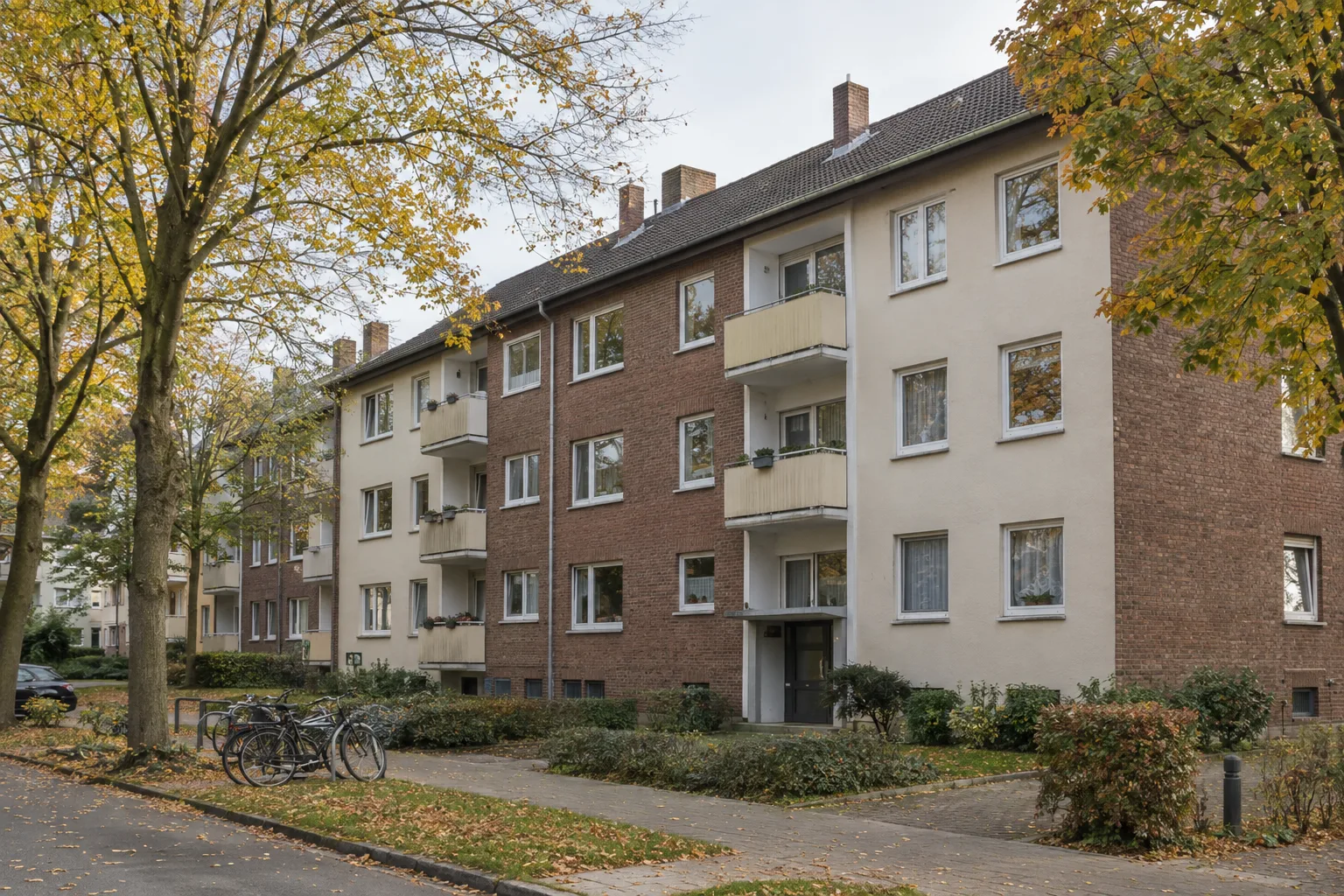
| 1950–1974 | €2,524/m² |
| 1975–1994 | €2,994/m² |
| 1995–2009 | €3,553/m² |
| 2010–2023 | €4,789/m² |
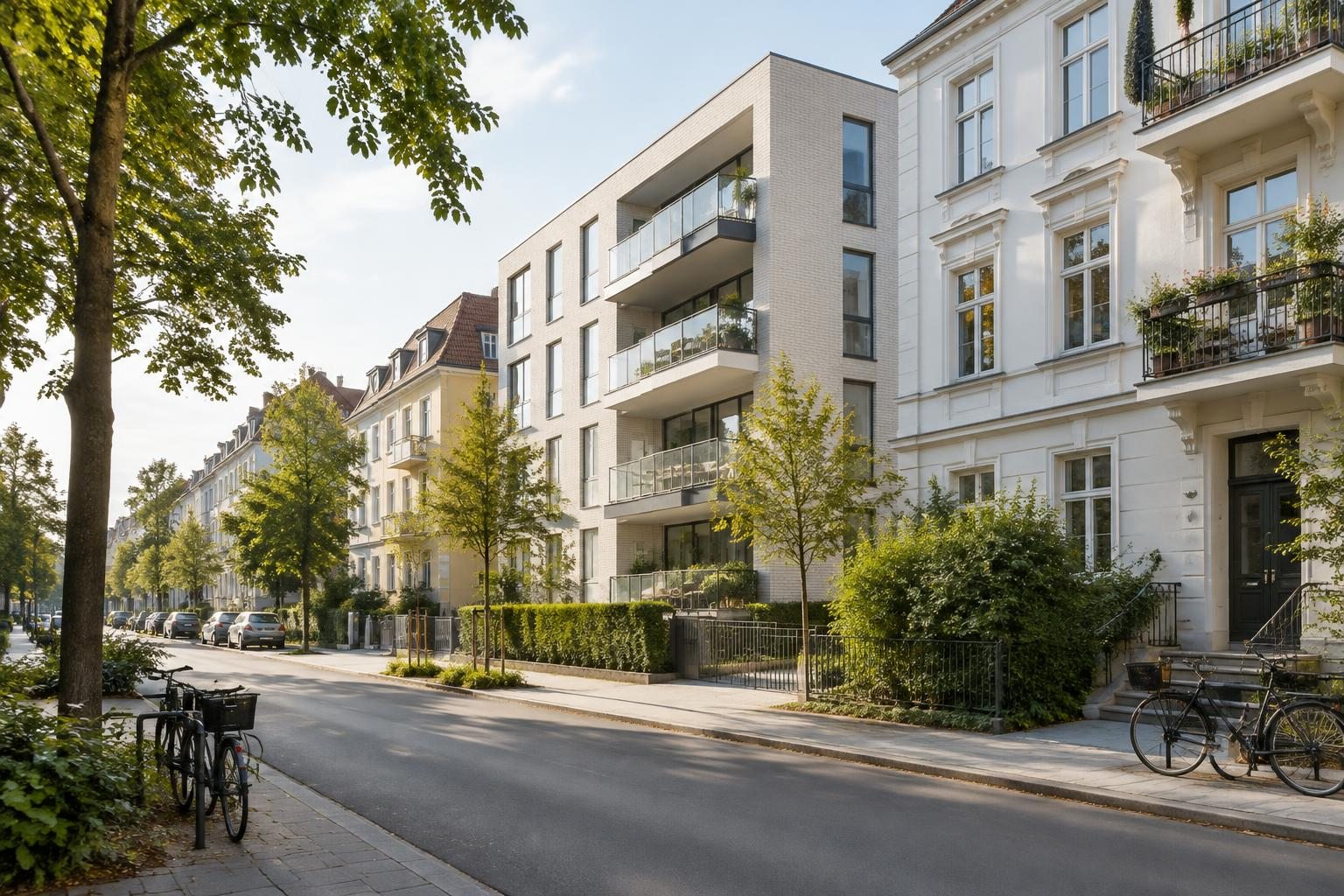
| New build | €4,949/m² |
The new-build figure is based on only four analysed first sales in Hösel/Eggerscheidt. Its relevance to other developments is therefore limited. The number of analysed sales does not establish the total level of new construction in the town.
What the sample of tenanted flats tells us
For 49 tenanted flats, the valuation committee reports an average floor area of 69 m² and a purchase price of €2,632/m². It uses a rent benchmark of €9.25/m² based on the local rent index. This benchmark is not equivalent to verified rent receipts for the flat you might buy.
These average figures give:
Gross rental yield = €9.25 × 12 ÷ €2,632 × 100 = 4.22%.
The corresponding calculated purchase price multiple is 23.71. This is a ratio of average figures, not necessarily the average of the individual purchase price multiples or yields in the sample.
| Model comparison | Purchase price per m² | Monthly rent per m², excluding service charges | Calculated gross rental yield |
|---|---|---|---|
| Built 1950–1974 | €2,524 | €9.25 | 4.40% |
| Tenanted flats, sample | €2,632 | €9.25 | 4.22% |
| Built 1975–1994 | €2,994 | €9.25 | 3.71% |
| New build | €4,949 | €10.47 | 2.54% |
Applying the same €9.25/m² to both construction periods is a modelling assumption, not a separately documented rent for each group. The €10.47/m² used for new build corresponds to the advertised rent reported in the Deutschlandatlas for Mettmann district in 2025 across all construction periods. It serves solely as an assumption here, not as an established new-build rent for Ratingen or a legally permissible rent.
All yields in this table use the purchase price alone. Acquisition costs, management, maintenance, rent losses and financing have not yet been taken into account.
03Districts: comparative prices rather than a blanket ranking
The district figures come from section 6.1.4 of the 2026 Property Market Report and relate to transactions in 2025. Figures in brackets show the number of analysed sales. A dash means that no figure was reported.
| District | Built 1950–1974 | Built 1975–1994 | Particular points to check |
|---|---|---|---|
| Ratingen-Mitte | €2,697/m² (65) | €3,057/m² (26) | Accessibility, street setting, building condition |
| Ratingen-West | €2,272/m² (41) | – | Development size, service charges, lifts and refurbishment plans |
| Tiefenbroich | €2,601/m² (16) | €2,563/m² (5) | Proximity to commercial premises, traffic and aircraft noise |
| Lintorf | €2,425/m² (18) | €2,894/m² (17) | Local amenities, transport connections and suitable layout |
| Breitscheid | – | €3,293/m² (4) | Actual commuting routes and street setting |
| Hösel/Eggerscheidt | €2,540/m² (10) | €3,169/m² (14) | Actual distance to the station and local amenities |
| Homberg | €2,638/m² (3) | €2,854/m² (8) | Transport options, local amenities and target tenants |
Ratingen-West has the lowest average price within the 1950–1974 construction group shown here. This does not mean that every flat there is cheaper or offers better financial prospects. Conversely, a higher district average does not justify any asking price.
Particularly where there are few transactions, the condition, size and specification of individual flats can materially affect the average. Compare similar properties wherever possible and assess the owners’ association independently of the district.
04Rental law in Ratingen: do not assume future rent increases
Ratingen is included in North Rhine-Westphalia’s Tenant Protection Ordinance. The following rules are particularly relevant to an investment decision, as at October 2026:
Rent control when reletting
Under the ordinance, the rent brake applies in Ratingen until 31 December 2029. When a property is newly let, the agreed rent generally cannot exceed the local comparable rent by more than 10%. Statutory exceptions and special provisions, such as those concerning a permissible previous rent or certain modernisation works, require separate assessment.
The new-build exception under section 556f of the German Civil Code applies to homes first used and let after 1 October 2014. The first letting after comprehensive modernisation may also be exempt. Ordinary renovation is not sufficient. Landlords relying on certain exceptions must provide information before the tenancy agreement is concluded.
The sample figure of €9.25/m² is not a universal comparable rent for every flat in Ratingen. The characteristics of the particular property and the applicable method of determining comparable rent are decisive. A town-wide average therefore cannot establish the legally permissible rent for a new tenancy.
Rent increase cap during an existing tenancy
For increases under section 558 of the German Civil Code, Ratingen has a reduced cap of 15% within three years; the corresponding ordinance provision runs until 28 February 2030. The local comparable rent is an additional ceiling. Waiting periods, justification requirements and the requirement for tenant consent must also be observed.
The 15% cap is not an automatic entitlement to an increase. Index-linked rents, stepped rents and increases following modernisation are subject to their own rules.
Protection against termination after conversion
If a flat already occupied by a tenant is converted into an individually owned condominium and subsequently sold, the eight-year protection period under section 577a of the German Civil Code, together with the NRW ordinance, may apply. It concerns, in particular, termination for the owner’s personal use or for economic exploitation of the property. The first sale after conversion is generally decisive; a further sale does not automatically restart the period.
This rule does not apply indiscriminately to every purchase of a tenanted flat. Check when the tenancy began, when conversion took place and the history of subsequent sales.
05Worked example: an existing tenanted flat
The following model is based on assumptions. It is neither a mortgage offer nor a forecast. It uses the average figures from the valuation committee’s sample as a starting point, rather than verified information about a specific property for sale.
The assumptions are 69 m² of floor area, a purchase price of €2,632/m² and monthly rent of €9.25/m² excluding service charges. The entire purchase price is financed with a loan, while acquisition costs are paid from the buyer’s own funds. A bank is not obliged to offer this financing structure.
Purchase and financing assumptions
| Item | Amount or assumption |
|---|---|
| Purchase price: 69 m² × €2,632 | €181,608.00 |
| NRW property transfer tax: 6.5% | €11,804.52 |
| Notary and land registry: assumed allowance of 1.8% | €3,268.94 |
| Acquisition costs excluding an estate agent | €15,073.46 |
| Total investment | €196,681.46 |
| Loan | €181,608.00 |
| Own funds for acquisition costs | €15,073.46 |
| Annual interest rate | 3.8% |
| Principal repayment in the first year | 1.5% |
The 1.8% is a planning allowance that includes land registry financing costs, not a fee calculation under the German Court and Notary Costs Act. Actual costs depend on the purchase agreement and financing. Further expenses, such as estate agent fees, initial renovation or an additional cash reserve, are not included. See Notary costs when buying property for an explanation of the cost structure.
Cash flow in the first full year of letting
To make the calculation transparent, interest and principal repayment are calculated on the opening loan balance, assuming a single payment at year end. Monthly payments would change the split between interest and principal. The annual owner’s budget of €1,392 is assumed to cover management and maintenance, including contributions to the maintenance reserve; no second maintenance budget is deducted on top.
| Item | Per year | Monthly average |
|---|---|---|
| Rent excluding service charges: 69 × €9.25 × 12 | €7,659.00 | €638.25 |
| Interest | −€6,901.10 | −€575.09 |
| Principal repayment | −€2,724.12 | −€227.01 |
| Owner’s budget, assumption | −€1,392.00 | −€116.00 |
| Cash flow before tax | −€3,358.22 | −€279.85 |
Calculations use unrounded intermediate figures; the displayed results are rounded. Recoverable operating costs are omitted as pass-through items. Full rent collection and no vacancy are assumed. Special assessments and larger additional works are not included.
In this model, rent does not fully cover even the interest and owner’s budget: the shortfall before principal repayment is €634.10 a year, or €52.84 a month. Principal repayment adds to the cash requirement. Although it reduces the outstanding loan, it is not spendable income.
Stress tests rather than an average-case calculation alone
Each of the following changes is considered separately against the base model, before tax and with the principal repayment assumption unchanged:
| Stress scenario | Additional monthly cash requirement | Total monthly shortfall |
|---|---|---|
| Interest rate 1 percentage point higher at initial borrowing or refinancing | €151.34 | €431.19 |
| Two months without rental income during the year | €106.38 | €386.23 |
During a vacancy, the owner may also have to bear operating costs; these are not included in this simplified scenario. During an agreed fixed-rate period, the loan’s interest rate does not change merely because market rates rise.
06New-build comparison: a lower gross yield in the model
The comparison assumes a 45 m² flat costing €4,949/m². Monthly rent of €10.47/m² excluding service charges is solely an assumption. Financing and the simplified payment schedule match the existing-property model. The owner’s annual budget is assumed to be €648, with no larger additional works.
| Item | New-build assumption |
|---|---|
| Purchase price: 45 m² × €4,949 | €222,705.00 |
| Acquisition costs: 6.5% tax plus an assumed 1.8% | €18,484.52 |
| Total investment | €241,189.52 |
| Loan | €222,705.00 |
| Annual rent excluding service charges: 45 × €10.47 × 12 | €5,653.80 |
| Interest: 3.8% | −€8,462.79 |
| Principal repayment: 1.5% | −€3,340.58 |
| Owner’s budget | −€648.00 |
| Annual cash flow before tax | −€6,797.57 |
| Average monthly cash flow before tax | −€566.46 |
The gross rental yield is 2.54%, compared with 4.22% in the existing-property model. The monthly pre-tax shortfall is correspondingly larger. This compares two sets of assumptions; it is not a general ranking of existing and new-build property.
With new builds, too, you should examine warranty rights, management costs, technical systems and future maintenance. A new building is not permanently maintenance-free.
07Tax: distinguish reserves, depreciation and principal repayment
Negative cash flow is not the same as a tax loss. The following distinctions are particularly important for rental property:
- Interest: Generally deductible as an expense where it is economically connected with the letting activity.
- Principal repayment: Not a deductible expense; it reduces the outstanding loan.
- Maintenance reserve: Paying into the condominium owners’ association’s reserve does not itself create a tax deduction. The association’s subsequent use of the money and the tax classification of the work are generally decisive.
- Depreciation: Applies to the building share of acquisition costs, including attributable purchase expenses, but not to the land. The allocation must be appropriate; an assumed building share of 80% is not a universal standard.
- Financing costs: May receive different tax treatment from costs directly attributable to acquiring the property.
Different depreciation rules may apply to residential buildings depending on completion dates and other conditions. Where the requirements are met, declining-balance building depreciation under section 7(5a) of the German Income Tax Act is 5% of the remaining depreciable value. For construction, relevant conditions include work beginning within the qualifying period from 1 October 2023 to 30 September 2029. For purchases, particular requirements include a legally binding purchase contract within that period and acquisition by the end of the year of completion.
Additional special depreciation under section 7b of the German Income Tax Act requires further conditions to be met. Buying a new-build property alone is not sufficient. Higher depreciation also does not replace cash reserves; under an unchanged declining-balance method, the annual depreciation amount falls as the remaining value decreases.
No standardised after-tax cash flow is therefore shown for either model. Establishing this would require, in particular, the breakdown of costs, the building share, completion dates and the buyer’s personal tax circumstances. See Tax on rental income and Special and declining-balance depreciation for the fundamentals.

08Before buying: documents and risks to examine
- Tenancy agreement and payments: Contractual rent, arrears, deposit, previous increases and any index-linked or stepped-rent provisions.
- Condominium owners’ association: Declaration of division, community rules, register of resolutions, meeting minutes and potential legal disputes.
- Service charges and reserves: Annual budget, annual accounts, statement of assets, payment arrears and special assessments already approved.
- Building and energy performance: Condition of the roof, façade, heating, pipework and lifts, together with the energy performance certificate and foreseeable works.
- Immediate location and lettability: Commuting routes, local amenities, noise, layout, accessibility and a realistic, legally permissible rent.
- Financing and reserves: Fixed-rate period, outstanding loan balance, refinancing and sufficient personal funds for rent losses and additional works.
A low town-wide vacancy rate does not compensate for excessive service charges or underfunded refurbishment. For broader guidance, see A flat as an investment: advantages and disadvantages.
09Conclusion: assess Ratingen property by property
Proximity to Düsseldorf and a variety of residential locations may make Ratingen interesting for property investors. However, the 2025 averages do not establish that an investment will automatically pay for itself. The existing-property model has a shortfall even before principal repayment; the new-build model requires more cash under the chosen assumptions.
Do not decide on the district name, gross yield or expected tax relief alone. The actual purchase price, verified rent, full ownership costs and financing that remains affordable under stress are decisive. This information does not replace individual legal or tax advice.
10Free initial consultation
During a free initial consultation, you can discuss your search criteria, available funds and the key details of a potential investment in Ratingen. The aim is an initial assessment of the property, financing and cash requirements. Arrange an initial consultation.
FAQFrequently asked questions
Is a flat in Ratingen a worthwhile investment?
That depends on the actual purchase price, legally permissible contractual rent, ownership costs and financing. The existing-property model shown here has a monthly shortfall of around €280 before tax. Proximity to Düsseldorf and a historically low vacancy rate do not replace an assessment of the individual flat.
What rental yield can you expect in Ratingen?
A purchase price of €2,632/m² and a rent-index-based benchmark of €9.25/m² produce a calculated gross rental yield of 4.22%. Both figures come from the valuation committee’s 2025 sample of tenanted flats. The result excludes acquisition costs, running costs and financing, and is not a guaranteed yield for an individual property.
How much does a flat cost in Ratingen?
The 2026 Property Market Report gives average 2025 transaction prices of €2,524/m² for flats built in 1950–1974, €2,994/m² for 1975–1994 and €3,553/m² for 1995–2009. The new-build figure of €4,949/m² is based on only four analysed first sales. These figures do not replace an individual valuation.
Does the rent brake apply in Ratingen?
Yes. Under North Rhine-Westphalia’s Tenant Protection Ordinance, it applies in Ratingen until 31 December 2029. On reletting, rent generally cannot exceed the local comparable rent by more than 10% unless a statutory exception applies. Increases under section 558 of the German Civil Code are also subject to a cap of 15% within three years.
Which Ratingen district has the lowest purchase prices?
In the analysis shown for flats built in 1950–1974, Ratingen-West had the lowest average price in 2025, at €2,272/m². This is not a general ranking for all flats and construction periods. Condition, service charges, reserves and forthcoming works can eliminate an apparent price advantage.
How much are acquisition costs in Ratingen?
Property transfer tax in North Rhine-Westphalia is 6.5%. Notary and land registry costs, and any estate agent fees, are additional. The example assumes a total of 8.3% without an estate agent: €15,073.46 on a purchase price of €181,608. The included allowance of 1.8% for notary and land registry costs is an assumption, not an individual fee calculation.
Writes about Taxes, AfA (depreciation), Existing properties and Portfolio building.
Since 2020, Eduard has bought seven properties of his own and supported more than 150 clients. He writes about tax levers, property documents and portfolio building – with honest numbers instead of rosy projections.
This guide does not replace tax or legal advice. All figures are example calculations with disclosed assumptions.