Special Repayment or a Second Apartment: €30,000
Special repayment, another apartment or cash reserves: what an explicit model shows, and which risks remain outside the calculation.
 Nadeem Shahid
Investment Advisor at InvestImmo
Not a market forecast or offer. Cash requirements differ; see the calculation and limitations below.
Your first rental apartment is operating, and you have accumulated €30,000 in cash. Should you reduce the mortgage balance, use the money to acquire a second apartment, or keep it available as a reserve?
Each option has advantages. The decision depends not only on borrowing costs and potential property appreciation, but also on your tax position, household cash flow and ability to commit capital for the long term. We compare the alternatives using an explicit model rather than a promised return.
01Why special repayments work differently for rentals
Interest on borrowing economically connected with rental activity can qualify as Werbungskosten, deductible income-related expenses. A Sondertilgung, or special repayment, then reduces both interest expense and the associated deduction. That rental-expense deduction generally does not apply to a wholly private owner-occupied home. The use of the borrowed funds matters, not simply the property pledged as collateral. § 9 EStG establishes the required economic connection. (gesetze-im-internet.de)
A simplified comparison uses borrowing rate × (1 − effective tax relief). This is a starting point, not an individual tax calculation. A deduction is valuable only to the extent that it actually reduces your tax. Our guide to deducting rental-property interest explains the background.
The question of using equity or borrowing more therefore arises both when buying and when considering a later repayment. Tax relief does not make interest free. The relevant question is whether the remaining financing cost justifies retaining the cash and accepting the associated risk.
02Illustrative example: Markus has €30,000 available
Markus is fictional. His first apartment has an outstanding loan of €180,000 at 3.8%, with monthly payments of €870. The €30,000 is available in addition to an existing minimum reserve for personal and property expenses. That existing reserve remains outside all three alternatives.
We assume a constant 47% tax effect for additional deductible expenses and deductions that disappear. This is explicitly not an exact income-tax calculation for a particular income, nor a statement about an individual's Solidaritätszuschlag. The model assumes that all tax relief becomes fully effective in the relevant year.
Option A: special repayment. Markus repays €30,000 at the outset and keeps the monthly payment unchanged. We assume his agreement permits this amount without additional charges. If the interest rate remained unchanged throughout, the calculated remaining term would fall from approximately 28 to approximately 21 years. This is not a promise about future refinancing rates.
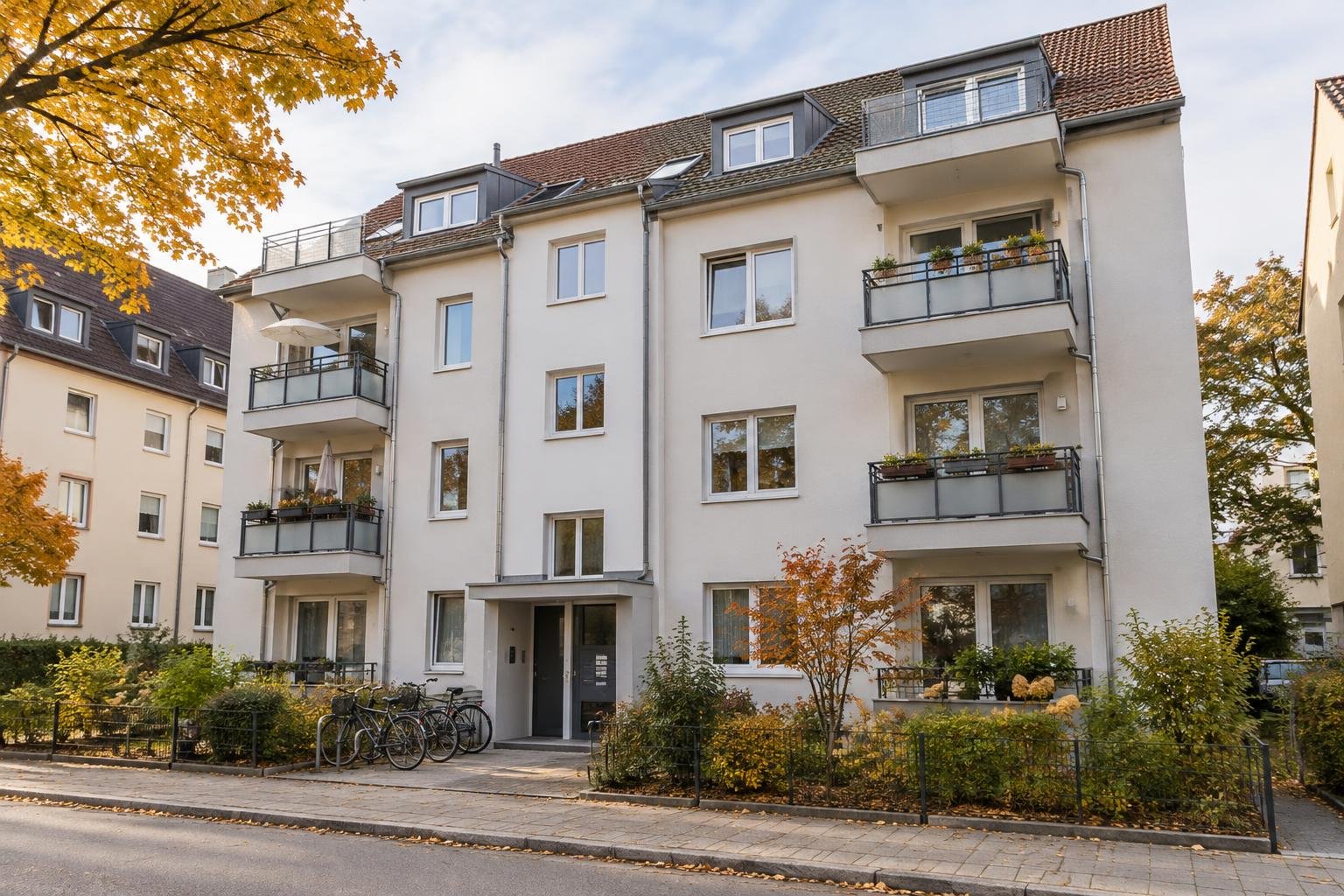
Option B: second apartment. He purchases an apartment in North Rhine-Westphalia for €220,000. Of the €30,000, acquisition costs absorb €17,600 and €12,400 remains as an additional reserve. He borrows the entire purchase price at 3.8% interest with initial annual principal repayment of 2%. The calculated monthly payment is €1,063.33. This financing structure is an assumption, not a lending commitment.
Option C: cash reserve. The €30,000 remains in Tagesgeld, an instant-access savings account. We assume annual interest of 2% throughout, credited and reinvested annually.
The 6.5% Grunderwerbsteuer assumption corresponds to the published North Rhine-Westphalia legislation. The other acquisition expenses are model inputs only and must be replaced with property-specific estimates. (recht.nrw.de)
The building acquisition cost and annual depreciation of €3,900 are explicit model assumptions; their applicability to a particular property must be assessed separately.

03Illustrative calculation: the first year
The loans use monthly interest of 3.8% / 12 and payments at the end of each month. Tables show whole euros; calculations use unrounded amounts.
| Item | A: Special repayment | B: Second apartment | C: Savings |
|---|---|---|---|
| Interest saved or earned | +€1,160 | — | +€600 |
| Interest on the second apartment's loan | — | −€8,283 | — |
| Additional cash flow before tax | €0 | −€5,360 | +€600 |
| Tax effect | −€545 | +€2,248 | €0 |
| Additional cash flow after tax | −€545 | −€3,112 | +€600 |
| Monthly average | −€45 | −€259 | +€50 |
| Additional debt reduction during year one | +€1,160 | +€4,477 | — |
| Wealth effect from the year's operations, excluding initial outlay and value changes | +€615 | +€1,365 | +€600 |
Important for A: The initial €30,000 special repayment is not included again in the annual cash-flow figures. Because the instalment stays unchanged, interest savings go into additional principal repayment rather than into the current account. The additional tax bill, however, requires cash. The approximately €615 economic benefit is therefore not an available annual cash surplus.
For B, pre-tax cash flow is €9,000 rent minus €1,600 expenses minus €12,760 annual loan payments: −€5,360. The taxable result is €9,000 minus €1,600 minus approximately €8,283 interest minus €3,900 AfA, giving a loss of approximately €4,783. Applying the assumed tax effect produces approximately €2,248 of relief. Principal repayment is not an additional tax expense.
For option C, no tax on interest is assumed solely for calculation purposes. Actual taxation must be assessed separately.
04Illustrative calculation: the position after ten years
We compare nominal changes in wealth after deducting the original €30,000 and additional ongoing contributions. These are not annualised returns, and the alternatives do not have identical annual savings budgets. Additional payments are not discounted; the interest they might have earned elsewhere is excluded.
For A, the additional reduction in debt compared with leaving the loan unchanged is approximately €43,842. This comprises the original €30,000 plus approximately €13,842 of interest savings. After applying the 47% tax effect to those savings, the net benefit is approximately €7,336.
For B, the calculation is apartment value − outstanding debt + additional reserve − ongoing after-tax contributions − €30,000. The original apartment is excluded from all alternatives to the extent that its position does not change.
| Alternative or property-value scenario | Change in wealth after ten years |
|---|---|
| A: Special repayment | +€7,336 |
| C: Savings at a constant 2% | +€6,570 |
| B: Apartment value unchanged at €220,000 | +€638 |
| B: Apartment value rises by 1% annually | +€23,655 |
| B: Apartment value falls by 1% annually | −€20,398 |
Without rent increases or appreciation, the model produces a small positive balance. Expenses not included in the assumptions could readily absorb it. Acquisition costs must first be earned back economically; they are not automatically an immediate tax deduction. The model's building depreciation already reflects the assumed building allocation, including allocated acquisition expenses.
The value scenarios are deliberately not forecasts. Annual appreciation of 1% would produce a calculated value of approximately €243,017; an annual decline of 1% would produce approximately €198,964. Such a valuation is neither a promised selling price nor immediately available cash.
A second apartment is therefore not exclusively a bet on rising prices: the relationship between price, rent, expenses and financing also matters. In this particular model, however, the surplus at unchanged values is thin. A longer holding period can reduce the relative importance of one-off acquisition costs without guaranteeing a better outcome. Further maintenance and refinancing costs must also be considered.
05Illustrative comparison: an older low-rate loan
At an assumed borrowing rate of 1.5%, the simple annual interest saving on €30,000 initially equals €450. After the modelled 47% tax effect, €238.50 remains, or approximately 0.8%. This simplified calculation deliberately excludes the effect of principal repayments within the year.
That does not establish a universal rule against repaying loans below a particular interest rate. The relevant factors are the alternative actually available after tax, the remaining fixed-rate period, your liquidity needs and your preference for lower debt. Before refinancing, also consider how much cash you want to retain and what outstanding balance you can comfortably carry.
Sondertilgung rights depend on the agreement. Check the permitted amount, the balance on which any percentage is based, payment dates and possible charges. A particular annual percentage is not a general statutory entitlement to make special repayments.
For fixed-rate borrowing, § 489(1) no. 2 BGB generally permits full or partial termination after ten years from complete receipt of the loan, subject to six months' notice. A subsequent new agreement on the borrowing rate or repayment period can replace the original date for calculating the period. The conditions must be checked against the actual agreement. (gesetze-im-internet.de)
06The order in which to make the decision
Our guide to financing a second property discusses financing structures. Borrowing the entire purchase price, as assumed here, is an option to assess rather than an entitlement to a bank loan.
Choosing not to buy another apartment for now is equally legitimate. If the additional ongoing commitments would restrict your finances too much, a potentially higher final valuation need not be the right objective. Splitting available funds between a reserve and an allowable special repayment may also suit your circumstances.

07Which option may fit your situation?
| Consider special repayment or a reserve | Consider assessing a second apartment |
|---|---|
| You want to reduce debt or preserve accessible cash. | You can commit additional capital for the long term. |
| Your income could fall or your expenses could rise. | Your household can fund ongoing contributions and adverse scenarios. |
| You do not want another property to manage. | You are willing to handle additional letting and due diligence. |
| The existing loan is relatively expensive after tax. | A specific property works without optimistic appreciation assumptions. |
A different location may reduce shared exposures, but it does not eliminate general property or financing risks. Assess what the properties actually have in common rather than relying solely on different addresses. See building a property portfolio for further considerations.
08Risks and limitations of the calculation
More letting exposure, not automatically twice the risk. Another apartment creates further potential repairs, rental shortfalls and Sonderumlagen, additional assessments by the owners' association. The change in overall risk depends on both properties and their shared exposures. Those extra burdens are not included in the model.
Interest-rate and liquidity risk. Option B adds another loan. Option A reduces the balance eventually requiring refinancing but commits cash to repayment. Obtaining a new loan later is not a guaranteed way of retrieving that money.
Valuation rather than sale proceeds. The comparison values the second apartment but does not sell it. An actual disposal requires a separate calculation including costs and individual tax analysis.
Taxes and expenses may differ. A constant tax effect and unchanged expenses are simplifications. Changes in effective tax relief alter both property-related alternatives. Current legislation does not promise unchanged treatment throughout the model period.
Budgets are not fully equalised. B requires additional contributions from income; A requires additional tax payments. Saving and investing equivalent amounts under C would change the comparison. Leaving B's reserve without interest is another explicitly chosen simplification.
09Conclusion: prioritise liquidity and affordable debt service
In this illustrative model, the special repayment provides a traceable wealth benefit, but no additional ongoing cash inflow while the instalment remains unchanged. The second apartment could perform considerably better or worse; its small positive baseline result is sensitive to additional expenses. Keeping a reserve preserves flexibility.
Our decision framework is therefore to establish adequate reserves first, compare loans after tax and under their contractual terms, and only then assess a specific second property with adverse scenarios included. An affordable financing structure even under less favourable conditions should matter more than the highest scenario result.
FAQFrequently asked questions
Is a special repayment worthwhile for a rental property?
It depends on borrowing costs, effective tax relief, contractual terms and liquidity needs. Illustrative assumption: at 3.8% interest and a 47% tax effect, the simple annual after-tax interest benefit is approximately 2%. This is not an individual tax or return calculation.
Should I make a special repayment or buy another apartment?
Compare additional cash commitments, reserves and risks as well as possible final values. A second apartment requires assessment of a specific property and affordable financing. It is not automatically more profitable.
Should I repay my own home's mortgage first?
An owner-occupied home loan may deserve priority because it generally lacks the rental-expense interest deduction. However, actual after-tax borrowing costs, repayment rights and liquidity needs determine the comparison. There is no automatic priority.
How much cash should I retain before a special repayment?
Allow for personal commitments, potential rental shortfalls, building condition and foreseeable Sonderumlagen. A few months of rent alone does not establish adequate provision. Review the owners' association's documents as well.
Is a special repayment tax-deductible?
Repayment of loan principal is not Werbungskosten. Interest economically connected with a rental property can qualify for deduction. A special repayment reduces that interest and may therefore reduce future deductions.
Can I pay only the acquisition costs from my own funds?
Borrowing the entire purchase price is a possible structure, not a lending commitment. Availability and affordability depend on the property, creditworthiness, household budget and loan terms. Additional reserves must also be planned.
10Further reading
- Financing a second property
- Building a property portfolio
- Deducting rental-property interest
- Marginal tax rate
- Borrowing against a property
- Glossary: Sondertilgung
11Sources
The following primary sources provide the legal background; model assumptions are not statutory guarantees. These sources do not establish future interest rates or property values.
- § 9 EStG: Werbungskosten and borrowing interest.
- § 489 BGB: ordinary termination rights.
- North Rhine-Westphalia: legislation setting the Grunderwerbsteuer rate.
- BFH judgment of 14 January 2025, IX R 19/24: Erhaltungsrücklage.
Editorial date: 28 October 2026. All model inputs are illustrative assumptions, not typical market outcomes, offers or forecasts. Calculations have been recomputed and are displayed rounded. Tax and legal outcomes depend on individual circumstances.
Writes about Investment properties, New builds and renovation and Financing.
Nadeem is a qualified insurance and finance merchant, spent around eight years self-employed in the insurance and finance industry and has specialised in investment property since 2024. He writes about new builds, renovation, financing and the running costs of rented property.
This guide does not replace tax or legal advice. All figures are example calculations with disclosed assumptions.