Hidden defects after buying property: your rights in Germany
An exclusion does not protect a seller who fraudulently conceals a defect. Understand the evidence, deadlines and other requirements, and the pre-tax investment impact of water damage.
 Herbert Gotschy
Investment Advisor at InvestImmo
Three months after handover, your tenant calls. A bathroom tile has come loose, revealing a wet wall. The plumber finds an old pipe that has been patched several times, alongside signs of previous water damage. The wall was freshly painted when you viewed the flat.
The purchase contract says that the flat is sold as inspected, with liability for defects excluded. Such an exclusion does not necessarily mean that you have no claim. The precise wording of the contract and what the seller knew are among the decisive factors.
01What counts as a hidden defect?
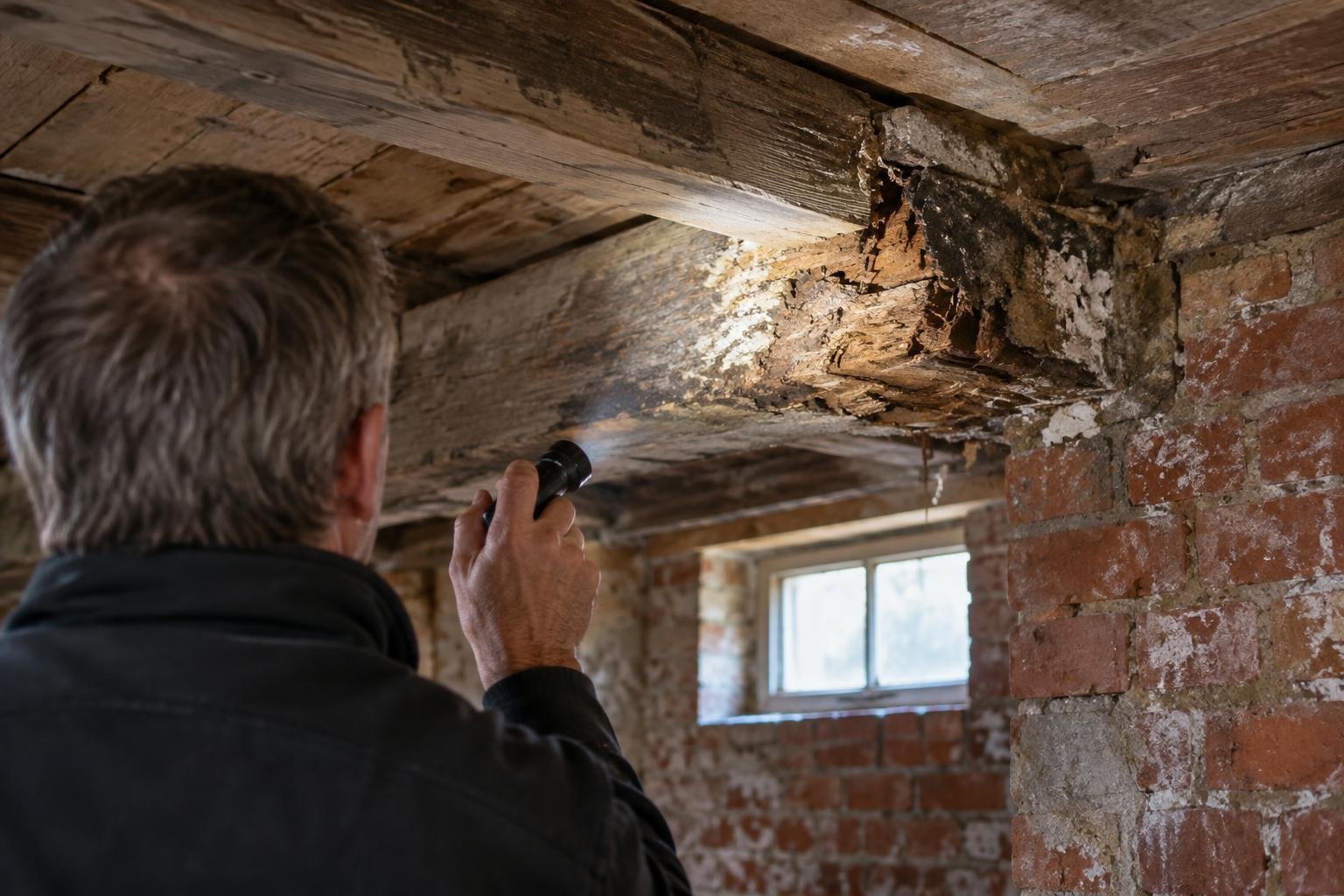
A property is defective, in particular, if it lacks an agreed characteristic or fails to meet the applicable objective requirements (§ 434 BGB). Its age, condition and the contractual agreements must also be considered. Possible examples include basement damp, dry rot in structural timber, faulty pipes, a leaking roof, hazardous materials or a converted flat without the necessary building approval. For a claim under German sales law, the defect must generally have existed when risk passed to the buyer, even if it became apparent only later.
A defect is hidden if you could not identify it during an ordinary viewing. This matters because buyers who know about a defect when entering into the contract generally have no statutory remedies for it (§ 442(1) BGB). If you overlooked a defect through gross negligence, remedies generally remain available only in cases of fraudulent concealment or a seller’s guarantee of a particular characteristic. A defect being discoverable does not automatically establish gross negligence.
| Defect | Typically hidden? | Why? |
|---|---|---|
| Damp basement wall with visible salt deposits | No | Apparent during a viewing |
| Damp behind a freshly painted wall | Possibly | If the paint actually conceals it |
| An old leak beneath new flooring | Possibly | If there are no visible warning signs |
| Missing building approval for an attic conversion | Possibly | Often identifiable only by checking the records |
| Cracks in the façade | Usually not | Where visible from outside |
The table shows why a viewing and document checks should go together. A defect being hidden does not, on its own, establish a claim despite an effective exclusion of liability.
02Exclusions of liability and their limits
A contract for an existing property may contain a broad exclusion of liability for defects [Gewährleistungsausschluss]. However, ‘bought as inspected’ does not automatically amount to a comprehensive exclusion: its scope depends on the wording and context. The glossary entry on exclusions of liability explains the term.
Section 444 BGB sets out two limits. The seller cannot rely on an exclusion to the extent that they fraudulently concealed a defect or guaranteed a particular characteristic. Whether a statement constitutes a guarantee requires an assessment of its specific wording.
An expressly agreed characteristic can also determine the scope of a general exclusion. A statement such as ‘roof re-covered in 2019’ must be distinguished from a statement of knowledge such as ‘no known damp damage’: the latter does not necessarily guarantee a dry building. Statements in sales particulars or during a viewing do not automatically become characteristics agreed in the notarised contract. They may nevertheless remain relevant to other grounds for a claim or as evidence.

03Fraudulent concealment: what you need to prove
A seller acts fraudulently if they know about a defect, or at least consider it possible, and know or accept that you are unaware of it and would not have bought, or would not have bought on the same terms, had you known. There may be a duty to volunteer information about material defects that are not readily apparent. Deliberately covering up known damage, giving false answers to specific questions or intentionally withholding material documents can indicate fraudulent concealment; the individual circumstances are decisive.
The difficulty is proving it. As the buyer, you generally have to establish the requirements for fraudulent concealment. The following evidence may help:
- Contractors’ invoices or insurance claims relating to the same damage before the sale
- Owners’ meeting minutes in which the damage was discussed
- Statements from tenants, neighbours or contractors
- An expert report showing that the damage was old and was concealed shortly before the sale
- Photographs or sales particulars from earlier attempts to sell the property
„Should I inspect the property before buying?“
A thorough viewing is advisable, preferably with a suitably experienced professional. It will not reveal every defect, but it helps document the visible condition. Not viewing a property does not automatically mean losing all remedies for defects; its legal significance depends on the circumstances.
During the viewing, ask specifically about water damage, mould, renovation work and disputes within the owners’ association [Wohnungseigentümergemeinschaft]. Ask for written confirmation of the answers, for example by email. An answer to a specific question that can be shown to have been false may later provide important evidence.
04Your remedies and the relevant deadlines
If the seller fraudulently concealed a defect, they cannot rely on the exclusion of liability for that defect. The remedies available under § 437 BGB depend on their respective additional requirements. Avoiding a contract for deception is governed by separate rules.
| Remedy | What it achieves | When it may be appropriate |
|---|---|---|
| Rectification | The seller remedies the defect | Generally takes priority; fraudulent concealment may make it unreasonable to expect the buyer to accept this |
| Price reduction | The price is reduced according to the statutory ratio of values | You want to keep the property; further requirements must be met |
| Damages | Depending on the claim, may cover repair costs, consequential losses or lost rent | Loss, causation and other requirements must be established |
| Withdrawal from the contract | The purchase is unwound | In particular, where the defect is not insignificant and the requirements for withdrawal are met |
| Avoidance for deception | Effective avoidance renders the contract void retrospectively | Where fraudulent deception caused the buyer to enter into the contract (§ 123 BGB) |
Without an effective exclusion of liability, claims for defects in buildings generally become time-barred five years after handover (§ 438(1), no. 2, and (2) BGB). Fraudulent concealment triggers the standard three-year limitation period (§ 438(3), §§ 195 and 199 BGB). It generally begins at the end of the year in which the claim arose and the buyer knew, or would have known without gross negligence, the circumstances giving rise to the claim and the party liable. For buildings, however, the claim does not become time-barred before the five-year period has expired. Other long-stop periods and possible grounds for suspending limitation must also be considered. Withdrawal and price reduction are additionally subject to the rules in § 438(4) and (5) BGB.
Avoidance for fraudulent deception must generally be declared within one year of discovering the deception. It is excluded at the latest ten years after the declaration of intent being challenged was made (§ 124 BGB). Simply notifying the seller of a defect does not automatically suspend limitation. Before commissioning repairs yourself, clarify whether the seller must be given a deadline to rectify the defect or whether an exception applies; necessary steps to limit damage remain important. Ask a lawyer practising German property law to assess the appropriate basis for a claim and the specific deadlines at an early stage.
05What to do after discovering a defect
- 01Limit the damage
Turn off the water, arrange drying and inform the tenant. You must take reasonable steps to prevent further damage.
- 02Preserve evidence
Keep dated photographs, samples and measurements. Do not immediately dispose of building components exposed during investigations.
- 03Appoint an expert
A report may establish the cause and age of the damage. Old damage alone does not prove that the seller knew about it.
- 04Request documents
Ask the managing agent or seller for owners’ meeting minutes, invoices and insurance records.
- 05Notify the seller in writing
Describe the defect and, following legal assessment, set a deadline for rectification where appropriate. A deadline merely to respond is not necessarily a substitute.
- 06Check and record deadlines
Ask a lawyer to assess, in particular, the one-year avoidance period from discovery and when limitation begins and ends. Fraudulent concealment generally attracts the standard three-year period from the relevant year-end; for buildings, claims are not time-barred before five years after handover.
Expert reports and legal assistance can involve substantial costs that you initially have to fund. Obtain a cost estimate. Whether legal expenses insurance covers a property purchase dispute depends, in particular, on the insured scope, exclusions, waiting periods and the insured event. Taking out a policy before the purchase does not in itself guarantee cover; obtain confirmation.

06Worked example: water damage after purchase
Jonas buys a rented two-room flat, built in 1974, for €220,000. For the example, his taxable income excluding the flat is assumed to be €60,000, and he is single. Three months after handover, the water damage described at the start appears. Jonas is fictional, and the figures are illustrative assumptions rather than a forecast. The calculation shows the pre-tax financial impact. The personal tax effect depends, among other things, on total taxable income including the rental activity and the tax treatment of expenditure and payments from the seller.
Repairs to the pipes and bathroom are assumed to cost €18,000 including VAT. The example assumes the complete loss of the monthly rent of €750, excluding service charges, for three months. Whether an unusable bathroom justifies a 100% rent reduction in a particular case requires a separate legal assessment.
We compare two scenarios. In the first, Jonas cannot prove that the seller knew and does not pursue a claim further; this simplified scenario includes no expert or legal fees. In the second, contractors’ invoices establish, within the assumed facts, that the seller knew about the damage and had it painted over. Following an expert report and a lawyer’s letter, the parties agree on €15,000 in damages. Expert and legal fees are assumed to total €4,000.
| No claim pursued further | Settlement for fraudulent concealment | |
|---|---|---|
| Bathroom and pipe repairs | −€18,000 | −€18,000 |
| Three months of lost rent | −€2,250 | −€2,250 |
| Expert and legal fees (assumed) | €0 | −€4,000 |
| Payment from the seller | €0 | +€15,000 |
| Pre-tax financial impact | −€20,250 | −€9,250 |
Without pursuing a claim further, the example produces a pre-tax financial impact of €20,250: €18,000 in repair costs plus €2,250 in lost rent. Eligible expenditure may reduce this impact through tax relief. However, not every renovation qualifies for an immediate deduction. Nor does the assumed income of €60,000 excluding the flat determine the tax relief on its own: the overall taxable result including rental activity, the timing of deductions and the classification of individual payments are decisive. Ask your tax adviser to calculate the personal tax effect.
With the settlement, the pre-tax financial impact falls from €20,250 to €9,250, a reduction of €11,000. This benefit equals the seller’s payment of €15,000 less €4,000 in expert and legal fees. Pursuing the claim may involve time, effort and uncertainty. Had Jonas incurred the assumed €4,000 in expert and legal fees without securing a payment, his pre-tax financial impact would have been €24,250.
07When pursuing a claim may be worthwhile
- The loss is substantial and there is evidence of the seller’s prior knowledge.
- Minutes or invoices record earlier repairs to the same component.
- The remaining time allows adequate assessment and protective action before deadlines expire.
- The defect was visible during the viewing; actual knowledge and possible gross negligence need assessment.
- There is no indication that the seller knew of the defect or considered it possible, and no other apparent basis for a claim.
- The loss is smaller than the combined expected expert and legal fees.
08Prevention and risks when buying existing property
Investigate before buying. Thorough checks can reduce, but not eliminate, the risk of hidden defects. Use the flat viewing checklist, read the owners’ meeting minutes and consider appointing an expert, particularly for an older building.
Allow for deferred maintenance. Damage may result from maintenance that has been neglected for some time. The guide to identifying deferred maintenance explains possible warning signs.
Read the contract. Check which characteristics are agreed and how far the exclusion of liability extends. See the guide to reviewing a flat purchase contract.
Evidence risk. Proceedings may fail because fraudulent concealment cannot be proved. Allow for the possibility of losing the money spent on expert and legal fees.
Liquidity. Urgent damage may need repairing before a claim against the seller is established or a payment arrives. Budget for a reserve when buying an existing property.
FAQFrequently asked questions
What counts as a hidden defect in a property?
A defect that could not be identified during an ordinary viewing, such as concealed damp, a leak beneath flooring or missing building approval revealed only by checking records. A defect being discoverable does not automatically establish gross negligence. For a claim under German sales law, the defect must generally have existed when risk passed to the buyer.
Can the seller be liable despite a ‘bought as seen’ clause?
It depends on the wording and circumstances. ‘Bought as seen’ does not automatically exclude all liability. Under § 444 of the German Civil Code, a seller cannot rely on an exclusion to the extent that they fraudulently concealed a defect or guaranteed a particular characteristic. Expressly agreed characteristics must also be considered.
How can I prove fraudulent deception in a property purchase?
Contractors’ invoices, insurance claims, owners’ meeting minutes, witnesses and expert reports may help. You generally need to establish that the seller knew of the defect or considered it possible and deliberately failed to disclose it despite a duty to do so. The age of the damage alone does not prove the seller’s knowledge.
How long do I have to bring a claim for hidden defects?
An effective exclusion may prevent a claim. Fraudulent concealment generally attracts a three-year limitation period from the end of the year in which the claim arose and the relevant circumstances and the party liable became known, or would have become known without gross negligence. For buildings, claims do not become time-barred before five years after handover. Avoidance for deception must generally be declared within one year of discovery and no later than ten years after the declaration of intent being challenged. Ask a lawyer to assess the specific deadlines.
Can I withdraw from the purchase contract?
Withdrawal may be possible, particularly where a defect is not insignificant. Fraudulent concealment does not remove the need to assess other requirements, including whether a deadline for rectification is required or an exception applies. Transferring ownership back, financing, tax consequences and existing tenancies require separate consideration. A price reduction or damages may be alternatives. Discuss the consequences with your lawyer and tax adviser.
Can I deduct the cost of repairing defects for tax purposes?
Eligible repair expenditure on a rented property may be immediately deductible. If the relevant expenditure excluding VAT on works within three years of acquisition exceeds 15% of the building’s acquisition cost, it generally constitutes acquisition-related production costs. Staying below the threshold does not automatically secure an immediate deduction. Payments from the seller require classification according to their purpose. Contributions to the owners’ maintenance reserve are not immediately deductible; only your attributable share of actual eligible expenditure can be taken into account. Discuss the classification with your tax adviser.
Do I need a lawyer?
Legal assistance is advisable where the loss is substantial or a deadline is approaching. A lawyer practising property law can assess the evidence, requirements for a claim, deadlines and cost risks before you start proceedings or commission repairs.
09Further reading
- Glossary: exclusions of liability for defects
- Viewing a flat: checklist
- Reviewing a flat purchase contract
- Identifying deferred maintenance
- Reviewing owners’ meeting minutes
- Property valuation reports: costs
10Sources
- § 434 BGB (defects) and § 437 BGB (buyers’ remedies)
- § 438 BGB (limitation; subsection 3 addresses fraudulent concealment; subsections 4 and 5 cover withdrawal and price reduction)
- § 442 BGB (buyer’s knowledge) and § 444 BGB (exclusion of liability)
- § 123 BGB and § 124 BGB (avoidance and time limit)
- § 195 BGB and § 199 BGB (standard limitation period)
- § 6 EStG (subsection 1, no. 1a, acquisition-related production costs) and § 32a EStG (income tax tariff)
- Worked example: own calculation using the stated assumptions, before tax
This guide provides general information. The worked example is simplified and is not a forecast. Consult a lawyer about the legal aspects of your individual case and a tax adviser about its tax treatment.
Writes about Investment properties, Purchase decisions and Financial viability.
Herbert has invested in property himself since 2023 and has worked in the property industry since 2024. His advice combines an investor’s perspective with clear explanations and an open assessment of opportunities and risks.
This guide does not replace tax or legal advice. All figures are example calculations with disclosed assumptions.