Recognising a Renovation Backlog: How to Properly Inspect an Existing Flat
A second-hand flat might be a bargain because the building has been neglected for years. We show you how to recognise a renovation backlog before buying, which documents you'll need, and how to factor the outstanding costs into the purchase price and your cash flow.
 Eduard Winter
Investment Advisor at InvestImmo
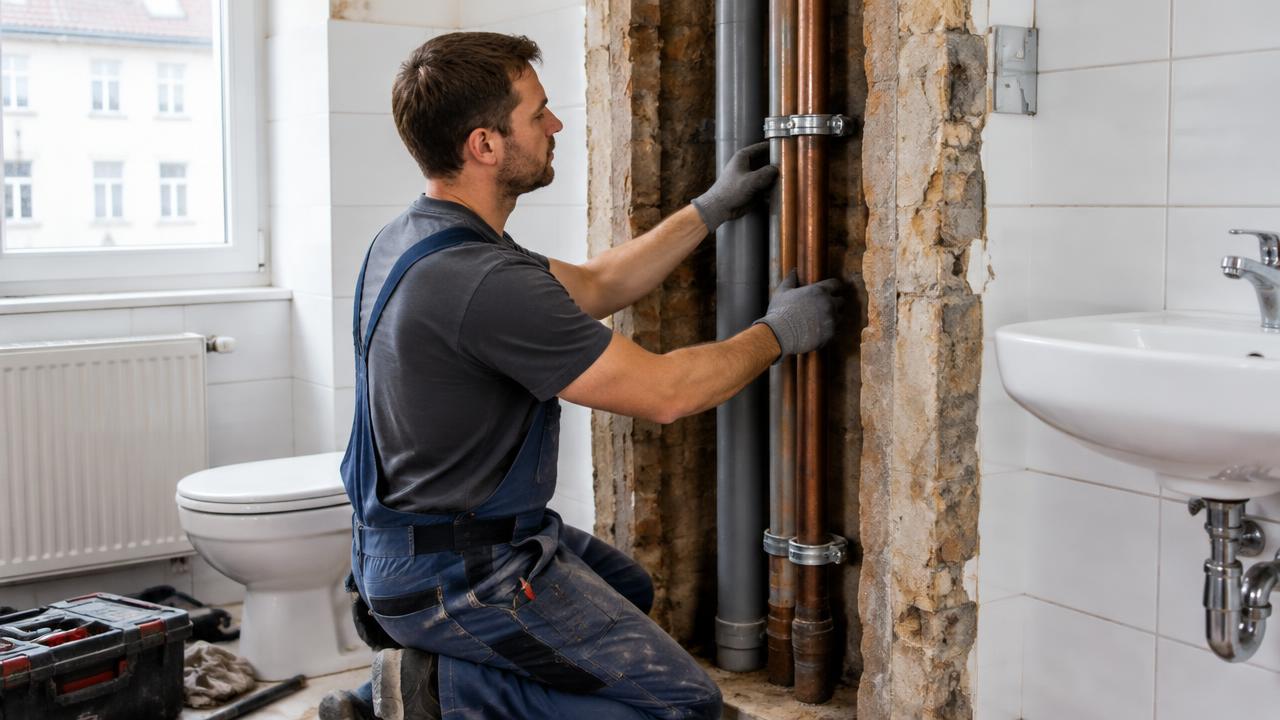
The flat costs €2,710 per square metre, significantly less than the newly refurbished ones in the building next door. It's tenanted, the Hausgeld (homeowners' association fee) is low, and the stairwell looks well-maintained. The minutes of the last meeting contain a sentence that is easy to overlook: "The replacement of the building's utility risers is postponed until the following year."
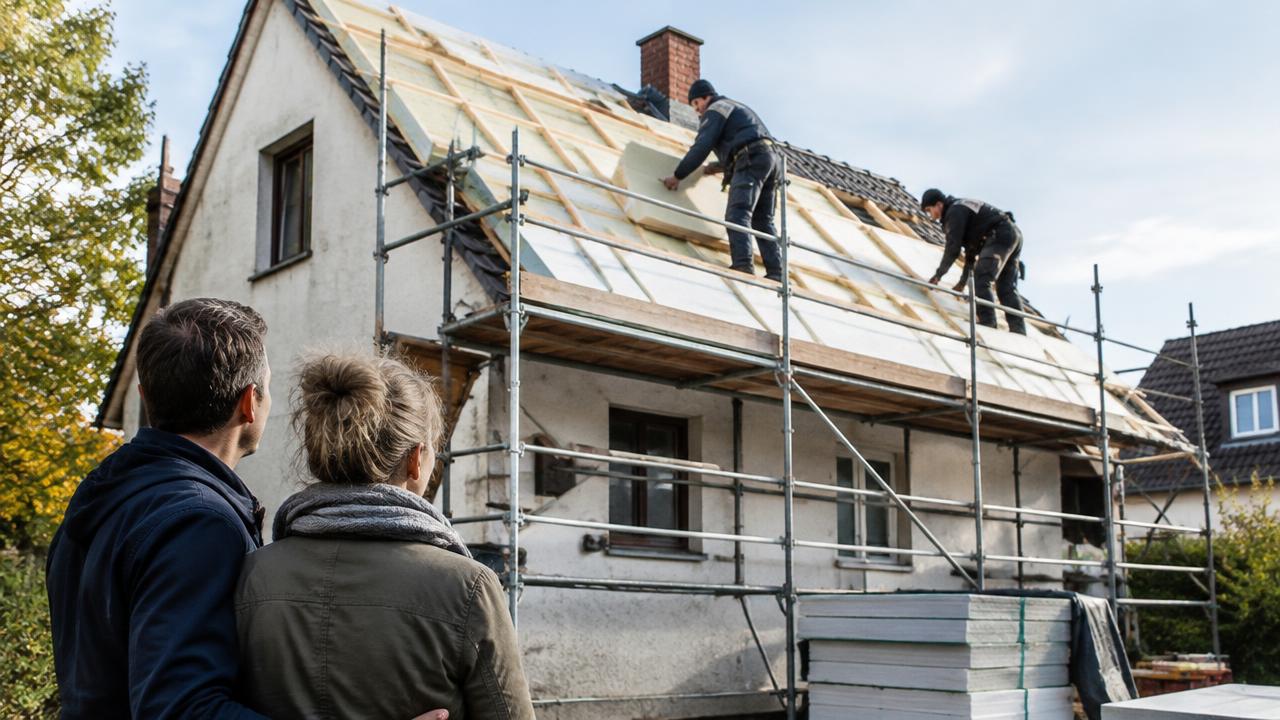
This is a maintenance backlog. In a flat, it's rarely found within the flat itself. It's in the roof, the pipework, the façade – in parts of the building that belong to all the owners. Nevertheless, it's paid for by each individual owner, often just a few years after purchase.
„I want a normal flat that I can rent out.“
We often hear this sentence from clients looking for a classic existing property. A second-hand flat is a good choice if you know what work is pending in the building. This guide shows you how to find that out before you buy and translate it into euros.
01What a maintenance backlog means for a flat
Every component of a building has a lifespan. A building where the major components are replaced sequentially and on time has consistent costs. A building where the owners' association postpones work year after year accumulates bills that all become due at once.
This is tricky for buyers for two reasons. First, you won't see most of the damage during a viewing because it is hidden in shafts, on the roof, or in the façade. Second, as the new owner, you will have to pay any special levy that becomes due after the transfer of ownership. By then, the seller will already have their money.
A maintenance backlog isn't a reason not to buy a flat. It's a reason to calculate the price differently.
02Warning signs and typical lifespans
The table shows the components that most frequently trigger refurbishments in blocks of flats. The lifespans are average values from the Federal Institute for Research on Building, Urban Affairs and Spatial Development's table for life cycle analyses, as at 2017. This table provides no values for heating systems and pipework.
| Component | Warning sign in the building or documents | Average lifespan |
|---|---|---|
| Flat roof with bitumen sealing | Damp patches under the roof, repeated repairs in the minutes | 20–30 years |
| Tiled roof | Slipped tiles, moss, leaking joints | 50 years and more |
| uPVC windows | Misted panes, leaky seals, built before 1990 | 40 years |
| Façade with insulation and render | Cracks, algae, flaking render | Insulation 40, render 30 years |
| Utility risers | Brown water, burst pipes, moisture in shafts, original pipes from the construction period | Table provides no value |
| Heating system | Frequent breakdowns, boiler well over 20 years old, missing maintenance records | Table provides no value |
A single warning sign means little. Several together, combined with a construction year from the 1950s to the 1970s and minutes showing postponed items, form a clear pattern. What it costs to replace utility risers is covered in our guide Replacing utility risers.

03Which documents you need before buying
The most important clues are not in the property particulars, but in the owners' association documents. As an owner, the seller has access to all of them. Request the complete set before you arrange an appointment with the notary.
- 01
Teilungserklärung(declaration of division) andGemeinschaftsordnung(community regulations)These show what belongs to the common property and how costs are allocated. See Declaration of division.
- 02Minutes from the last three years
They show what was resolved, postponed, or rejected. Our guide on how to check the minutes of owners' meetings explains how to read them.
- 03
Beschluss-Sammlung(collection of resolutions)The management must keep a collection of all resolutions and court decisions made by the owners' association (§ 24 paras. 7 and 8 WEG - German Condominium Act). See Collection of resolutions.
- 04
Wirtschaftsplan(economic plan)This shows the current
Hausgeldand the portion that flows into the reserve (§ 28 para. 1 WEG). See Economic plan. - 05Annual statement and
Vermögensbericht(assets report)The assets report states the balance of the
Erhaltungsrücklage(maintenance reserve) and significant assets of the association (§ 28 paras. 2 and 4 WEG). - 06Energy performance certificate
This must be presented at the viewing at the latest (§ 80 GModG) and shows the building's energy demand and the heating system's year of construction. Our guide on the refurbishment obligation after purchase explains what energy-related obligations remain.
- 07Expert reports and quotes
If there is an expert report on the roof, pipework, or façade, ask for it. It often already contains cost estimates.
If you do not receive some of these documents, that in itself is a piece of information. With the seller's consent, you can also enquire directly with the property management.
04"Is the maintenance reserve full? Who pays for refurbishments?"
Clients regularly ask this question in our consultations. It is the most important question when buying a second-hand flat.
Payment is first made from the community's Instandhaltungsrücklage (maintenance reserve). If it's not enough, the owners' association passes a resolution for a Sonderumlage (special levy). It allocates the costs according to co-ownership shares, unless it resolves otherwise (§ 16 para. 2 WEG). Whether a reserve is "full" can only be assessed in relation to the upcoming measures.
Here's how to proceed. Divide the reserve by the building's total living area. Compare this with what is planned for the next few years. The flat rate from the II. Berechnungsverordnung (Second Calculation Ordinance) serves as a rough guide for the annual requirement: for 2026, for flats 32 years or older, this is €18.62 per m² per year, part of which applies to the flat itself. Read more in our guide to property maintenance costs.
„A reserve of just 1,000 euros, 1,500 euros… An electrician comes and changes a socket, and it's gone.“
This was a client's comment on a low reserve during a consultation, and he was right. A reserve of a few hundred euros per flat is enough for minor repairs, not for a roof. Therefore, don't calculate with the reserve per flat, but with the shortfall for the upcoming measures.
05Example calculation: a flat with a maintenance backlog
Jonas is 41, single, and has a taxable income of €72,000. He is buying a tenanted 62 m² flat in North Rhine-Westphalia, in a 1966 building with 16 flats and 1,000 m² of living space. Purchase price €168,000, net rent €607.60 per month. He is paying the 8.5% ancillary purchase costs from savings; the purchase price is financed by the bank, subject to creditworthiness. The name is fictional; the figures are a sample calculation and not a forecast.
In the minutes, Jonas finds two postponed items. The utility risers are original; an expert report estimates the refurbishment cost at €160,000. The flat roof from 1996 is 30 years old; a company estimates the cost at €90,000. According to the assets report, the reserve amounts to €48,000.
| Community | Jonas (62/1,000) | |
|---|---|---|
| Utility riser replacement (estimate) | €160,000 | €9,920 |
| Flat roof (estimate) | €90,000 | €5,580 |
| Existing reserve | -€48,000 | -€2,976 |
| Shortfall, probable special levy | €202,000 | €12,524 |
So, Jonas must expect to pay around €12,500 in the next few years, in addition to the purchase price. What does this mean for his monthly finances? First, the calculation without the special levy, before tax.
For the calculation, we assume an interest rate of 3.8% with 2% principal repayment. In mid-October 2026, the best offers for a ten-year fixed-interest period are more in the range of 4.0% to 4.2% (Dr. Klein, nominal interest rate 4.06% on 7 October 2026). With the market interest rate, the instalment would be correspondingly higher.
| Without special levy | Saving for levy over 24 months | |
|---|---|---|
| Net rent | +€608 | +€608 |
Hausgeld, non-apportionable (of which €45 is for the reserve) | -€95 | -€95 |
| Instalment €168,000 (3.8% interest, 2% principal repayment) | -€812 | -€812 |
| Savings rate for the special levy | – | -€522 |
| Pre-tax cash flow | -€299 | -€821 |
| Tax savings (Income Tax 2026, year 1) | +€83 | +€83 |
| Post-tax cash flow | -€216 | -€738 |
EStG (German Income Tax Act) 2026, single, without solidarity surcharge (not applicable) and church tax. Own calculation, as at 16 October 2026.Without the special levy, Jonas adds €299 per month out of his own pocket in the first year; €216 after tax. At the same time, he repays €3,419 of the principal in the first year, around €285 per month. If he has to save for the special levy over two years, the pre-tax burden increases to €821 per month. That is almost three times as much.
Where do the tax savings come from? The rental income of €7,291 is offset in the first year by €6,325 in interest, €2,734 in depreciation, and €600 in deductible Hausgeld costs. The reserve portion of the Hausgeld does not yet count; it only becomes deductible when the owners' association spends the money (BFH, ruling of 14 January 2025, IX R 19/24). This leaves a tax loss of €2,368, which saves Jonas €995 in income tax for the year.
06Negotiate the purchase price instead of taking on the risk
A known shortfall is a negotiating position. The seller has paid a low Hausgeld for years, and the bill for that is arriving after the sale. It is fair to reflect this in the price.
| Variant A: List price | Variant B: €12,000 discount | |
|---|---|---|
| Purchase price | €168,000 | €156,000 |
| Ancillary purchase costs 8.5% | €14,280 | €13,260 |
| Instalment (3.8% interest, 2% principal repayment) | €812 | €754 |
| Pre-tax cash flow without levy | -€299 | -€241 |
| Probable special levy | €12,524 | €12,524 |
With the discount, the instalment and ancillary costs decrease, but the special levy remains. In economic terms, however, Jonas will have received it upfront in the price. Whether a seller agrees depends on the market. In any case, with the minutes and an expert report in hand, the request is well-founded.
07The 15% threshold: when a special levy and renovations coincide
Jonas is considering renovating the old bathroom for €12,000 immediately after the purchase. That way, tenants and tradespeople are in the building anyway. From a tax perspective, this could be expensive.
If, in the first three years after purchase, you spend more than 15% of the building's acquisition costs (excluding VAT) on repairs, all these costs are treated as production costs (Herstellungskosten) (§ 6 para. 1 no. 1a EStG). They are then only depreciated at 2% per year (§ 7 para. 4 EStG). As a rule, your share of the owners' association's measures is also included in this limit.
| Amount | |
|---|---|
| Acquisition costs of the building (75% of €182,280) | €136,710 |
| Threshold 15% | €20,507 |
| Special levy net (Jonas's share excl. VAT) | €10,524 |
| Bathroom net (€12,000 gross) | €10,084 |
| Sum in three years | €20,608 |
If both fall within the first three years, the threshold is just barely exceeded. Instead of tax savings of around €9,238 from an immediate deduction, Jonas only gets around €205 per year via depreciation. If he postpones the bathroom renovation to the fourth year, the special levy remains below the threshold and alone saves around €4,978 in taxes in the year of payment. The glossary entry on acquisition-related production costs explains the rule in detail. Plan the timing with your tax advisor.
08Risks and limitations
Unknown damage. Even the most thorough check of the documents won't uncover everything. Expert reports are estimates, not fixed sums. Plan for a buffer of 10% to 20% on every estimate.
The owners' association decides. The majority decides if and when refurbishments are carried out. If they continue to postpone, the damage will increase. If they decide quickly, your levy will be due sooner than you planned.
Rentability. During the replacement of utility risers or a roof refurbishment, the tenant may reduce the rent. A building with a visible need for refurbishment is harder to re-let when a tenant moves out.
Interest rates and follow-on financing. In the example, the assumed interest rate is lower than the market rate in October 2026. If the interest rate rises when it's time for follow-on financing, the cash flow will worsen further. You should budget for a higher interest rate later on.
A cluster of costs. If a special levy, your own renovation, and a change of tenant all fall in the same year, you will be hit three times over. For an older flat, you should keep a reserve of several monthly instalments.
- You know the shortfall and have factored it into the purchase price
- You have savings for the special levy or can save for it from your current income
- You want to hold the flat long-term and can accept a few years of negative cash flow
- You need a positive cash flow every month
- The owners' association documents are incomplete or you cannot get them
- You are planning a major renovation of your own right after the purchase without having checked the 15% threshold
FAQFrequently asked questions
What is a renovation backlog?
A renovation backlog (Sanierungsstau) means that necessary maintenance on a building has been postponed for a long time. The costs then arise all at once, often together with consequential damage, for example from damp.
How do I recognise a renovation backlog in a freehold flat?
Primarily in the documents from the owners' association. Postponed works in the minutes of meetings, a low maintenance reserve fund in the asset report, and surveys on the roof or pipework are the clearest signs. During a viewing, look for damp, cracks, and the age of the windows and heating system.
As a buyer, do I have to pay for renovations that were approved before my purchase?
In relation to the owners' association, whoever is the owner when the payment is due is liable. If an approved special levy (Sonderumlage) becomes due after the transfer of ownership, you will have to pay it. You can agree with the seller in the purchase agreement that they will cover this cost.
How large should the maintenance reserve fund be?
The law does not specify a figure. The crucial factor is whether the Instandhaltungsrücklage (maintenance reserve fund) is sufficient to cover the work planned for the next few years. The flat rates specified in the Second Calculation Ordinance (II. Berechnungsverordnung) can be used as a guide for the annual requirement; for 2026, this is €11.50 to €18.62 per m², depending on the building's age.
Is a flat with a renovation backlog a worthwhile investment property?
That depends on the price. If the shortfall is known, is reflected in the purchase price, and you can afford the special levy, it can be a suitable investment. Without these figures, you are buying a risk of an unknown size.
Can I deduct a special levy for tax purposes?
For a rented property, usually yes, as maintenance expenses in the year the owners' association spends the money. In the first three years after the purchase, the 15% limit for acquisition-related expenses (anschaffungsnahe Aufwendungen) applies.
Do I need a surveyor for a second-hand flat?
For the common parts of the building, an existing survey from the property management company is often sufficient. Hiring your own building expert (Bausachverständiger) is worthwhile for older buildings with unclear documentation. You can find out what this costs in our guide on the cost of a valuation report.
09Further reading
- How to check the minutes of owners' meetings
- Replacing utility risers
- Property maintenance costs
- Refurbishment obligation after purchase
- Checklist for viewing a flat
- Buying a tenanted flat
- Glossary: Special levy
- Calculator: Property cash flow
10Sources
All sources accessed on 16 October 2026.
- § 16 WEG, § 24 WEG, § 28 WEG
- § 6 EStG, § 7 EStG, § 32a EStG
- § 80 GModG (Energy performance certificate)
- BFH, ruling of 14 January 2025, IX R 19/24, bundesfinanzhof.de
- BBSR, Service lives of building components for life cycle analyses according to BNB, as at 24 February 2017, nachhaltigesbauen.de
- Haus + Grund München, press release of 5 December 2025 (Flat rates II. BV 2026)
- Dr. Klein, interest rate quote from 7 October 2026, drklein.de
- Example calculation: own calculation, as at 16 October 2026
Disclaimer: This guide is for general information purposes and does not constitute legal, tax, or financing advice for individual cases. Whether a bank provides financing and on what terms depends on your creditworthiness. All figures are sample calculations with disclosed assumptions, as at 16 October 2026.
Writes about Taxes, AfA (depreciation), Existing properties and Portfolio building.
Since 2020, Eduard has bought seven properties of his own and supported more than 150 clients. He writes about tax levers, property documents and portfolio building – with honest numbers instead of rosy projections.
This guide does not replace tax or legal advice. All figures are example calculations with disclosed assumptions.