Two-Unit House Investment: Costs and Risks
How to assess two rental apartments, financing, reserves and the property checks that matter before buying.
 Andriy Bezborodko
Managing Director of the InvestImmo Group
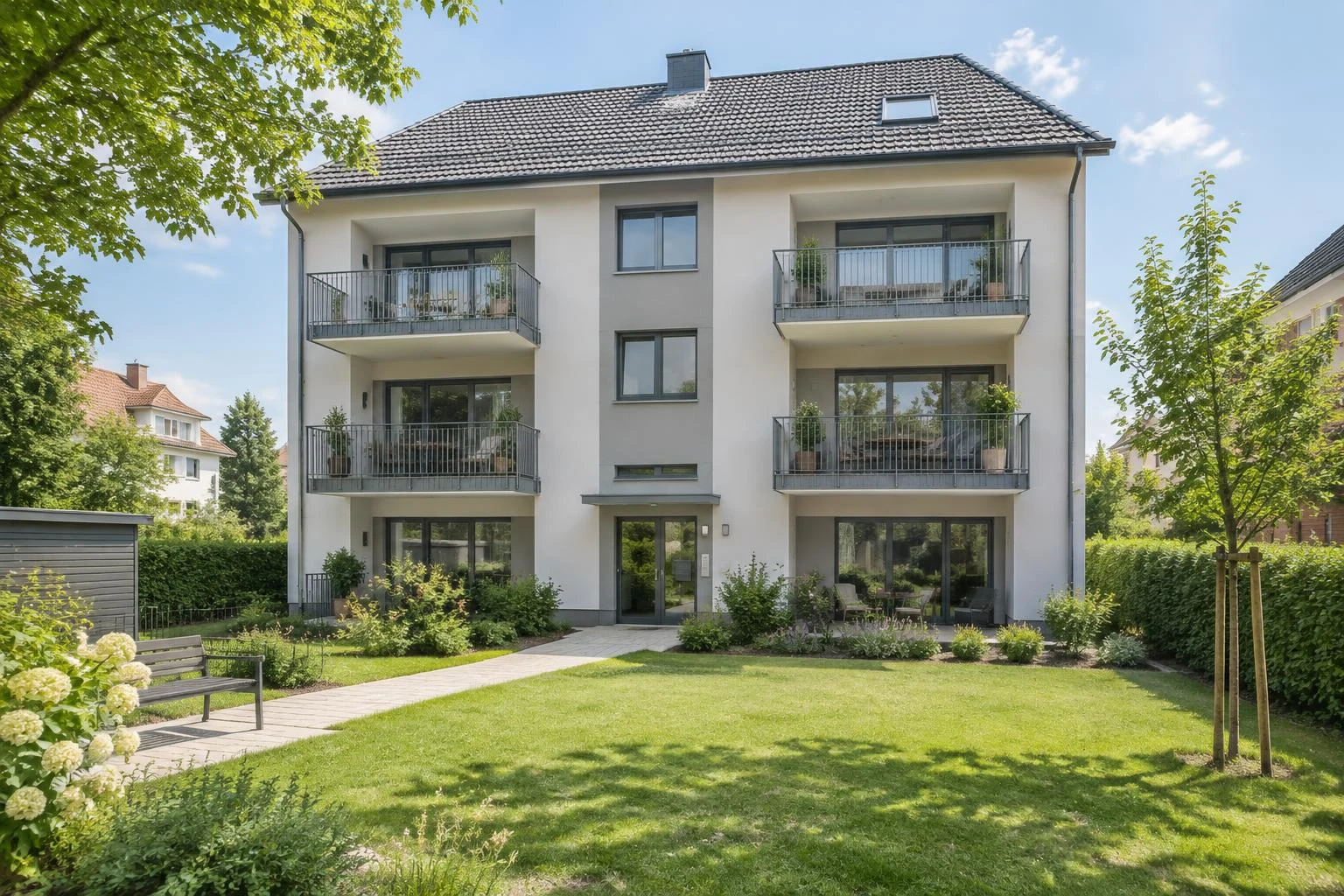
A Zweifamilienhaus combines two rental apartments with responsibility for an entire building. In this guide, the buyer acquires the whole property without a division into Wohnungseigentum and rents out both apartments. You control decisions about the building, but you also bear its costs alone.
The central question is not simply how much rent comes in. Acquisition costs, financing, maintenance, tax treatment and the ability to absorb a tenant change matter just as much. Potential future owner-occupation should not be confused with immediate availability.
01What defines a two-unit investment house
For purchase due diligence, establish whether the property actually contains two independently usable apartments with the necessary building approval. Check the building records, approved use, Grundbuch—the German land register—and any Teilungserklärung, the document establishing a division into separate ownership. Do not rely solely on the estate agent’s description.
The following comparison describes the ownership models considered here, rather than statistical market conditions:
| Criterion | Individually owned apartment | Two-unit house under sole ownership | Apartment building under sole ownership |
|---|---|---|---|
| Rental units compared | one | two | several |
| Responsibility for building costs | review shared and individual costs | entirely with the owner | entirely with the owner |
| Potential buyer groups | investors or owner-occupiers | investors or households needing two apartments | investigate demand from income-focused buyers |
| Valuation question | comparability and tenancy | suitability for owner-occupation and income | sustainable income and building condition |
| Land allocation | property-specific | property-specific | property-specific |
For certain houses suitable for owner-occupation, § 4(2) BelWertV permits a lending valuation based on Sachwert or Vergleichswert: respectively, an asset-based valuation or comparable sales. This does not automatically mean a higher lending value or a smaller equity requirement.
Treat a potential range of buyers as an additional resale option, not a price guarantee. A family-friendly layout may be relevant to your marketing strategy. Whether there is sufficient local demand needs to be tested against reliable comparable evidence.
02Worked example: a fully rented two-unit house
Illustrative assumptions, not an offer or forecast: The example concerns a fully rented house built in the 1970s in Lower Saxony. Each apartment measures 85 m², with assumed monthly Kaltmiete of €9 per square metre. Kaltmiete means rent excluding service charges and heating costs. Together, the apartments generate €1,530 a month or €18,360 annually. The purchase price is 21.24 times annual rent, giving a gross rental yield of 4.71% on the price before all costs.
The published Grunderwerbsteuer rate for Lower Saxony is 5%. The other acquisition costs below are expressly modelling assumptions, not binding fee or commission quotations.
Illustrative acquisition and financing calculation:
| Item | Amount |
|---|---|
| Purchase price | €390,000 |
| Grunderwerbsteuer, 5% | €19,500 |
| Notary and Grundbuch costs, assumed at 1.5% | €5,850 |
| Buyer’s agent commission, assumed at 3.57% including VAT | €13,923 |
| Total acquisition expenditure | €429,273 |
| Equity: acquisition costs plus 20% of the price | €117,273 |
| Loan | €312,000 |
Additional financing costs, immediate renovation work and a separate liquidity reserve are not included in this total. Include these items in your own budget before committing to a purchase.
The first full year before tax
Illustrative assumptions: 3.8% contractual interest, 1.5% initial principal repayment and a ten-year fixed-rate period. For transparency, the model assumes annual interest and principal payments at year-end. This produces €11,856 in interest and €4,680 in principal repayment. Monthly annuity payments would change that allocation during the first year; the bank’s repayment schedule would then be decisive. The assumed rate is not a current mortgage offer.
| Item | Annual amount | Monthly average |
|---|---|---|
| Kaltmiete | €18,360 | €1,530 |
| Management, assumed at €30.19 per apartment per month | −€725 | −€60 |
| Maintenance budget, assumed at €14 per m² | −€2,380 | −€198 |
| Additional rental-loss buffer, assumed at 2% | −€367 | −€31 |
| Balance before financing | €14,888 | €1,241 |
| Interest | −€11,856 | −€988 |
| Principal repayment | −€4,680 | −€390 |
| Planning balance before tax | −€1,648 | −€137 |
Calculations use unrounded amounts; the table shows rounded figures. The management charge is solely a modelling input, not a verified industry average.
This planning balance is not the same as the actual bank-account movement. Money earmarked as a buffer has not yet been spent on a third party. Without the rental-loss reserve allocation, the balance would be correspondingly higher. Other owner-paid costs that cannot be passed on to tenants are not included because no property-specific information is available; any such costs would worsen the result.
Illustrative self-management variant: Removing the assumed management charge improves the planning balance to approximately −€923 annually, or −€77 a month. The owner’s time is not priced. Principal repayment reduces the debt by €4,680 in the annual model; it is neither capital appreciation nor a guaranteed total return.
What changes after tax?
Rental-related loan interest and qualifying running expenses may be deductible as Werbungskosten. Principal repayment, simply setting money aside and a general rental-loss buffer are not equivalent current deductions. Building work requires particular attention: expenditure may be immediately deductible Erhaltungsaufwand or may have to be capitalised instead.
For the assumed residential building completed in the 1970s, the standard straight-line building deduction under § 7(4) EStG is generally 2% annually. Land does not qualify for this building depreciation. The allocation between building and land must be supportable; selecting a convenient percentage is not sufficient for a tax return.
Illustrative tax calculation: Assume that 65% of the acquisition costs used here is an accepted building allocation. Annual Absetzung für Abnutzung, or AfA—the German depreciation deduction—is therefore €429,273 × 65% × 2% = €5,580.55. Also assume that the €2,380 maintenance budget is actually spent during the same year and qualifies in full for immediate deduction. Merely reserving that money would not produce the deduction.
| Item | Illustrative annual amount |
|---|---|
| Rent actually received | €18,360.00 |
| Deductible management costs | −€724.56 |
| Maintenance actually paid and immediately deductible | −€2,380.00 |
| Loan interest | −€11,856.00 |
| Building AfA | −€5,580.55 |
| Taxable rental result | −€2,181.11 |
| Assumed tax reduction at a constant 42% | +€916.07 |
| Planning balance after assumed tax reduction | −€731.69 |
That is approximately −€61 a month. The 42% rate is a simplifying assumption, not an individual tax-tariff calculation. Solidaritätszuschlag and Kirchensteuer are excluded. Loss offsetting, personal income, acceptance of deductions and the timing of relief need individual assessment. A tax reduction is not automatically available each month to help pay the mortgage.

03Vacancy removes a substantial share of rent
Illustrative comparison: With equal rents, one empty apartment out of two removes 50% of rental income. One out of six removes approximately 16.7%. The proportional loss in the first case is three times as large, not twice as large. Where rents differ, use the apartment’s actual contribution to income.
Illustrative stress scenarios based on the assumptions above:
| Scenario | Annual planning balance before tax |
|---|---|
| Base case | −€1,648 |
| Self-managed | −€923 |
| One apartment empty for six months | −€6,238 |
| Initial interest of 4.2% instead of 3.8%, initial repayment still 1.5% | −€2,896 |
In the vacancy scenario, missing rent is 6 × €765 = €4,590. The general risk buffer is deliberately retained on top of this: it is a conservative stress test, not a forecast of an actual annual statement. Additional refurbishment costs and operating costs borne by the owner while the apartment is empty are not yet included.
Half a year’s rent would be €9,180 in this model. At most, use that amount as a starting point for reserve planning, not as a universally adequate minimum. The mortgage payment, building condition, planned work and your other available funds are more important than a single rule of thumb.
04What to address after purchase
Check energy-related retrofit obligations. The retrieved legislation is titled Gebäudemodernisierungsgesetz, or GModG. Its § 35 addresses insulation of the uppermost floor ceiling; an appropriately insulated roof may already satisfy the requirement. For qualifying buildings with no more than two apartments, one of which the owner occupied on 1 February 2002, the deadline is two years after the first ownership transfer after that date. A later resale does not restart the deadline.
Accessible, previously uninsulated heating-distribution and hot-water pipes outside heated rooms require separate assessment under § 69 GModG. The special two-year deadline there also refers to the first qualifying ownership transfer.
Organise management. Whether to self-manage depends on your time, knowledge and availability. Plan for tenancy administration, payment monitoring, repair coordination and the Betriebskostenabrechnung, the German service-charge statement. Obtain property-specific quotations for external rental management instead of relying on an allegedly universal average fee.
No simplified termination right for an off-site investor. § 573a BGB generally requires a building with no more than two apartments in which the landlord also lives. When applicable, the notice period increases by three months. An owner renting out the entire house cannot rely on this provision; ordinary landlord termination generally requires a berechtigtes Interesse—a legitimate interest—under § 573 BGB. Tenants’ hardship objections must also be considered.
05Financing and resale
Subject to its conditions, the BelWertV permits a lending valuation oriented towards Sachwert or Vergleichswert. Any reduction in value attributable to the existing tenancy must be assessed transparently. This provision governs valuation within the regulation’s scope; it is not a general financing commitment by all banks.
Ask about more than the interest rate. Establish the bank’s Beleihungswert, or mortgage lending value, the rental income it recognises, required equity, optional additional repayments and the balance remaining when the fixed-rate period ends. The example’s 20% equity contribution towards the price is a modelling choice, not a universal lending requirement.
For resale, assess investor and owner-occupier scenarios separately. Do not assume a fixed premium for vacant possession or a guaranteed selling period. Selling alone does not justify ordinary termination; § 573 BGB specifically excludes termination solely to create Wohnungseigentum and then sell it.
06Who a two-unit house may suit
- You want to own the entire building and make decisions yourself.
- You can reliably manage it or pay someone to do so.
- You evaluate the property using its actual rents and costs.
- You retain separate liquidity for income losses and major repairs.
- The financing works only with uninterrupted full occupancy.
- You depend on an immediate positive cash surplus.
- The purchase depends on an unconfirmed tax saving.
- No funds remain for necessary renovation after completion.
07Risks of a two-unit investment house
Concentration in a small number of tenancies. Test whether you could withstand a prolonged loss of income from the larger apartment. In the equal-rent model, each apartment contributes half the income.
Building costs without other owners to share them. Arrange inspections of the roof, heating, façade and pipes in particular. The annual maintenance allowance in the example is not an assurance that major work can be funded from it.
Purchase-price allocation and tax effects. A larger land allocation leaves less acquisition expenditure eligible for building depreciation. However, that does not establish a universal tax disadvantage compared with every individually owned apartment.
Interest and refinancing risk. The illustrative 4.2% initial-interest scenario increases annual financing expenditure by €1,248. An actual refinancing calculation must instead use the outstanding loan balance at that time and the terms genuinely available.
Resale risk. Allow enough time and financial flexibility for a future sale. An additional potential buyer group does not replace a sound valuation of the particular house.
08Conclusion
A two-unit house can be a manageable rental project, but it remains an entire building with full responsibility for its costs. In the illustrative model, the planning deficit is approximately €137 a month before tax and €61 after the simplified assumed tax reduction. Meanwhile, the annual-payment model reduces the mortgage principal by €4,680.
What matters is not those isolated figures but whether your own budget is resilient: supportable rents, documented building condition, sufficient liquidity and financing that can withstand vacancy. Tax effects and possible later owner-occupation should be assessed separately, not used to rescue an otherwise overstretched purchase.
FAQFrequently asked questions
Is a two-unit house a worthwhile investment?
That depends on the price, actual rents, building condition and financing. In the illustrative €390,000 example, the planning deficit is approximately €137 a month before tax and €61 under simplified tax assumptions. These figures are not a return forecast.
How much equity do I need?
The illustrative example uses €117,273: €39,273 in acquisition costs and €78,000 towards the price. A separate liquidity reserve and immediate renovation work are excluded. Your actual requirement also depends on the lender’s valuation and your credit profile.
Must both apartments be the same size?
No. Independent usability and approved residential use matter more than identical floor areas. A listing describing one unit as an Einliegerwohnung does not replace a check of the approved use.
Does owning a two-unit house make termination easier?
§ 573a BGB generally requires the landlord to live in the building, which must have no more than two apartments. The notice period then increases by three months. This exception does not apply to the fully rented house considered here, and hardship objections may remain relevant.
Must I add insulation after buying?
The property requires individual assessment. § 35 GModG addresses the uppermost floor ceiling and recognises sufficient roof insulation as an alternative. The special two-year deadline starts with the first qualifying ownership transfer after 1 February 2002, not each resale. The economic exception in subsection 4 requires owner-occupation among its conditions.
Do I need a property manager?
Under the sole-ownership model considered here, you can organise management yourself or appoint a rental manager. Time, expertise and availability should guide the decision. The example’s €30.19 per apartment per month is only a calculation assumption, not a verified market price.
09Further reading
- An apartment as an investment: advantages and disadvantages
- Preparing a Betriebskostenabrechnung
- Eigenbedarfskündigung
- Renovation obligations after purchase
- Rent out or sell a house
- Property cash-flow calculator
10Sources
Sources checked and calculations prepared as of 28 October 2026.
- § 35 GModG: retrofitting and § 69 GModG: pipe insulation.
- BelWertV, particularly §§ 1 and 4.
- § 573 BGB, § 573a BGB and § 574 BGB.
- § 7 EStG, § 9 EStG and § 6 EStG.
- Brandenburg tax administration: Grunderwerbsteuer rates by state.
- Original illustrative calculations using the assumptions disclosed in the text; not a market forecast.
This guide provides general information and does not replace individual tax, legal or investment advice. Tax outcomes, financing and retrofit obligations depend on the circumstances.
Writes about Taxes, AfA (depreciation), Financing and Investment concept.
Andriy is Managing Director of the InvestImmo Group and has been an entrepreneur in the property industry since 2020. His experience in estate agency, property marketing and his own investments shapes his view on property selection and long-term investment concepts. His team handles the personal advice for investors.
This guide does not replace tax or legal advice. All figures are example calculations with disclosed assumptions.