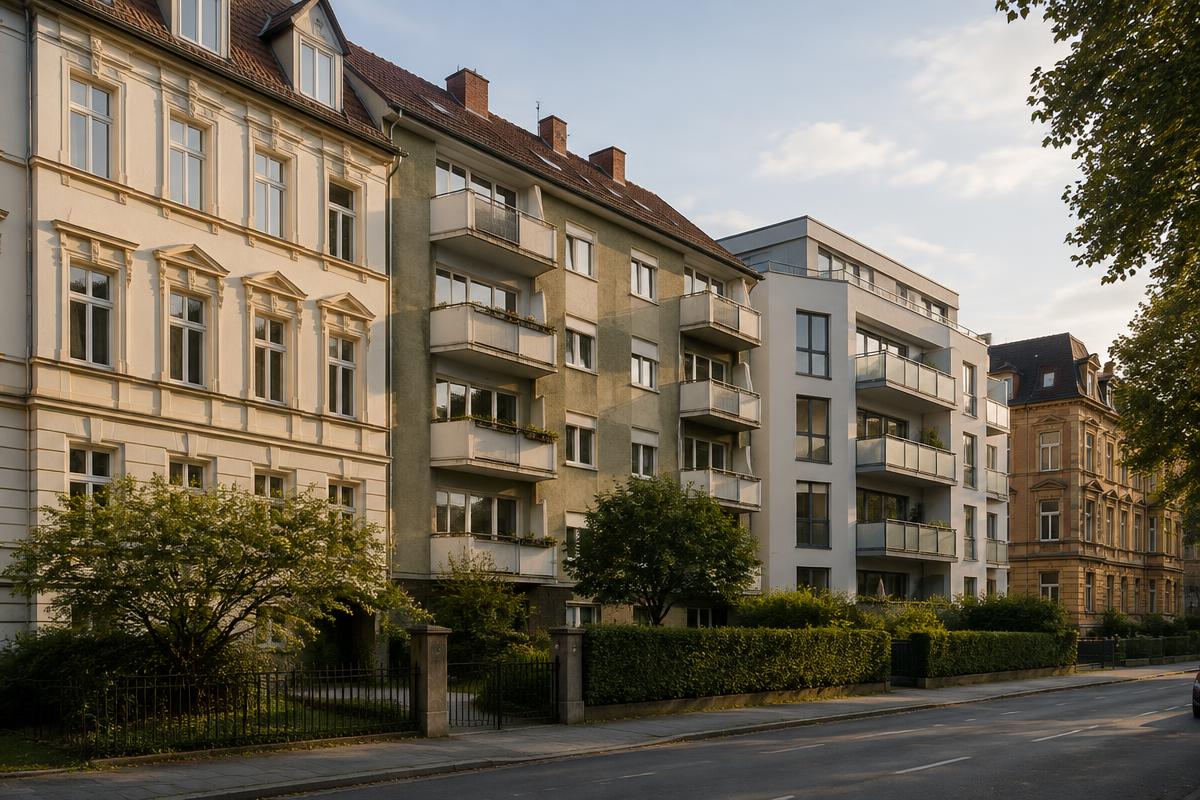
Property exit strategies: retain, sell or transfer
Buying flats also calls for planning an eventual exit. We compare four routes for three rental flats before retirement, with simplified illustrative figures before and after income tax and the key deadlines.
 Nadeem Shahid
Investment Advisor at InvestImmo
Over the years, you have bought two, three or four flats. Rent is coming in and the loans are getting smaller. Eventually, a question arises: how do I get out of this investment? And do I actually want to?
An exit need not mean a sale. It could mean paying off the loans and using the rent to supplement your pension. Or passing the flats on to your children. The right route depends on your objectives and the finances of your portfolio.
01Why the exit belongs in the purchase plan
When buying a flat, the initial focus is on the purchase price, financing and rent. What happens after 15 or 25 years can remain unresolved. Yet the exit also helps determine the investment's eventual return.
„Who will buy it from me after ten years?“
A buyer cannot be guaranteed. How readily a flat sells depends on factors including its location, condition, tenancy agreement and the interest-rate environment in the year of sale. That is precisely why you should avoid depending on a particular sale date.
A sound exit strategy therefore has two parts: a plan and a fallback if the market is weak in your intended year.
02Four routes out of a property portfolio
| Route | What happens | Suitable if |
|---|---|---|
| Retain and repay | You keep all the flats and continue repaying the loans until they are mortgage-free. | You have time to clear the debt and want rental income. |
| Sell part of the portfolio | You sell one flat and use the available proceeds to repay the loans. | You want to be debt-free at retirement and the net proceeds are sufficient. |
| Sell everything | You sell the whole portfolio and hold capital instead of receiving rent. | You no longer want to manage the properties or need the money. |
| Transfer ownership | You give or leave the flats to your children. | You want the assets to remain in the family. |
Combinations are also possible: for example, keeping one flat, selling another and giving a third to a child. Selling part of the portfolio here means selling an entire flat, not selling a co-ownership share in an individual property.

03Worked example: three flats at 67
Simplified illustrative calculation. Ingrid is 67 in this example, single and owns three rental flats bought between 2014 and 2018. She is fictional, and the figures are an illustration rather than a forecast. The assumed retirement and sale date falls after the ten-year holding period has expired for every flat, so it is not necessarily in 2026. The German income tax schedule for 2026 provides a consistent calculation basis for all scenarios. This allows the routes to be compared under the same tax assumptions; it does not predict future tax liabilities.
Each flat generates €800 a month in rent excluding service charges [Kaltmiete]. The model assumes annual costs of €1,900 per flat for management and maintenance actually carried out and eligible for immediate tax deduction. Contributions to the maintenance reserve of the owners' association [Wohnungseigentümergemeinschaft, WEG] are not immediately deductible rental expenses. Only amounts actually spent may be recognised for tax purposes, depending on the work involved; the entire owners' service charge [Hausgeld] is not automatically deductible either. Additional reserve contributions, void periods and special levies are excluded from the example.
An assumed sale price of €250,000 is used for each flat. The outstanding loans total €240,000, and their fixed-rate periods end at the assumed date. Ingrid's pension provides taxable income of €20,000 in the model, before rental income.
For depreciation purposes, each flat is assumed to be in a building completed in 1995. Acquisition costs attributable to the building, including the relevant share of incidental purchase costs, are €148,500 per flat. Straight-line depreciation at 2% therefore amounts to €2,970 per flat each year. The land element is not depreciated. A sufficient remaining depreciation period is assumed at every comparison point, including the mortgage-free scenario from age 82.
Route A: retain the flats. Ingrid refinances the €240,000 at an assumed nominal annual interest rate of 4.0%, with full repayment over 15 years. Assuming monthly payments, monthly interest at one-twelfth of the annual rate and no additional financing costs, the payment is approximately €1,775 a month. The annual calculation uses the unrounded monthly payment. In the first year, approximately €9,383 goes towards interest and €11,920 towards principal repayment. Only the interest reduces taxable rental income as a deductible expense; principal repayments do not.
Route B: sell one flat. She sells one flat for €250,000. After an assumed seller's share of estate agency fees of 3.57%, €241,075 remains. This is sufficient to repay €240,000 of outstanding debt, leaving a one-off balance of €1,075 before other selling costs. Whether that remaining cash is sufficient depends particularly on any costs of releasing security and other seller's costs. If further selling costs exceed this €1,075, Ingrid needs additional liquid funds to become fully debt-free. The model assumes that all loans can be repaid at the end of their fixed-rate periods without an early repayment charge, subject to contractual and statutory requirements, and that the necessary release of security is possible. It also assumes that the ten-year holding period has expired and that the sale does not constitute commercial property trading.
Route C: sell everything. She sells all three flats and repays the loans. The same assumptions about selling costs, loan repayment and tax treatment apply.
| A: retain | B: sell one | C: sell everything | |
|---|---|---|---|
| Rent after costs | €23,100 | €15,400 | €0 |
| Loan payments | −€21,303 | €0 | €0 |
| Cash flow before tax | +€1,797 | +€15,400 | €0 |
| Additional income tax attributable to letting | −€1,229 | −€2,495 | €0 |
| Annual surplus after income tax | +€568 | +€12,905 | €0 |
| Monthly surplus after income tax | +€47 | +€1,075 | €0 |
| Capital after sale and loan repayment, before other selling costs | – | €1,075 | €483,225 |
Income tax on the €20,000 of other taxable income is €1,570 in the model. Including rental income increases it to €2,799 under route A and €4,065 under route B. The additional tax is therefore €1,229 and €2,495 respectively. Depreciation reduces taxable income but is not a current cash outflow. Principal repayments, by contrast, are a cash outflow without reducing taxable income. Your tax adviser can prepare a calculation for your own circumstances.
The difference between A and B is substantial. When Ingrid retains the flats, almost all the rent goes towards the new loan payments. Repaying principal continues to build equity, but initially leaves little additional cash in retirement. She would only be mortgage-free at 82. Assuming unchanged rent, costs, depreciation and tax treatment, the calculation then leaves her with €19,242 a year, or approximately €1,604 a month after income tax. This is a comparison under consistent modelling assumptions, not a forecast of her income at 82.
Selling one flat means Ingrid gives up a property, but the model leaves her with a monthly surplus of approximately €1,075 after income tax from the first month and no remaining loan debt. That is around €1,028 more than route A. Interest-rate risk on those loans disappears; letting and maintenance risks remain.
Route C provides the most liquid capital, at €483,225 before other selling costs, but no continuing rent. The calculation is €750,000 of sale proceeds less €26,775 of assumed estate agency fees and €240,000 of loan repayments. Returns or taxes from subsequently investing this money are excluded. What Ingrid does with the capital depends on her needs. Selling one flat can offer a middle course: rental income, no loan debt and one fewer property to manage.
04Transferring property to children
If the assets are to stay in the family, a lifetime gift or inheritance may be appropriate. Both fall within German inheritance and gift tax law, although different exemptions and conditions can apply.
- Allowance: Each child has a personal allowance of €400,000 from each parent under section 16(1), no. 2 of the German Inheritance and Gift Tax Act [ErbStG]. The allowance for grandchildren is generally €200,000; a higher allowance may apply, particularly to children of a deceased child. For spouses, the allowance is €500,000.
- Ten-year period: Multiple acquisitions from the same person within ten years are aggregated (§ 14 ErbStG). Earlier acquisitions outside that period are generally no longer included. This is not an automatic reset on fixed calendar dates.
- Discount for rental flats: Qualifying residential rental properties are assessed at 90% of their tax value where the statutory conditions are met (§ 13d ErbStG).
- Family home: The family-home exemptions require, among other conditions, the relevant owner-occupation; they do not apply to investment flats that remain continuously let (§ 13(1), nos. 4a–4c ErbStG).
- Ten-year period for a subsequent sale: For a wholly gratuitous gift, the child generally takes over the parents' acquisition date for the disposal period (§ 23(1), sentence 3 EStG). Where a transfer involves partial consideration, the part transferred for consideration must be assessed separately.
A flat can also be transferred with debt outstanding. Releasing the parent from the loan and substituting the child as borrower generally requires the lender's consent. Debt assumed by the child can constitute consideration for tax purposes, making the transfer partly a sale. This may trigger income tax if the ten-year holding period has not yet expired. Discuss the tax consequences and contractual arrangements with a tax adviser and notary.

05Dates and periods that matter
- 01Purchase contract date
The ten-year period generally depends on the dates of the binding acquisition and disposal contracts. Only after the period has expired is the sale of a privately held rental flat generally outside German income tax (§ 23(1), sentence 1, no. 1 EStG). Ask your tax adviser to determine the exact expiry date. Read more in the guide to the Ten-year holding period.
- 02End of the fixed-rate period
Repayment at this point may be possible without an early repayment charge if the requirements and deadlines are met. Selling the property does not automatically terminate the loan. Earlier repayment can incur costs. Clarify repayment conditions with the lender well in advance; consult a lawyer on legal questions.
- 03Number and timing of sales
Selling more than three properties in close temporal connection with their acquisition, construction or substantial modernisation may indicate commercial property trading. A period of approximately five years is often considered. However, the three-property threshold is neither an automatic classification nor a safe harbour. A long holding period does not remove the need for your tax adviser to assess the individual circumstances. See the glossary entry on the Three-property threshold.
- 04Tenancy type and possible termination dates
Many residential tenancies are open-ended. A vacant flat may also appeal to owner-occupiers and therefore reach a different pool of buyers; a higher price is not guaranteed. A sale alone does not entitle the landlord to terminate a tenancy. A landlord's termination must meet the statutory requirements. Seek advice from a lawyer where needed.
- 05Your retirement date
A change in total taxable income can also change your marginal tax rate. At a lower rate, both the tax on rental income and the tax relief from deductible interest may decrease. Your tax adviser can calculate the effects for your income position.
06When selling may make sense, and when retaining may be better
- The ten-year holding period has expired and repayment at the end of the fixed-rate period is possible.
- You want to be debt-free at retirement and the net proceeds are sufficient.
- Major repairs or a special levy are approaching; their effects on the sale price and the seller's obligations must be considered.
- The flat is mortgage-free and financially sustainable.
- Several years remain before the ten-year holding period expires.
- The local market is currently weak and you do not have to sell.
07Exit risks
The market in the year of sale. A sale price is never certain. Residential property can lose value, and national trends do not reflect every location or individual flat. Someone forced to sell in a weak market may receive less than planned. An actual loss depends on factors including acquisition costs, selling costs and the price achieved.
Interest rates when refinancing. Retaining properties and refinancing exposes you to interest-rate risk. Whether financing is available in retirement, and on what terms, depends on factors including income, affordability, loan term and security. The 4.0% used in the example is a calculation assumption, not a financing offer.
Care needs and liquidity. Care needs in later life can create a need for cash at short notice. A single flat cannot readily be sold in portions, quickly and on predictable terms. A liquid reserve alongside the properties can therefore be important.
Tenants and condition. A problematic tenancy or a maintenance backlog can reduce the price. Keep your flats in good condition even when you intend to sell.
Legislative changes. Income tax, inheritance tax and tenancy law may change before your exit. Involve your tax adviser, and a lawyer for legal questions, when making later adjustments to your plans too.
FAQFrequently asked questions
What is a property exit strategy?
An exit strategy sets out what happens to a property once the investment objective has been reached. For private investors, this could mean retaining it and clearing the debt, selling some or all of a portfolio, or transferring property to children.
When is the best time to sell a rental flat?
There is no universally best time. The expiry of the ten-year holding period and the opportunity to repay a loan at the end of its fixed-rate period can be important planning points. Tax conditions, notice periods and financing costs must also be taken into account. Whether the market will be favourable then cannot be reliably predicted. Discuss the tax consequences with your tax adviser and legal questions with a lawyer.
Do I have to pay tax when selling after ten years?
Selling a privately held flat is generally outside German income tax once the applicable ten-year holding period has expired. Different rules apply to commercial property trading and business assets. The dates of the binding acquisition and disposal contracts are generally decisive. Ask your tax adviser to determine the exact expiry date.
Should I sell my properties in retirement?
That depends on your debt, income needs and willingness to remain a landlord. Mortgage-free flats can provide additional income, but still involve costs and letting risks. Selling one flat from the portfolio can help clear debt if the available net proceeds are sufficient.
Can I transfer a flat with an outstanding loan to my child?
Yes. If your child is to replace you as the borrower, the lender's consent is generally required. Debt assumed by the child can constitute consideration for tax purposes, making the transfer partly a sale. Income tax may arise if the ten-year holding period has not expired. Discuss the arrangement with a tax adviser and notary beforehand.
How often can I use the gift tax allowance?
Each child has a personal allowance of €400,000 from each parent. Multiple acquisitions from the same person within ten years are aggregated. Earlier acquisitions outside that period are generally no longer included; the dates of the individual acquisitions are decisive. Ask your tax adviser for advice on timing.
08Further reading
- Selling a tenanted flat
- The ten-year property holding period
- Leaving or giving property to the next generation
- Property investment from age 50
- Glossary: Life annuity
- Calculator: Early repayment charges
09Sources
- § 23 EStG (ten-year holding period) and § 7 EStG (depreciation)
- § 32a EStG (income tax schedule; the illustrative calculation uses the 2026 schedule)
- § 16 ErbStG (allowances), § 14 ErbStG (ten-year aggregation period), § 13d ErbStG (90% valuation for qualifying rental flats), § 13 ErbStG (family home)
- Federal Ministry of Finance circular dated 26 March 2004, IV A 6 - S 2240 - 46/04, Federal Tax Gazette I 2004, 434 (commercial property trading)
- Illustrative calculations: own calculations using the stated assumptions, the 2026 income tax schedule and refinancing at an assumed nominal annual interest rate of 4.0%.
This guide provides general information and does not replace individual tax, legal or investment advice. The illustrative figures are modelling assumptions or calculation results, not forecasts or promises of returns.
Writes about Investment properties, New builds and renovation and Financing.
Nadeem is a qualified insurance and finance merchant, spent around eight years self-employed in the insurance and finance industry and has specialised in investment property since 2024. He writes about new builds, renovation, financing and the running costs of rented property.
This guide does not replace tax or legal advice. All figures are example calculations with disclosed assumptions.