Property Flipping in Germany: Costs, Tax and Risks
Buy, refurbish and sell after nine months: we work through the costs and risks, showing how €17,678 before tax can become a loss.
 Nadeem Shahid
Investment Advisor at InvestImmo
You may have seen the videos: a run-down flat is bought cheaply, refurbished in eight weeks and sold at a premium. This is property flipping: buying, improving and reselling. The idea is understandable. Work and expertise can create value.
In Germany, however, numerous costs can absorb much of that increase: property transfer tax [Grunderwerbsteuer], notarial fees, potentially estate agency fees on both purchase and sale, interest during refurbishment and tax on any taxable profit. We work through an illustrative flip, including funding requirements, stress scenarios and an explicitly simplified tax illustration.
01What property flipping involves
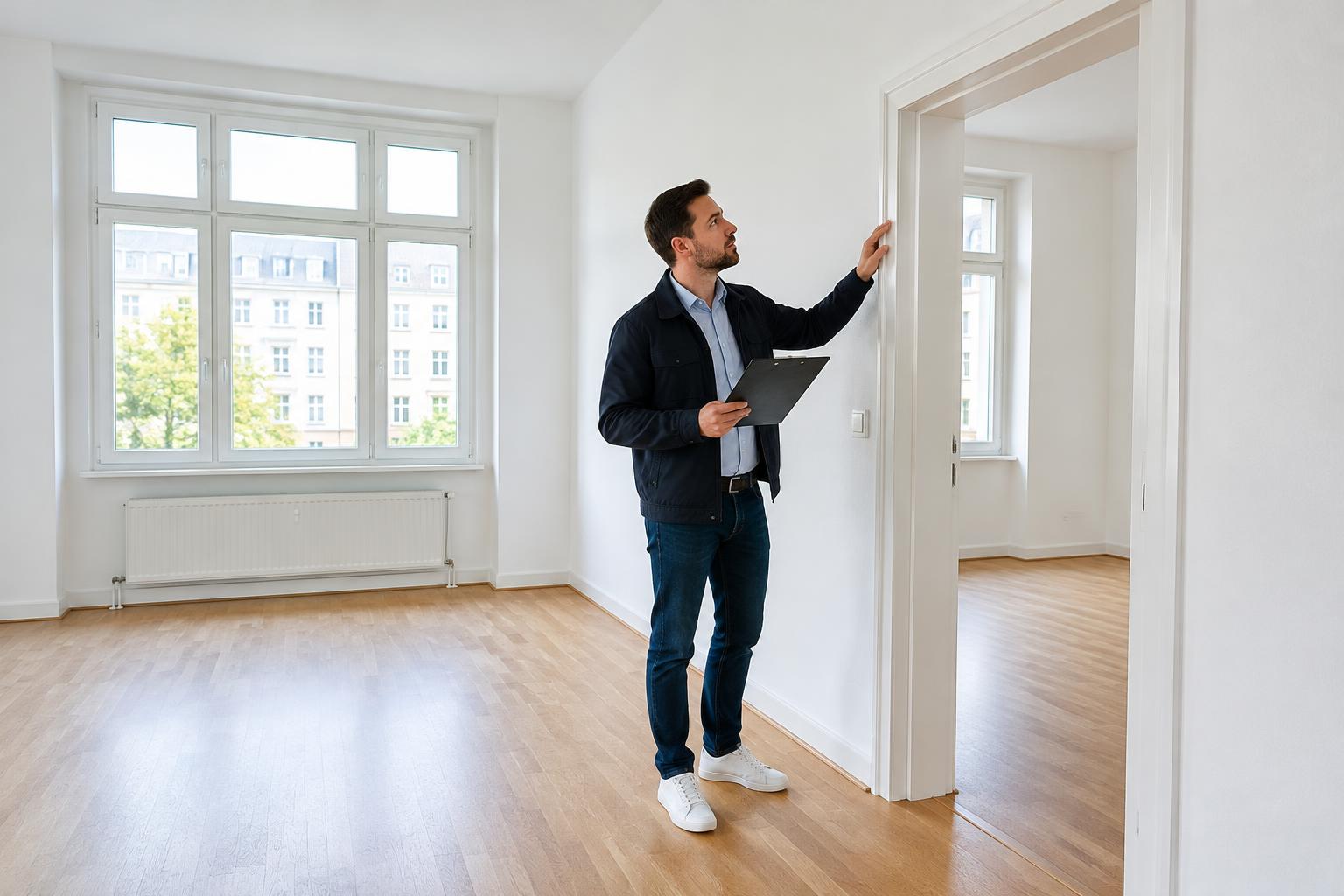
A flip might involve buying a property with an outdated bathroom, old wiring or pipework, an awkward layout or a neglected interior. You address the defects and seek a buyer willing to pay more for the improved flat. Whether the additional proceeds cover the costs must be established through the appraisal. This approach is also known as value-add investing: increasing value through improvements.
The alternative is buy and hold. You buy to let and retain the flat for many years. Returns can come from rental surpluses and changes in value. Mortgage principal repayments reduce debt and increase your equity if the property's value remains unchanged, but are not a separate return. A sale of privately held property after more than ten years generally falls outside section 23 EStG. Discuss the conditions applicable to your circumstances with your tax adviser.
The distinction is fundamental: a flip centres on a single sale. Holding a property spreads income, costs and risks over many years.
02A worked property flip
Sandra buys a three-room flat requiring refurbishment in North Rhine-Westphalia for €200,000. Sandra is fictional, and the figures are an illustration, not a forecast. She budgets €40,000 for the bathroom, flooring, electrical work and decorating. Refurbishment takes six months and the sale takes three months.
In the example, the bank lends 80% of the purchase price and planned refurbishment budget: €192,000 at an assumed annual interest rate of 3.8%. For simplicity, the interest calculation assumes that the entire loan remains outstanding for nine months without principal repayments. This rate is a modelling assumption, not a statement about current lending offers. Additional financing costs, such as commitment fees or a possible early repayment charge, are not included. If incurred, they reduce the result further. The estate agency fees and other cost allowances are also assumptions for this example.
| Amount | |
|---|---|
| Sale price after refurbishment | €300,000 |
| Selling costs: estate agent at 3.57%, plus €300 for an energy performance certificate and other items | −€11,010 |
| Purchase price | −€200,000 |
| North Rhine-Westphalia property transfer tax at 6.5% | −€13,000 |
| Notarial and land registration fees | −€3,000 |
| Estate agent on purchase at 3.57% | −€7,140 |
| Refurbishment | −€40,000 |
| Interest for 9 months on €192,000 at 3.8% annually | −€5,472 |
| Building service charges [Hausgeld], electricity and insurance while vacant | −€2,700 |
| Economic result before tax | €17,678 |
| Assumed tax burden at a flat 40% | −€7,071.20 |
| Result after assumed tax | €10,606.80 |
How to read the tax illustration: The 40% is purely a calculation assumption for the total additional tax burden. Actual tax and the after-tax result depend on factors including other income, tax classification and the treatment of costs, as well as any solidarity surcharge [Solidaritätszuschlag] and church tax. Interest and vacancy costs do not automatically reduce the taxable gain in full. In particular, contributions to the maintenance reserve [Erhaltungsrücklage] of an owners' association [Wohnungseigentümergemeinschaft, WEG] are not immediately tax-deductible. Only actual expenditure that qualifies for tax recognition can become relevant, not the full building service charge automatically. The tax treatment of refurbishment costs also requires separate assessment. Have your tax adviser prepare an individual calculation.
Of the €100,000 price difference, just under 18% remains before tax. Around €34,000 goes towards the assumed purchase-related and selling costs, €40,000 towards refurbishment and around €8,000 towards interest and running costs. Sandra's own working time has not been valued.
How much of her own money is required? Sandra funds €48,000 of the purchase price and refurbishment budget herself. She also pays €23,140 in acquisition costs, €5,472 in interest and €2,700 in vacancy costs. This produces a personal funding requirement of €79,312 before sale, excluding an additional contingency. The full amount is not necessarily payable on day one, so it cannot be described as being tied up for the entire nine months. Selling costs are assumed to be paid from the sale proceeds. Sandra's time spent arranging tradespeople, viewings and coordination is additional.
03If things turn out differently
The base case assumes that the stated prices, costs and timescales are achieved. Refurbishment can become more expensive, and the sale price is an estimate rather than guaranteed proceeds.
„The calculation looks workable if everything goes to plan. What happens if it does not?“
This question belongs in every property appraisal. With a flip, a single sale has a major influence on profit or loss. When holding a property, rental income, costs, financing and changes in value operate over many years instead.
We model the same flat with two changes: a sale price 5% below plan and refurbishment costs 25% above budget. We also consider a sale price 10% below plan. The loan, interest, vacancy costs and project duration remain unchanged in every scenario. Additional refurbishment costs are paid from further personal funds. Selling costs remain 3.57% of the relevant sale price plus €300.
| Scenario | Sale price | Refurbishment | Result before tax | After tax (illustration) |
|---|---|---|---|---|
| Base case | €300,000 | €40,000 | €17,678 | €10,606.80 |
| Sale price 5% lower | €285,000 | €40,000 | €3,213.50 | €1,928.10 |
| Refurbishment 25% more expensive | €300,000 | €50,000 | €7,678 | €4,606.80 |
| Both | €285,000 | €50,000 | −€6,786.50 | −€6,786.50 |
| Refurbishment 25% more expensive, sale price 10% lower | €270,000 | €50,000 | −€21,251 | −€21,251 |
Simplified illustrative calculation: the tax gain or loss is assumed to equal the economic result. Positive results are subject to an assumed total tax burden of 40%. For losses, no tax relief through offsetting against other transactions is assumed.
The after-tax column illustrates the effect of the chosen tax assumption, not Sandra's individual tax liability. The amounts shown for the loss scenarios remain unchanged because the example assumes no other gains available for offsetting. In practice, both the tax result and the effect of any loss relief may differ. Your tax adviser's calculation is decisive.
A sale price 5% below plan combined with €10,000 of additional refurbishment costs produces an economic loss in this example. A tax loss from a private disposal transaction [privates Veräußerungsgeschäft] can generally be offset only against gains from such transactions, not salary income (section 23(3), sentences 7 and 8 EStG). Subject to the statutory conditions, losses may also be carried back to the preceding year or carried forward to later years. Discuss the relief available to you with your tax adviser.
Even without additional building defects, a weaker market can undermine the calculation. What matters is the price a buyer pays for this particular flat at the time of sale. A national annual index is not a forecast for the sale of an individual flat; location, condition and local demand can produce a different outcome. Further discussion appears in the guide to property value growth.
04Tax: the ten-year period and commercial property trading
Selling within ten years
If you sell privately held property within ten years of purchase, the gain may be taxable as a private disposal transaction (section 23(1), sentence 1, no. 1 EStG). A taxable gain is subject to the personal income tax tariff.
Two statutory owner-occupation exemptions are particularly relevant: exclusive use as your own home between acquisition or completion and sale, or a continuous period of use as your own home spanning the year of sale and the two preceding calendar years. Whether an exemption applies depends on the actual pattern of use. A nine-month holding period does not automatically rule out the first exemption; merely leaving a property vacant for refurbishment and resale is not owner-occupation.
If total gains from private disposal transactions in the calendar year remain below €1,000, they are tax-free (section 23(3), sentence 5 EStG). At €1,000 or above, the whole gain is generally taxable, not just the excess: this is an exemption threshold [Freigrenze], not a tax-free allowance. Read more in the guide to the property disposal tax holding period. Discuss the calculation of the holding period and any exemptions for your particular sale with your tax adviser.
The three-property threshold: an indicator, not a safe harbour
Repeated purchases and sales can constitute commercial property trading. The three-property threshold [Drei-Objekt-Grenze] is an important indicator: selling more than three relevant properties in a close temporal connection with acquisition, construction or substantial modernisation, usually within around five years, can indicate commercial activity (Federal Ministry of Finance circular of 26 March 2004). An individual flat can count as a separate property. The overall circumstances remain decisive; commercial property trading is also possible with fewer sales.
The consequences can be substantial. Attributable profits are business income under section 15 EStG. Trade tax [Gewerbesteuer] may arise, taking account of any applicable allowances under section 11 of the Trade Tax Act [Gewerbesteuergesetz, GewStG]. For individuals, section 35 EStG may allow a limited credit against income tax; full relief is not guaranteed.
The private ten-year rule does not apply to properties attributable to the commercial trading activity. Earlier transactions may be included retrospectively in the assessment. Other rented or long-held properties do not automatically become business assets as a result; their classification requires separate assessment. Have a tax adviser assess the implications for your properties and tax liability.

05What a flip requires
- 01A purchase advantage
The expected sale price must exceed the purchase price, refurbishment and other costs by a sufficient margin. With the example's cost assumptions unchanged, the economic break-even point before tax is around €42,000 above the purchase price plus refurbishment. This allows for the percentage-based selling costs.
- 02Building knowledge
You need to assess defects. Damp walls, old wiring or pipework, and deferred maintenance in communal areas can create substantial additional costs. See the guide to identifying deferred maintenance.
- 03Reliable tradespeople
Delays create further interest and running costs. An additional three months costs €2,724 in this example if the loan and monthly vacancy costs remain unchanged.
- 04A contingency
As an additional planning assumption, you might reserve 20% of the refurbishment budget. Whether that is sufficient depends on the property's condition and the scope of work. It is not included in the €79,312 funding requirement.
- 05Market knowledge
You need reliable comparable evidence from completed sales, not just portal asking prices. The relevant local valuation committees [Gutachterausschüsse] publish standard land values and, where available, property market reports. Land values alone do not establish a flat's market value.
06Flip or hold: which suits you?
- You understand building work and refurbishment or have a trade background.
- You have time to manage a building project over several months.
- You have capital you can commit and can absorb additional costs or losses.
- You are employed and have little time to manage building work.
- You want to build wealth over the long term and discuss the potential tax treatment of depreciation and interest with your tax adviser.
- You do not want your result to depend primarily on a single short-term sale.
Different factors apply when holding property for the long term. Rent can cover part of the mortgage payment and running costs. Principal repayments reduce debt, but are a cash outflow rather than additional profit. Letting-related interest and depreciation may qualify for tax recognition under the relevant conditions. After more than ten years, a sale of privately held property is generally outside section 23 EStG. Discuss the tax implications of letting and a subsequent sale with your tax adviser.
This strategy is not automatic either. A pre-tax appraisal including maintenance, vacancies and financing is the starting point for establishing whether a rental property is economically viable. Our guide to building wealth through property explains how this can develop over many years.
07Risks of property flipping
Refurbishment risk. Hidden defects may only become visible when walls or floors are opened up. Model additional stress scenarios, for example with refurbishment costs 20–30% higher. These percentages are illustrative planning assumptions; the contingency required depends on the building and the planned work.
Market risk. The sale price is a central uncertainty. Rising borrowing rates can limit prospective buyers' budgets and put pressure on the achievable price.
Timing risk. Each additional month can create further interest and building service charges. If a sale cannot be achieved, letting may be an alternative if the property and financing arrangements are suitable. Letting does not restart the ten-year period for a private disposal transaction; the original acquisition generally remains the relevant starting point. Discuss the tax implications of a change in strategy with your tax adviser.
Tax risk. The economic result and tax result can differ. Tax losses from private disposal transactions have restricted offset options. The three-property threshold does not protect fewer sales from commercial treatment. Involve your tax adviser early in the planning process.
Communal ownership risk. For a flat, the owners' association decides on work to the roof, façade and communal heating system within its responsibilities. A special assessment [Sonderumlage] shortly before sale can require additional cash and affect sale negotiations. Consult a lawyer about the legal allocation of costs.
FAQFrequently asked questions
What does property flipping mean?
Property flipping means buying a property with scope for improvement, upgrading it and reselling it shortly afterwards. An economic profit arises only if the sale proceeds exceed the purchase price, refurbishment and all other costs.
Do I have to pay tax on a property flip?
A gain on the sale of privately held German property within ten years may be subject to income tax. Exemptions apply for qualifying owner-occupation. Repeated purchases and sales may constitute commercial property trading; the three-property threshold is an indicator, not a safe harbour. Discuss the classification with your tax adviser.
How much profit is realistic on a flip?
That depends on the purchase price, refurbishment, financing and sale proceeds. In the example, a €200,000 purchase and €300,000 sale leave €17,678 before tax. Applying a purely illustrative tax burden of 40% to that result leaves €10,606.80. This does not establish a reliable general profit benchmark. Your tax adviser can calculate the actual tax liability.
How does flipping differ from buying and holding?
Flipping centres on a short-term sale. Buying and holding involves long-term letting, with potential returns from rental surpluses and changes in value. Principal repayments reduce debt but are not a separate return. After more than ten years, a sale of privately held German property generally falls outside section 23 of the German Income Tax Act. Discuss the conditions with your tax adviser.
Can I offset a loss on a flip against my salary?
Generally not if it is a private disposal transaction. Such tax losses can be offset only against gains from private disposal transactions, subject to the statutory conditions, in the same year, the preceding year or later years. An economic loss is not automatically identical to the tax loss. Discuss the available loss relief with your tax adviser.
Do I need a German limited company to flip property?
No, a German limited liability company is not compulsory. The guide to an asset-managing company explains the basics, but that classification cannot simply be assumed for active property trading. Whether a company is suitable depends on factors including the activity, liability and tax classification. Discuss the appropriate structure with your tax adviser and lawyer.
08Further reading
- Property disposal tax holding period
- Glossary: three-property threshold
- Identifying deferred maintenance
- Property value growth
- Calculator: property purchase costs
- Calculator: tax on property disposals
09Sources
- Section 23 EStG (ten-year period, owner-occupation, €1,000 exemption threshold, loss relief)
- Section 15 EStG, section 35 EStG, section 11 GewStG
- Federal Ministry of Finance circular of 26 March 2004, IV A 6 - S 2240 - 46/04, BStBl I 2004, 434 (commercial property trading)
- North Rhine-Westphalia Act setting the rate of property transfer tax: 6.5%
- Our own illustrative calculations using the cost, financing and tax assumptions stated in the text
This guide provides general information and does not replace individual tax, legal or investment advice. Figures are simplified illustrations using the stated assumptions, not forecasts or promises of returns. Consult a tax adviser or lawyer about your personal tax and legal circumstances.
Writes about Investment properties, New builds and renovation and Financing.
Nadeem is a qualified insurance and finance merchant, spent around eight years self-employed in the insurance and finance industry and has specialised in investment property since 2024. He writes about new builds, renovation, financing and the running costs of rented property.
This guide does not replace tax or legal advice. All figures are example calculations with disclosed assumptions.