Buying a property without viewing it
How to check documents, condition and financing remotely and arrange notarisation without travelling yourself.
 Eduard Winter
Investment Advisor at InvestImmo
01Buying a property without viewing it: What does it mean?
A tenanted flat in another city may be a suitable investment. What matters is not simply whether you have visited, but how reliably you can assess its condition, tenancy and financial risks before buying.
Buying without viewing personally is different from buying without checks. Photographs, sales particulars and a positive financing decision replace neither a technical inspection nor a review of the ownership documents.
Purchase agreement and liability for defects
Under section 311b of the German Civil Code (BGB), a purchase agreement for land or a flat must be notarised. A prior viewing is not required.
Liability for defects is frequently excluded by contract when existing properties are sold. Whether an exclusion applies, and how far it extends, depends on the specific agreement. The wording “as inspected” does not automatically amount to a comprehensive exclusion of liability.
Under section 444 BGB, the seller cannot rely on an exclusion insofar as they fraudulently concealed a defect or gave a guarantee concerning the property’s characteristics. An agreement about a characteristic is not the same as a guarantee; it may nevertheless matter when interpreting the liability provisions. Ensure that important assurances about the property’s condition are clearly and legally reflected in the notarised agreement.
Not viewing a property does not remove all buyer rights. However, it may mean that you only discover substantial risks after buying and later struggle to prove what the seller knew.
02What you can check remotely
Request documents early. When buying a flat, you need to consider both the individual unit and the owners’ association, known in Germany as the WEG.
| Area to check | Important documents and questions |
|---|---|
| Ownership and usage rights | Current land register extract, declaration of division, community rules and division plan: What are you buying, and what rights exist? |
| Association and resolutions | Minutes from the last three years as a starting point, the register of resolutions and relevant older resolutions: What works and disputes are known? |
| Running costs | Annual budget, latest annual accounts and statement of assets: Which costs will you bear? |
| Reserves and renovation | Maintenance reserve balance, planned works, approved special levies and available quotations: Are sufficient funds available? |
| Tenancy | Tenancy agreement, amendments, rent increases, deposit and documented payment history for the last twelve months: Are there arrears, rent reductions or disputes? |
| Energy and building services | Energy performance certificate, available servicing records and information on heating, roof, windows and pipework |
The maintenance reserve belongs to the association and is not a balance the buyer can freely withdraw. For special levies, check the resolution, payment due date and transfer of ownership in particular. The allocation of costs in the purchase agreement governs the relationship between buyer and seller; it does not automatically bind the owners’ association.
For more on reviewing these records, see Checking owners’ meeting minutes.
Location and management
Use maps, street views, municipal information, local rent indices and public transport plans. Street views may be outdated; they cannot reliably show noise, smells or neighbourhood conditions at different times of day. Supplement your desktop checks with a neighbourhood visit by the person you appoint. See Checking a property’s immediate location for guidance.
Ask the seller to facilitate communication with the WEG manager. Enquire about planned works, liquidity problems within the association and ongoing legal proceedings. The manager cannot disclose personal information to prospective buyers without restriction. Important statements should be supported by documents.
Tenancy and energy performance certificate
For a tenanted flat, the buyer generally takes over the existing tenancy when ownership transfers under section 566 BGB, not when the purchase agreement is signed. Check the deposit, service charge statements, supplementary agreements and known defect notifications as well. Tenants’ personal data should only be shared to the extent necessary.
Even without a viewing, the energy performance certificate must generally be made available when a property is sold, at the latest without undue delay following your request. Statutory exceptions remain applicable. The certificate does not replace a technical inspection or provide a reliable prediction of your future energy costs.
03What someone should inspect on site
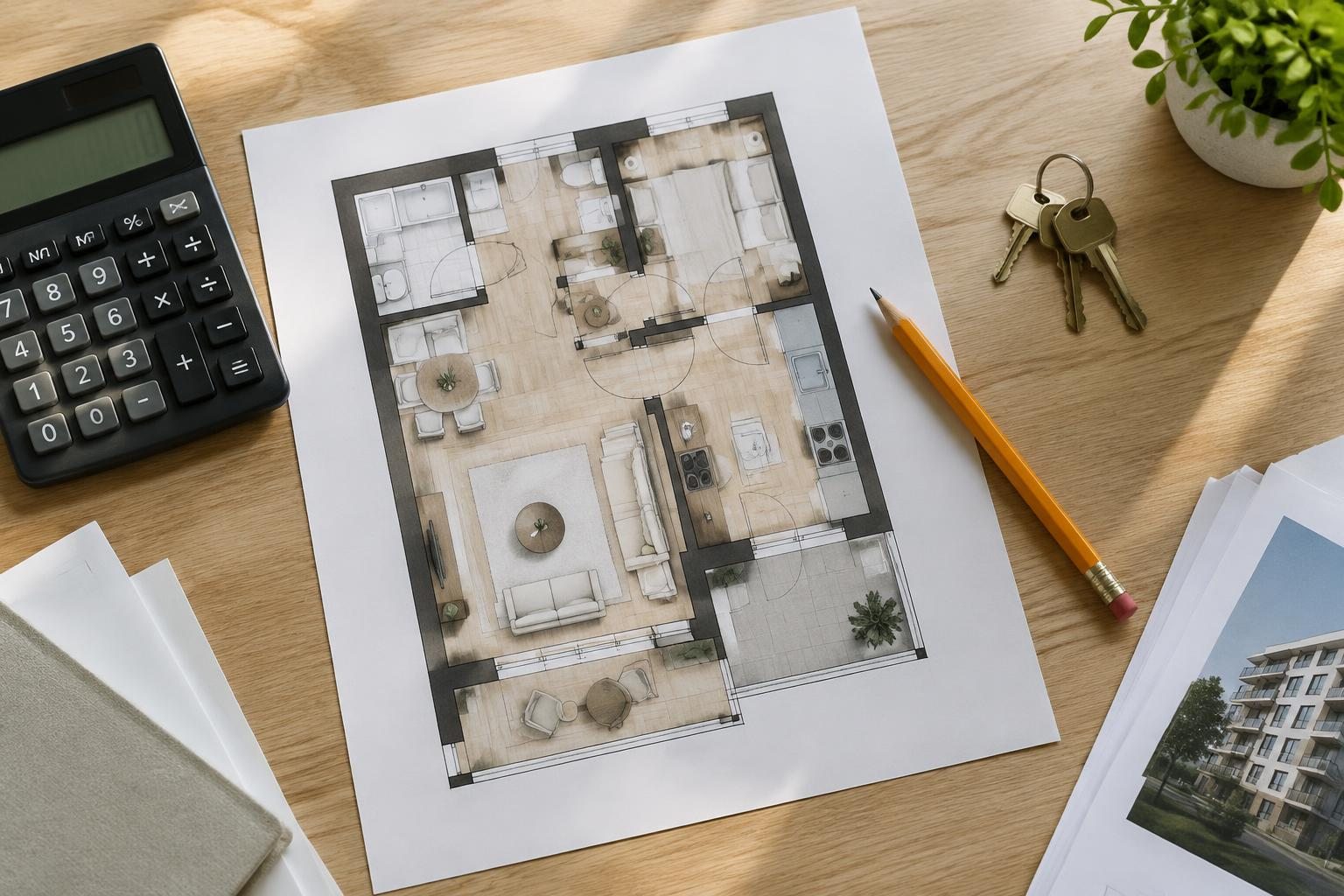
A trusted person can document the location, accessibility and visible condition. For a professional assessment of damp, cracks or renovation needs, a suitably qualified and preferably independent building surveyor is more appropriate.
Agree the scope of the inspection in writing. It should specify:
- which rooms and parts of the common property should be accessible;
- which building elements will be examined and which measurements taken;
- whether photographs and a written summary report are included;
- which areas cannot be checked;
- whether identifiable risks and necessary follow-up investigations will be highlighted.
The roof, façade, basement, heating and pipework are often just as important financially as the condition of the flat. An inspection limited to the flat may not be sufficient. Even a surveyor cannot reliably rule out concealed defects without further investigation.
The Flat viewing checklist provides a practical starting point. For the distinction between different types of reports, see Property valuation reports and costs.
Video viewings and tenants’ rights
A live video viewing can supplement, but not replace, a professional inspection. By prior agreement, ask to see areas around windows, wet rooms and visible pipework, for example. Smells, concealed damp and the functioning of building services can only be assessed over video to a limited extent, if at all.
A genuine intention to sell can justify a right to inspect. Appointments must be announced with sufficient notice and be reasonable for the tenant. This does not, however, create blanket permission to film the flat. Video transmission, photographs and recordings should only take place with the prior consent of the people concerned and a clearly agreed scope. Refusing recordings alone is not evidence of a defect.
04A checklist before deciding to buy
- Request documents: Obtain a complete picture of ownership, the WEG, tenancy, energy and building services.
- Resolve discrepancies: Follow up in writing on inconsistent floor areas, missing resolutions, rent arrears and renovation questions.
- Check the location: Combine desktop research with observations on site.
- Arrange access: Coordinate with the seller, management and, where relevant, the tenant.
- Commission an independent inspection: Define its scope, limitations and documentation.
- Calculate financing and a stress scenario: Allow for vacancy, repairs, special levies and additional management.
- Review the draft agreement: Clarify liability, assurances, cost allocation and representation before notarisation.
Sales pressure is no substitute for reliable information. If material risks remain unresolved, postpone notarisation or walk away from the purchase.
05Worked example: Inspection costs and ongoing cash flow
The following model uses assumptions only. It is neither market pricing information nor a financing offer. It assumes a tenanted flat measuring 58 m², a purchase price of €160,000 and monthly rent excluding service charges of €9.80 per square metre. The entire purchase price is financed; acquisition costs and inspection costs are paid separately from the buyer’s own funds.
The model covers a full rental year without lost rent. The assumed loan interest rate is 3.8%, with principal repayment of 1.5% in the first year. For a straightforward calculation, payment is assumed to take place at the year end. Monthly loan payments would change the split between interest and principal. The monthly column shows annual averages only.
| Item | Per year | Monthly average |
|---|---|---|
| Rent excluding service charges: 58 × €9.80 × 12 | €6,820.80 | €568.40 |
| Owner’s expenditure not recoverable from the tenant, assumed | −€900.00 | −€75.00 |
| Loan interest: €160,000 × 3.8% | −€6,080.00 | −€506.67 |
| Principal repayment: €160,000 × 1.5% | −€2,400.00 | −€200.00 |
| Cash flow before tax | −€2,559.20 | −€213.27 |
The assumed €900 is not a general cost benchmark. Additional repairs, special levies, lost rent and any separately commissioned rental management are not included. You need further liquidity for these items. Monthly totals may differ slightly due to rounding.
Principal repayment reduces the loan balance but is not disposable income. No after-tax calculation is assumed: this depends on factors including the building’s share of acquisition costs, depreciation, deductible expenses and your personal tax position. Principal repayments are not deductible rental expenses; contributions to the WEG maintenance reserve are generally not immediately deductible rental expenses either.
Inspection costs in the example
| Inspection expenditure, assumptions only | Amount |
|---|---|
| Building surveyor with summary report | €900 |
| Separate travel and overnight accommodation for the appointed person | €400 |
| Total inspection expenditure | €1,300 |
| Share of purchase price: €1,300 ÷ €160,000 × 100 | 0.81% |
These are one-off costs and are not included in the ongoing cash flow above. Check whether travel costs are already included in the quotation.
If an additional assumed repair costing €6,000 arose and you had to bear it in full, that year’s funding requirement before tax would rise from €2,559.20 to €8,559.20. Inspection and acquisition costs would still be additional. This illustrates the importance of a reserve, not a guarantee that a viewing will prevent damage.
06Notarisation without travelling yourself
Agree the arrangements with the notary handling the transaction at an early stage. Notarisation by video conference is not available for property purchase agreements.
| Option | Points to consider |
|---|---|
| Representation under a power of attorney | Agree its content and form with the notary in advance. Formally authenticated evidence is generally required for land register purposes; depending on the arrangement, the power of attorney itself may need notarisation. |
| Separate notarisation of offer and acceptance | Buyer and seller can make their declarations before different notaries. Binding periods, procedure and additional costs must be coordinated. |
| Representation without authority, followed by approval | The agreement’s effectiveness initially depends on subsequent approval. Clarify form, deadlines and costs in advance; this is not a blanket substitute for the intended personal participation or representation by a trusted person. |
For a property consumer contract between a trader and a consumer, the intended contract text should generally be provided to the consumer by the officiating notary or an associated notary two weeks before notarisation, under section 17(2a) of the German Notarisation Act (BeurkG). This requirement does not apply indiscriminately to every private property purchase.
For consumer contracts, the notary should also work towards the consumer making their declaration personally or through a trusted person. Someone aligned with the seller or estate agent is not automatically suitable for that role.
Further reading: Checking a flat purchase agreement and The notary appointment when buying a flat.
07When it is better not to buy
Reasons against a remote purchase include refusal to provide essential documents, lack of access for a reasonable inspection or unresolved substantial renovation needs. Financing without a sufficient liquidity buffer is also problematic.
Independently check the identity and authority of the people you deal with. Unusual advance payments or last-minute changes to bank details are warning signs. Pay the purchase price only once the contractual conditions for payment have been met and the notary has issued the corresponding notice.
Finally, plan management after the purchase. The WEG manager does not automatically handle the individual tenancy of your flat. Property management for rented investments explains the responsibilities and costs of additional support.
Conclusion: Buying without a personal viewing can be reasonable if the documents, condition, tenancy and financing have been independently checked. Buying without adequate checks remains a risk that is difficult to quantify.
This guide does not replace individual legal, tax or investment advice.
08Free initial consultation
In a free initial consultation, you can discuss which documents and checks are still needed for your purchase decision and how a remote purchase can be organised. Request an initial consultation.
FAQFrequently asked questions
Can you buy a flat without viewing it?
Yes. The purchase agreement must be notarised, but a personal viewing is not a legal requirement. An independent on-site inspection is nevertheless advisable because photographs and documents only provide a limited picture of the technical condition.
Is the seller liable for defects if I have not viewed the property?
That depends on the contract and the circumstances. Liability for defects is frequently excluded when existing properties are sold. Under section 444 BGB, the seller cannot rely on an exclusion insofar as they fraudulently concealed a defect or gave a guarantee concerning the property’s characteristics. Not viewing therefore does not automatically remove all buyer rights.
Do I have to attend the notary appointment personally?
Not necessarily. Options include an agreed power of attorney, separately notarised declarations or, under certain conditions, subsequent approval. Clarify form, costs and consumer protection requirements with the notary in advance. Notarisation of a property purchase agreement by video conference is not available.
How much does a surveyor’s inspection cost?
The price depends on factors including the scope, property, access and reporting requirements. The worked example assumes €900 for the surveyor and a further €400 for travel and overnight accommodation. The €1,300 total is not a general price indication. Obtain a quotation for the specific assignment.
Does the tenant have to allow a video viewing?
An intention to sell can justify an inspection announced with sufficient notice at reasonable times. This does not automatically permit video transmission or recordings. These should only take place with the prior consent of the people concerned and a clearly agreed scope.
Can I get the energy performance certificate without a viewing?
Generally, yes. Even without a viewing, the energy performance certificate must be made available when a property is sold, at the latest without undue delay following your request. Statutory exceptions remain applicable. The certificate does not replace a technical inspection.
Does the two-week period apply to every property purchase?
No. The rule concerns property consumer contracts between a trader and a consumer in particular. The intended contract text should generally be provided to the consumer by the officiating notary or an associated notary two weeks before notarisation.
Writes about Taxes, AfA (depreciation), Existing properties and Portfolio building.
Since 2020, Eduard has bought seven properties of his own and supported more than 150 clients. He writes about tax levers, property documents and portfolio building – with honest numbers instead of rosy projections.
This guide does not replace tax or legal advice. All figures are example calculations with disclosed assumptions.