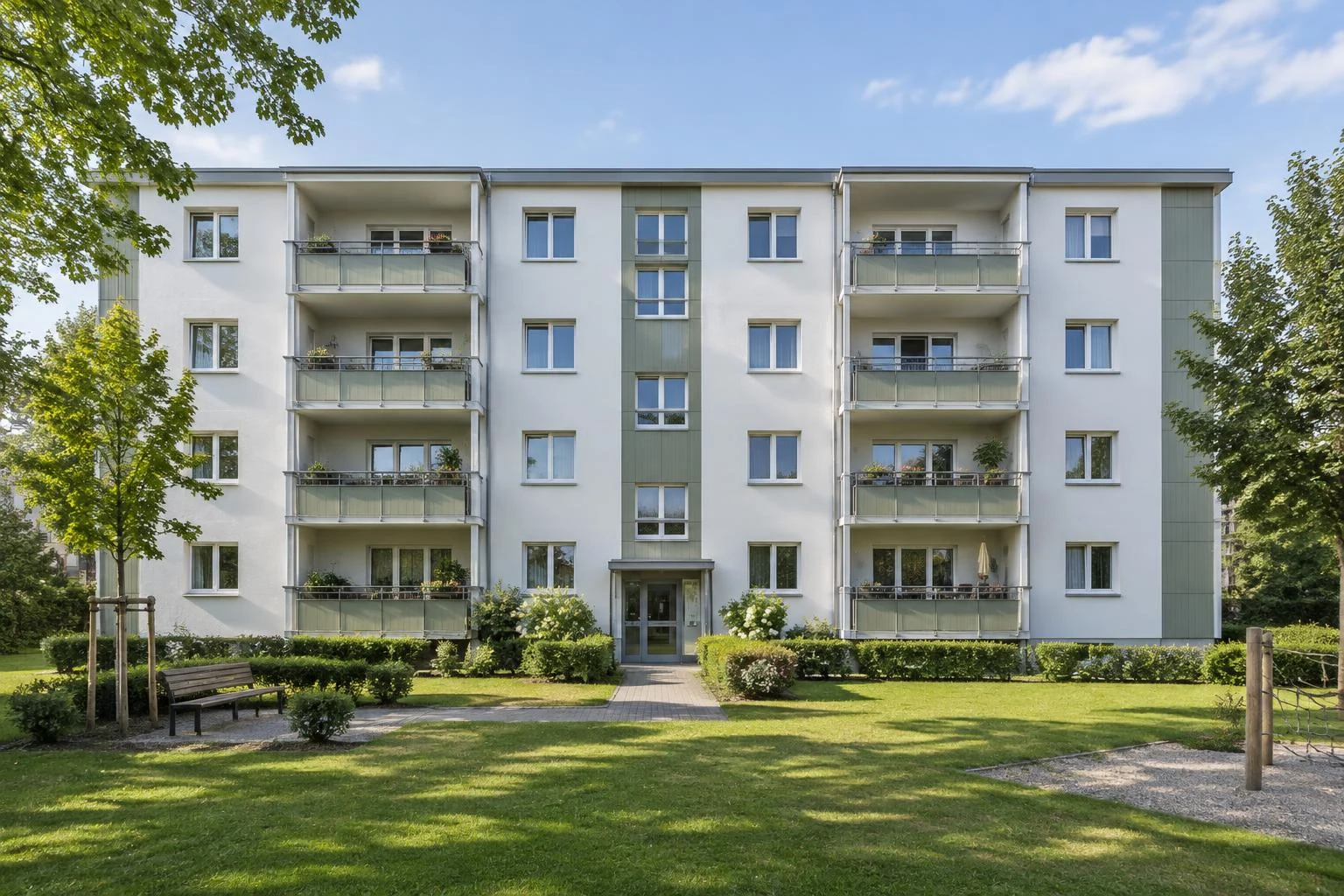
Assessing the micro-location: how to evaluate a flat’s location
The city may be right, but the street may still be wrong. We show you which official maps to use to assess a flat’s micro-location in an hour, and what a better location really costs per month.
 Kevin Celentano
Investment Advisor at InvestImmo
The city ticks the boxes. The labour market, the university, a growing population: everything points to a good location. Then you stand outside the building and hear the traffic on the four-lane road, even with the windows closed.
That is precisely what micro-location means. It determines whether your flat in a good city lets quickly or whether you spend an extra month searching every time a tenant moves out. And unlike the layout, it can never be changed.
The good news is that you can assess much of the micro-location from your desk. Municipalities and federal states publish maps for this purpose that many buyers are unaware of.
01Micro-location and macro-location: the difference
When assessing a flat as an investment, you look at two levels. Macro-location answers the question of whether enough people will still be looking for a flat in this city in 20 years' time. Micro-location answers whether they will want this particular flat.
| Macro-location | Micro-location | |
|---|---|---|
| Level | City, region | Street, neighbourhood, building |
| Typical questions | Population, jobs, vacancy, rent levels | Noise, transport links, local amenities, neighbourhood, views |
| Where to check | Federal state statistical offices, census, Arbeitsagentur | Local rent index, standard land value, noise and flood maps, site visit |
| What it determines | whether demand will be there in the long term | how quickly you can let the property and at what rent |
You can find criteria and data sources for assessing the city in the guide to location analysis. Here, we focus on the last few hundred metres.
„Location, location, location.“
We regularly hear these three words in discussions about locations, usually as an objection. They are true. But knowing the city is not enough. The street determines the location.
02The eight features of micro-location
Tenants assess a location differently from buyers who intend to live there themselves. For an investment property, the main considerations are those that carry weight when people search for a flat.
| Feature | What to look for | Importance for letting |
|---|---|---|
| Noise | Main road, railway, flight path, bars and restaurants | high |
| Transport links | Walking distance to buses, trains and trams; frequency during rush hour | high |
| Local amenities | Supermarket, bakery and pharmacy within a 10-minute walk | high |
| Neighbourhood | Condition of buildings, vacancy, rubbish, green spaces | medium to high |
| Schools, nurseries, doctors | crucial for family flats | depends on the target group |
| Employers, university | Distance to major employers or campus | depends on the target group |
| Natural hazards | Flooding, heavy rainfall, hillside location | rarely visible, but costly |
| Planning | Planned roads, commercial developments, new housing areas | effects only become apparent years later |
Which features matter depends on the flat. A studio flat for students needs a tram stop on the doorstep, but not a nursery. A four-room flat for families needs a school and green space; the tram can be ten minutes away.

03Checking official maps
Much of the information on micro-location is public and free. All you need is the flat's address. An hour at your desk is often enough for an assessment.
- 01Residential location rating in the local rent index
Qualified local rent indices assign each address a residential location rating, such as basic, average or good (§§ 558c, 558d BGB). The classification directly affects the rent you are allowed to charge. Many cities provide an online map or street directory for this purpose.
- 02Standard land value
The expert valuation committees determine an average land value per square metre for each zone (§ 196 BauGB). A high value compared with the surrounding area indicates a sought-after location. You can find the values on the BORIS-D portal or the federal state portals.
- 03Noise map
Noise maps are available for major roads, major railway lines, large airports and urban agglomerations under § 47c BImSchG. They show average noise levels at the building façade and are reviewed at least every five years.
- 04Flood hazard map
The federal states publish maps of flood-prone areas under § 74 WHG. If the address is in a risk area, check insurability and premiums before buying. Many municipalities provide their own indicative maps for heavy rainfall.
- 05Local development plan
The municipality's geoportal or planning office shows what may be built on neighbouring plots. An open plot designated for commercial use in the plan is very different from a protected green space.
- 06Broadband and mobile coverage
The Bundesnetzagentur's broadband atlas shows which internet speeds are available at the address. For tenants working from home, this has now become a selection criterion.
A poor rating on one map is not a reason to rule a property out. But it should be reflected in the price. A flat on a mapped noise corridor should be significantly cheaper than an equivalent flat two streets away.
04Worked example: main road versus side street
Take Tobias Kern. The name is fictional, and the figures are a worked example, not a forecast. He is considering two equally sized, two-room flats of 60 square metres in the same city.
Flat A is on a main road that appears on the noise map. It costs €3,800 per m², or €228,000, and generates rent of €10 excluding service charges. Flat B is on a quiet side street with a good residential location rating in the local rent index. It costs €4,300 per m², or €258,000, and generates rent of €11.50 excluding service charges.
Tobias Kern makes realistic allowances for tenant turnover. On the main road, a tenant moves out every three years on average, and finding a replacement takes two months. On the side street, the tenant changes every six years, and finding a replacement takes one month. He has taxable income of €60,000, pays the purchase costs of 10% from his own funds and borrows the purchase price.
| A Main road | B Side street | |
|---|---|---|
| Purchase price | €228,000 | €258,000 |
| Annual rent excluding service charges at full occupancy | €7,200 | €8,280 |
| Average annual vacancy loss | −€400 | −€115 |
| Non-recoverable costs, maintenance | −€1,500 | −€1,500 |
| Interest | −€8,664 | −€9,804 |
| Principal repayment | −€3,420 | −€3,870 |
| Annual result before tax | −€6,784 | −€7,009 |
| Depreciation allowance of 2% on 75% of purchase price plus purchase costs | −€3,762 | −€4,257 |
| Tax loss | −€7,126 | −€7,396 |
| Tax saving at €60,000 taxable income (single, § 32a EStG 2026) | +€2,662 | +€2,759 |
| Annual result after tax | −€4,122 | −€4,250 |
| Per month | −€344 | −€354 |
For a purchase price that is €30,000 higher, Tobias Kern contributes just €11 more per month after tax for the side-street flat. In return, he repays €450 more of the principal each year, has a more settled tenant and owns a flat that will appeal to more buyers when he eventually sells.
In the sales particulars, the two flats appear almost equally expensive. Once vacancy is factored in, the cheaper flat on the main road is the more expensive one relative to its rent. A cheap flat in a weak micro-location is therefore not automatically a bargain.

05The on-site check: two visits at two different times of day
Maps show averages. You can only get a feel for what it is like to live somewhere by visiting in person. If you cannot go yourself, ask the seller or someone you know for photos and a short video at both times.
| When | What to look out for |
|---|---|
| Weekday, 7:30 to 9 am | Traffic, noise, pressure on parking spaces, the walk to the stop and train frequency |
| Evening or weekend | Restaurants and bars, noise, lighting, who spends time on the street |
| Both visits | Condition of neighbouring buildings, vacant properties, rubbish, names on doorbells, green spaces |
| Inside the building | Stairwell, letterboxes, basement, bicycle storage room, signs of damp |
Speak to a neighbour if the opportunity arises. Asking “What is it like living here?” often tells you more in two minutes than any map. For guidance on checking the flat itself, see the viewing checklist.
06Which micro-location suits whom
- You want to hold the property for a long time and keep tenant turnover low.
- The flat should remain lettable even in weaker market conditions.
- You value having a pool of potential buyers if you sell later.
- The price discount is significantly greater than the rent discount, and you factor in void periods realistically.
- The drawback does not particularly bother your target tenants, such as students on a tram line to campus.
- An upgrade to the neighbourhood is officially planned, and you can afford to wait until it happens.
07Risks: what can change in a micro-location
New development plans. A commercial estate, a bypass or a large new housing development next door changes the location. The local development plan shows what has already been approved, but not what will happen in ten years.
Loss of local amenities and services. If the supermarket on the corner closes or bus services are reduced, the street becomes less attractive to tenants. Locations with only one option are more severely affected.
Natural hazards. Heavy rainfall can also affect locations outside officially designated flood zones. Check the basement, underground car park and backflow protection.
Tenancy law. The residential location classification in the local rent index can change when a new index is published, in either direction.
Interest rates. As with any flat bought with a mortgage, refinancing can become more expensive. A flat with a high risk of void periods is doubly affected.
FAQFrequently asked questions
What is a property’s micro-location?
The micro-location describes a property’s immediate surroundings: street, neighbourhood, noise, bus and rail connections, local amenities, schools and risks such as flooding. It determines how quickly a flat can be let and what rent it can achieve.
What is the difference between micro-location and macro-location?
The macro-location concerns the city and region, including population, labour market and rent levels. The micro-location concerns the street and neighbourhood. A good investment property needs both.
How do I find the residential location rating for an address?
In cities with a qualified rent index, every address is assigned a residential location rating, usually through a street directory or an online map provided by the city. Where there is no rent index, standard land values and a comparison with advertised rents in the surrounding area can help.
What does a prime location mean?
The term originates in retail. A prime location is a shopping street with the highest footfall in a city. For flats, the terms good or very good residential location are more commonly used.
Where can I find the standard land value?
On the BORIS-D portal or the federal states’ standard land value portals. The property valuation committees determine these values under § 196 of the Federal Building Code (BauGB), usually every two years.
How do I check noise levels at an address?
The noise maps published by federal states and municipalities under § 47c of the Federal Immission Control Act (BImSchG) show average noise exposure along major roads and railway lines, and around airports. A visit during rush hour and in the evening is also helpful.
Is a flat on a main road a bad investment?
Not automatically. However, it must be sufficiently cheaper to offset lower rent and more frequent vacancies. In the example, it was more expensive relative to the rent actually achieved than the flat on the side street.
08Further reading
- Location analysis for property investment
- Commuter belt: invest in the surrounding area or in the city?
- Viewing a flat for purchase: checklist
- Local comparable rent
- Glossary: purchase price-to-annual-rent ratio
- Glossary: property valuation committee
09Sources
All sources accessed on 14 October 2026.
- Section 196 BauGB (standard land values), gesetze-im-internet.de
- Section 47c BImSchG (noise maps), gesetze-im-internet.de
- Section 74 WHG (flood hazard and flood risk maps), gesetze-im-internet.de
- Sections 558c, 558d BGB (local rent index, qualified local rent index), gesetze-im-internet.de
- Section 32a EStG, gesetze-im-internet.de
- BORIS-D, standard land value portal of the property valuation committees
- Bundesnetzagentur, Broadband Atlas
- Keyword data: Semrush, Germany database, as at 14 October 2026
Disclaimer: This guide provides general information and is not a substitute for tax or legal advice. All figures are illustrative calculations with disclosed assumptions, as at 14 October 2026.
Writes about Purchase process, Notary and land registry and Letting.
Kevin combines twelve years of sales experience with nine years specialising in property and more than 500 consultations. He writes about property quality, location risks and a safe path from the first comparison to completion.
This guide does not replace tax or legal advice. All figures are example calculations with disclosed assumptions.