Buying a flat with a garden: what buyers and landlords should check
A garden may appeal to tenants considering a ground-floor flat. The documents establish ownership, maintenance duties and rights; the figures show whether the premium makes sense.
 Herbert Gotschy
Investment Advisor at InvestImmo
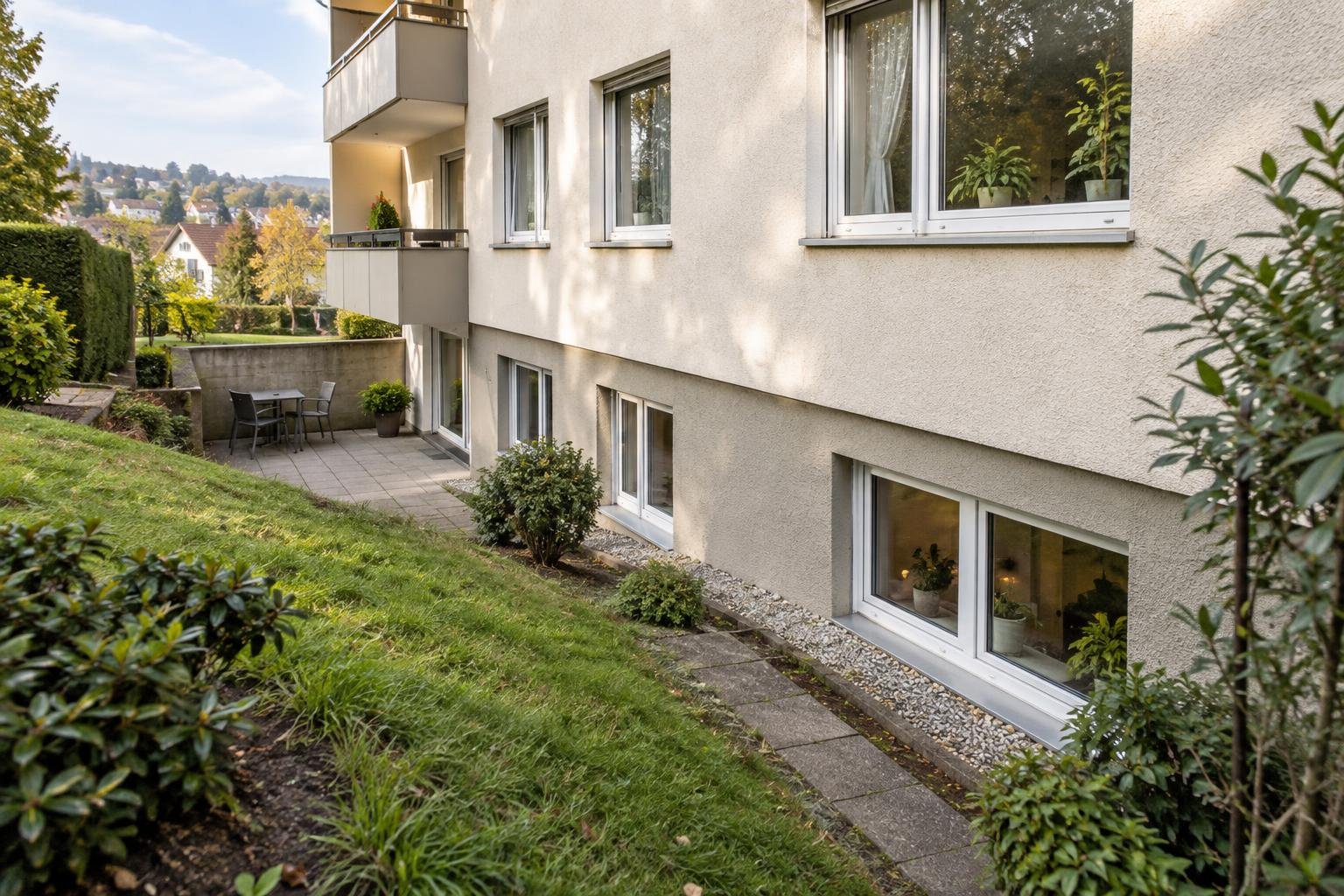
Two flats in the same building, with the same layout, each with 70 m² of living area. In our simplified worked example, one is on the first floor and costs €238,000. The other is on the ground floor, has a terrace with 80 m² of lawn behind it, and costs €252,000. A garden of your own could tip the balance towards the ground-floor flat.
As a property investor, you should first establish whether the garden really is “your own”. Then, who maintains it. And finally, whether a tenant will pay enough extra for it to justify the €14,000 premium.
01Does the garden really belong to the flat?
The land within a condominium development generally forms part of the common property, except where individual ownership has been validly established (§ 1(5) of the German Condominium Act [Wohnungseigentumsgesetz, WEG]). A garden does not become your property simply because it lies in front of your flat. There are two principal ways to secure rights to it; a description in the sales particulars is no substitute for either.
| Form | What it means | Protected on resale? |
|---|---|---|
| Individual ownership of the garden area | The area forms part of the flat’s individually owned property; possible since the 2020 WEG reform (§ 3(2) WEG) | yes, if validly established and registered in the land register; the area must be defined by measurements in the division plan [Aufteilungsplan] (§ 3(3) WEG) |
| Exclusive right of use | The area remains common property; exclusive use is allocated to the entitled flat | protected against subsequent purchasers through registration in the land register (§ 10(3) WEG) |
| Informal agreement, customary practice, sales particulars | “The garden is used by the ground-floor flat” | not secured by this alone; the legal basis and binding effect of any agreement require separate examination |
For older individually owned flats, use of the garden may be governed by an exclusive right of use. Since 2020, a garden can also be individually owned property, provided the flat remains the principal asset in economic terms (§ 3(2) WEG). Both arrangements can provide exclusive use, but they differ legally. Check not only the registration but also the precise scope of the rights and obligations. Installations serving communal use remain common property even within such an area (§ 5(2) WEG).
02Who pays for maintenance, trees and fencing?
A garden brings costs. Responsibility follows from the statutory rules, the rules of the owners’ association and valid resolutions. The association’s rules may assign routine maintenance and its costs to the holder of the exclusive right of use. For more substantial work, such as felling an old tree, replacing a fence or working on pipes beneath the lawn, the cost provisions need separate examination. An exclusive right of use does not automatically transfer responsibility for every cost.
| Type of cost | Possible responsibility — check the documents | What you should check |
|---|---|---|
| Mowing the lawn, trimming hedges | Holder of the exclusive right of use, where the rules provide for this | Is this stated in the rules of the owners’ association? |
| Tree felling, roots | Owners’ association or rights holder, depending on ownership and cost provisions | Are there large trees? Have any resolutions been passed? |
| Fencing, privacy screens | Check costs and any approval requirements separately | Is a privacy screen permitted at all? |
| Pipes, drainage | Owners’ association for communal installations; check the specific allocation | Has there been any damage in recent years? |
As a landlord, you can address routine maintenance in the tenancy agreement in two ways. Either make a valid agreement that the tenant will undertake specified maintenance tasks, or hire a gardener and agree to recover eligible operating costs [Betriebskosten]. Garden maintenance costs, including replacing plants and woody vegetation, are listed in § 2 no. 10 of the German Operating Costs Ordinance [Betriebskostenverordnung, BetrKV]. However, not all work in the garden is automatically recoverable: repairs to fencing or drainage and new structural installations do not become operating costs simply because the agreement contains a garden maintenance clause. The area concerned, the allocation method and the specific tenancy agreement also need checking. Without a valid transfer of responsibility or cost-recovery agreement, you bear the costs yourself.
03Living area: terrace yes, garden no
Sales particulars may advertise the size of a garden. It does not count towards the living area. Of the outdoor areas relevant here, the German Living Area Ordinance includes balconies, loggias, roof gardens and terraces that belong exclusively to the flat (§ 2(2) WoFlV), usually at one quarter of their area and at most one half (§ 4 no. 4 WoFlV).
A 12 m² terrace therefore adds 3 m² to the living area when the quarter-area allowance is used. The 80 m² of lawn behind it adds none. The garden therefore does not directly count towards the rent per square metre. It may influence the achievable rent, subject to demand and the applicable legal limits on rents. The example below assumes a total living area of 70 m² for each flat; any qualifying terrace area is not added again.
04Ground floor: advantages and disadvantages
A directly accessible garden may belong to a ground-floor flat. That means you also buy the characteristics of that particular ground-floor position.
| Point | Possible advantage | Possible disadvantage |
|---|---|---|
| Access | where access is step-free, convenient for older people, families with pushchairs and dog owners | entrance area and letterboxes may be directly outside the window |
| Outdoor space | garden and terrace may be an important reason to rent | maintenance work; problems if the garden is neglected |
| Security | no inherent advantage arising from the garden alone | ground-level windows and terrace doors may be easier to access |
| Peace and light | direct garden access without using the stairwell | depending on the building, stairwell noise, less light or reduced privacy |
| Tenant group | may appeal to tenants looking for a garden | not everyone wants to live on the ground floor; longer tenancies are not assured |
For landlords, a ground-floor flat with a garden can offer a distinctive property profile. This may make finding a tenant easier if there is corresponding local demand. Someone with little time or interest in gardening may instead see the garden as work. This cannot be inferred simply from age, household type or occupation.
05Worked example: what the garden earns and costs
Markus is single and, in this example, has taxable income of €80,000 before the flat is taken into account. He compares the two flats from the introduction, both built in 1998 and each with 70 m² of living area. For the ground-floor flat, he assumes monthly rent that is €70 higher. For an actual purchase decision, assess the achievable additional rent against comparable local listings and the applicable legal limits on rents. Markus is a fictional person; the figures are a simplified worked example, not a forecast. The price premium and additional rent are assumptions.
In each case, he finances the purchase price at an assumed interest rate of 3.8% and an initial principal repayment rate of 1.5%; he pays the assumed purchase costs of 7% from his own funds. The interest rate is not a statement about available market offers. For this simplified annual calculation, both interest and principal repayments are calculated on the initial loan amount; the effect of repayments during the year is ignored. For each flat, excluding the garden, he assumes a combined annual allowance of €1,020 for non-recoverable costs and reserves. The garden adds €30 a month: €25 for maintenance and €5 as a reserve allowance if he pays for the maintenance himself.
The calculation shows available cash after reserve allowances. Simply setting money aside in your own account is not a payment to a third party, but it reduces the amount treated here as freely available. Contributions to the owners’ association’s maintenance reserve [Erhaltungsrücklage] are not immediately tax-deductible. What matters is the association’s subsequent actual expenditure that qualifies for tax treatment. Nor is the entire owners’ service charge [Hausgeld] automatically deductible. The €1,020 allowance is used here for cash-flow planning; the individual cost items and their actual use determine their tax treatment. Discuss the tax classification with your tax adviser.
| Upper-floor flat | Ground-floor flat with garden | |
|---|---|---|
| Purchase price | €238,000 | €252,000 |
| Annual rent excluding operating costs [Kaltmiete] (€770 or €840 per month) | €9,240 | €10,080 |
| Interest (3.8% of the initial loan) | −€9,044 | −€9,576 |
| Principal repayments (1.5% of the initial loan) | −€3,570 | −€3,780 |
| Non-recoverable costs and reserve allowances, including the garden | −€1,020 | −€1,380 |
| Cash flow before tax, after reserve allowances | −€4,394 | −€4,656 |
| Illustrative annual depreciation (assumption: 2% on 80% of the purchase price plus 7% purchase costs; rounded to whole euros) | €4,075 | €4,314 |
The depreciation illustration assumes that 80% of acquisition costs are attributable to the building and that all the assumed purchase costs form part of the acquisition costs allocated in this way. At a depreciation rate of 2%, this produces annual amounts of €238,000 × 1.07 × 80% × 2% = €4,074.56 and €252,000 × 1.07 × 80% × 2% = €4,314.24. The land component is not depreciated. The standard straight-line depreciation rate for a residential building completed in 1998 is 2% (§ 7(4) of the German Income Tax Act [Einkommensteuergesetz, EStG]). The actual purchase price allocation and treatment of ancillary costs must reflect the particular property. The personal tax effect also depends on deductible expenditure, your income and, where applicable, the solidarity surcharge [Solidaritätszuschlag]. Ask a tax adviser to prepare your individual after-tax calculation.
Before tax and after reserve allowances, Markus contributes €262 more per year towards the garden flat than towards the upper-floor flat. In the pre-tax calculation, the additional annual rent of €840 does not quite cover the additional interest of €532, additional principal repayments of €210 and garden allowance of €360. However, the €210 of principal repayments reduces the loan balance; it is not a running expense like interest or maintenance.
At the assumed percentage, the additional purchase costs are €980, paid from the buyer’s own funds. They are not included in the annual cash flow. The calculation therefore does not demonstrate full recovery of the premium and does not allow for a return on the equity invested.
What changes if the tenant takes on the maintenance?
With maintenance carried out by the tenant, the garden flat comes out €38 per year ahead of the upper-floor flat in this simplified pre-tax calculation. That does not establish a higher overall return. The garden may make the flat more attractive to tenants who want that feature. Whether the premium is worthwhile also depends on void periods, tenancy length, actual costs and acquisition expenditure.
Start by comparing two flats with different purchase prices and rents before tax. Separate running expenditure from reserve allowances. The purchase price allocation, depreciation and deductible expenditure are particularly important for an after-tax calculation; your tax adviser can help.
06Checklist before buying
- 01Clarify the legal arrangement
Individual ownership, a registered exclusive right of use, or another use arrangement? Inspect the declaration of division, division or site plan, and land register.
- 02Check the boundaries
Does the area shown on the plan match what is used as the garden on the ground? Hedges do not always follow the legal boundary.
- 03Read the cost provisions
Who pays for routine maintenance, trees and fencing? Are any valid resolutions recorded in the meeting minutes?
- 04Inspect the trees
Large trees bring shade and leaves and may cause costs later. Local tree protection bylaws can make felling more difficult.
- 05Check burglary protection
Terrace door, windows, lighting. Any missing measures belong in your calculations.
- 06Prepare the tenancy agreement
Describe the garden, specify maintenance responsibilities and agree on lawful recovery of garden maintenance costs if you hire a gardener.
07Who a flat with a garden suits
- There is local demand for flats with gardens, for example from families, older people or dog owners.
- The garden has been validly allocated to individual ownership or is secured by a registered exclusive right of use.
- Maintenance responsibilities are clear and can validly be transferred to the tenant to the intended extent.
- The premium is reasonable in relation to the achievable additional rent and extra costs.
- The garden has merely been promised “for use”, without a clear legal basis.
- Large, old trees without clear rules on who pays.
- The intended tenants do not want to maintain a garden.
- You are looking for a flat requiring as little work as possible.
08Risks when buying a garden flat
Unclear rights. Without land-register protection, subsequent purchasers in particular may not be bound. Whether existing use can be changed depends on its legal basis. Paying a premium does not protect that use.
Costs. Tree felling, fencing and drainage can cost several thousand euros, depending on the scope of the work. Unclear rules may lead to disputes within the owners’ association.
Neglected garden. If the tenant fails to maintain the garden despite a valid obligation to do so, neighbours may complain and you will need to intervene. Restoration work may be needed when the tenant moves out; who pays requires separate clarification. A lawyer can advise on disputes over rights, costs or tenant obligations.
Burglary and noise. Ground-floor windows and doors may be easier to access. Noise and privacy depend on the building and location and may affect letting prospects or tenancy length.
Interest rates. At an assumed 4.2% rather than 3.8%, simplified annual interest on the garden flat’s €252,000 loan rises by €1,008; for the upper-floor flat’s €238,000 loan, the increase is €952. This is a sensitivity calculation, not an assessment of market interest rates.
FAQFrequently asked questions
Does the garden belong to me if I own the flat?
If validly allocated to individual ownership (Sondereigentum), the garden area forms part of your flat’s individually owned property. An exclusive right of use (Sondernutzungsrecht), by contrast, provides exclusive use while the area remains common property. Check the land register, declaration of division and plan. Other use arrangements require separate assessment. A lawyer can help if the allocation is unclear.
What is the difference between an exclusive right of use and individual ownership of the garden?
With an exclusive right of use, the garden remains common property, with exclusive use allocated to the entitled flat. With individual ownership, the area forms part of the flat’s individually owned property. Valid establishment and the appropriate land-register entry are decisive for protection against subsequent purchasers; a plan alone is insufficient. Consult a lawyer if any legal questions remain.
Does the garden count towards the living area?
No. Lawns and flowerbeds do not count towards the living area. Among outdoor areas, the German Living Area Ordinance covers balconies, loggias, roof gardens and terraces belonging exclusively to the flat, usually at one quarter and at most one half of their area.
Who pays for garden maintenance if I let the flat?
First check your obligations towards the owners’ association. In the tenancy agreement, you can validly assign suitable maintenance tasks to the tenant or agree to recover eligible garden maintenance costs under § 2 no. 10 of the German Operating Costs Ordinance. Not every garden job is a recoverable operating cost; repairs and new structural installations require separate treatment. A lawyer can help you draw up the agreement.
Is a ground-floor flat with a garden a good investment?
It can be, if there is local demand for a garden, the rights are secure and cost responsibilities are clear. The premium does not automatically pay for itself. In the simplified worked example, if the tenant maintains the garden, the garden flat comes out only €38 per year ahead before tax and after reserve allowances; additional purchase costs are not included. Void periods, actual costs and the tax position also affect the result.
Can I put up a fence or a garden shed in the garden of an individually owned flat?
An exclusive right of use does not automatically permit structural alterations. Depending on the work, ownership arrangements and rights affected, approval or a resolution of the owners’ association may be required. Check the association’s rules, the local development plan and applicable public-law requirements; individual ownership does not provide unrestricted permission to build. Consult a lawyer if any legal questions remain.
09Further reading
- Glossary: exclusive right of use
- Glossary: declaration of division
- Recoverable operating costs under the BetrKV
- Checking the purchase contract for an individually owned flat
- Assessing a property’s immediate surroundings
- Calculator: property cash flow
10Sources
- § 1 WEG, § 3 WEG, § 5 WEG, § 10 WEG
- § 2 BetrKV (no. 10, garden maintenance)
- German Living Area Ordinance, § 2(2), § 4 no. 4
- § 7 EStG (depreciation), § 32a EStG (income tax rates), § 3 SolZG, § 4 SolZG
- Worked example: own calculation using the assumptions stated in the article.
This guide provides general information and does not replace tax, legal or investment advice for an individual case. The figures in the worked example are illustrative assumptions or calculations derived from them, not forecasts or promises of returns. Discuss tax and legal questions with your tax adviser or lawyer.
Writes about Investment properties, Purchase decisions and Financial viability.
Herbert has invested in property himself since 2023 and has worked in the property industry since 2024. His advice combines an investor’s perspective with clear explanations and an open assessment of opportunities and risks.
This guide does not replace tax or legal advice. All figures are example calculations with disclosed assumptions.