Buying a top-floor flat: opportunities and risks
Light and views can make a top-floor flat appealing. For investors, the actual living area, roof condition and possible special levies matter. The example shows how these factors affect price and cash flow.
 Rula Mama
Investment Advisor at InvestImmo
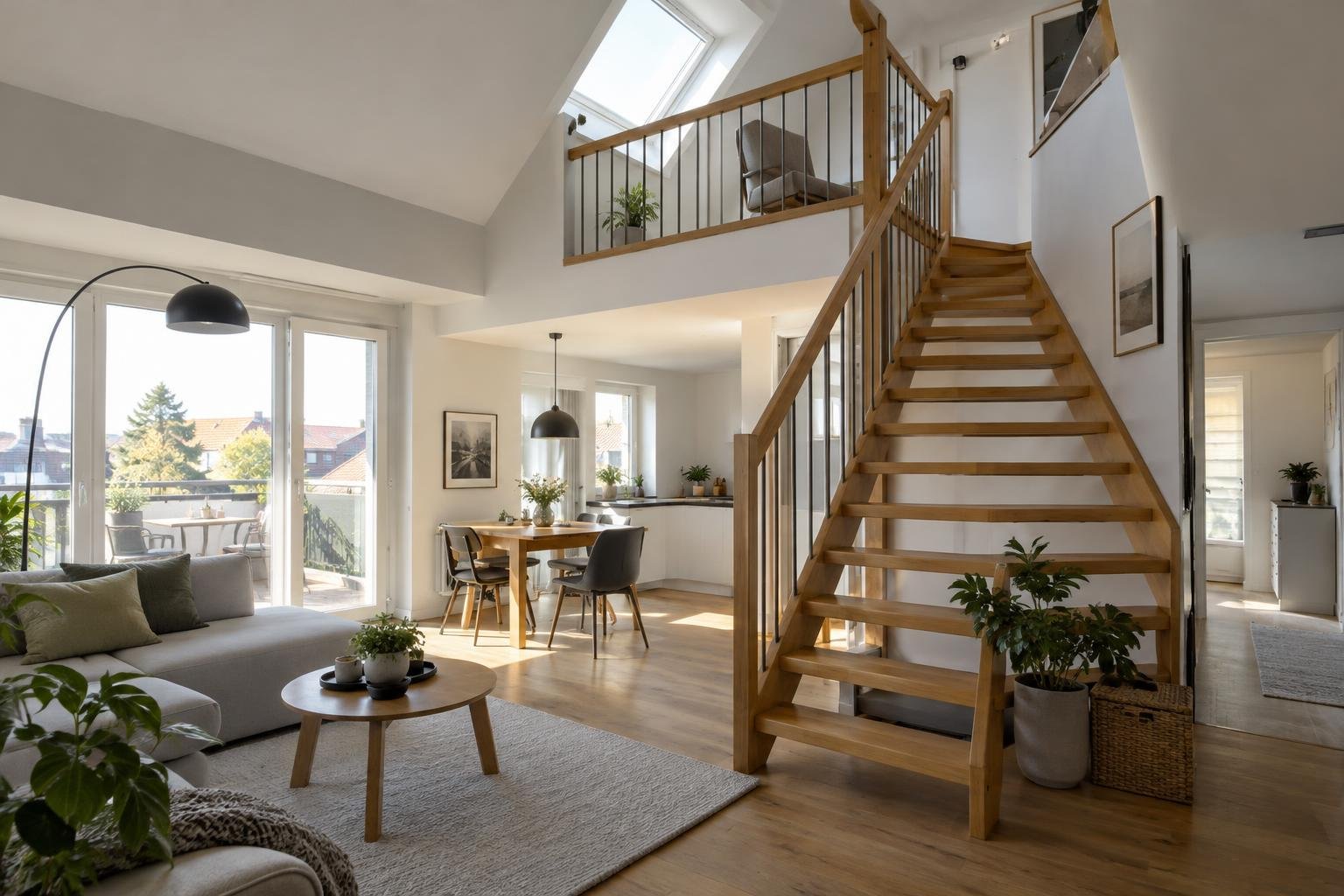
At the top of the building, with nobody living above and perhaps a view across the rooftops: top-floor flats can appeal through their light and outlook. Whether these advantages apply depends on the building and the layout.
For property investors, a closer look is worthwhile. Low sloping ceilings restrict standing room, which affects the calculated living area. Renewing the roof can also involve substantial costs.
01What counts as a top-floor flat
A top-floor flat occupies the storey immediately beneath the roof. A pitched roof may create slopes on two sides; a flat roof may leave no sloping ceilings. Three variants can be distinguished.
| Variant | Typical features | Important for landlords |
|---|---|---|
| Purpose-built roof-level accommodation | designed as a flat when the building was constructed, often with sloping ceilings | check the living area calculation |
| Converted loft | subsequently converted into a flat | check planning and building approval and the declaration of division |
| Penthouse or set-back upper storey | top storey, set back from the façade, often without sloping ceilings | assess the purchase price and local demand separately |
A subsequent loft conversion requires the same caution as any other conversion. Does it comply with planning and building law, and is the unit designated as a flat in the declaration of division [Teilungserklärung]? Uncertainty does not automatically mean that the entire area is excluded under the Living Area Ordinance. However, rooms that fail to meet the relevant state building regulations for their use do not count as living area (§ 2(3), no. 2 of the ordinance). In Bavaria, Article 45 of the Bavarian Building Code [Bayerische Bauordnung, BayBO] sets out requirements for habitable rooms. The ceiling-height requirements and exceptions applicable to a particular loft conversion depend on the relevant building regulations and the building itself. Ask a lawyer to resolve any outstanding questions about lawful residential use before you buy.
02Sloping ceilings and living area: what counts
The Living Area Ordinance weights areas beneath sloping ceilings according to their clear height (§ 4, nos. 1 and 2). The calculation method used for the assessment should be explicit; the ordinance is not automatically the mandatory agreed method for every privately financed flat.
| Clear height or building element | Amount included |
|---|---|
| 2 m or more | full area |
| 1 m to below 2 m | half the area |
| below 1 m | excluded |
| stairs with more than three risers and their landings | excluded (§ 3(3) of the ordinance) |
| balcony or roof terrace | normally one quarter, up to one half |
A description such as ‘approximately 72 m² living/usable area’ leaves the measurement basis unclear. In the following example, 72 m² is the floor area; the living area under the ordinance is smaller.
| Floor area | Weighting | Living area | |
|---|---|---|---|
| Parts of rooms at least 2 m high | 50 m² | 100% | 50 m² |
| Parts of rooms from 1 m to below 2 m | 16 m² | 50% | 8 m² |
| Parts of rooms below 1 m | 6 m² | 0% | 0 m² |
| Total | 72 m² | 58 m² |
The 72 m² becomes 58 m²: approximately 19% less. The relevant living area matters when comparing rents per square metre. If the actual living area is more than 10% below the contractually agreed area, this may generally entitle the tenant to a rent reduction; the agreed area is the denominator (Federal Court of Justice, judgment of 24 March 2004, VIII ZR 295/03). For a rent increase up to the local comparable rent, the actual living area is generally decisive (Federal Court of Justice, judgment of 18 November 2015, VIII ZR 266/14). The consequences for a particular tenancy also depend on the contractual wording. Seek advice from a lawyer where necessary.
„Rent per m², purchase price per m², overall return?“
For a top-floor flat, all three measures depend on the same question: which square metres are being used? For comparison, divide the purchase price by a transparently calculated living area, rather than accepting the floor area without checking. This example uses the Living Area Ordinance.

03Heat, insulation and the roof above you
Will the flat become too hot in summer? This matters to landlords too. A flat that stays above 28°C for several days in July may be less attractive to some prospective tenants. That temperature is an example, not a legal threshold.
Overheating risk depends on factors including insulation, rooflight size and orientation, external shading and ventilation options. External shading can limit solar heat gain more effectively than an internal blind. There is no general statutory temperature threshold that automatically permits a rent reduction. Whether the conditions constitute a defect depends particularly on the condition contractually owed and the severity and duration of the heat. Consult a lawyer if a specific dispute over a rent reduction arises.
Roof renewal can trigger energy-performance requirements for altered external building elements, while insulation obligations may also apply to the ceiling beneath an unheated roof space. Whether and to what extent these requirements apply depends on the building, the scope of works and any exemptions. The Building Energy Act [Gebäudeenergiegesetz, GEG] contains provisions for existing buildings. Discuss the requirements triggered by the proposed works with a qualified energy adviser or building design specialist. Necessary works may be financed from the maintenance reserve, through a special levy [Sonderumlage] or by another agreed method.
04Worked example: 72 m² advertised, 58 m² of living area
Julia is employed, single and has taxable income of €60,000 before the rental activity is taken into account. She is considering a top-floor flat built in 1985, priced at €230,000. The sales particulars quote 72 m², equivalent to approximately €3,194 per square metre of floor area. Under the Living Area Ordinance, the flat has 58 m² of living area. The example assumes achievable rent excluding service charges of €11.50 per square metre of living area, or €667 a month. This does not establish the local market rent. Julia is a fictional investor; the figures are illustrative, not a forecast.
She borrows the full purchase price at an assumed interest rate of 3.8%, with initial annual principal repayments of 1.5%. She pays the assumed purchase costs of 7% from her own funds. These figures are not current market quotations. In the simplified annual calculation, both interest and principal repayments are applied to the original loan amount; repayments during the year are not modelled.
The €1,020 annual allowance for costs not recoverable from the tenant is assumed to consist entirely of ongoing expenditure paid and deductible for tax purposes in that year. It excludes contributions to the maintenance reserve [Erhaltungsrücklage]. Any reserve contributions actually payable would reduce cash flow further but would not be immediately tax-deductible. Tax relief can arise only when the association spends the funds on works qualifying for the relevant tax treatment. Neither payments into the reserve nor the entire owners’ service charge [Hausgeld] are automatically deductible rental expenses.
The tax illustration assumes relief at a flat rate of 35% of the rental loss for tax purposes. This is a simplifying assumption, not a calculation of Julia’s personal income tax liability. It assumes that the loss can be fully offset against other positive income in the same year. Church tax and the solidarity surcharge are excluded. Principal repayments are not tax-deductible expenses; depreciation, by contrast, reduces the taxable result without creating an additional cash outflow in that year. Ask a tax adviser to calculate your individual tax position.
| Purchase at €230,000 | Purchase at €185,250 | |
|---|---|---|
| Price per m² of living area | €3,966 | €3,194 |
| Annual rent excluding service charges | €8,004 | €8,004 |
| Interest (3.8%) | −€8,740 | −€7,040 |
| Principal repayments (1.5%) | −€3,450 | −€2,779 |
| Non-recoverable ongoing costs, excluding reserve contributions | −€1,020 | −€1,020 |
| Cash flow before tax | −€5,206 | −€2,834 |
| Depreciation (2% on an 80% building share of acquisition costs including 7% purchase costs) | €3,938 | €3,171 |
| Rental result for tax purposes | −€5,694 | −€3,227 |
| Assumed tax relief: 35% of the rental loss | +€1,993 | +€1,129 |
| Cash flow after assumed tax relief | −€3,213 | −€1,705 |
The right-hand column shows an assumed lower purchase price approximately equivalent to applying the advertised floor-area price per square metre to the living area. It does not establish market value. At €230,000, Julia contributes approximately €434 a month before tax under the simplified model. At the comparison price, this would be approximately €236. The gross rental yield on the purchase price, excluding purchase costs, is 3.5% and 4.3% respectively. Voids, additional repairs and reserve contributions are excluded.
A year with a special levy
Three years after the purchase, the association decides to renew the roof at an assumed cost of €160,000. Julia’s flat has a co-ownership share of 130/1,000. If costs are allocated on that basis and funded entirely through a special levy, her share is €20,800.
Potential tax relief does not eliminate the liquidity needed to pay the special levy. The model year’s pre-tax shortfall is €26,006. Even after the assumed tax relief, negative cash flow of approximately €16,733 remains. Tax relief is also not automatically available when the special levy falls due.
Where repair and modernisation works are carried out within three years of acquisition, the rules on acquisition-related production costs [anschaffungsnahe Herstellungskosten] must be considered. If total relevant expenditure excluding VAT exceeds 15% of the building’s acquisition costs, relief may be available only through depreciation rather than an immediate deduction (§ 6(1), no. 1a of the German Income Tax Act [Einkommensteuergesetz, EStG]). The exact acquisition and works dates matter, not merely the year in which the resolution is passed.
Under the model’s assumptions, the building’s acquisition costs are €230,000 × 1.07 × 80% = €196,880; 15% is €29,532, or approximately €29,500. The €20,800 special levy is below that amount in isolation. This does not establish immediate deductibility: other relevant works must be aggregated, VAT treatment clarified and the tax classification of the roof works assessed separately. Discuss the specific works and the timing of any tax relief with your tax adviser.
Enter the living area calculated under the Living Area Ordinance and compare cash flow at different purchase prices. Record reserve contributions as cash outflows separately from tax-deductible expenditure.
05Advantages and disadvantages at a glance
| Factor | Advantage | Disadvantage |
|---|---|---|
| Position in the building | nobody living above; potentially quiet and light, depending on the building | stairs if there is no lift |
| Area | sloping ceilings can feel cosy | less countable living area per square metre of floor area |
| Indoor climate | heat may transfer from rooms below | overheating risk; inadequate insulation can also increase winter heat loss |
| Prospective tenants | may appeal to couples and single occupants | without a lift, potentially unsuitable for people with limited mobility or pushchairs |
| Costs | no inherent cost advantage | roof renewal and rooflight replacement can involve substantial expenditure |
06Who a top-floor flat may suit
- The purchase price is assessed against a transparently calculated living area, not unchecked floor area.
- The condition and likely renewal needs of the roof and insulation have been professionally assessed; necessary works are financially covered.
- There is a lift, or access arrangements suit local demand.
- You have a buffer for a possible special levy.
- The sales particulars quote only ‘living/usable area’ and provide no calculation.
- Meeting minutes identify forthcoming roof works without funding.
- The flat is on the fourth floor without a lift and poorly matches the needs of the intended tenants.
- Large south-facing rooflights without external shading increase overheating risk.
Roof renewal within the past 20 years does not, on its own, establish good condition or adequate insulation.
07Risks when buying a top-floor flat
Incorrect area figures. Copying an unchecked area from the sales particulars into the tenancy agreement can create a risk of rent reduction. Request the living area calculation and obtain a competent assessment if anything is unclear.
Special levies. Roofs, gutters and rooflights can generate substantial costs. Check resolutions, allocation rules and available reserves; not every project is allocated in the same way or funded entirely from reserves.
Voids. Heat, the absence of a lift and awkward layouts can make letting more difficult. Include a void allowance.
Interest rates. An assumed rate of 4.2% rather than 3.8% adds €920 in annual interest when applied to the original €230,000 loan. This comparison does not account for actual repayments during the year.
Maintenance within the flat. As part of the building envelope, rooflights generally form part of the common property. Responsibility for maintenance and payment may be allocated differently. Check the declaration of division, the association’s rules and relevant resolutions; a cost-allocation provision does not automatically make a window individually owned property. Ask a lawyer to assess unclear responsibilities and cost-allocation provisions.
FAQFrequently asked questions
How is living area calculated beneath sloping ceilings?
Under the German Living Area Ordinance (Wohnflächenverordnung, WoFlV), areas with a clear height of at least 2 m count in full, those from 1 m to below 2 m count at half their floor area, and those below 1 m are excluded (§ 4). Stairs with more than three risers and their landings are also excluded (§ 3(3)). Check which calculation method applies to the flat.
What are the disadvantages of a top-floor flat?
Possible disadvantages include restricted use beneath sloping ceilings, summer overheating, stairs without a lift and forthcoming roof works. Depending on the building and local demand, these factors can make letting more difficult.
Who pays for roof renewal in a jointly owned building?
The roof generally forms part of the common property. Costs are normally allocated according to co-ownership shares unless a valid alternative arrangement applies. Funding may come from the maintenance reserve, a special levy or another agreed method. Consult a lawyer if the cost-allocation provisions are unclear.
Is a top-floor flat a good investment?
That depends particularly on the purchase price per square metre of transparently calculated living area, roof condition, financing and local rental demand. Adequate reserves and suitable solar shading can limit risks but do not guarantee a profitable letting.
Can a tenant reduce the rent because a top-floor flat is too hot?
There is no general statutory temperature threshold that automatically triggers a rent reduction. Whether a defect exists depends on factors including the building, the condition contractually owed, and the severity and duration of the heat. Ask a lawyer to assess your individual case.
Does a roof terrace count as living area?
Under the Living Area Ordinance, a roof terrace normally counts at one quarter of its floor area, up to a maximum of one half (§ 4, no. 4).
08Further reading
- Glossary: Living Area Ordinance
- Identifying a renovation backlog
- Reviewing owners’ meeting minutes
- Property maintenance costs
- Calculating rental yield
- Calculator: property cash flow
09Sources
- Living Area Ordinance, §§ 2–4
- Article 45 of the Bavarian Building Code (habitable rooms)
- § 6(1), no. 1a of the German Income Tax Act (acquisition-related production costs), § 7(4) (building depreciation), § 32a (income tax scale)
- Building Energy Act (GEG) (energy-performance requirements for buildings)
- Federal Court of Justice, judgments of 24 March 2004, VIII ZR 295/03, and 18 November 2015, VIII ZR 266/14
- Worked examples: simplified model calculations using the stated assumptions; tax relief assumed at a flat 35% of the rental loss for tax purposes
This guide provides general information and does not replace individual tax, legal or investment advice. The worked examples use modelling assumptions and are neither forecasts nor guarantees of returns. Discuss your specific tax and legal circumstances with a tax adviser or lawyer, as appropriate.
Writes about Existing properties, Investment calculations and Property assessment.
Rula has worked in financial services since 2021. He focuses on existing investment properties, transparent calculations and an honest assessment of building condition and running costs.
This guide does not replace tax or legal advice. All figures are example calculations with disclosed assumptions.