Buying and letting a semi-basement flat: what the price advantage is really worth
A semi-basement flat may cost less than the flat one floor above. Whether that advantage lasts depends on factors including permitted use, living space and potential damp damage.
 Rula Mama
Investment Advisor at InvestImmo
The illustrative listing describes a two-room flat, 58 m², built in 1972, for €145,000. The flat on the first floor of the same building costs €174,000. The difference appears in small print, described as “semi-basement” [Souterrainwohnung] or “garden level”. It sounds like a discount for going down a few steps.
Sometimes that is exactly what it is. But sometimes you are buying premises that are not legally a dwelling, damp walls or a unit with frequent tenant turnover. This guide explains how to assess the risks beforehand and what the figures show.
01What a semi-basement flat is
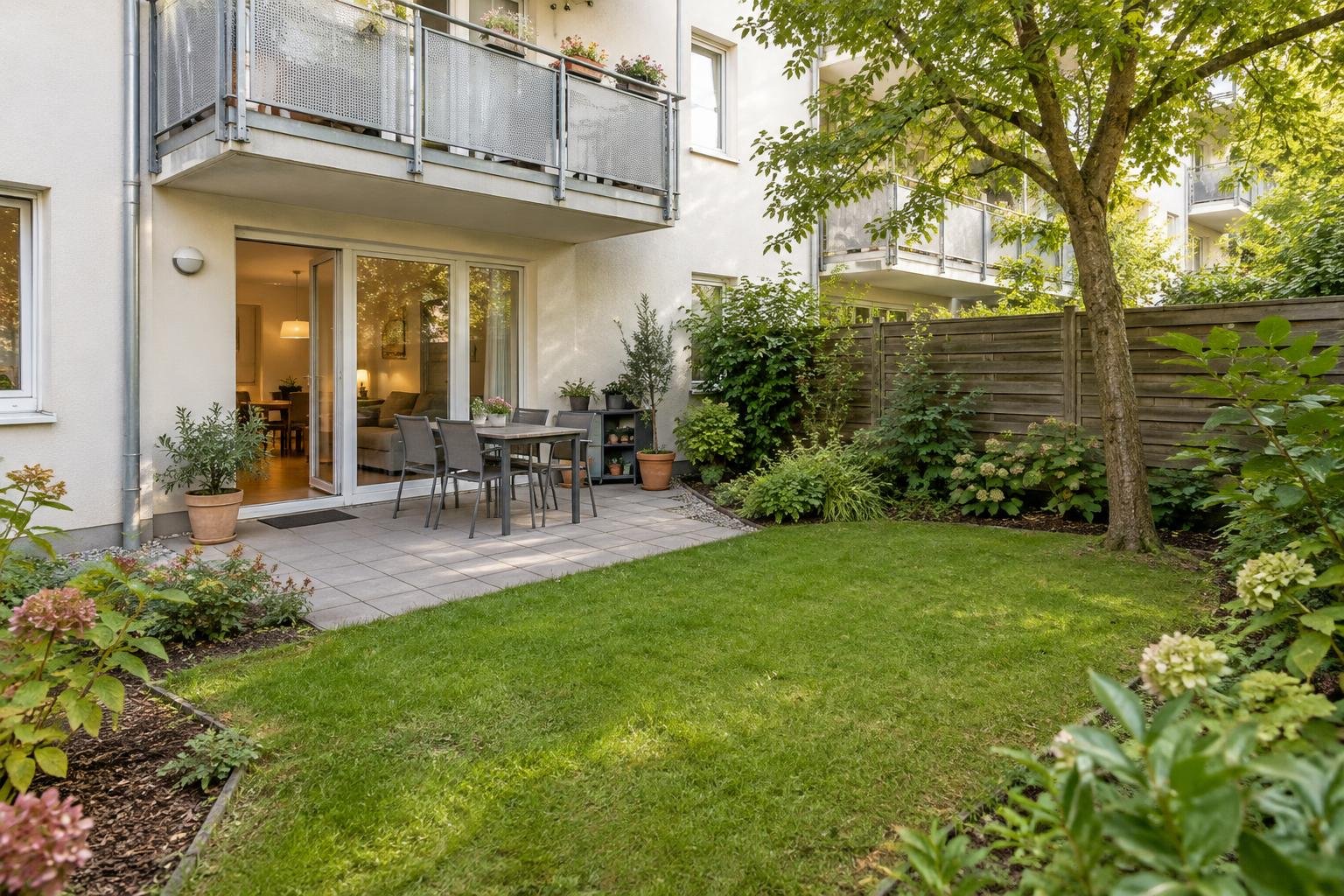
The German term for this level [Souterrain] comes from French and means “underground”. It describes a storey that is partly below ground level. Buildings on slopes provide a clear example: on the uphill side, the flat is half underground; on the downhill side, it looks out onto the garden at ground level.
In everyday usage, three terms are often confused.
| Term | Position | Typical windows |
|---|---|---|
| Raised ground floor | Ground floor, a few steps above ground level | standard windows, slightly raised |
| Semi-basement, lower ground floor | partly below ground level | often high in the wall, with the sill just above the ground outside |
| Basement | mostly below ground level | light wells or small basement windows |
For buyers, the wording in the listing is secondary. What matters is what the land register [Grundbuch], declaration of division and building permit say.
02Flat or hobby room: what the declaration of division and building law say
The German Residential Property Ownership Act [Wohnungseigentumsgesetz, WEG] distinguishes between residential unit ownership [Wohnungseigentum] and non-residential unit ownership [Teileigentum]. Residential unit ownership comprises individual ownership [Sondereigentum] of a dwelling together with a co-ownership share in the common property. Non-residential unit ownership covers the corresponding ownership of rooms not intended for residential use (§ 1(2) and (3) WEG). A “hobby room”, “basement room” or “office” in a semi-basement may be registered as a non-residential unit or belong to another unit as ancillary accommodation.
For you as a landlord, this is no minor detail. The declaration of division and its designated purposes are central to the permitted use. Residential use contrary to these provisions may give rise to claims requiring it to cease. Whether such a claim exists and who can enforce it depends on the specific documents and use. A prohibition on use does not automatically give the landlord a right to terminate the tenancy. The permitted alternative use and its income potential must also be reassessed. Ask a lawyer to assess the legal implications for your unit.
Building law imposes separate requirements
Even if the declaration of division says “dwelling”, rooms used for regular occupation [Aufenthaltsräume] must meet the applicable building-law requirements. These are set out primarily in the state building regulations. In Bavaria, for example, Article 45 of the Bavarian Building Regulations [Bayerische Bauordnung, BayBO] governs requirements for habitable rooms, including clear ceiling height and adequate daylight and ventilation. The minimum dimensions and exceptions that apply depend on factors including the building class and use. Other states have their own rules, potentially including additional requirements for basement storeys. The necessary escape routes must also be considered. For existing buildings, the approval history, any protection for lawful existing use [Bestandsschutz] and approved departures from the regulations must be taken into account. Discuss building-law questions with the building authority and legal disputes with a lawyer.
03Living space under German rules: how 58 m² can become 46 m²
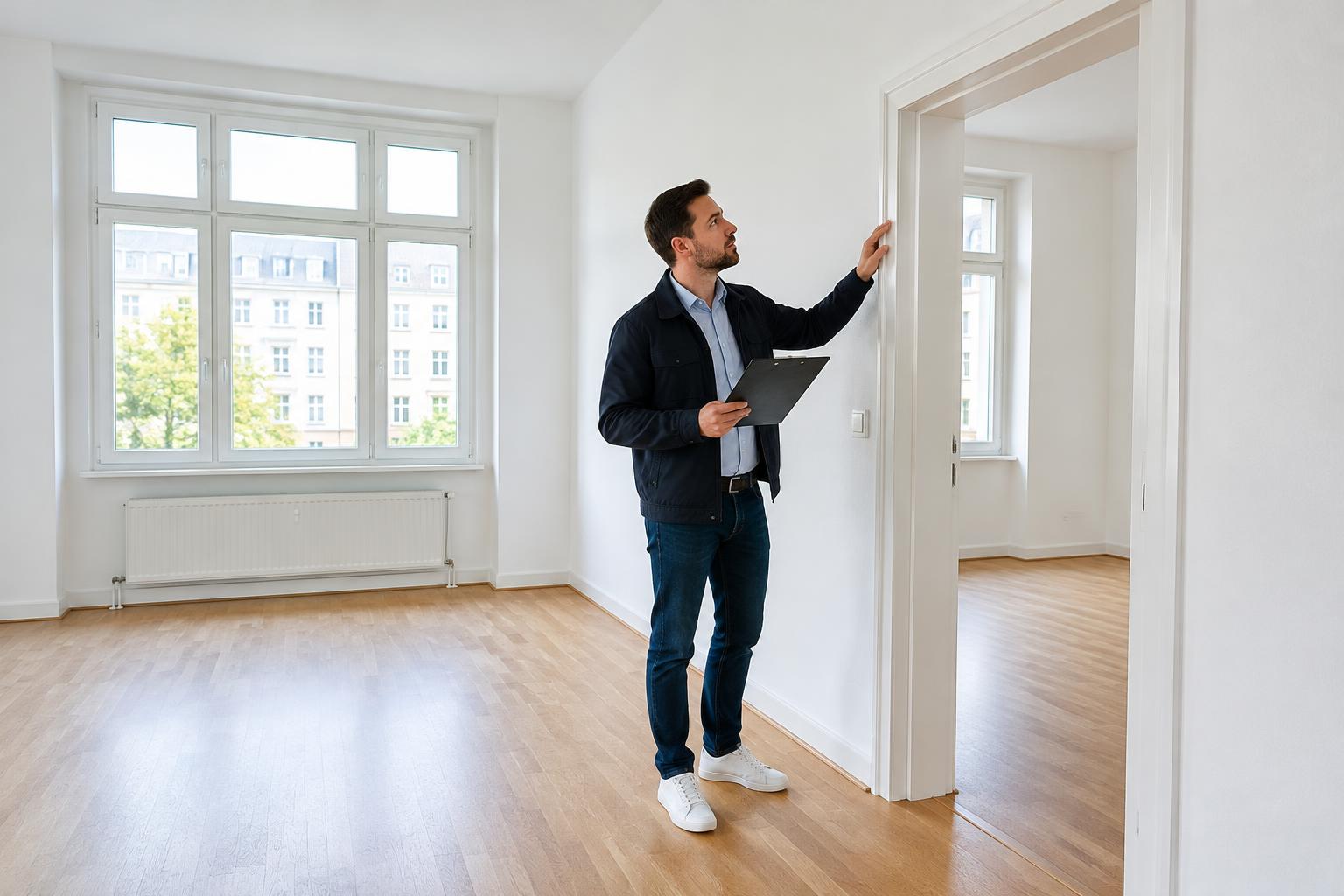
Living space matters when setting the rent. For housing built without public subsidy, the German Living Space Ordinance [Wohnflächenverordnung, WoFlV] is often used unless a different agreement or another applicable calculation basis takes precedence. Two rules particularly affect semi-basement flats.
First, ancillary rooms such as basement rooms, storage rooms outside the dwelling and rooms outside the dwelling used instead of basement storage do not count as living space (§ 2(3), no. 1 WoFlV). A storage room within the dwelling is not excluded merely because of that use. Second, rooms that do not meet the states’ building-law requirements for their intended use do not count (§ 2(3), no. 2 WoFlV). If a room marketed as a bedroom fails those requirements, it must not be included as living space. The calculation rules in §§ 3 and 4 WoFlV, including those concerning clear height, must also be considered.
| Room in the listing | Area | Does it count under the WoFlV? |
|---|---|---|
| Living room with kitchen | 24 m² | yes, assumed to count in full in this example |
| Bedroom | 14 m² | yes, assumed to count in full in this example |
| Bathroom and hallway | 8 m² | yes, assumed to count in full in this example |
| “Study” with a basement window, approved as a basement room | 12 m² | no, treated in this example as a basement room rather than lawful living accommodation |
| Living space | 46 m² | rather than the 58 m² in the listing |
Anyone who discovers this only after buying has two problems. In the example, the purchase price per square metre of living space rises from €2,500 to around €3,150. And if the actual living space falls more than 10% short of the contractually agreed area, this may constitute a defect entitling the tenant to a rent reduction (German Federal Court of Justice [Bundesgerichtshof, BGH], judgment of 24 March 2004, VIII ZR 295/03). The agreed area is the denominator: (58 − 46) ÷ 58 gives approximately 20.7% here. Ask a lawyer to assess the implications under your specific contract.
04Damp, light and security
Why might a semi-basement flat command less rent, even where residential use is approved? Three potential factors deserve particular attention.
Damp. Walls in contact with the ground may have cool internal surfaces on which moisture from the air can condense. This is not just a winter issue: in summer, warm, humid outdoor air can cause condensation on cool basement walls. Defective waterproofing can also allow moisture from the ground to enter. Persistent damp encourages mould and may lead to disputes over a rent reduction. Check corners behind wardrobes, window reveals and the bases of walls. A musty smell is a warning sign; fresh paint does not rule out damage. The cause and an appropriate ventilation approach must be assessed for the particular building.
Light. High-level windows, light wells, hedges or neighbouring buildings can limit daylight. Photographs offer only a limited basis for judging this. View the flat in daylight where possible and consider the time of year.
Security. Windows near ground level may be easier to reach. Suitable window fittings, lockable handles or other protective measures can improve security. Bars must not obstruct necessary escape routes; work affecting common property also requires clarification of the necessary approvals.
The tenants a flat attracts and how long they stay depend on factors including location, price, daylight and condition. The floor level alone does not establish a reliable tenant profile. More frequent changes can mean additional refurbishment costs and periods without rent. Check the actual letting history and model different vacancy scenarios.
05Worked example: semi-basement versus upper floor
Stefan is single and has a taxable income of €60,000 before the rental investment is taken into account. He compares the two flats from the introduction: the same building, built in 1972, each measuring 58 m². The name is invented, and the figures are a worked example, not a forecast. Purchase prices and rents are assumptions, not market statistics.
In each case, he borrows the purchase price at an assumed interest rate of 3.8% with an initial annual principal repayment rate [Tilgung] of 1.5%. He pays assumed purchase transaction costs of 7% from his own funds. The interest rate is solely a calculation assumption, not a statement about available market offers. The later interest-rate comparison uses 4.2% as an alternative scenario.
Monthly rents are rounded to whole euros for this example: 58 × €9.80 = €568.40, entered as €568; 58 × €10.80 = €626.40, entered as €626. All subsequent cash flows use these rounded monthly rents. The cost items of €960 and €840 represent annual cash outflows. The tax model treats them entirely as immediately deductible running expenses; they do not include contributions to the maintenance reserve.
For simplicity, the tax saving is calculated at a constant 35% of the rental loss for tax purposes. This rate is a model assumption, not an individual tax rate derived from Stefan’s income. The model assumes that the loss can be offset in full against other positive income in the same year. Church tax and the solidarity surcharge are excluded.
| Semi-basement | Upper floor | |
|---|---|---|
| Purchase price | €145,000 | €174,000 |
| Annual rent excluding service charges (monthly rent rounded from €9.80 and €10.80 per m² respectively) | €6,816 | €7,512 |
| Interest (3.8%) | −€5,510 | −€6,612 |
| Principal repayments (1.5%) | −€2,175 | −€2,610 |
| Costs not recoverable from tenants, treated as cash outflows | −€960 | −€840 |
| Cash flow before tax | −€1,829 | −€2,550 |
| Depreciation (2% on 75% of the purchase price including assumed acquisition costs of 7%) | €2,327 | €2,793 |
| Tax saving (simplified: 35% of the rental loss for tax purposes) | +€693 | +€956 |
| Cash flow after tax in the simplified model | −€1,136 | −€1,594 |
For the tax calculation, neither all non-recoverable payments nor the full owners’ service charge [Hausgeld] may automatically be treated as deductible rental expenses. Payments into the community’s maintenance reserve [Erhaltungsrücklage] are not immediately deductible. Only actual expenditure by the community that qualifies for tax recognition can be taken into account accordingly; some measures may require capitalisation. Principal repayments are not deductible rental expenses either. Depreciation, by contrast, reduces the taxable result without creating an additional cash outflow in that year. Your actual tax effect depends particularly on your income, the building’s share of the purchase price and the tax treatment of expenditure. Ask a tax adviser to assess these points.
On paper, the semi-basement flat comes out ahead before tax. It costs €29,000 less, and the purchase-price discount of around 17% is greater than the rental discount of around 9%. Before tax, Stefan needs to contribute approximately €152 a month for the semi-basement flat and €213 for the upper-floor flat. The gross rental yield on the purchase price is 4.7% rather than 4.3%.
But this calculation assumes everything goes well. What happens if it does not?
Under these assumptions, two months’ vacancy between tenants is enough for the semi-basement flat to perform worse than the fully let upper-floor flat in that year. If one room does not count as living space, the advantage also disappears when rent is assumed to fall accordingly. Ask a lawyer whether and how the contractual rent must change. In the 46 m² scenario, the annual funding shortfall before tax is €3,233. Under the same simplified tax assumptions as above, it is approximately €2,048 after tax.
Enter the purchase price, rent and financing details, and compare two properties before tax first. Tax scenarios are only useful where the assumptions are clear; have these checked by qualified tax advisers where needed.

06What to check before buying
- 01Read the declaration of division
Does it specify residential or non-residential unit ownership? A designation as a hobby room or basement is a warning sign. Ask a lawyer to assess the permitted use and any necessary changes before letting it as a dwelling.
- 02Request the building permit
Is residential use approved, and do the relevant rooms meet the applicable requirements for habitable rooms? If in doubt, ask the building authority; the property manager may help obtain the documents.
- 03Recalculate the living space
Include only areas that count under the applicable calculation basis. Use this to calculate the actual price per square metre.
- 04Check for damp
Inspect corners and the bases of walls, bring a hygrometer and ask about seasonal problems. A hygrometer measures air humidity, not moisture within walls. If you have doubts, involve a building surveyor; a winter viewing alone does not rule out summer problems.
- 05Read the minutes and check the reserve fund
Have resolutions been passed on waterproofing or drainage? Is the maintenance reserve sufficient if excavation work is needed outside? Also check other foreseeable works and possible special levies.
- 06Ask about the tenancy history
How often have tenants changed over the past ten years, and how long has the flat stood empty? Documented information improves the estimate but does not replace assumptions about future letting.
Also ask the seller why they are selling. An answer such as “frequent tenant turnover” is an important pointer for your calculations, but should be assessed against the letting records.
07Who a semi-basement flat suits
- You are looking for a small flat in a good location whose price and financing requirements fit your available equity.
- The unit is registered as residential unit ownership and approved for residential use.
- The building is on a slope, and the flat has ground-level windows or a terrace on one side.
- You have a buffer for vacancies and refurbishment between tenants.
- The declaration of division specifies a hobby room, basement or office, and permission for residential use remains unresolved.
- There is visible damp damage or there are resolutions for waterproofing work without funding in place.
- Your budget cannot withstand two months without rental income.
- You want to live in the flat yourself later and need more daylight than this unit offers.
08Risks when buying a semi-basement flat
Vacancy and tenant turnover. Limited daylight, damp or an awkward layout can make a flat harder to let. The impact depends on local demand and competing properties, not simply the size of the town or city.
Rent reduction. Damp and mould may constitute a defect entitling the tenant to a rent reduction. The cause, responsibility and individual circumstances are decisive. Where the cause lies in waterproofing that forms part of the common property, organising remedial work may take time. Consult a lawyer if a dispute arises over a rent reduction.
Maintenance. Retrofitting external waterproofing can involve substantial costs. For common property, funding must be arranged through the community. If existing funds are insufficient, a special levy [Sonderumlage] may be needed; your share depends on the applicable cost-allocation basis.
Interest rates. The calculation above uses 3.8%. At an assumed 4.2%, the semi-basement loan costs €580 more in interest in the simplified annual comparison, assuming the same loan balance.
Resale. Limitations involving daylight, condition or permitted use may also mean a price discount or a smaller pool of buyers when selling. This does not establish whether today’s discount will persist.
FAQFrequently asked questions
What is a semi-basement flat?
A flat on a storey that is partly below ground level. Its windows are usually high in the wall and just above the ground outside. In buildings on slopes, one side may open onto the garden at ground level. The description alone does not establish approval for residential use.
Is a semi-basement flat a basement flat?
The terms are not used consistently. A semi-basement usually describes a level partly below ground, while a basement is often mostly underground. What matters is the approved use and the building-law requirements, not these descriptions. The declaration of division also governs permitted use under unit-ownership law, but does not replace a building permit.
Does the whole of a semi-basement flat count as living space?
Not automatically. Under the German Living Space Ordinance, lawful living accommodation counts subject to its calculation rules, including those concerning ceiling height. Basement rooms and rooms that do not meet building-law requirements for their use are excluded (§ 2(3) WoFlV). Storage rooms within the dwelling are not excluded merely because of their use.
Can I let a hobby room in a semi-basement as a dwelling?
Not simply because it has been fitted out as living accommodation. Check its designated purpose in the declaration of division and whether building law permits residential use. Unlawful residential use may give rise to claims requiring it to cease. Whether changes to ownership documents, consents or building-law approval are necessary and achievable depends on the individual case. Ask a lawyer to assess the legal position.
Is a semi-basement flat a good investment?
That depends on the individual case. A lower purchase price may offset lower rent. However, check permitted use, actual living space, damp, local demand and resale prospects. Allow a property-specific buffer for vacancies and maintenance, and test less favourable scenarios.
How can I spot damp in a semi-basement flat?
Look out for smells, discolouration at the bases of walls, peeling paint and mildew marks behind furniture. A hygrometer shows air humidity, not moisture within a wall. Condensation can also occur in summer. If you suspect a problem, have a building surveyor assess its cause and extent before buying.
Who pays if the building needs external waterproofing?
External walls and waterproofing against the ground generally form part of the common property. The community of unit owners organises remedial work. Costs are generally allocated according to co-ownership shares unless a valid different arrangement applies. If existing funds are insufficient, a special levy may be needed. A lawyer can help with disputes over cost allocation.
09Further reading
- Viewing a flat to buy: checklist
- Identifying a backlog of repairs and refurbishment
- Rent reductions for mould
- Checking the minutes of owners’ meetings
- Glossary: declaration of division
- Calculator: property cash flow
10Sources
- § 1 WEG (residential and non-residential unit ownership)
- German Living Space Ordinance, §§ 2 to 4
- Article 45 BayBO (habitable rooms)
- German Federal Court of Justice, judgment of 24 March 2004, VIII ZR 295/03 (living-space discrepancy exceeding 10%)
- § 32a EStG (income tax schedule), § 7(4) EStG (straight-line depreciation [Absetzung für Abnutzung, AfA])
- Worked examples: author’s calculations using the stated model assumptions
This guide provides general information and does not replace tax, legal or investment advice for individual circumstances. Purchase prices, rents, financing terms and costs in the worked examples are model assumptions, not forecasts. Consult a tax adviser or lawyer about your personal tax and legal position.
Writes about Existing properties, Investment calculations and Property assessment.
Rula has worked in financial services since 2021. He focuses on existing investment properties, transparent calculations and an honest assessment of building condition and running costs.
This guide does not replace tax or legal advice. All figures are example calculations with disclosed assumptions.