Maisonette flats: what they are and how they work as investments
A maisonette feels like a small house within a multi-unit residential building. We explain its defining features, how stairs and sloping ceilings affect qualifying living area, and how the figures work for property investors.
 Rula Mama
Investment Advisor at InvestImmo
The listing says “Maisonette, 4 rooms, 85 m², over two levels”. The photographs show an open staircase, bedrooms under the roof upstairs, and a living area with a balcony downstairs. It feels like a house in the city, without a garden, but without any lawn to mow either.
Many people encountering the term for the first time initially wonder exactly what it means. As a property investor, you should immediately ask a second question: what am I paying for, and which space qualifies as living area?
01What a maisonette is
The word comes from French and means “little house”. Here it refers to a flat in a multi-unit residential building extending over at least two levels. Its own staircase connects the levels. Access may be from a communal stairwell; the number of entrances to the flat does not define this layout.
Three possible variants are:
| Variant | Position | Possible features |
|---|---|---|
| Top-floor maisonette | top floor plus converted roof space | bedrooms upstairs under sloping ceilings, plenty of light depending on the windows |
| Garden maisonette | ground floor plus basement or first floor | terrace or garden, potentially suitable for families |
| Mid-floor maisonette | two intermediate floors | found, for example, in larger residential developments |
Two other terms need to be distinguished from this. A gallery or mezzanine is an open intermediate level within a tall room, rather than a full second storey. A maisonette may include such a mezzanine; the defining feature is a flat spanning several internally connected levels. A loft is a large, open space, often in a former commercial building, and may or may not have a mezzanine. The layout alone does not determine the form of ownership. If the maisonette is sold as a legally separate, individually owned flat [Eigentumswohnung], it is entered in the land register [Grundbuch] as apartment ownership [Wohnungseigentum] with a co-ownership share [Miteigentumsanteil].
02Advantages and disadvantages of a maisonette
The list looks similar for residents and landlords. The difference is who feels the disadvantages. As a landlord, you may feel them when looking for tenants.
| Aspect | Advantage | Disadvantage |
|---|---|---|
| Layout | separate living and sleeping areas, the feeling of a house | staircase takes up space, longer distances when cleaning and carrying things |
| Light and quiet | potentially bright on the top floor, no neighbour above the highest residential level | potential heat under the roof if insulation and solar shading are inadequate |
| Tenant pool | may appeal to couples, families with older children and people working from home | may be more difficult for people with limited mobility and families with young children |
| Heating | separate zones are possible | warm air rises, potentially making the lower level feel cooler |
| Living area | mezzanines and high ceilings can feel spacious | staircases with more than three risers are excluded; areas under sloping ceilings may count only partly, depending on height |
How much the disadvantages matter also depends on the location. Where households are looking for larger flats, a maisonette with three or four rooms may offer an alternative to a terraced house. Where demand is low or step-free accommodation is particularly sought after, the staircase may make letting more difficult. This needs to be assessed for the specific location, rather than inferred from the type of flat.

03Living area: what the staircase costs
Under the Living Area Ordinance, staircases with more than three risers and their landings are excluded from the floor area used in the calculation (section 3(3), point 2). A staircase connecting two storeys will generally exceed this threshold. The relevant measure is the number of risers, not an imprecise count of visible steps. The area figures below use this ordinance. For housing without public funding, any valid contractual agreement on the calculation method must also be taken into account.
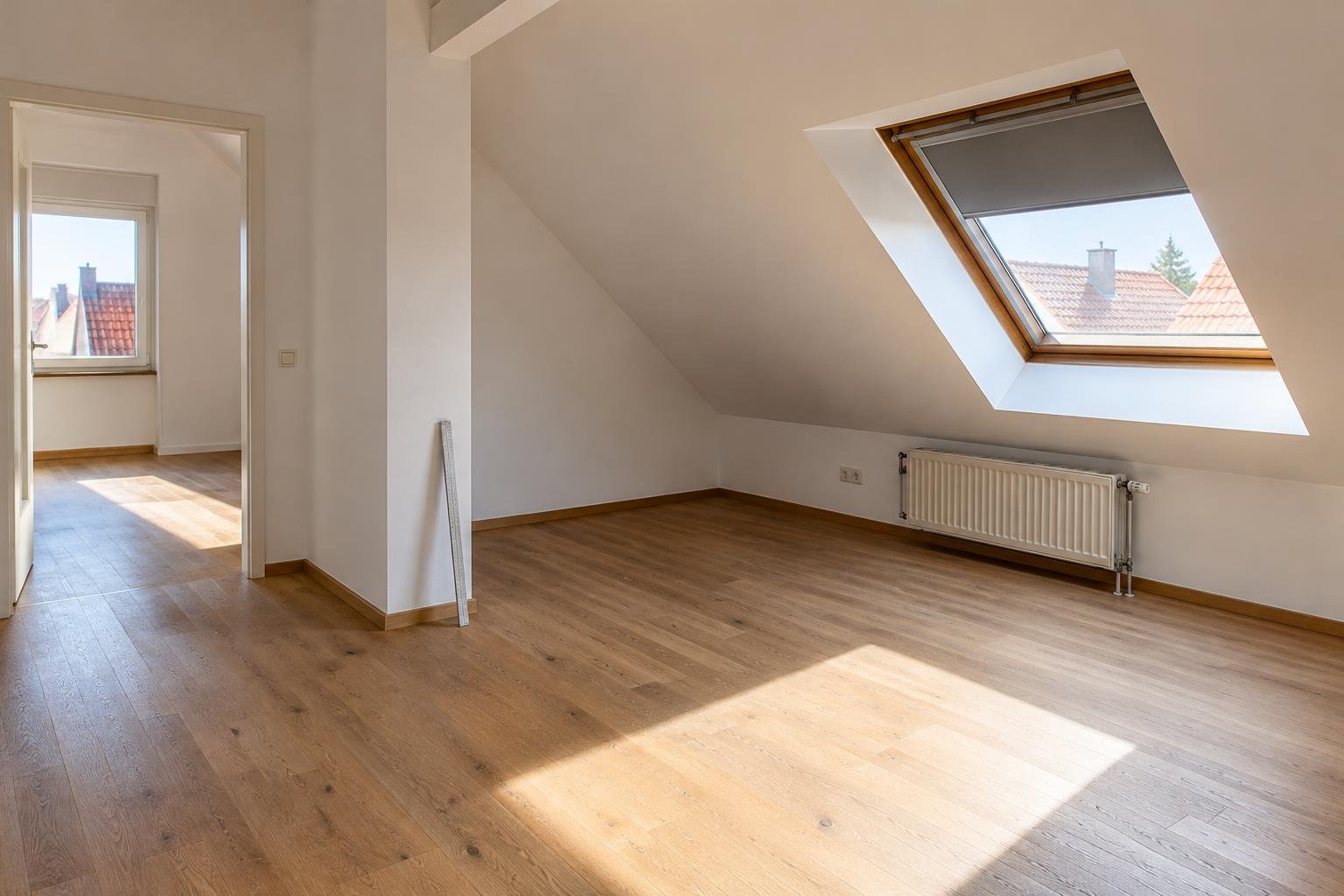
Top-floor maisonettes also have sloping ceilings to consider. Areas with a clear height of at least 2 m count in full, those from 1 m to below 2 m count at half their area, and anything below that does not count at all (section 4, points 1 and 2). Roof space with a low ridge height may therefore provide considerably less living area than floor area. The rooms must first be eligible for inclusion in the living-area calculation at all.
| Value | |
|---|---|
| Floor area occupied by the staircase on the lower level | 5 m² |
| Assumed purchase price per m² of qualifying living area | €3,300 |
| Comparative value of an additional 5 m² of qualifying living area | €16,500 |
| Assumed rent per m² of qualifying living area | €11.20 |
| Hypothetical annual rent for that additional living area | €672 |
The €16,500 is therefore not a price premium for the layout. A staircase that does not count towards the calculated living area still forms part of the usable features of the rented flat. Check whether the seller bases the price per square metre on living area under the ordinance or on an area that includes the staircase, roof space and areas under sloping ceilings in full. An overstated area makes the quoted price per square metre appear lower; it does not establish that you are paying for the staircase “twice”.
04Worked example: a maisonette as a rental property
Simplified illustrative calculation: Anna and Tobias are married and have an assumed combined taxable income of €120,000 before the result from this letting. They buy a top-floor maisonette built in 1995, with 85 m² of living area calculated under the ordinance, for €280,000. The example assumes rent of €11.20 per square metre, or €952 a month. The rent is a modelling assumption; for a specific property, achievable and legally permissible rent depends on the local market and applicable tenancy law. The names are fictional, and the figures are a worked example, not a forecast.
They borrow the full purchase price of €280,000 at an assumed interest rate of 3.8% and an initial principal repayment rate of 1.5%. They pay the assumed acquisition costs of 7%, or €19,600, from their own funds. The interest rate, repayment rate and acquisition costs are modelling assumptions, not market offers. For simplicity, interest and principal repayments are calculated on the original loan amount for the full year; their actual split changes as repayments are made.
The additional tax illustration assumes a constant tax saving of 40% of the rental loss calculated for tax purposes. This rate is purely a modelling assumption and is not derived from the €120,000 income or the spousal income-splitting tax schedule. The model assumes that the losses are offset in full against other taxable income. Actual income tax depends on section 32a of the German Income Tax Act [Einkommensteuergesetz] and personal circumstances. The solidarity surcharge and church tax are excluded from this worked example.
| Normal year | Year with a change of tenant | |
|---|---|---|
| Rent excluding service charges [Kaltmiete] | €11,424 | €8,568 |
| Interest (3.8%, simplified) | −€10,640 | −€10,640 |
| Principal repayments (1.5%, simplified) | −€4,200 | −€4,200 |
| Cash outgoings not recoverable from tenants | −€1,200 | −€1,200 |
| Refurbishment when the tenant leaves | €0 | −€4,000 |
| Cash flow before tax | −€4,616 | −€11,472 |
| Depreciation (2% on 80% of the purchase price including 7% acquisition costs) | €4,793.60 | €4,793.60 |
| Illustrative tax saving (40% of the loss for tax purposes) | €2,083.84 | €4,826.24 |
| Cash flow after illustrative tax saving | −€2,532.16 | −€6,645.76 |
In the model, the €1,200 consists exclusively of immediately deductible administration and routine maintenance expenses; it does not include contributions to the maintenance reserve. Payments into the apartment owners’ association’s maintenance reserve [Erhaltungsrücklage] are not immediately tax-deductible. A deduction can only arise when the association uses the funds for tax-deductible expenditure; the full owners’ service charge [Hausgeld] is not deductible as a single amount either. The model also assumes that the €4,000 refurbishment qualifies for immediate deduction as rental expenses. In practice, costs may need to be capitalised, for example where they fall within the rules on acquisition-related construction costs [anschaffungsnahe Herstellungskosten]. Principal repayments are not tax-deductible expenditure.
Under these assumptions, the loss for tax purposes is €5,209.60 in a normal year and €12,065.60 in the year with a change of tenant. Applying the flat 40% tax assumption gives savings of €2,083.84 and €4,826.24 respectively. Discuss the tax treatment of the costs and your personal tax position with your German tax adviser [Steuerberater].
In a normal year, Anna and Tobias contribute a rounded €385 a month before tax. Separately, the simplified model reduces the loan balance by €350 a month; this is not an additional cash receipt. After the illustrative tax saving, the monthly contribution is a rounded €211. The gross rental yield is a rounded 4.1%, calculated as €11,424 annual rent excluding service charges divided by the €280,000 purchase price, excluding acquisition costs.
A change of tenant can put substantial pressure on the figures. Three months without rent and €4,000 for refurbishment are a stress scenario here, not a statement about typical letting periods or refurbishment costs for maisonettes. In this scenario, the annual shortfall before tax is €11,472, which is €6,856 more than in a normal year.
What might suggest that years like this could be infrequent? A suitable layout may encourage tenants to stay longer, but does not guarantee it. When buying a tenanted maisonette, ask how long the existing tenancy has lasted and request records of vacancy periods. These details help inform your assessment but do not replace an examination of current local demand.
Enter the purchase price, living area calculated under the ordinance and rent, then model a change of tenant.
05What to check when buying
- 01Request the living-area calculation
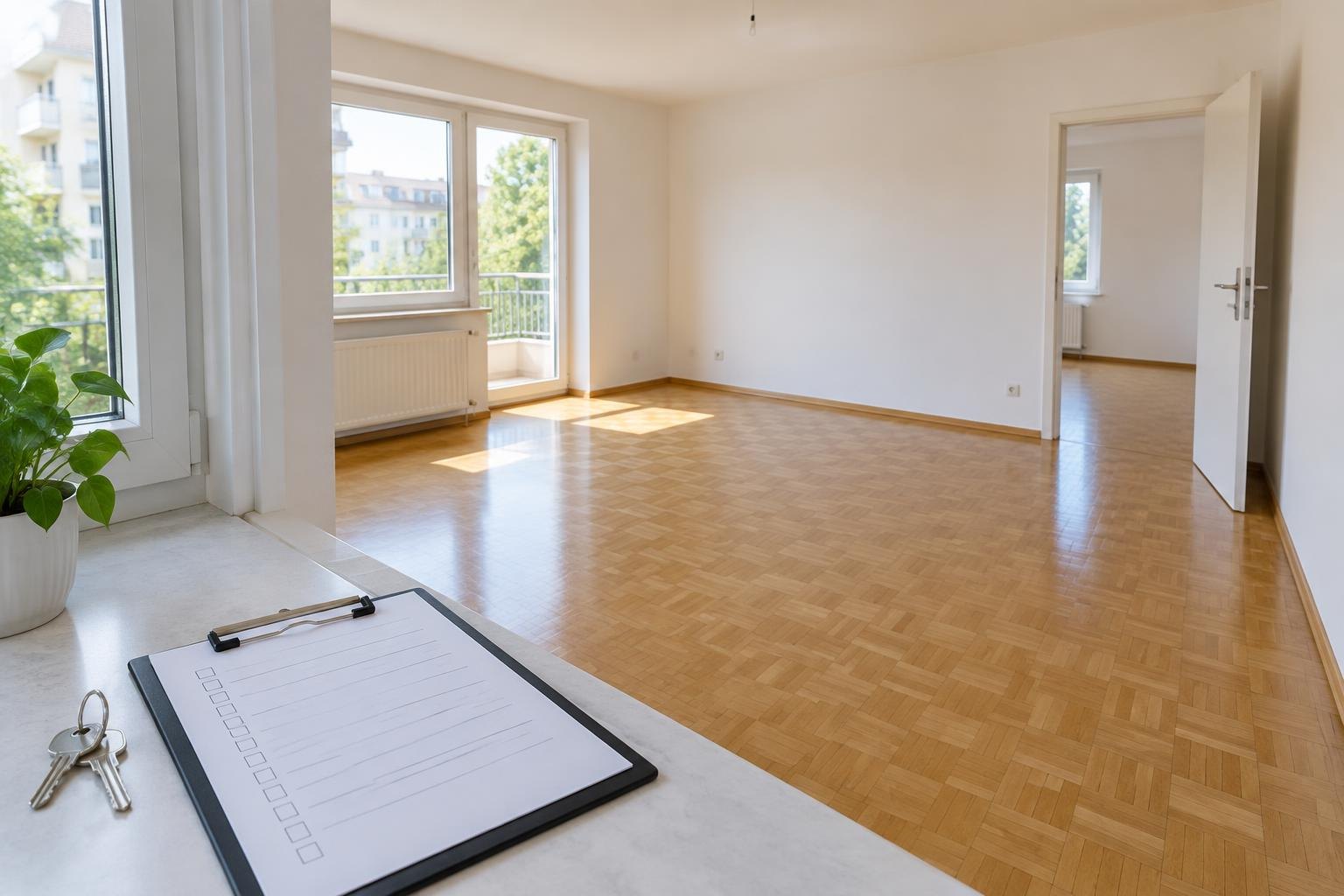
Has the staircase with more than three risers, including its landings, been excluded? Have areas under sloping ceilings been assessed under the ordinance? Use this to calculate the price per square metre of living area.
- 02Check the upper level
Is use of the roof space as a habitable room [Aufenthaltsraum] permitted under building law? Do the declaration of division [Teilungserklärung] and division plan [Aufteilungsplan] allocate the level to the unit being offered, and what use do they provide for? Building-law compliance, ownership boundaries and the living-area calculation are separate checks. Allocation to the flat does not by itself turn an attic storage room into qualifying living area.
- 03Ask about the roof and insulation
In a top-floor maisonette, the roof is directly above the upper level. Check when the roof covering was installed and read the minutes of the apartment owners’ meeting.
- 04Inspect the staircase
Steep or winding stairs may put tenants off and make moving more difficult. An easy-to-use staircase can be a letting advantage.
- 05Assess the local tenant pool
Who is looking for flats with three or four rooms in this area? Talking to a local property management company can help.
06Who a maisonette suits
- You are investing in a location where couples and families are looking for larger flats.
- The staircase is easy to use, and the main areas of the upper level have full ceiling height.
- The purchase price is compared using living area calculated under the ordinance.
- You have a financial buffer for a change of tenant involving a longer vacancy.
- Local demand is primarily for step-free accommodation, but the flat does not offer suitable access to both levels.
- The upper level is low roof space being sold with its entire floor area counted as living area.
- Your budget cannot withstand a year with three months without rent.
- You want to live in the flat yourself in old age, need step-free access and have no suitable solution for it.
07Risks of a maisonette as an investment
Potentially smaller tenant pool. Stairs may rule out some prospective tenants. This can matter more when there are more alternative flats available.
Vacancy. Finding suitable tenants for a larger flat with stairs may take longer. Whether that applies locally needs to be assessed. Budget for a reserve to cover possible vacancies.
Maintenance. The roof, roof windows and a wooden staircase may each incur costs. In a building divided into individually owned flats, the roof is common property [Gemeinschaftseigentum]; roof works may be funded through the maintenance reserve or a special levy on owners [Sonderumlage]. Check the specific allocation of costs. A payment into the reserve is not immediately tax-deductible.
Interest rates. At an assumed 4.2% rather than 3.8%, the loan in the example costs an additional €1,120 in annual interest on the simplified assumption of an unchanged €280,000 loan balance. The 4.2% rate is also only a comparison assumption, not a market quotation.
Resale. Features that restrict the tenant pool may also reduce the buyer pool. Location, ease of using the staircase and price may affect saleability; they do not guarantee a sale.
FAQFrequently asked questions
What is a maisonette flat?
In German property listings, it is a flat in a multi-unit residential building spanning at least two levels. The levels are connected by a staircase within the flat. A single entrance is not a defining requirement.
What is the difference between a maisonette and a mezzanine?
A mezzanine is an open intermediate level within a tall room. A maisonette is a flat spanning several internally connected levels and may also include a mezzanine.
Does the staircase in a maisonette count towards its living area?
Staircases with more than three risers and their landings are excluded under section 3(3), point 2 of Germany’s Living Area Ordinance (Wohnflächenverordnung). This exclusion does not apply to shorter staircases.
What are the disadvantages of a maisonette?
The staircase takes up space and may be impractical for people with limited mobility or families with young children. Top-floor accommodation may get hot in summer if protection against heat is inadequate. These factors may reduce the pool of prospective tenants compared with a similar single-level flat.
Is a maisonette a good investment?
It can be, if the purchase price is appropriate for the correctly calculated living area and there is local demand for larger flats. Assess the financing, ongoing costs and a vacancy scenario when tenants change.
Is a maisonette more expensive than an ordinary flat?
Not as a general rule. Stairs and low areas under sloping ceilings may mean that less of the floor area qualifies as living area. That alone does not establish a higher market price. Compare the price per square metre of correctly calculated living area for properties with similar locations and specifications.
How is a maisonette recorded in the land register?
The layout alone does not determine the form of ownership. If sold as a legally separate, individually owned flat, it is recorded as apartment ownership with a co-ownership share. The declaration of division and division plan identify which rooms belong to it.
08Further reading
- An individually owned flat as an investment: advantages and disadvantages
- Buying a tenanted individually owned flat
- Viewing a flat to buy: checklist
- Glossary: Living Area Ordinance
- Calculator: property cash flow
09Sources
- Living Area Ordinance, sections 2 to 4
- German Federal Court of Justice, judgment of 24 March 2004, VIII ZR 295/03 (living-area shortfall exceeding 10%)
- Section 32a of the German Income Tax Act (income tax schedule, spousal income splitting in subsection 5), section 7(4) of the German Income Tax Act (building depreciation)
- Worked examples: own calculations using the assumptions stated in each case
Note: This guide provides general information and is not a substitute for tax, legal or investment advice on your individual circumstances. The figures are simplified worked examples using the stated assumptions, not a forecast for a specific property. Discuss tax and legal questions with your German tax adviser or lawyer respectively.
Writes about Existing properties, Investment calculations and Property assessment.
Rula has worked in financial services since 2021. He focuses on existing investment properties, transparent calculations and an honest assessment of building condition and running costs.
This guide does not replace tax or legal advice. All figures are example calculations with disclosed assumptions.