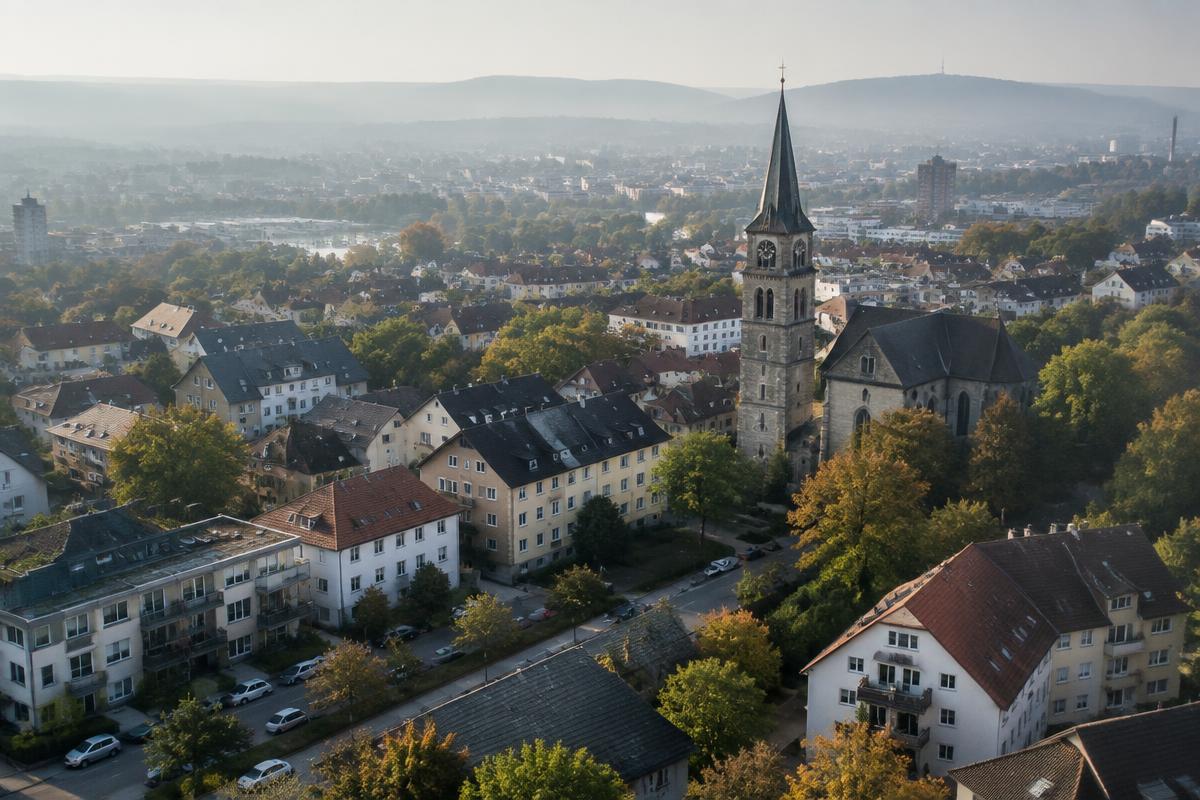
Commuter Belt: Invest in Property Outside or Within the City?
In the commuter belt, you get more flat for your money, and rents sometimes even exceed those in the city. We use official figures to show where this holds true and where the surrounding area becomes an investment trap.
 Romolo Marini
Investment Advisor at InvestImmo
You live in the city and see what a two-room flat costs there. Twenty-five kilometres further out, with an S-Bahn connection, the same money gets you three rooms and a balcony. The obvious question is: is the commuter belt the better investment?
Sometimes, yes. In some municipalities around Berlin, rents under existing tenancies are actually above the Berlin average. A few dozen kilometres further out, however, they fall to half that level. The affluent commuter belt is not a uniform area but a narrow ring, and its boundary often follows a railway line.
Here we explain what the term means, what official rent figures show for Berlin, Hamburg and München, and how a flat in the commuter belt compares with one in the city when you invest the same amount.
01What is the affluent commuter belt?
“Speckgürtel” is a colloquial German term for the area surrounding a major city. It refers to places where many families and high earners move because housing is cheaper and surroundings are greener, while their jobs remain in the city. The “Speck”, literally “bacon” or “fat”, represents the purchasing power and tax revenue these places gain.
There is no official boundary. In Brandenburg, the statistics distinguish between the “Berlin surrounding area” and the “wider metropolitan area”. In everyday terms, what matters is the distance a commuter can cover in around an hour. For property investors, this is the most important boundary, as it usually marks the limit of demand from tenants who work in the city.
| Term | What it means | Typical implications for investors |
|---|---|---|
| Major city | Urban core with jobs and universities | high purchase prices, small flats, strong demand |
| Affluent commuter belt / surrounding area | neighbouring municipalities with direct rail or motorway connections | more space for the money, tenants often families and commuters |
| Wider metropolitan area | places without a fast connection to the city | low prices, but weaker demand |

02What official rent figures show
The 2022 Census calculated the average net rent excluding service charges for all rented homes in each municipality. These are rents under existing tenancies from May 2022, not today’s advertised rents. This makes them particularly useful for comparing cities and their surrounding areas, because every location was surveyed using the same methodology.
Berlin and Brandenburg
The pattern is clearest here. Municipalities directly on the city boundary are above the Berlin average. Further out, rents are barely sufficient to support mortgage financing.
| Location | Setting | Net rent excluding service charges per m² |
|---|---|---|
| Schönefeld | Commuter belt, BER airport | €9.28 |
| Kleinmachnow | Commuter belt, south-west | €8.43 |
| Falkensee | Commuter belt, west | €8.40 |
| Potsdam | State capital | €7.85 |
| Berlin | Urban core | €7.67 |
| Oranienburg | Commuter belt, north | €6.63 |
| Prenzlau | Uckermark | €5.45 |
| Schwedt/Oder | Uckermark | €5.11 |
| Wittenberge | Prignitz | €5.07 |
New-build housing also stands out. Homes built from 2010 onwards commanded an average rent of €10.84 per square metre in the Berlin surrounding area, compared with €7.94 in the wider metropolitan area. The same new-build property therefore generates a rent difference of almost €3 depending on which ring it is in.
Hamburg and Schleswig-Holstein
Hamburg recorded €9.16 per square metre, with a vacancy rate of just 1.9%. Stormarn district, north-east of the city, topped Schleswig-Holstein at €8.65. In Dithmarschen district on the west coast, the figure was €6.12. The state as a whole recorded €7.41 and a vacancy rate of 2.73%.
München and Upper Bavaria
In the south, the gradient is reversed. According to the figures cited when Bavaria’s census results were presented, München stood at €12.89, but Bavaria’s most expensive municipality was Neubiberg in München district, at €13.84. Upper Bavaria as a whole recorded €10.95, compared with €5.99 in Upper Franconia.
03Worked example: the same investment, city versus commuter belt
„It really does need to be near me.“
We often hear this when discussing locations. For many city dwellers, “near me” means the commuter belt: accessible by train, but significantly cheaper than their own street.
Take Jana Wolff. The name is fictional, and the figures are a worked example, not a forecast. She is assessed individually for tax on an annual income of €70,000, has €30,000 for purchase costs and borrows €300,000. She compares two flats in the same federal state.
The city flat has 60 square metres at €5,000 per m² and generates rent excluding service charges of €14 per m². The commuter-belt flat has 80 square metres at €3,750 per m² and generates rent excluding service charges of €11.50 per m². The land accounts for a larger share of the value in the city, so she assumes a building share of 65% there, compared with 80% in the commuter belt.
| Major city | Affluent commuter belt | |
|---|---|---|
| Purchase price | €300,000 | €300,000 |
| Living space | 60 m² | 80 m² |
| Annual rent excluding service charges | €10,080 | €11,040 |
| Gross rental yield | 3.36% | 3.68% |
| Non-recoverable costs, maintenance | −€1,500 | −€1,800 |
| Interest | −€11,400 | −€11,400 |
| Principal repayment | −€4,500 | −€4,500 |
| Annual result before tax | −€7,320 | −€6,660 |
| Depreciation allowance of 2% on the building share of €330,000 | −€4,290 | −€5,280 |
| Tax loss | −€7,110 | −€7,440 |
| Tax saving on taxable income of €70,000 (single, section 32a of the Income Tax Act (EStG), 2026) | +€2,902 | +€3,032 |
| Annual result after tax | −€4,418 | −€3,628 |
| Per month | −€368 | −€302 |
In the commuter belt, Jana Wolff contributes around €66 less per month out of her own pocket. There are two reasons for this: the larger flat generates more rent, and the higher building share provides a larger depreciation allowance. Both options include €4,500 in principal repayments, which builds equity.
The advantage is slim, however. It depends on the commuter-belt flat remaining let just as reliably as the city flat.
A single change of tenant involving three months of vacancy in the commuter belt wipes out more than three years of that advantage. So the question is not “city or countryside”, but: how quickly can I find a new tenant in this location?
04How to identify a good commuter-belt location
A commuter-belt location depends on the city. It needs a fast, reliable connection to it, as well as reasons of its own for people to stay. These steps will help you assess it.
- 01Measure journey times
How long does it take to reach the city centre by train and car during rush hour? Under 45 minutes on a direct train is in a different league for commuters from 70 minutes with a change.
- 02Local jobs
Are there local employers, business parks, an airport or research facilities? Schönefeld, with BER airport, shows what this means for rents.
- 03Check vacancy rates and population figures
The state statistical offices publish population trends and census vacancy rates for each municipality. Is the location growing, or slowly shrinking?
- 04New builds in the pipeline
Many commuter-belt municipalities designate large areas for development. Ask the local planning office how many homes are due to be built over the next few years. A large amount of new supply puts downward pressure on rents for older flats.
- 05Clarify your target tenants
Families and couples often look for larger flats in the commuter belt. A small one-room flat without a nearby railway station is harder to let there than in the city.
A quick test: check how many comparable flats are currently advertised on property portals and how long they have been online. If many listings have been there for weeks, demand is weaker than the average rent suggests.
05Who the commuter belt suits — and who it does not
- You want more living space for the same money and tenants who are families and commuters.
- The town has a direct rail connection and local employment opportunities.
- You know the region and can assess it yourself, or you have a local property management company.
- You allow for periods without tenants and do not base your calculations on wafer-thin margins.
- The town is outside a reasonable commuting radius, and the rent is high only on paper.
- The municipality is currently building hundreds of new homes in the immediate neighbourhood.
- You are looking for small flats for students or single people.
- The figures only stack up if the flat is continuously let.
06Risks: what to watch out for in the surrounding area
Void periods between tenancies. The pool of prospective tenants is smaller in the surrounding area. In this example, an extra month without a tenant costs €920.
Dependence on transport links. If a rail service is withdrawn, services become less frequent or commuting costs rise, demand falls. You cannot predict this, but you can check how many connections are available today.
Waves of new construction. Large development sites bring many new homes onto the market at once. Older flats in the neighbourhood then have to compete on price.
Regulation. In many federal states, rent controls on new lettings and reduced caps on rent increases apply not only in major cities but also in surrounding municipalities with tight housing markets. Check your federal state's regulations.
Interest rates. As with any flat bought with a mortgage, refinancing can become more expensive. The narrower the financial advantage, the greater the impact.
Resale. The pool of buyers for a flat in the surrounding area is smaller than in the city. If you need to sell in a few years, you may need more time or have to make concessions on price.
FAQFrequently asked questions
What does commuter belt mean?
Commuter belt is a colloquial term for the affluent area surrounding a major city. It refers to municipalities with good transport links where many families and high earners move while continuing to work in the city.
Is a flat in the commuter belt a good investment?
That depends on the location. According to the 2022 Census, some municipalities directly on the city boundary with rail connections have higher rents than the city itself. In places without a fast connection, however, rents and demand fall significantly. Check transport links, employment opportunities, vacancy rates and planned new developments.
Which places belong to Berlin’s commuter belt?
Typical surrounding municipalities include Potsdam, Kleinmachnow, Falkensee, Schönefeld, Hoppegarten, Glienicke/Nordbahn and Hohen Neuendorf. Official statistics refer to the “Berlin surrounding area”. Read more about the city itself in Property investment in Berlin.
Which places belong to Hamburg’s commuter belt?
Primarily municipalities in the districts of Stormarn, Pinneberg, Segeberg and Herzogtum Lauenburg, as well as those south of the Elbe in the district of Harburg. According to the 2022 Census, Stormarn had the highest average rent in Schleswig-Holstein at €8.65 per m².
Is the area surrounding Munich cheaper than Munich itself?
Often in terms of purchase prices, but not necessarily in terms of rent. According to the census results for Bavaria, Neubiberg in the district of Munich, at €13.84 per m², was even above the city of Munich at €12.89.
Does the rent brake also apply in the commuter belt?
In many federal states, yes. State governments determine by statutory regulation which municipalities have a tight housing market. These often include municipalities surrounding major cities. Check the current regulation for your federal state.
How far from the city can the commuter belt extend?
There is no fixed boundary. Journey time is what matters, not the distance in kilometres. Places with a direct rail connection and a journey time of under an hour to the city centre usually benefit from the city; further out, demand declines noticeably.
07Further reading
- Assessing the immediate location: how to evaluate a flat's location
- Location analysis for property
- Cities compared: where property investment pays off
- Property investment in Brandenburg
- Property investment in Schleswig-Holstein
- Glossary: rent controls on new lettings
08Sources
All sources accessed on 14 October 2026.
- Amt für Statistik Berlin-Brandenburg: 2022 Census, rents in Berlin and Brandenburg, release dated 21 August 2024 (reference date: 15 May 2022)
- Statistikamt Nord: Statistics Update No. 85/2024, “2022 Census in Hamburg”, and No. 86/2024, “2022 Census in Schleswig-Holstein”, 25 June 2024
- 2022 Census in Bavaria: presentation of the results by the Ministry of the Interior and the State Statistical Office on 28 June 2024 (figures for München and Neubiberg based on press reports)
- Statistisches Bundesamt: 2022 Census, average net rent excluding heating and service charges in Germany: €7.28 per m²
- Section 32a of the German Income Tax Act (EStG), gesetze-im-internet.de
- Keyword data: Semrush, Germany database, as at 14 October 2026
Disclaimer: This guide provides general information and is not a substitute for tax or legal advice. All figures are illustrative calculations based on disclosed assumptions, as at 14 October 2026.
Writes about Financing and Taxes.
Romolo brings almost 17 years of banking and financing experience, including leading around 145 sales staff, to his work. He writes about financing, taxes and property decisions that fit your life for the long term.
This guide does not replace tax or legal advice. All figures are example calculations with disclosed assumptions.