Pets in rented flats: what landlords need to consider
When landlords must consent, which conditions may be appropriate and how to document damage. Includes a simplified worked example of repair costs and tax relief.
 Andriy Bezborodko
Managing Director of the InvestImmo Group
0 | valid blanket bans | on dogs and cats in standard-form tenancy agreements 6 months | limitation period | generally for claims concerning damage to the flat after possession is recovered 3 | months’ rent excluding service charges | maximum agreed tenancy deposit, including where pets are kept €1,800 | illustrative repair cost | before reimbursement and tax relief
The applicant seems ideal: a steady job, good documentation and a pleasant manner. Then, at the end of the viewing, she says: ‘By the way, I have a Labrador.’ Your old tenancy agreement says ‘Dogs and cats are not permitted’. You wonder whether that still applies.
The short answer: not as a blanket standard-form clause. But that does not mean you have to accept every animal. Between a ban and unrestricted permission lies a balancing exercise that landlords should document carefully.
A blanket ban on dogs and cats in a standard-form tenancy agreement is invalid (BGH VIII ZR 168/12). Tenants can generally keep ordinary small pets, such as fish, hamsters or budgerigars, without permission, provided their number and the conditions in which they are kept remain within normal limits and cause no significant disturbance or danger. For dogs and cats, the decision requires an individual assessment: the animal’s type and size, the flat’s layout, neighbours’ interests and your previous approach all matter. A valid consent requirement and written permission with reasonable conditions can be useful. Tenants may be liable for pet damage that exceeds normal wear and tear where the requirements for a claim are established.
01What applies without a valid clause
Tenants may use the flat as agreed in the tenancy agreement (§ 535(1) of the German Civil Code [BGB]). The legislation does not expressly specify what this means for pets. The Federal Court of Justice [BGH] has therefore developed principles.
Small pets can generally be kept without permission. This means ordinary animals living, for example, in cages, aquariums or terrariums that cause no significant disturbance or danger: ornamental fish, hamsters, guinea pigs and budgerigars (BGH VIII ZR 340/06). Their number and the conditions in which they are kept also matter. Twenty rabbits may exceed normal limits; this does not establish a universal numerical threshold. Not every animal kept in a terrarium automatically qualifies as a small pet that requires no permission.
Dogs and cats are the contentious cases. If the agreement contains no valid provision, a comprehensive balancing of interests is required. The court identifies factors including the animals’ type, size, behaviour and number, the location and condition of the flat and building, the interests of other occupants and neighbours, the landlord’s previous approach and the tenant’s particular needs (VIII ZR 168/12).
Dangerous or exotic animals require a separate assessment. For venomous snakes or dogs classified as dangerous under the relevant German state’s law, specific safety risks and public-law requirements may weigh against keeping them. Being ‘exotic’ is not, in itself, sufficient grounds for refusal; the animal, its living conditions and the individual circumstances remain decisive.
02Which tenancy clauses are valid?
Clauses in standard-form tenancy agreements must not place tenants at an unreasonable disadvantage (§ 307 BGB). This has clear implications for pets.
| Clause | Valid? | Why? |
|---|---|---|
| ‘Dogs and cats are not permitted.’ | No | Blanket ban without a balancing of interests (BGH VIII ZR 168/12) |
| ‘Keeping any animal requires consent.’ | Legally problematic | Includes small pets that do not require permission (BGH VIII ZR 340/06) |
| ‘Dogs and cats require the landlord’s consent; small pets are permitted.’ | Depends on the precise wording | Small pets are excluded; the consent requirement must allow an objective assessment of individual circumstances |
| Consent at the landlord’s ‘sole discretion’ | Legally problematic | The assessment must be based on objective grounds |
An invalid clause cannot generally simply be narrowed to an acceptable meaning. Whether separable parts remain effective depends on its structure. If no valid provision for dogs and cats remains, an individual balancing of interests applies.
The practical implication: a validly worded consent requirement for dogs and cats, expressly excluding small pets that need no permission, creates a structured opportunity for assessment. The tenant must then obtain the required consent; any conditions must be objectively justified and legally permissible. A blanket ban offers only a false sense of security. Seek a lawyer’s advice on the contractual wording where necessary.
03Consent or refusal: balancing the interests
Whether you may refuse or must consent depends on a comprehensive assessment of the specific interests involved. Three questions help in practice.
Is the animal suited to the flat? A cat in a 70 m² flat presents a different situation from two large dogs in a studio flat. The position within the building, garden, stairwell and flooring may matter. Neither the size of the flat nor the animal’s size decides the case alone.
How are other occupants affected? A neighbour’s documented allergy, a narrow stairwell or specific complaints about barking may be relevant. What matters is the actual impact expected or already evidenced. Other tenants’ mere dislike of animals is insufficient.
What has your previous approach been? If you have allowed another tenant in the same building to keep a dog, that is a factor in the assessment. Differences in the animal or the conditions in which it is kept may nevertheless justify a different decision.
Assistance and therapy dogs require particular consideration. A tenant’s evidenced disability-related or therapeutic needs may carry considerable weight. The label alone does not establish that need or replace an individual assessment.
If you refuse consent, set out the specific reasons in a short letter. This demonstrates that you have considered the interests involved and may help if the tenant brings a claim for consent.
04Consent with conditions: how to structure it
Consent is not a blank cheque. You can make it specific to the animal and attach objectively justified, reasonable conditions. A short statement might read as follows. The illustrative wording must suit the individual circumstances.
The landlord consents to the keeping of the dog ‘Bruno’ (Labrador, born in 2023) in the flat. This consent applies only to this animal. Where proof of pet owner’s liability insurance is required by law or under a valid agreement, the tenant will provide the relevant evidence. Withdrawal of consent may be considered in the event of significant disturbance to other occupants or significant damage exceeding normal wear and tear, provided withdrawal is legally permissible and proportionate following an assessment of the individual circumstances.
Three points matter. Consent relates to a particular animal, not dogs in general. Withdrawal needs substantial grounds and must be proportionate; a change of mind is not enough. An additional pet deposit demanded by the landlord must not circumvent the statutory cap on agreed tenancy security: three months’ rent excluding service charges [Nettokaltmiete] (§ 551 BGB). Whether an insurance requirement can be validly agreed depends on the specific agreement; cover for damage to rented premises cannot be assumed either. Consult a lawyer about conditions or withdrawal of consent.
- Obtain a written request Ask for the animals’ type, breed, size, age and number; for dogs, obtain evidence of liability insurance where legally required.
- Assess the building and flat Consider flooring, location, specific effects on neighbours and previous permissions in the building.
- Decide and explain Give consent with permissible conditions or refuse with specific reasons, recording either decision in text form.
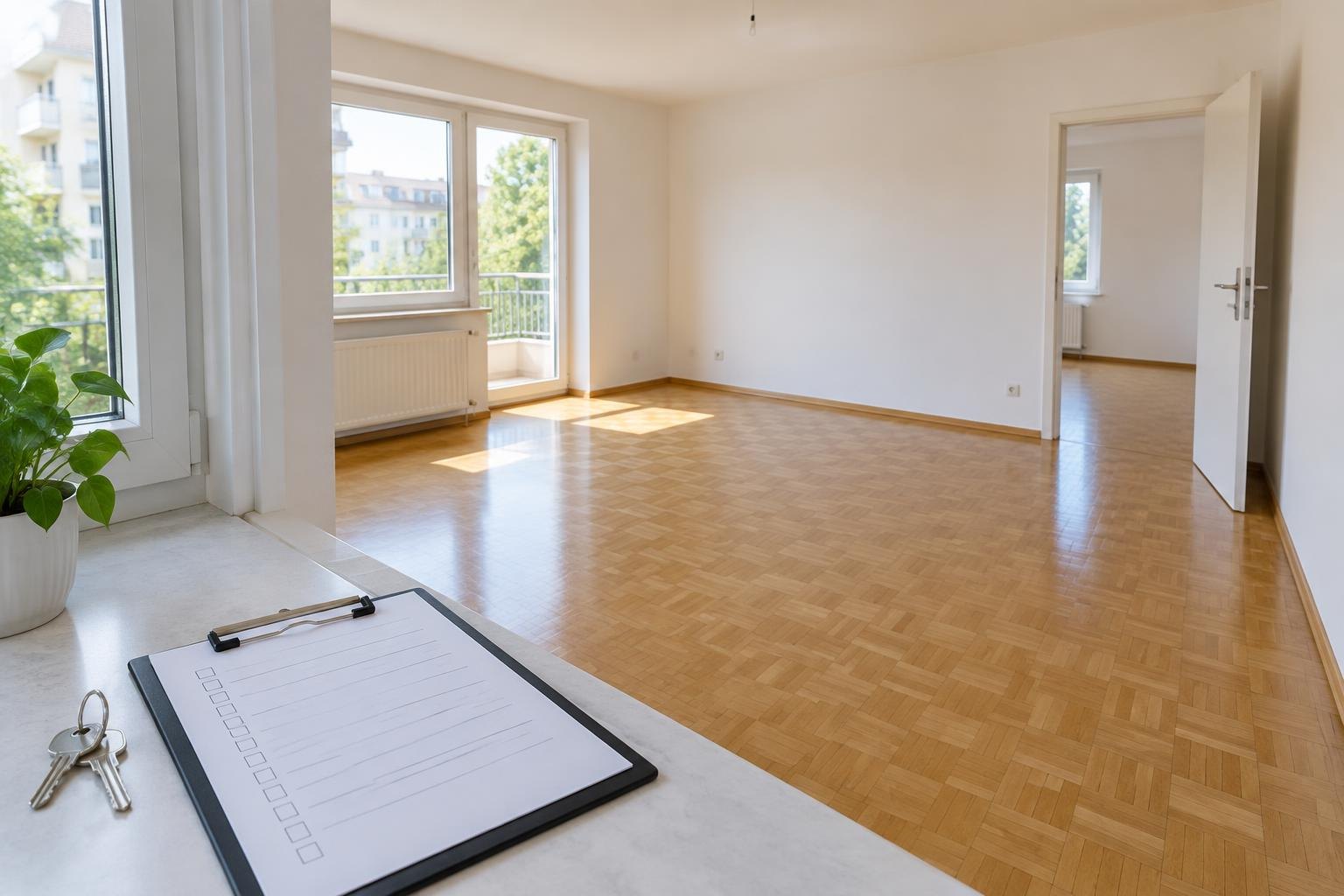
- Document the condition Record floors, doors and frames in the check-in inventory [Übergabeprotokoll], with photographs.
- Respond to problems Establish the facts and discuss the issue first; where complaints are justified, consider a formal warning and, if necessary, a claim for an injunction (§ 541 BGB).

05Worked example: dog damage with and without evidence
Illustrative calculation, simplified. Ms Albers lets a 65 m² flat with oak parquet flooring for €750 a month excluding service charges, or €9,000 a year. She has consented to a dog. The tenant leaves after four years. The living-room parquet has deep scratches, and sanding and sealing costs €1,800. The name is fictional; the figures illustrate a calculation and are not a forecast.
Tenants do not have to compensate landlords for normal wear and tear (§ 538 BGB). Whether claw marks exceed that depends, among other things, on their extent, the flooring and the agreed use of the property. A check-in inventory with photographs may establish the initial condition, but does not by itself prove liability or the amount recoverable. Other forms of evidence are also possible.
For this comparison, the first scenario expressly assumes that Ms Albers can establish a valid compensation claim for the full €1,800 and validly set it off against the €2,250 deposit in the same year. The example makes no deduction for betterment or the age of the flooring. The second scenario assumes that insufficient evidence makes the claim unenforceable. These are modelling assumptions, not automatic consequences of having or lacking a photograph.
She has borrowed €180,000 at an assumed interest rate of 3.8% and repays 1.5% of that starting amount in the simplified annual model. The calculation therefore uses fixed annual figures of €6,840 interest and €2,700 principal repayments; it does not reproduce an actual repayment schedule after four years. The 3.8% rate is an illustrative assumption, not a current market quotation. First, the cash flow before tax.
For the taxable-result rows, the €1,100 of costs not recoverable from tenants is assumed to consist entirely of expenditure actually incurred and immediately deductible. It excludes contributions to the owners’ association maintenance reserve [WEG-Erhaltungsrücklage]: paying into the reserve is not immediately deductible; only actual qualifying expenditure from it may be recognised. Nor are the full service-charge payments to the owners’ association [Hausgeld] automatically deductible. The assumed annual depreciation allowance [AfA] of €3,600 is calculated using an illustrative building depreciation base of €180,000 and a depreciation rate of 2%. The land element is not depreciated. The repair is treated, for simplicity, as immediately deductible maintenance expenditure. In the first scenario, the repair and an equal reimbursement are recognised in the same year; the table shows the net amount of €0.
To illustrate the tax effect, the calculation uses an assumed flat tax-relief rate of 35% on the rental loss. It assumes that the loss can be fully offset against other positive income in the same year. This is not a calculation under the progressive income tax tariff in § 32a of the German Income Tax Act [EStG]. Church tax and the solidarity surcharge are excluded from the model. The actual tax effect depends on your personal circumstances.
| Damage substantiated | Damage not substantiated
Rent excluding service charges | €9,000 | €9,000 Interest (3.8% of €180,000) | −€6,840 | −€6,840 Principal repayments (1.5% of €180,000) | −€2,700 | −€2,700 Costs not recoverable from tenants | −€1,100 | −€1,100 Sanding and sealing parquet, after reimbursement | €0 | −€1,800 = Cash flow before tax | −€1,640 | −€3,440 ~ Taxable result with assumed depreciation of €3,600 | −€2,540 | −€4,340 ~ Illustrative tax relief at an assumed 35% | +€889 | +€1,519 = Cash flow after tax in the simplified model | −€751 | −€1,921
Illustrative calculation, simplified: tax relief is calculated as €2,540 × 35% = €889 and €4,340 × 35% = €1,519 respectively. Principal repayments are not deductible; depreciation creates no current cash outflow. The calculation assumes immediately deductible expenditure, full loss offset and tax relief in the same year.
Under these modelling assumptions, repair expenditure borne by the landlord is deductible against rental income. The additional illustrative tax relief is €1,800 × 35% = €630. This leaves €1,800 − €630 = €1,170 for the landlord to bear. That also equals the difference between the two after-tax cash flows. This is a simplified model, not a guaranteed tax saving or a compensation claim automatically secured by taking a photograph. Ask your tax adviser to assess the deductibility of the costs and your personal tax position.
Repair borne by landlord | -1800 | −€1,800 Illustrative tax relief at 35% | 630 | +€630 Additional after-tax cost in the model | -1170 | −€1,170
Illustrative calculation, simplified: €1,800 in repair costs less €630 in illustrative tax relief leaves €1,170 for the landlord to bear. The assumptions explained above apply.
The example illustrates the potential financial value of good documentation. It neither prevents damage nor guarantees compensation. The repair is financially neutral for Ms Albers only under the express assumption here of full reimbursement.
06When consent may be appropriate
The following points inform the balancing exercise; they are not automatic grounds for permission or refusal.
- The flat has durable flooring and a suitable layout.
- The proposed arrangements appear compatible with the property; any required liability insurance evidence is available.
- You record the condition at check-in with photographs; this improves the evidence but does not replace the balancing exercise.
- Several large dogs in a small flat, where specific adverse effects are expected.
- Neighbours with a documented animal allergy or a very narrow stairwell, where these create specific conflicts or risks.
- Animals classified as dangerous under the relevant state’s law, where there are material safety risks or conflicting legal requirements.
07Risks and common mistakes
An invalid tenancy clause. A blanket ban does not protect you. In a dispute, the interests must be balanced. Check your tenancy agreement, for example using our guide to invalid tenancy clauses.
Different decisions within the building. Previous consent is a relevant factor, but does not automatically entitle other tenants to permission. Document objective differences, such as the animal’s behaviour or the conditions in which it is kept.
The six-month limitation period. Claims for changes to or deterioration of the flat generally become time-barred six months after the landlord recovers possession (§ 548 BGB). Merely sending a demand for payment does not suspend the limitation period. Case law allows set-off against a claim for repayment of a cash deposit after limitation in certain circumstances (BGH VIII ZR 184/23); this is not a general extension of the deadline. Obtain timely advice from a lawyer on the measures required, particularly if the deposit is insufficient. Read more in our guide to holding a tenancy deposit.
Damage or wear and tear? Minor signs of use are part of normal occupation, including with a pet. Tenants may be liable for damage beyond that; causation, responsibility and the recoverable amount must be established. A good property handover record at check-in and check-out is important evidence.
Disturbance within the building. If a dog barks for hours or fouls the stairwell, a formal warning and possibly withdrawal of consent may be considered after assessing the severity, evidence and proportionality. Our guide to issuing a formal warning to a tenant explains how to address complaints.
A blanket ban on dogs and cats in a standard-form tenancy agreement is not a reliable basis for managing pets. A valid consent requirement, a documented assessment of individual circumstances, written permission for the particular animal and a thorough check-in inventory with photographs are more useful. Evidence of liability insurance may also be required by law or under a valid agreement. The simplified example involves €1,800 in repair costs; assuming tax relief of 35%, the landlord bears €1,170 if there is no reimbursement. Do not refuse merely because an animal is involved: assess the flat, building and specific interests. Documentation and a deposit can limit financial risk, but cannot guarantee full recovery.
FAQFrequently asked questions
Can landlords impose a blanket ban on dogs and cats?
Not through a blanket prohibition in a standard-form tenancy agreement: such a clause is invalid. Whether the animal must be permitted depends on a comprehensive balancing of interests, including the animal, flat, specific effects on neighbours and the tenant’s particular needs. The size of the flat alone does not decide the matter.
Which animals can tenants keep without permission?
Ordinary small pets such as fish, hamsters, guinea pigs and budgerigars generally require no permission if their number and living conditions remain within normal limits and cause no significant disturbance or danger. Not every animal kept in a terrarium automatically qualifies.
Can I demand a higher deposit because of a dog?
An additional pet deposit demanded by the landlord must not circumvent the statutory cap of three months’ rent excluding service charges for agreed tenancy security (§ 551 BGB). A dog does not, by itself, create a right to increase an existing deposit. Whether evidence of liability insurance can be required depends on statutory obligations or a valid agreement.
Can I withdraw consent once it has been given?
Withdrawal may be considered where there is significant disturbance or damage, but it is not automatically permissible. The grounds, evidence, terms of the consent and proportionality are decisive. A withdrawal clause alone does not permit arbitrary withdrawal; a request to remedy the problem and a formal warning may first be necessary. Seek advice from a lawyer.
What should I do if a tenant keeps a dog without permission?
First check whether a valid consent requirement exists and, if appropriate, ask the tenant to apply. If consent should be granted, its absence does not automatically justify removing the dog. Where there are substantial grounds for refusal and use in breach of the tenancy continues after a formal warning, an injunction claim under § 541 BGB may be possible.
Who pays for damage caused by pets?
The tenant may be liable for damage exceeding normal wear and tear if causation, responsibility and the recoverable amount are established. A check-in inventory helps but is not the only possible evidence. Compensation claims generally become time-barred six months after the landlord recovers possession; merely sending a demand does not suspend the limitation period. Set-off against a cash deposit may remain possible later in certain circumstances.
Are repairs following pet damage tax-deductible?
Repairs related to letting and paid for by the landlord may be deductible against rental income, but an immediate deduction is not available in every case. If the tenant or insurer pays directly, the landlord incurs no corresponding expenditure. If the landlord receives reimbursement for repairs they paid for, both expenditure and reimbursement must be recognised for tax purposes; timing may matter. Contributions to the owners’ association maintenance reserve are not immediately deductible, and its service-charge payments are not deductible in full. Discuss the treatment of your individual circumstances with your tax adviser.
08Further reading
- Invalid clauses in tenancy agreements
- Property handover record
- Holding a tenancy deposit
- Issuing a formal warning to a tenant
- Property handover record to download
09Sources
- § 535 BGB and § 538 BGB (use of rented premises, wear and tear)
- § 307 BGB (assessment of standard-form contract terms)
- § 541 BGB, § 548 BGB, § 551 BGB (injunction claims, limitation, tenancy deposits)
- BGH, judgment of 20 March 2013, VIII ZR 168/12 (blanket bans on dogs and cats), via dejure.org
- BGH, judgment of 14 November 2007, VIII ZR 340/06 (small pets), via dejure.org
- BGH, judgment of 10 July 2024, VIII ZR 184/23 (set-off against a deposit after limitation)
- § 32a EStG (income tax tariff)
- Worked example: simplified annual model using the assumptions explained above, including an illustrative flat tax-relief rate of 35%.
This guide covers German tenancy and tax law and does not replace individual legal, tax or investment advice. The sample wording is illustrative; the figures use the modelling assumptions explained above. Consult a lawyer about contractual wording and enforcing claims, and your tax adviser about tax treatment.
Writes about Taxes, AfA (depreciation), Financing and Investment concept.
Andriy is Managing Director of the InvestImmo Group and has been an entrepreneur in the property industry since 2020. His experience in estate agency, property marketing and his own investments shapes his view on property selection and long-term investment concepts. His team handles the personal advice for investors.
This guide does not replace tax or legal advice. All figures are example calculations with disclosed assumptions.