
§ 548 BGB: Protecting Landlord Damage Claims
Property return, limitation and rental deposits: the distinctions that matter to rental-property investors.
 Romolo Marini
Investment Advisor at InvestImmo
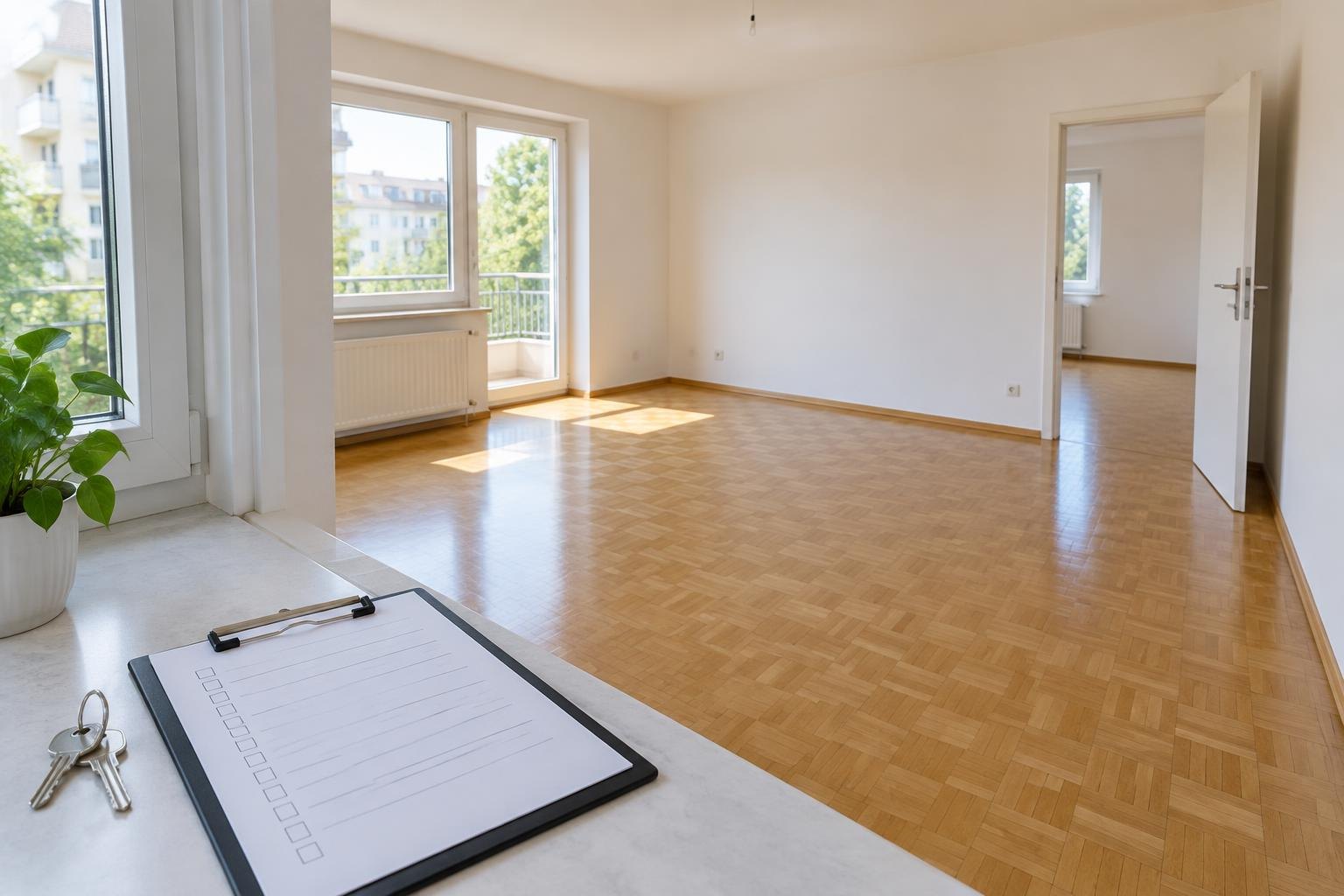
Illustrative scenario: Your tenant returns the apartment at the end of April. During the inspection, you notice scratches in the parquet, a damaged internal door and poorly filled drill holes. You request quotations, contractors are busy, and summer passes. You first demand compensation in November. The former tenant invokes limitation.
That defence may succeed. Claims arising from alterations or deterioration generally fall under the short period in § 548 BGB. The crucial event is recovery of possession, not simply moving out or the contractual end date. Whether compensable damage exists and whether limitation has expired are separate questions. Limitation generally gives the debtor a right to refuse performance rather than automatically extinguishing the claim. §§ 548 and 214 BGB
01What § 548 BGB covers
A landlord’s claims for compensation arising from alterations or deterioration generally become time-barred six months after recovery of the rented property. For a tenant’s claims for reimbursement of expenditure or removal of an installation, the six-month period instead starts when the tenancy ends. § 548 BGB does not itself create these claims: their existence depends on other provisions and agreements. § 548 BGB
Recovery depends on actual possession and the ability to inspect. Handing over the keys is often decisive, and an early return can start the period before the tenancy ends. Furniture left behind or keys deposited in a letterbox cannot be assessed using an absolute rule. Record the keys, access arrangements, remaining objects and each party’s apparent intentions. The apartment’s condition and the question of whether it has been returned are not necessarily the same issue. § 548(1) BGB
Practical organisation: Record the return date and the deadline separately. Have the precise expiry checked under the statutory calculation rules. A calendar reminder saying “six months later” is not a substitute: month-end dates, weekends and public holidays can matter. §§ 187–193 BGB
02Which claims are affected?
Not every tenancy-related claim falls under § 548 BGB. Its legal basis and relationship to the property’s condition matter. Under the ordinary limitation rules, accrual of the claim generally needs to be accompanied by knowledge, or grossly negligent lack of knowledge, of the relevant circumstances and debtor.
| Claim | General rule | Starting point |
|---|---|---|
| Compensation for damage to floors, doors or sanitary fittings | 6 months | Recovery of possession |
| Compensation for omitted, validly owed Schönheitsreparaturen | Generally 6 months | Recovery of possession |
| Condition-related removal and reinstatement claims | Generally 6 months; classification needs checking | Recovery of possession |
| Rent arrears | Generally 3 years | Year-end under §§ 195, 199 BGB |
| Additional Betriebskosten payment | Generally 3 years | Year-end once the claim has accrued, is due and knowledge requirements are met |
| Nutzungsentschädigung under § 546a BGB | Generally 3 years | Year-end under §§ 195, 199 BGB |
Legal basis: BGB, particularly §§ 195, 199, 546a and 548. Individual claims may require legal classification. Schönheitsreparaturen means contractual decorative maintenance; Betriebskosten are operating costs; Nutzungsentschädigung is compensation for withholding possession after termination.
For Betriebskosten, also consider the accounting deadline in § 556(3) BGB. A supplementary demand may already be excluded before limitation becomes relevant. Lost rent caused by damage is not automatically equivalent to Nutzungsentschädigung for delayed return. § 556 BGB
Ordinary wear is not compensable damage. Section 538 BGB protects changes arising from contractual use. Whether scratches, drill holes or wall marks exceed that threshold depends on their extent, cause and the circumstances of use. Schönheitsreparaturen additionally require a valid obligation. § 538 BGB See the guide to Schönheitsreparaturen.
03Protecting the deadline: what can suspend limitation?
A payment demand can be useful without protecting the limitation period. Keep communication with the tenant separate from legal deadline management. The following steps are organisational recommendations, not a guarantee of successful recovery.
- Document the return: Use an Übergabeprotokoll, the written handover record, supported by clear photographs and witnesses where appropriate. Request signatures and record any refusal. Keep evidence of the move-in condition too.
- Check deadlines early: Record the return date, provisional expiry and a review date comfortably beforehand. Establish the former tenant’s current address for service.
- Explain the amount claimed: Match each item to photographs, quotations and a reasoned description. Consider existing damage and any “neu für alt” adjustment—a deduction for betterment when new work replaces an older item.
- Keep evidence of negotiations: Negotiations about the claim or its underlying circumstances can suspend limitation under § 203 BGB. Silence is insufficient. Limitation cannot expire earlier than three months after this suspension ends.
- Choose appropriate proceedings: A claim brought before a court, service of a Mahnbescheid or service of an application for a selbständiges Beweisverfahren can suspend limitation under § 204 BGB. Their effect depends on the subject matter and procedural requirements.
A Mahnbescheid is a court-issued payment order. A selbständiges Beweisverfahren is a separate court procedure for preserving evidence. Where service occurs later, § 167 ZPO may allow its effect to relate back to receipt of the application if service takes place “demnächst”—a procedural requirement assessed in context. Filing on the final day is therefore not a risk-free default. Monitor the proceedings and the eventual end of suspension as well.
A separate distinction concerns deadlines to perform repairs. For physical damage caused by a breach of the tenant’s duty of care, a landlord generally need not first set a repair deadline before requesting money. Compensation instead of validly owed Schönheitsreparaturen generally does require an appropriate performance deadline, unless an exception applies. The judgment of 28 February 2018, VIII ZR 157/17, expressly distinguishes these situations.
04The deposit after limitation expires
On 10 July 2024, in VIII ZR 184/23, the BGH held that a typical residential Barkaution agreement can permit set-off using time-barred damage claims even if the landlord only chooses money instead of restoration after expiry. This rests on § 215 BGB and interpretation of the security agreement. The ruling does not establish that every alleged damage claim exists.
Set-off is limited to the available deposit repayment claim. Once the deposit has been fully repaid, that opposing claim is no longer available. Timely protection remains important for amounts exceeding it: where the tenant invokes limitation, the excess is generally no longer enforceable. §§ 214 and 215 BGB
Nor does the decision permit indefinite retention. After a reasonable review, the landlord must account for the deposit and return security no longer needed. An outstanding operating-cost statement does not automatically justify keeping the entire amount. Assess which claims still require security. See holding and accounting for a Mietkaution.
05Worked example: timely action, delay and no deposit
Illustrative assumptions—not market data, an offer or a tax forecast: A fictional landlord, Mr Becker, receives monthly Kaltmiete, rent excluding operating costs, of €700. His tenant’s cash deposit is €2,100. Actual repair payments total €4,800: €3,200 for parquet, €900 for an internal door and €700 for walls.
For the parquet alone, the model assumes a 20% betterment deduction: €3,200 × 20% = €640. The assumed valid compensation claim is therefore €4,800 − €640 = €4,160. The 20% is not a standard court allowance. The validity of every item is assumed solely for this illustration.
We compare three outcomes:
- A—timely action: Valid set-off covers €2,100. The remaining claim is protected in time, and the tenant actually pays €2,060.
- B—deposit only: The limitation period expires without suspension. Set-off of €2,100 is nevertheless valid, but the tenant refuses the remainder on limitation grounds.
- C—no set-off: The deposit has already been returned. The period expires and the tenant invokes limitation.
| Item | A: timely action | B: deposit only | C: no set-off |
|---|---|---|---|
| Repair payments | −€4,800 | −€4,800 | −€4,800 |
| Economic recovery through deposit | +€2,100 | +€2,100 | €0 |
| Actual additional payment | +€2,060 | €0 | €0 |
| Balance before tax | −€640 | −€2,700 | −€4,800 |
| Assumed tax relief: 40% of negative balance | +€256 | +€1,080 | +€1,920 |
| Balance after assumed tax effect | −€384 | −€1,620 | −€2,880 |
Author’s hypothetical calculation. Set-off provides economic recovery, not a new cash receipt. Deposit interest, court, lawyer and enforcement costs, and timing differences are excluded. Successful payment in A is an assumption, not a guaranteed consequence of filing proceedings in time.
Illustrative tax assumptions: This calculation deliberately uses neither the 2026 income-tax tariff nor a specified taxable income. It assumes immediately deductible Erhaltungsaufwand, meaning maintenance expenditure, taxable recovery in the same year and a fully usable, uniform 40% tax effect. Whether and when expenses or compensation are actually recognised requires individual assessment. Sections 9 and 21 EStG provide the general framework. § 9 EStG, § 21 EStG
One point matters particularly for investment budgeting: even timely action leaves a cost in this example because of the assumed betterment deduction. Recovery costs, inability to pay and delayed tax effects can worsen the outcome further. Do not build your liquidity plan around full reimbursement of every repair invoice.

06Which route fits which situation?
| Situation | Useful next assessment |
|---|---|
| Damage and responsibility are supported by evidence | Try an itemised settlement and deposit accounting |
| The tenant is genuinely negotiating | Document the exchanges and check their legal suspension effect |
| Damage substantially exceeds the deposit | Assess court protection of the remaining claim early |
| The tenant denies everything or remains silent | Do not treat further reminders as deadline protection |
| Cause or extent of damage is technically disputed | Assess whether a selbständiges Beweisverfahren is appropriate |
| Expiry is approaching | Obtain prompt legal advice rather than waiting for repairs to finish |
Organisational recommendations. Legal suitability depends on the individual case and the requirements of §§ 203 and 204 BGB.
07Risks and common mistakes
- Using the wrong starting point: Moving out, contractual termination and recovery of possession need not occur on the same date. Document the relevant event. § 548 BGB
- Relying on an unchecked contract clause: A standard extension like the one invalidated by the BGH does not provide protection.
- Confusing reminders with suspension: An unanswered letter is insufficient; the legal requirements must be satisfied.
- Returning the deposit too early or blocking it indiscriminately: Avoid both; proper accounting and justified security belong together.
- Charging for ordinary use: Assess responsibility, condition and extent separately. § 538 BGB
- Treating a claim as collected money: For liquidity planning, distinguish expected compensation from funds actually recovered.
08Conclusion
Treat return, documentation, quantification and legal deadline review as one connected process. The deposit provides additional security, not a reason to wait. In the expressly simplified example, delayed action increases the burden after the assumed tax effect by €1,236 or €2,496. Those are model results, not universal costs of missing a deadline.
FAQFrequently asked questions
What does § 548 BGB regulate?
Landlord compensation claims for alterations or deterioration generally become time-barred six months after recovery of possession. The tenant’s six-month period for expenditure reimbursement or removal claims starts when the tenancy ends. Whether a claim exists requires separate assessment.
Does the period start when the tenant moves out?
Not necessarily. Recovery of possession is decisive, often at the key handover. Moving out and the contractual termination date may differ. Actual possession and the opportunity to inspect require case-specific assessment.
Does a payment reminder suspend limitation?
A private reminder alone does not. Negotiations and appropriate court proceedings may suspend limitation if their statutory conditions are met. Correct identification of the claim, service and procedural progress matter.
Can a landlord use the deposit after six months?
Set-off may remain possible subject to conditions. On 10 July 2024, the BGH confirmed this for typical residential Barkaution agreements. The damage claim and set-off must be valid, and recovery is limited to the available deposit repayment claim.
Can the tenancy agreement extend limitation?
Do not rely on a standard extension like the clause invalidated in BGH case VIII ZR 13/17. That clause provided twelve months from tenancy termination. Genuinely individually negotiated arrangements require separate assessment.
Does the short period apply to rent arrears?
Rent arrears generally follow the ordinary three-year limitation period with a year-end start under §§ 195 and 199 BGB. Additional operating-cost demands are also subject to the accounting deadline in § 556(3) BGB.
What does neu für alt mean?
It is a potential betterment deduction where repair or replacement leaves the landlord economically better off than without the damage. Age, condition and remaining usability matter; there is no universal fixed percentage.
09Further reading
- Holding and accounting for a Mietkaution
- The Wohnungsübergabeprotokoll
- Schönheitsreparaturen
- Landlords’ rights and obligations
- German Übergabeprotokoll template
10Sources
Editorial reference date: 28 October 2026. The linked legislation and judgments are the basis of this guide, not a promise about subsequent legal developments.
- BGB: statutory text, particularly §§ 187–199, 203–215, 538, 548 and 556.
- § 167 ZPO: relation-back effect of service.
- BGH, 10 July 2024, VIII ZR 184/23—published judgment text: cash deposits and set-off.
- BGH, 8 November 2017, VIII ZR 13/17—published judgment text: standard-contract extensions of limitation.
- BGH, 28 February 2018, VIII ZR 157/17—published judgment text: physical damage and performance deadlines.
- § 9 EStG and § 21 EStG: general tax framework, not an individual calculation.
- Worked example: original, explicitly hypothetical model using an assumed tax effect.
General information only, not individual legal, tax or investment advice. Obtain timely legal assistance where a limitation period is already running.
Writes about Financing and Taxes.
Romolo brings almost 17 years of banking and financing experience, including leading around 145 sales staff, to his work. He writes about financing, taxes and property decisions that fit your life for the long term.
This guide does not replace tax or legal advice. All figures are example calculations with disclosed assumptions.