Buying a Flat at Auction: Preparation, Bidding and Costs
A flat bought at a compulsory auction can cost less than on the open market. But you buy without warranty protection, potentially without a viewing and with a fixed payment deadline. We explain how to prepare, calculate your maximum bid and what happens after the award.
 Rula Mama
Investment Advisor at InvestImmo
Imagine you have found a two-room flat on the judicial auction portal. The valuation report puts its market value at €200,000; it is let, and the auction is in seven weeks. Comparable flats in the area are being advertised for more. It is tempting to think this could be a good purchase. However, asking prices do not establish achievable sale prices. This fictional example runs throughout the guide.
An auction can offer an opportunity to buy at a favourable price. The final price may also be closer to the market level than expected. There are particular risks and payment deadlines to consider. Buyers should therefore clarify as much as possible beforehand and ensure that payment can be made on time.
01How a flat ends up at auction
One possible trigger is an owner’s inability to service their loan. The bank applies for a compulsory auction, and the local court commissions a market valuation and sets a hearing date. An association of flat owners [Wohnungseigentümergemeinschaft] can also initiate proceedings over unpaid owners’ service charges [Hausgeld]. Our glossary entry on compulsory auctions explains the legal framework, value thresholds and order of priority.
Three points matter to you as a bidder. While the value thresholds apply, the court must refuse to award the property below 50% of the assessed market value (§ 85a ZVG). Below 70%, the award may be refused on an application by a creditor entitled to make it (§ 74a ZVG). Both tests use the highest bid including the capital value of rights remaining in place. The thresholds do not automatically disappear at the second hearing: their removal follows an applicable refusal of the award under these provisions. Check the position in the particular proceedings. Hearings may also be cancelled at short notice, for example following an agreement between debtor and creditor. Your preparation may then not lead to a purchase.
02Preparation: what to check before the hearing
Hearing dates are published on the German federal states’ joint auction portal at zvg-portal.de. Where a valuation report is available to download, read it in full. Check the valuation date. A report may be more than a year old by the time the hearing takes place.
- 01Read the valuation report
Condition, year of construction, defects, tenancies, owners’ service charges and the maintenance reserve. If it says “internal inspection not possible”, the report does not establish the condition of the interior.
- 02Inspect the case file
Ask the court conducting the auction which parts of the proceedings file and which land register [Grundbuch] documents you can inspect, subject to the applicable access requirements. Check which rights will remain in place, such as a registered right of residence [Wohnrecht]. These must be considered in addition to the cash bid (§ 52 ZVG).
- 03Call the managing agent
Ask about owners’ service charges, the maintenance reserve, approved special levies [Sonderumlagen] and forthcoming refurbishment work. Read the latest meeting minutes if you can obtain them. Prospective buyers do not automatically receive all documents.
- 04View the exterior
Look at the building and accessible areas, such as the entrance, doorbell panel and letterbox. Enter the stairwell only with the appropriate permission. You cannot demand an internal viewing, although a friendly letter to the occupier may help.
- 05Clarify the tenancy agreement
Rent, tenancy deposit and payment history. The tenancy agreement generally transfers to you (§ 57 ZVG).
- 06Secure financing
Before bidding, obtain a reliable financing commitment and clarify the conditions and deadlines for releasing the funds.

03Financing and security
With a purchase by private agreement [freihändiger Kauf], the payment date depends on the contract and the conditions for payment becoming due. At auction, you need to organise liquidity in two stages. If validly requested, security of generally 10% of the assessed market value must be provided at the hearing (§ 68 ZVG). Cash is not accepted. Subject to specific requirements, § 69 ZVG permits qualifying bank-issued crossed cheques [Verrechnungsschecks], bank guarantees or a transfer received by the court treasury in time. For cheques, the statutory requirements include issuance no more than three working days before the hearing. Not every bank cheque or guarantee meets the requirements concerning the issuer and form. Ask the court to confirm the permitted form, account details, payment reference and receipt deadline in advance (§ 69 ZVG).
Pay the outstanding cash bid to the court treasury in accordance with its instructions in time for the distribution hearing (§ 49 ZVG). This may take place only a few weeks after the award. Interest generally accrues on the cash bid at 4% a year from the award onwards; a qualifying deposit under the statutory conditions can end the interest obligation. You must expressly clarify whether the bank will also provide or finance the security. Do not rely on a later loan drawdown to meet the security requirement at the hearing.
04Calculate your maximum bid backwards
One risk at the hearing is getting drawn into a bidding battle. Without a firm limit, you could bid, for example, in €1,000 increments beyond the amount you previously considered reasonable. Calculate backwards beforehand, starting with the rent.
Suppose you want your total outlay to be no more than 23 times the annual rent excluding service charges [Kaltmiete], including acquisition costs and a contingency. Rent of €650 a month excluding service charges amounts to €7,800 a year. All the worked examples assume that no rights remain in place.
| Amount | |
|---|---|
| Annual rent excluding service charges | €7,800 |
| Total budget at 23 times annual rent | €179,400 |
| less contingency for unknowns | −€15,000 |
| less court fees, land registry fees and interest (budget assumption) | −€2,000 |
| Remaining for bid plus property transfer tax | €162,400 |
| Maximum bid with property transfer tax of 6.5% | around €152,000 |
The target multiple is your decision. It depends on the location, condition and your financing. Set your limit before the hearing and do not raise it in a bidding battle. For your own bid, you need a property-specific calculation of the applicable fees, interest and financing costs rather than the lump-sum estimate. Use the cash flow calculator to check whether the figure works with your financing.
05At the hearing
The hearing begins with the announcement of the conditions, including the minimum permissible bid [geringstes Gebot] and any rights that will remain in place. This is followed by a bidding period of at least 30 minutes (§ 73 ZVG). This is not a fixed closing time: bidding may continue for longer. Bring identification and the required evidence of security. If bidding for a company or another person, clarify the required evidence of authority beforehand; a power of attorney authorising you to bid must have an officially certified signature.
While the value thresholds apply, the award must be refused if the highest bid including the capital value of rights remaining in place is below 50% of the assessed market value; below 70%, an entitled creditor may apply for refusal. Exceeding these thresholds does not, by itself, guarantee an award. The court may announce its decision at the end of the hearing or at a separate hearing. You become the owner upon the award (§ 90 ZVG).
06After the award
From the award onwards, you are generally entitled to the income and benefits and responsible for the property’s charges (§ 56 ZVG). These include owners’ service charges, German recurrent property tax [Grundsteuer] and insurance; check the accounts and avoid counting items already included in the service charges twice. The award does not generally make you personally liable for the previous owner’s service charge arrears. Whether and to what extent those claims are paid from the proceeds depends, among other things, on their ranking and the proceeds available. Ask the managing agent about special levies that have already been approved but fall due only after the award. You may have to pay these.
The tax office assesses property transfer tax on the highest bid including rights remaining in place (§ 9(1), no. 4 of the German Property Transfer Tax Act, GrEStG). In North Rhine-Westphalia, the tax rate is 6.5%. The court charges half of the standard fee for the award (fee schedule item 2214 of the German Court Costs Act, GKG). A fee under the German Court and Notary Costs Act, GNotKG, is payable for registering your ownership in the land register. The amount depends on the relevant fee assessment value and statutory fee table. If the former owner occupies the flat, the court’s award order [Zuschlagsbeschluss] may serve as an enforceable basis for eviction [Räumungstitel] (§ 93 ZVG). This does not authorise you to carry out an eviction yourself; enforcement requirements and possible applications for protection must be considered. Where a tenant’s tenancy continues, the order does not permit eviction simply because the property has been awarded to a new owner. Discuss the tax assessment with your tax adviser and liability or eviction questions with a German lawyer.

07Worked example: an award at €150,000
Svenja buys the flat described at the start for €150,000 at the first hearing. It is in North Rhine-Westphalia, was built in 1985 and is let for €650 a month excluding service charges. Svenja is single and has taxable income of €60,000 before the rental activity is taken into account. The name is fictional, and the figures are a worked example, not a forecast. No rights are assumed to remain in place. For land registration and the court’s award fee, the following simplified calculation expressly uses assumed budget amounts, not fees derived from the statutory tables.
| Bought at auction | Bought by private agreement | |
|---|---|---|
| Purchase price or highest bid | €150,000 | €200,000 |
| Property transfer tax, 6.5% | €9,750 | €13,000 |
| Notary and land registry | €400 (land registry only; budget assumption) | €4,000 (budget assumption) |
| Court fee for the award | €850 (budget assumption) | €0 |
| Estate agent, assumed at 3.57% | €0 | €7,140 |
| Interest on the bid for an assumed six weeks (6/52 of a year, 4%) | €692 | €0 |
| Contingency for unknown defects | €15,000 | €0 (comparison assumption only) |
| Total budget in the example | €176,692 | €224,140 |
| as a multiple of annual rent | 22.7 times | 28.7 times |
The difference on paper is €47,448, or more than €47,000. This does not establish a typical price advantage: the private purchase price of €200,000, the estate agent’s fee and the zero contingency in that column are comparison assumptions. Defects and additional liquidity requirements can also arise with a purchase by private agreement. Svenja may not need the €15,000 contingency, or it may not be enough. The assessed market value is an estimate, not a guaranteed sale price. The contingency is also money held available, rather than money already spent.
Now consider the ongoing annual figures. Svenja borrows €140,000 at an assumed interest rate of 3.8% with initial annual principal repayment of 2%. Her remaining own-funds requirement in the example is €36,692, or around €36,700, plus any additional financing costs. A €20,000 security payment made in money and credited against the cash bid would be included in that amount, not payable on top. If a guarantee is used or the arrangements differ, the liquidity plan must be adjusted accordingly. What matters is when each portion of her own funds and loan funds becomes available. The 3.8% rate is solely a calculation assumption, not a statement about available market terms.
For ongoing costs, the example assumes €900 of immediately tax-deductible expenses that cannot be recovered from the tenant and €600 contributed to the owners’ association maintenance reserve [WEG-Erhaltungsrücklage]. No expenditure from the reserve is assumed for this year. The 75% allocation to the building is also purely an illustrative assumption, not a generally applicable allocation rule.
| Amount | |
|---|---|
| Rent excluding service charges | €7,800 |
| Interest at 3.8% on €140,000 | −€5,320 |
| Principal repayment at 2% of €140,000 | −€2,800 |
| Costs not recoverable from the tenant and contributions to the owners’ association maintenance reserve | −€1,500 |
| Cash flow before tax | −€1,820 |
| Depreciation at 2% on the assumed building share (75%) | €2,415 |
| Taxable rental result | −€835 |
| Tax relief | according to the individual income tax calculation |
| Cash flow after tax | −€1,820 plus individual tax relief |
Before tax, Svenja must contribute approximately €152 a month in this simplified model, while principal repayments reduce her debt by €2,800 a year. Tax relief may reduce the contribution required; its size depends on her personal tax position. At an interest rate of 4.1% rather than 3.8%, annual interest would be €420 higher using the same simplified calculation. This shows how tight the figures can be, even with a low purchase price.
08Who an auction purchase suits
- You have funds available for the security, acquisition costs and contingency.
- You know the area and can assess the condition and rent.
- You have time for several hearings, some of which may be cancelled.
- You need financing with little of your own capital and have no confirmed arrangement for providing security.
- You want to view the interior and have it inspected before buying, but access has not been secured.
- You tend to exceed your limit when competing with others.
09Risks of buying at auction
No warranty protection. There is no warranty protection for defects in compulsory auction proceedings (§ 56, sentence 3 ZVG). Unlike a purchase by private agreement, there is no contractual seller against whom you can enforce purchase-contract remedies for defects. Do not therefore expect to recover the cost of unknown or concealed damage through that route. Our guide to identifying a maintenance backlog explains why enforcing claims can be difficult even with a notarised purchase.
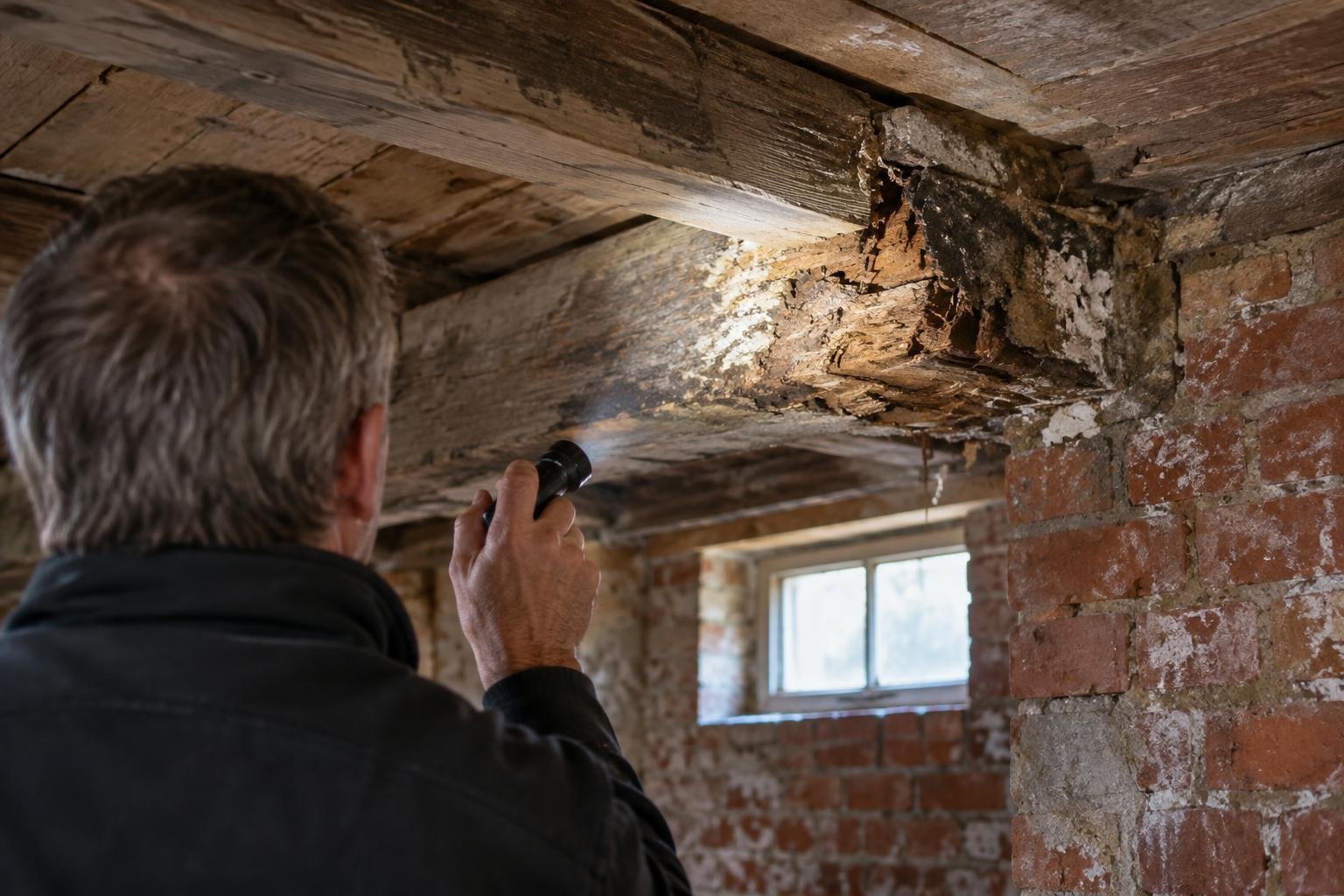
Unknown condition. Without an internal viewing, the bathroom, pipework, wiring and floors may not have been adequately assessed. Include a contingency in your liquidity plan.
Tenants in arrears. Check rent payments and arrears where records are available. The owner’s financial position does not establish whether the tenant pays reliably. Read more in our guide to tenants who deliberately avoid paying rent.
Owners’ service charges and the owners’ association. If a flat is being auctioned over service charge arrears, examine the arrears, maintenance reserve and planned works. The proceedings alone do not establish difficult relations among owners or an inadequate reserve.
Interest and liquidity. The money must be available within the court’s deadlines. A delay by the bank may lead to further interest and consequences of late payment. If the hearing is cancelled, you may already have spent time and, where applicable, incurred valuation costs.
Price. Competition at the hearing can drive the highest bid up to or above the assessed market value. An auction is a way to buy, not a built-in discount.
FAQFrequently asked questions
How does buying a flat at auction work?
You read the valuation report and accessible case documents, arrange financing and bid at the hearing before the German local court [Amtsgericht]. If validly requested, you generally provide security [Sicherheitsleistung] equal to 10% of the assessed market value [Verkehrswert]. You become the owner when the court awards the property to you [Zuschlag]. Pay the outstanding cash bid in accordance with the court’s instructions in time for the distribution hearing [Verteilungstermin], and allow separately for interest and other costs.
Is a flat bought at a compulsory auction cheaper?
It can be, but this is not guaranteed. The value thresholds do not automatically disappear at the second hearing; their removal follows an applicable refusal of the award under §§ 74a or 85a ZVG. There is no notarised purchase contract or estate agent’s commission for the court sale itself, but land registry fees and any financing costs remain. Lack of access for a viewing, excluded warranty protection and competing bids can outweigh a possible price advantage.
How much of my own money do I need to buy at auction?
This depends on the loan, conditions for releasing the funds and form of security. Security of generally 10% of the assessed market value must be available on time if validly requested. A security payment credited against the cash bid is part of that bid, not an additional purchase price. Simplified illustrative calculation: with a €150,000 bid and a €140,000 loan, the own-funds requirement is €36,692, or around €36,700, including the assumed acquisition costs and a €15,000 contingency. Additional financing costs may also apply.
Can I view the flat before the auction?
You have no right to do so. Some occupiers let interested buyers in if asked. Otherwise, you have to rely on the valuation report, which may itself be based only on an external inspection.
What happens to the tenant after the award?
The tenancy agreement generally transfers to you. The special termination right under § 57a ZVG must be exercised for the first legally permissible termination date, subject to the statutory notice period. For residential property, you still need a legitimate interest, such as a qualifying need to use the home yourself or for family members [Eigenbedarf]; other tenant protection rules must also be observed. The award alone does not end the tenancy. Ask a German lawyer to assess any intended termination.
Do I have to pay the previous owner’s service charge debts?
The award does not generally make you personally liable for the previous owner’s owners’ service charge [Hausgeld] arrears. Whether they are paid from the proceeds depends on their ranking and the proceeds available. However, you may be liable for special levies [Sonderumlagen] that fall due after the award. Discuss liability in your particular case with a German lawyer.
Is property transfer tax payable when I buy at auction?
Yes. The tax base is the highest bid including rights remaining in place. The German property transfer tax [Grunderwerbsteuer] rate depends on the federal state and ranges from 3.5% to 6.5%. In North Rhine-Westphalia, it is 6.5%. Discuss the tax treatment of rights remaining in place and your specific tax base with your tax adviser.
10Further reading
- Glossary: compulsory auction
- Court auction to dissolve joint ownership
- Buying a flat with an existing tenant
- Identifying a maintenance backlog
- Documents for property financing
- Calculator: property cash flow
11Sources
- ZVG: § 49, § 52, § 56, § 57a, § 68, § 69, § 74a, § 85a, § 93
- § 9 GrEStG (consideration represented by the highest bid)
- GKG fee schedule (item 2214) and Annex 2 GKG
- Annex 2 GNotKG (Table B)
- § 566a BGB and § 573 BGB
- § 7 EStG (building depreciation)
- § 32a EStG (income tax tariff)
- Auction dates: zvg-portal.de (joint portal of the federal states)
- Worked examples: own calculations using the stated assumptions; monetary amounts and rental multiples are rounded as shown.
Note: This guide provides general information and is not a substitute for legal, tax or investment advice on individual circumstances. The worked examples are not forecasts or promises of returns. Discuss tax questions with your tax adviser and legal questions with a German lawyer.
Writes about Existing properties, Investment calculations and Property assessment.
Rula has worked in financial services since 2021. He focuses on existing investment properties, transparent calculations and an honest assessment of building condition and running costs.
This guide does not replace tax or legal advice. All figures are example calculations with disclosed assumptions.