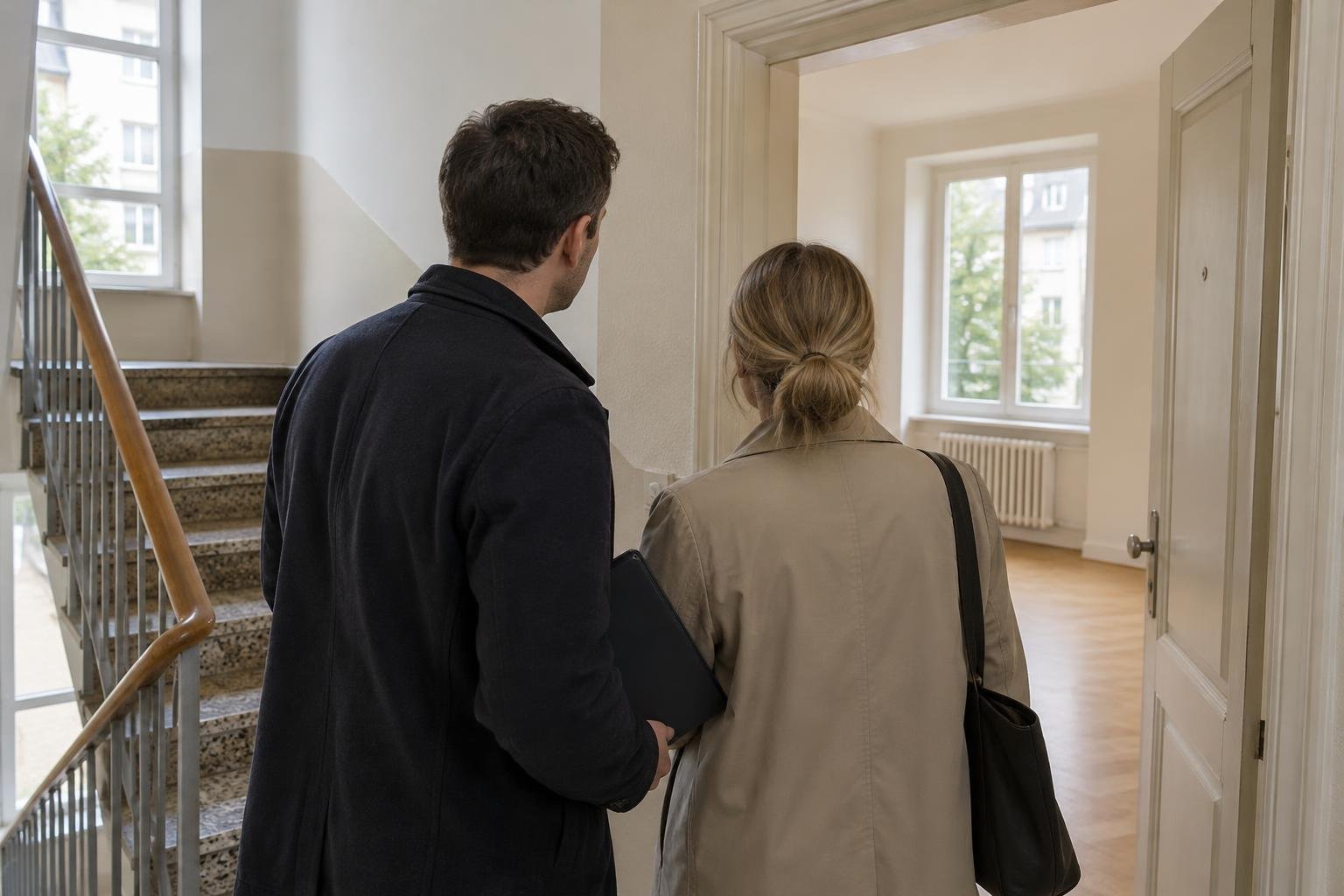
Building surveyor: costs and benefits when buying a flat
What a building surveyor can do when you buy a flat, when site visits are useful and how the costs add up in a new-build example.
 Herbert Gotschy
Investment Advisor at InvestImmo
The developer has its own specialists for construction management and design, and may also have internal quality assurance. You have a purchase contract and a building specification. If the two sides end up arguing about a crack in the wall or a leaking balcony door, one side may lack the necessary technical knowledge.
An independent building surveyor [Bausachverständiger] helps reduce that imbalance. Their services cost money, and many buyers wonder whether they are really necessary for a new flat. The answer depends on when you bring them in and what you want them to do.
01What a building surveyor does
A building surveyor checks a building’s technical quality within the agreed scope. They can identify defects, assess their causes, estimate the cost of remedial work and document their findings. Such a report can support discussions or disputes with the developer. However, a privately commissioned report is not equivalent to a report commissioned by a court.
This differs from the work of a market valuation expert. Their task is to determine market value [Verkehrswert]; a comprehensive technical defects inspection is not automatically included. Our guide Property valuation report: costs explains what a valuation report costs.
The German titles for building surveyor and building expert [Baugutachter] do not, on their own, demonstrate a particular assessed qualification. It is therefore worth checking training, experience and any public appointment or certification:
| Designation | What it means |
|---|---|
| Publicly appointed and sworn expert [öffentlich bestellt und vereidigt] | Appointed for a particular field by a competent body, such as a chamber, after assessment of the requirements; a private report does not automatically carry greater weight in court |
| Certified expert | Certification by a certification body; check the assessment standard, field of expertise and validity |
| Independent expert [freier Sachverständiger] | The designation alone does not demonstrate a particular assessment; practitioners may include architects, civil engineers or master craftspeople with experience and additional qualifications |
An acceptance inspection of a flat does not necessarily require a publicly appointed expert. What matters is experience with blocks of flats, suitable professional indemnity insurance and a written report with photographs.
02What a building surveyor costs
There is no single binding fee scale for the privately commissioned services described here. Ask for the basis of the fees to be stated in the quotation. Prices may vary by region, experience and scope. The following overview reproduces figures from a Commerzbank guide from February 2025.
| Service | Price range according to the overview |
|---|---|
| Hourly rate for inspection and assessment | €70 to €200 plus travel expenses and the report |
| Written expert report | €40 to €60 per page |
| Acceptance inspection of the structural shell | €500 to €600 |
| Acceptance inspection of a house | €700 to €800 |
| Ongoing quality checks during construction | 1 to 2% of the construction cost |
| Pre-purchase advice on an existing detached house of around 150 m² | €300 to €400 |
A smaller floor area may reduce the inspection work. However, this does not automatically mean a lower price for an individually owned flat: the common property and the extent of documentation may add to the workload. The percentages for quality checks are not a reliable basis for calculating fees from the purchase price of a developer-built flat. Separate appointments with clearly defined scopes may be offered instead.
03When the surveyor should visit a new build
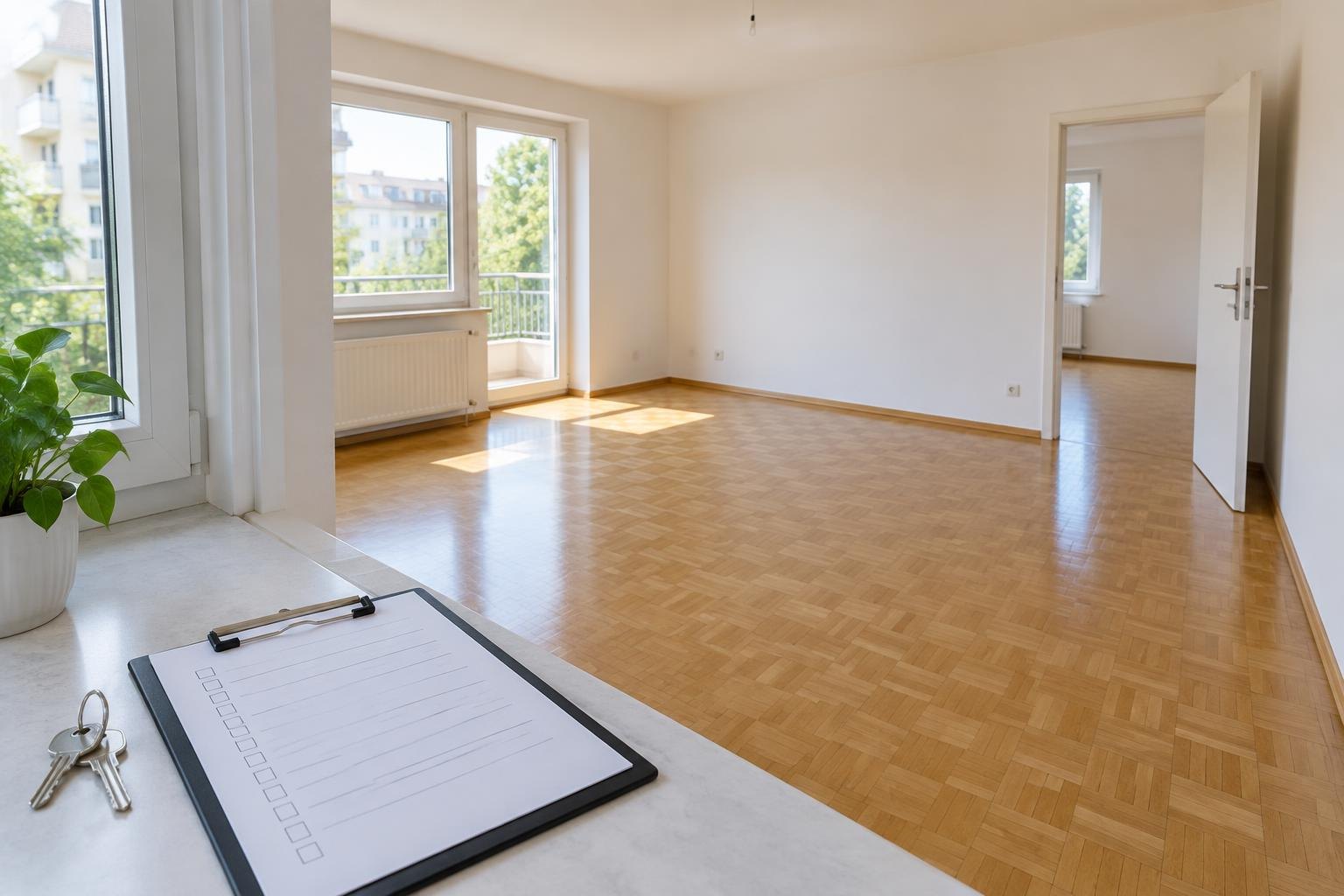
When you buy from a developer, the flat takes shape in stages. Defects may arise that will later be concealed. A surveyor therefore does not need to be present at every step, but should attend at the appropriate points in the actual construction programme.
- 01Before the notarial appointment
Review the building specification, plans and technical appendices to the contract. Unclear technical wording can still be raised at this stage. Legal questions about the contract should go to qualified legal advisers.
- 02Structural shell stage
Masonry, floor slabs, waterproofing of the basement and underground car park, and window junctions, where accessible at that stage. Subsequent work may conceal these components.
- 03Before screed is laid and before plastering
First-fix plumbing, heating, electrical and ventilation installations, and impact sound insulation. Depending on the construction programme, separate visits may be needed.
- 04Acceptance of the individually owned parts [Sondereigentum]
Inspect your flat room by room, record defects and make any necessary reservations of rights. A surveyor’s attendance alone does not safeguard rights. See the construction acceptance checklist for more details.
- 05Acceptance of the common property
Arrange a technical inspection of the roof, façade, stairwell, underground car park and external areas. The owners’ association [Eigentümergemeinschaft] may commission a shared surveyor. This does not automatically replace the legally required acceptance declarations under the individual purchase contracts. The appointment and allocation of costs, for example by co-ownership shares [Miteigentumsanteile], must be clarified against the applicable agreements and resolutions.
Do not assume that buyers have an unrestricted right to enter the construction site whenever they wish. Access and accompanying visitors depend on contractual arrangements, who actually controls access and safety requirements. Before buying, agree in writing that you may visit at specified construction stages with a surveyor of your choice. No general conclusion can be drawn about developers’ willingness to agree to this.
04Worked example: support when buying a new-build flat
Martin is buying a new-build flat of 65 m² for €340,000 as an investment. The example covers a pre-purchase review, three site visits and support at acceptance, plus a contribution towards technical support for acceptance of the common property. Martin is fictitious; the figures are illustrative assumptions, not quotations or forecasts. We assume an hourly rate of €120 including VAT, within the quoted range.
| Scope | Amount | |
|---|---|---|
| Review of the building specification and plans before purchase | 2.5 hours | €300 |
| Three site visits with brief reports | 7.5 hours | €900 |
| Acceptance inspection of the flat with a written record | 3 hours | €360 |
| Additional reports and photographic documentation | 10 pages at €50 | €500 |
| Travel expenses | Fixed fee | €150 |
| Share of the common property acceptance inspection | 50/1,000 of €6,000 | €300 |
| Total cost | €2,510 | |
| Share of the purchase price | 0.74% |
€2,510 is money Martin initially pays out. Whether and when the costs affect his tax liability depends on the classification of each service. Acquisition-related costs may form part of incidental acquisition costs [Anschaffungsnebenkosten]. To the extent that they are attributable to the depreciable building cost, they are relieved through depreciation rather than an immediate deduction of the full amount. A tax adviser should check the precise allocation.
As a conditional calculation only: if 80% of these costs is allocated to the depreciable building and the straight-line depreciation allowance [Absetzung für Abnutzung, AfA] is 3%, the result is €2,510 × 80% × 3% = €60.24 for a full year. Section 7(4) of the German Income Tax Act [Einkommensteuergesetz, EStG] generally provides for a 3% straight-line rate for buildings completed after 31 December 2022. This does not establish whether the surveyor’s fees in this example qualify for that treatment or whether the 80% allocation is appropriate; technical services may require a separate allocation.
What does the surveyor achieve, then? Suppose they find a missing waterproofing connection at the balcony door during the acceptance inspection. If it went unnoticed, water could enter the screed after the first winter.
Section 634a of the German Civil Code [Bürgerliches Gesetzbuch, BGB] generally provides for a five-year limitation period from acceptance for defects claims relating to buildings. Whether the developer is liable for the assumed damage depends on factors including the cause, the contract and the running of the limitation period. Martin might need to prove the defect, arrange remedial work, coordinate appointments with the tenant and account for a justified rent reduction. The example does not calculate whether costs would be recovered or ultimately borne by him.
If a defect is identified at acceptance, accurate documentation and any necessary reservations of rights are important. An entry in the inspection record does not automatically justify withholding an arbitrary amount. The conditions and reasonable amount are governed in particular by section 641(3) of the German Civil Code. For known defects, the legal consequences of section 640(3) must also be considered.
05Buying an existing property
Existing properties may still have construction documents and outstanding claims arising from earlier building work. Purchase contracts frequently contain an exclusion of liability for material defects [Sachmängelhaftungsausschluss], as explained in the glossary entry on exclusion of defects liability. The remaining rights depend on the contract and circumstances; whether a defect could have been spotted during a viewing is not the sole deciding factor. Knowledge, grossly negligent lack of knowledge, fraudulent concealment and guarantees may be legally relevant.
Technical pre-purchase advice can help buyers assess the condition and foreseeable costs before deciding. The Commerzbank overview quotes €300 to €400 for advice on an existing detached house of around 150 m²; this does not establish a standard price for a flat. For a flat, the agreed inspection scope may include damp, pipework, windows and heating within the unit, as well as the roof, façade and shared vertical pipework in the common property. Ideally, review the owners’ association documents at the same time, as described in our guide Identifying a renovation backlog.
06Finding the right building surveyor
- 01Independence
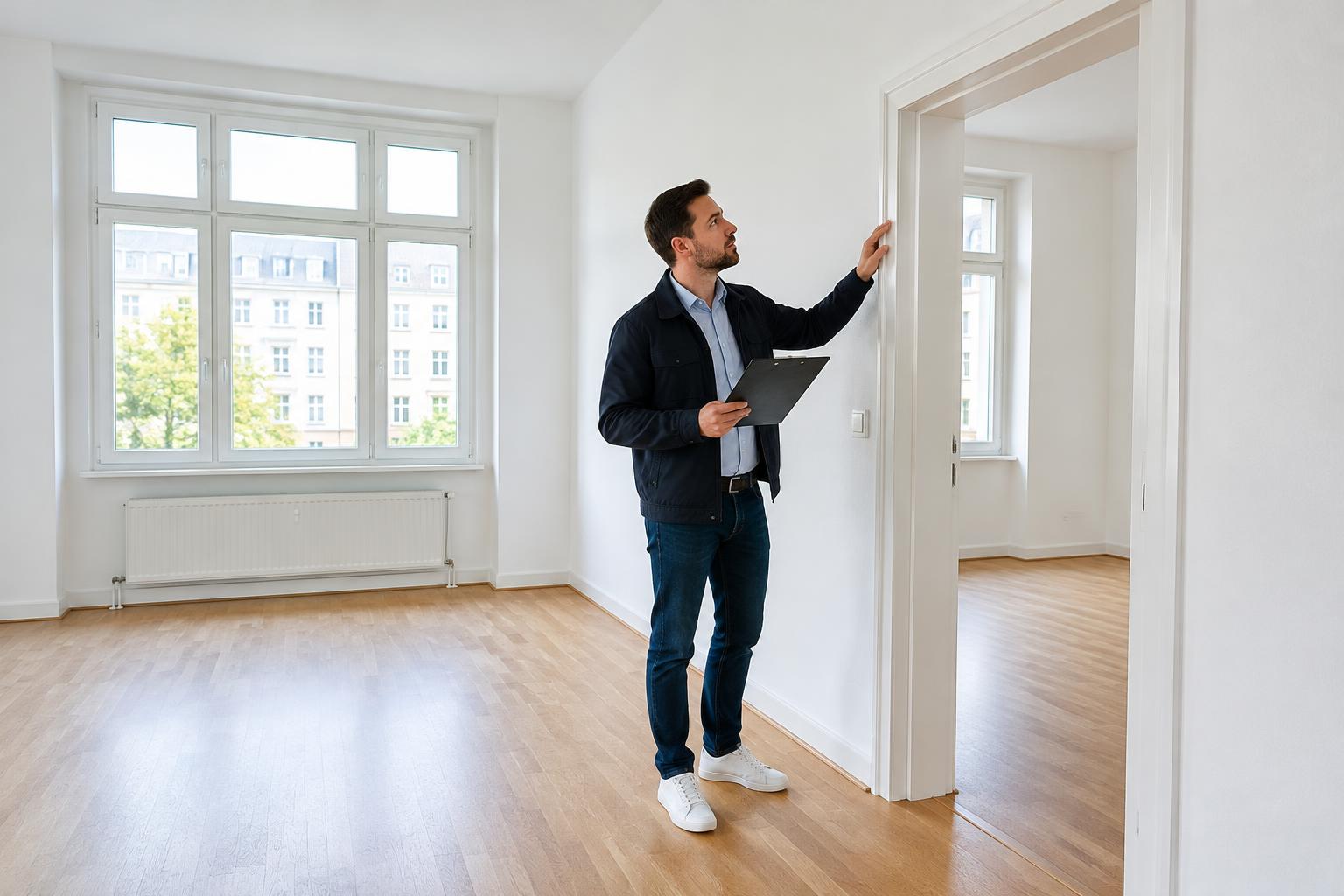
Commission the surveyor yourself and check financial connections with the developer or seller. A recommendation alone proves neither independence nor a conflict of interest; payment by the other party warrants particular scrutiny.
- 02Experience
Ask about acceptance inspections in blocks of flats, not just detached houses.
- 03Qualifications
Check public appointment, certification or documented training as an architect, civil engineer or master craftsperson, alongside experience in the required field.
- 04Insurance
Ask for confirmation of suitable professional indemnity cover.
- 05Quotation
In writing, with services, appointments, report, travel expenses, VAT and a fee cap.
- 06Sample report
An anonymised sample report shows whether defects are described specifically, with their location, a photograph and an assessment.
07Who benefits from a building surveyor
- You are buying from a developer and cannot monitor the construction site yourself.
- The common property needs a technical inspection for acceptance.
- You are buying an existing property with older pipework or unexplained damp.
- You have no construction experience of your own.
- The owners’ association has already commissioned a shared surveyor. Check the scope: your own flat is not automatically included, and even a small flat with basic fittings can have defects.
- You have relevant construction experience yourself and time for several site visits. Still consider whether additional specialist input or independent documentation is needed.
08Risks and limitations
A surveyor cannot see everything. Even a surveyor can only carry out spot checks, if any checks at all, on what lies behind tiles or beneath the screed. This is why visits before walls are closed up are so valuable.
Costs arise even if you do not buy. If the surveyor inspects before the notarial appointment and advises against buying, the inspection may prevent a poor decision. The agreed fee is still payable. An unsuccessful acquisition may receive different tax treatment. Clarify this with your tax adviser.
The developer refuses the surveyor access to the site. Without a clear access agreement, disputes over visits may arise. Clarify access and safety requirements before buying.
Liability may be contractually limited. Check the scope of services, liability clauses and insurance cover. Whether a limitation is effective, and whether claims exist against the surveyor or developer, depends on the circumstances. An overlooked defect does not automatically mean that either party is liable for it.
A good report does not make a good property investment. A flat with no apparent technical defects but in the wrong location or at the wrong price remains a risk. Technical maintenance needs may fall within the surveyor’s appointment. A complete investment appraisal covering rental voids, financing and interest-rate risks is not automatically included.
FAQFrequently asked questions
How much does a building surveyor charge per hour?
The Commerzbank overview cited in the source article, dated February 2025, quotes €70 to €200, plus travel expenses and the report. This is not a verified price range for 2026. Obtain a written quotation including VAT and additional charges.
How much does an acceptance inspection with a surveyor cost?
The cited overview quotes €700 to €800 for a house and €500 to €600 for a structural shell inspection. These figures do not establish a standard price for a flat. For a shared inspection of the common property, the appointment and allocation of costs need to be clarified.
Do I need a surveyor for a new-build flat?
Buyers are generally not required to appoint their own surveyor. Doing so may be useful if you lack construction experience or time to monitor the work. A surveyor helps identify and document defects; their attendance alone does not prevent the loss of rights at acceptance.
Can I deduct the surveyor’s costs for tax purposes?
For a rented flat, this depends on the service and its connection with the acquisition. Acquisition-related costs may form part of incidental acquisition costs and, to the extent allocated to the building, be relieved through depreciation. A tax adviser should check the classification, allocation and treatment if the purchase does not proceed.
What is the difference between a building surveyor and a valuation expert?
A building surveyor checks the technical condition and potential defects within the agreed scope. A valuation expert determines market value; this does not automatically include a comprehensive technical inspection. The appointment you need depends on whether you want to assess construction quality, market value or both.
May I visit the construction site with a surveyor?
Do not assume an unrestricted right of entry. Contractual access arrangements, responsibility for access and safety requirements determine what is permitted. Before buying, agree visits with a surveyor of your choice in writing.
09Further reading
- New-build construction acceptance: checklist
- Reviewing the building specification
- Reviewing a developer purchase contract
- Property valuation report: costs
- Viewing a flat to buy: checklist
- Calculator: depreciation allowance
10Sources
- Commerzbank, An overview of the costs of a building survey, published on 12 February 2025
- Section 640 of the German Civil Code and section 641 (acceptance and withholding payment)
- Section 634a of the German Civil Code (generally a five-year limitation period for defects claims relating to buildings)
- Section 7 of the German Income Tax Act (depreciation allowances)
- Worked example: own calculation under section 32a of the German Income Tax Act, using the 2026 tax schedule, as at 19 October 2026
Note: This guide provides general information and does not replace legal, tax or investment advice for individual circumstances. Worked examples are based on assumptions. Price information is based on the sources cited. Dated 19 October 2026.
Writes about Investment properties, Purchase decisions and Financial viability.
Herbert has invested in property himself since 2023 and has worked in the property industry since 2024. His advice combines an investor’s perspective with clear explanations and an open assessment of opportunities and risks.
This guide does not replace tax or legal advice. All figures are example calculations with disclosed assumptions.