§ 82b EStDV: Deduct maintenance expenses immediately or spread them?
You can spread major repairs to a rented property over two to five years. Whether this saves or costs you money depends on your income in the coming years. We run through the numbers for a €30,000 renovation in four different scenarios.
 Eduard Winter
Investment Advisor at InvestImmo
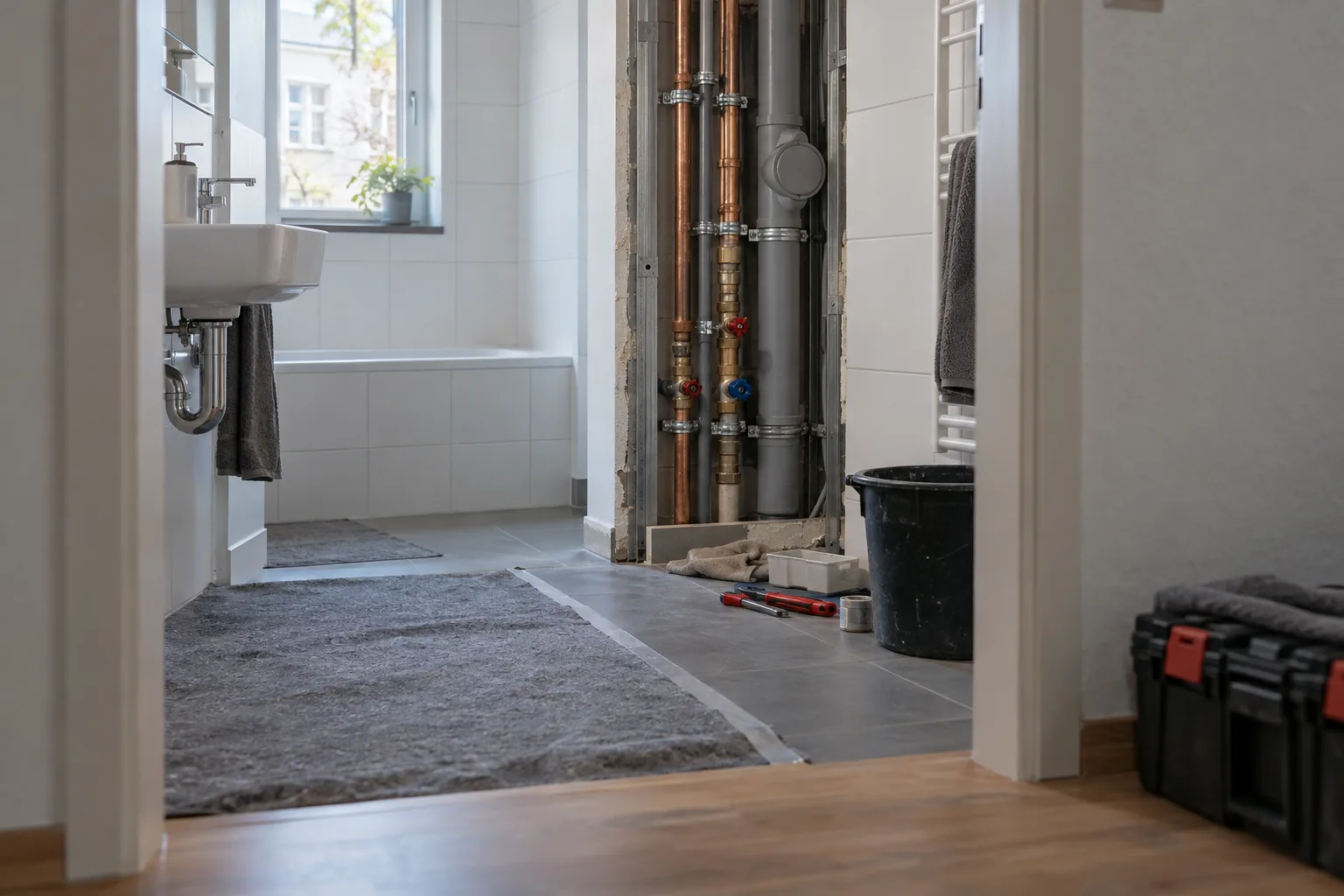
The tenants have moved out, and the flat needs more than a lick of paint. A new bathroom, new flooring, the electrics updated. In the end, the invoices total €30,000. As a landlord, you are allowed to deduct these costs from your tax. The only question is when.
Normally, expenses are counted in the year you pay them. However, there is an exception for major repairs to residential buildings. You are allowed to spread the costs over two to five years. This might sound like a mere formality. But depending on your income, the choice can make a difference of several thousand euros, in either direction.
01What § 82b EStDV allows
This provision is found in the Income Tax Implementing Regulation, a regulation pertaining to the German Income Tax Act. It deviates from the cash basis principle of § 11 (2) of the EStG (Einkommensteuergesetz – Income Tax Act), according to which expenses are counted in the year they are paid.
| Condition | What it means | Paragraph |
|---|---|---|
| Maintenance and repair costs | Repairs and refurbishment, not capital or acquisition costs | Para. 1, Sentence 1 |
| "Major" | The regulation does not specify a fixed limit | Para. 1, Sentence 1 |
| Private assets | The building does not belong to a business's assets at the time of payment | Para. 1, Sentence 1 |
| Predominantly for residential purposes | Living area is more than half of the usable area; one garage space per flat counts as residential use | Para. 1, Sentences 2 to 4 |
| Evenly | Equal portions each year, for a period of between two and five years | Para. 1, Sentence 1 |
| Multiple owners | All owners must spread the costs over the same period | Para. 3 |
You make the decision in your tax return for the year in which you made the payment. Appendix V (Anlage V) has its own lines for maintenance and repair costs to be spread and for the partial amounts from previous years. The choice applies on a per-measure basis. You can deduct a small repair immediately and spread a large one in the same year.
02Maintenance and repair costs or capital expenditure
You can only spread maintenance and repair costs. Capital expenditure only takes effect through depreciation, spread over the remaining useful life of the building. Therefore, the question of classification always comes before the question of spreading the costs.
| Type | Examples | Tax effect |
|---|---|---|
| Maintenance and repair costs | Replacing a bathroom with one of the same standard, new flooring, same type of windows, replacing the heating system, painting | Immediate deduction or spread according to § 82b |
| Capital expenditure | Extension, loft conversion, additional living space, significant upgrade of standard | Depreciation over the useful life |
| Acquisition-related capital expenditure (anschaffungsnahe Herstellungskosten) | Refurbishment in the first three years after purchase costing more than 15% of the building's acquisition cost, excluding VAT | Depreciation like the building (§ 6 (1) no. 1a EStG) |
Regarding the standard, the tax authorities look at four central areas: heating, plumbing, electrics and windows (Federal Ministry of Finance (BMF) circular dated 26 January 2026). If you only replace what was already there, these are generally maintenance and repair costs. According to the Income Tax Guidelines (EStR), the tax office will, upon request, always treat expenses up to €4,000 excluding VAT per construction measure as maintenance and repair costs (R 21.1 (2) EStR).

03Why spreading the costs is beneficial at all
Income tax is progressive. Up to a taxable income of €69,878 in 2026, the marginal tax rate increases from 14% to 42% (§ 32a EStG). A large deduction in one year pushes your income far down into brackets with a lower rate. Each additional euro saved provides less of a benefit there.
If you spread the amount, the deduction is applied each year where your rate is high. Our guide to the marginal tax rate explains exactly how this works. If your income remains consistently in a band with a fixed rate even after the deduction, spreading the costs offers no advantage. In that case, the only thing that matters is that you get the money back sooner with an immediate deduction.
04Example calculation: €30,000 renovation in four scenarios
Sabine bought a flat in 2019 and lets it out. In 2026, the tenant moves out. She has the bathroom replaced to the previous standard, new flooring laid and the flat painted. She pays the invoices totalling €30,000 in 2026. As the purchase was more than three years ago, these are maintenance and repair costs. The names are fictional, and the figures are for illustrative purposes and do not constitute a forecast.
Sabine is single. We will compare the total tax savings over the years 2026 to 2030 for four income scenarios. The income shown in each case is before the renovation costs.
| Immediate | 2 years | 3 years | 5 years | |
|---|---|---|---|---|
| A: €72,000 in every year | €11,255 | €12,026 | €12,279 | €12,470 |
| B: Parental leave in 2026 with €35,000, then €72,000 | €5,670 | €10,113 | €11,006 | €11,710 |
| C: Still €72,000 in 2026, retirement from 2027 with €40,000 | €11,255 | €10,372 | €10,077 | €9,842 |
| D: €110,000 in every year | €14,099 | €14,099 | €14,099 | €14,099 |
Case A is the typical landlord with a good income. With an immediate deduction, Sabine's income in 2026 falls from €72,000 to €42,000. Part of the €30,000 then only saves a good 30% in tax. Spread over five years, each instalment of €6,000 reduces an income that is taxed at 42%. This results in €1,215 more in savings.
Case B shows the greatest leverage. If the renovation falls in a year with low income, such as during parental leave or part-time work, part of the immediate deduction is almost completely wasted. Spreading the cost shifts the deduction to years with a full income and yields €6,040 more.
Case C is the opposite. If income decreases from the following year, the deduction is most valuable in the year of payment. Anyone who spreads the cost here loses out on €1,413.
Case D falls within the same fixed-rate tax band with and without the deduction. The total is the same, but the immediate deduction means the money comes back four years sooner.
05Sale, inheritance and personal use
What happens to the instalments that are still outstanding? The regulation explicitly addresses this.
- 01Sale
If you sell the flat while spreading the costs, you deduct the outstanding amount as income-related expenses (Werbungskosten) in the year of the sale (§ 82b (2) Sentence 1 EStDV).
- 02End of letting
The same applies if you no longer let the property, for example because you move in yourself, or if you transfer it to your business assets (Para. 2, Sentence 2).
- 03Death
If the landlord dies, the remainder must be deducted in the year of death for the deceased, not by the heirs. This was the ruling of the Federal Fiscal Court (BFH, IX R 31/19), which opposed the previous administrative rule in R 21.1 (6) of the EStR (Income Tax Guidelines).
Therefore, anyone who plans to sell the flat in a year or two will gain little from spreading the costs over a long period. The remainder will be incurred all at once in the year of sale anyway.

06Freehold flat: Your share of work on the community property
With a freehold flat, there are two types of repairs. In your separate property (Sondereigentum), i.e. in your flat, you commission and pay for the work yourself. For the common property (Gemeinschaftseigentum) such as the roof, facade or pipework, the community of owners makes the decision, and you bear your share of the cost.
„Does a small owner also have to pay for these major components like the roof and structure?“
This question came up in a consultation about a buy-to-let investment. The answer is yes, proportionally according to the co-ownership shares, usually from the maintenance reserve fund or via a special levy. For tax purposes, your share only counts when the community spends the money on the maintenance, not when you pay into the reserve fund (BFH, ruling of 14 January 2025, IX R 19/24).
Whether and how you can spread your share of a major project by the community according to § 82b is best clarified with your tax advisor. The regulation requires that all owners of a building spread the costs over the same period (Para. 3). For work within your separate property, you decide alone.
07Who is spreading the cost suitable for
- The amount would push your income in the year of payment into a significantly lower tax band.
- Your income is exceptionally low in the year of renovation.
- You expect an equally high or higher income in the coming years.
- Your income will soon decrease, for example due to retirement or part-time work.
- You will remain in the 42% band even after the deduction.
- You plan to sell the flat or use it yourself soon.
- You need the tax refund now, for instance for the next instalment payment.
08Risks and limitations
The future is uncertain. Spreading the costs is based on an assumption about your income in the coming years. A change of job, illness or a switch to part-time work can turn the calculation on its head. Case C shows how quickly an advantage can become a disadvantage.
The time value of money. With an immediate deduction, the refund arrives with the next tax assessment. If spread, it comes in instalments over up to five years. Anyone who could use the money for an unscheduled mortgage repayment or to build up a reserve will lose some of the benefit by spreading the costs.
Disputes over classification. If the tax office classifies the work as capital expenditure, the option to spread the costs is lost entirely. Keep invoices with a detailed description of the work; photos of the condition before and after can help with queries.
Tax rates can change. Our calculation uses the 2026 rate for all years. The draft of the 2027 Income Tax Reform Act provides for new bands, but it has not been passed. Small shifts usually only change the result slightly; the direction remains the same.
FAQFrequently asked questions
What does § 82b EStDV regulate?
The regulation (§ 82b of the EStDV, the German Income Tax Implementing Regulation) allows major maintenance expenses for a privately held building used predominantly for residential purposes to be distributed evenly over two to five years. Without it, the costs would have to be deducted in the year of payment.
From what amount are maintenance expenses considered 'major'?
There is no fixed limit. In practice, it becomes a relevant question for amounts that significantly reduce your taxable income, for example, from a few thousand euros upwards.
Can I choose the distribution period freely?
Yes, anywhere between two and five years, with equal instalments each year. If the building is owned by several people, they must all choose the same period (§ 82b para. 3 EStDV).
Does § 82b also apply to commercial properties?
Only if the building is used predominantly for residential purposes, meaning the living area accounts for more than half of the usable area. If the property is part of business assets, distribution under § 82b is not permitted.
What happens to the remaining amount if I sell the property?
The portion not yet deducted is claimed as income-related expenses (Werbungskosten) in the year of sale (§ 82b para. 2 EStDV). The same applies if you stop letting the property or transfer it into business assets.
Can the heirs continue to spread the remaining amount?
Not according to the Federal Fiscal Court (Bundesfinanzhof). The remainder must be deducted for the deceased in the year of death (BFH, IX R 31/19). The previous administrative rule, under which heirs could continue the distribution, is therefore obsolete.
Can I spread the cost of renovations made shortly after purchase?
Only if they are maintenance expenses. In the first three years after purchase, repairs costing more than 15% of the building's acquisition cost (excluding VAT) are classified as acquisition-related construction costs (anschaffungsnahe Herstellungskosten) and are handled via depreciation.
Is it worth spreading the costs if you are in the top tax bracket?
Usually not. If your income remains in the 42% bracket throughout, even after the deduction, the tax saving is the same. Deducting immediately simply gets you the money sooner.
09Further reading
- Income-related expenses for rental properties
- Marginal tax rate 2026
- How to fill in Appendix V
- Selling a tenanted flat
- Glossary: Maintenance and repair costs
- Glossary: Acquisition-related capital expenditure
- Glossary: Maintenance reserve fund
- Calculator: Tax on rental income
10Sources
All sources retrieved on 16 October 2026.
- § 82b EStDV (Treatment of major maintenance and repair costs for residential buildings)
- § 11 EStG (Cash basis principle), § 6 EStG (Para. 1 no. 1a, acquisition-related capital expenditure), § 32a EStG (2026 tax rate)
- BMF circular dated 26.01.2026, Distinction between maintenance and repair costs and capital expenditure for the refurbishment and modernisation of buildings, summarised according to EY
- BFH, IX R 31/19 (Maintenance and repair costs under § 82b in the year of death), summarised according to EY
- BFH, ruling of 14.01.2025, IX R 19/24 (Payments into the maintenance reserve fund)
- Income Tax Guidelines R 21.1 (Maintenance expenditure and capital expenditure)
- Example calculations: own calculation based on the 2026 tax rate, as at 16 October 2026
Disclaimer: This guide provides general information and is not a substitute for professional tax advice in individual cases. All figures are example calculations with disclosed assumptions, as at 16 October 2026.
Writes about Taxes, AfA (depreciation), Existing properties and Portfolio building.
Since 2020, Eduard has bought seven properties of his own and supported more than 150 clients. He writes about tax levers, property documents and portfolio building – with honest numbers instead of rosy projections.
This guide does not replace tax or legal advice. All figures are example calculations with disclosed assumptions.