Changing your owners’ association’s property manager
Since the WEG reform, owners can remove their manager at any time. We explain the steps from concerns to a resolution, what happens to the contract and what a change costs for a rented flat.
 Nadeem Shahid
Investment Advisor at InvestImmo
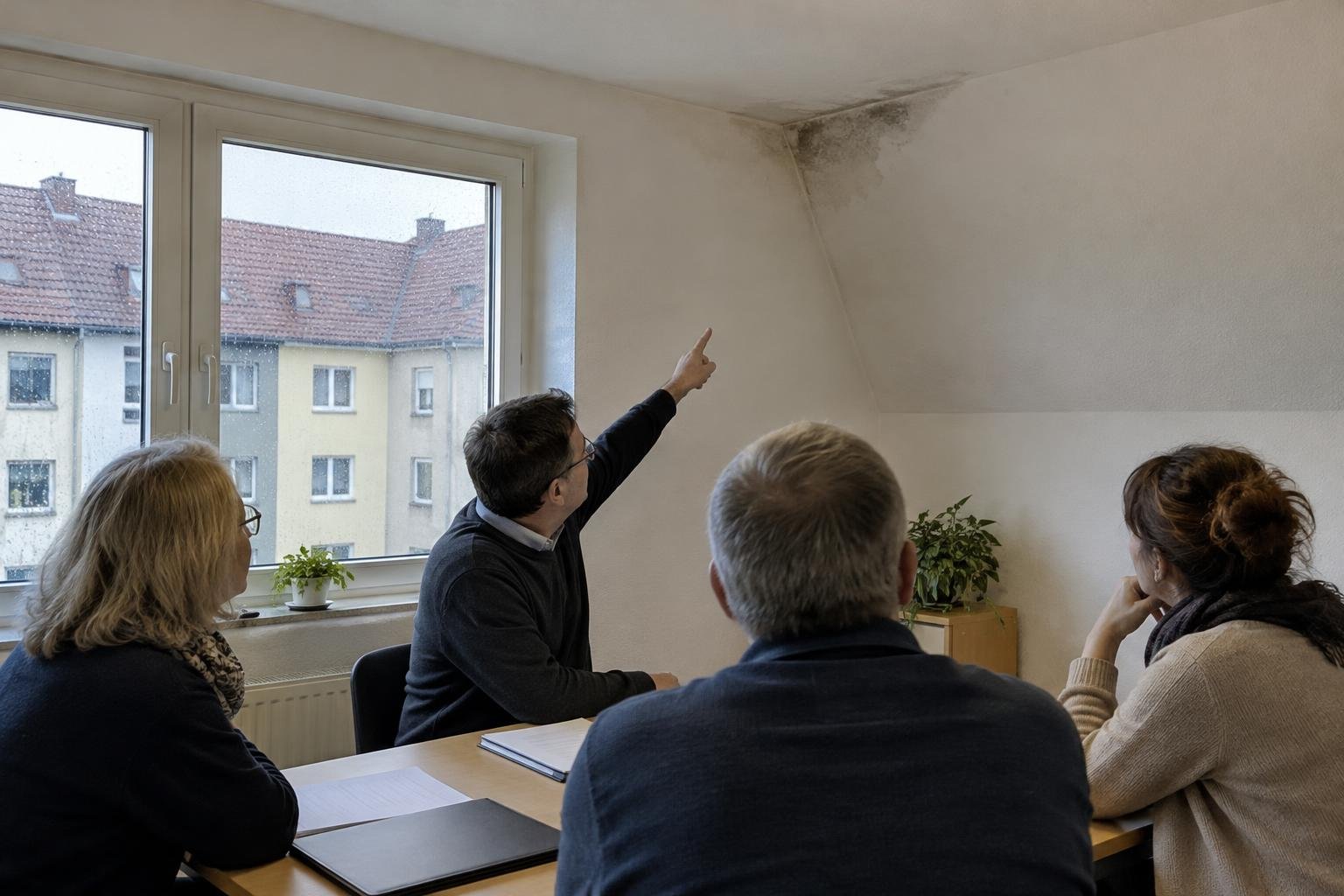
The annual accounts arrive in October rather than spring. A water stain in the stairwell has been ‘being dealt with’ for eight months. When you call, the voicemail box is full. Situations like these can be more than an irritation for investors who do not live in the building. They cannot see damage themselves and depend on someone else to deal with it.
Owners do not necessarily have to keep a manager in office until the contract expires. Since December 2020, removal has been possible at any time. How a change works depends, however, on which type of management you mean.
01Which property management arrangement do you want to end?
For a flat, property management can involve two separate contracts. Confusing them could mean directing a termination notice to the wrong party.
| Owners’ association management | Individual letting management | |
|---|---|---|
| Responsible for | Roof, façade, stairwell, heating, reserve, owners’ service charge [Hausgeld], meetings | Your tenancy agreement, tenant and tenant service charge statement |
| Contracting party | The owners’ association | You personally |
| Who decides on a change | The owners by resolution | You alone |
| Termination | Removal under section 26 WEG; the contract ends no later than 6 months afterwards | Subject to contractual and statutory requirements |
| Paid through | The owners’ service charge | A separate invoice to you |
For letting management, check the contract term, notice period and required form, and document receipt of the termination notice. Then arrange the handover of the tenancy file, deposit records including evidence of the deposit account, and outstanding statements. Any transfer of managed deposit funds must preserve their separate and proper safekeeping. Our guide to property management: costs and services explains what this service covers and costs.
The rest of this guide concerns the association’s manager.
02Removal and the management contract: what section 26 WEG provides
The Act distinguishes two matters that go hand in hand in practice. Appointment makes someone the manager through an owners’ resolution. The management contract sets out services and remuneration through an agreement between the association and the manager.
Since the reform of 1 December 2020:
- Removal is possible at any time. Owners can remove the manager at any time under section 26(3), first sentence, WEG. Earlier provisions restricting removal to good cause do not prevent this; departures from the statutory rules are prohibited by section 26(5) WEG.
- The contract ends within six months. The management contract ends no later than six months after removal under section 26(3), second sentence, WEG, even if it was originally due to run until 2029.
- Appointments have a maximum term. A manager may be appointed for no more than five years, or three years for the first manager following the establishment of apartment ownership rights (section 26(1) WEG). Reappointment can be resolved no earlier than one year before the current appointment expires (section 26(2) WEG).
Removal requires a simple majority of votes cast (section 25(1) WEG). Abstentions do not count. Each owner generally has one vote, irrespective of the size of their flat (section 25(2) WEG). The community regulations [Gemeinschaftsordnung] may provide a different voting system, such as voting by co-ownership shares [Miteigentumsanteile].

03When a change makes sense
Not every disagreement makes a change worthwhile. Finding a suitable replacement and allowing them to familiarise themselves with the property can take time. Take these warning signs seriously:
- Annual accounts repeatedly arrive late or contain errors. The manager must prepare them after the end of each calendar year (section 28(2) WEG); this does not establish a universal spring deadline.
- There is no financial position report [Vermögensbericht] showing the maintenance reserve [Erhaltungsrücklage] (section 28(4) WEG).
- Resolutions are not implemented and work orders remain outstanding.
- The register of resolutions [Beschluss-Sammlung] is missing or incomplete (section 24(7) and (8) WEG).
- Access to records is refused even though every owner can request it (section 18(4) WEG).
- An owners’ meeting is not held at least once a year (section 24(1) WEG).
Anyone commercially managing communal property generally needs a licence under section 34c of the German Trade Regulation Act [Gewerbeordnung, GewO] and professional indemnity insurance. The continuing professional development requirement is 20 hours within three calendar years (section 34c(2a) GewO); the specific evidence requirements and statutory exceptions must be observed. Since 1 December 2023, appointing a certified manager has generally formed part of proper management (section 19(2), no. 6, WEG). The exception requires all three conditions to be met: fewer than nine separate ownership rights, an owner appointed as manager, and fewer than one third of the owners requesting a certified manager. Missing required evidence provides an objective reason to seek clarification at the meeting.
04Eight steps to a new manager
- 01Find support
You cannot remove the manager on your own. Speak to the advisory board and other owners, and record the shortcomings in writing.
- 02Obtain quotations
Where possible, obtain two or three comparable quotations from other managers, covering fees per unit, additional charges and the required evidence of licensing under section 34c GewO and certification. Give owners the quotations and key contractual terms in good time before the meeting. Removing the manager without a replacement can leave a management gap.
- 03Request a meeting
If the next ordinary meeting is too far away, more than one quarter of the owners can request a meeting in text form, stating its purpose and reasons (section 24(2) WEG).
- 04Set out a precise agenda
The subject of each resolution must be identified in the meeting notice (section 23(2) WEG). Explicitly include removal, ending the old contract, appointing the new manager and entering into the new contract. Errors can leave resolutions open to challenge.
- 05Secure the meeting notice
If there is no manager, or the manager wrongfully refuses to convene a meeting, the advisory board’s chair, their deputy or an owner authorised by resolution may convene it (section 24(3) WEG). Unless there is particular urgency, at least three weeks’ notice should be given (section 24(4) WEG).
- 06Pass the resolutions
Removal and the new appointment each require a simple majority of votes cast. Owners unable to attend may grant a proxy in text form (section 25(3) WEG).
- 07Arrange signature of the contract
In dealings with the manager, the association is represented by the advisory board’s chair or an owner authorised by resolution (section 9b(2) WEG). If another owner is to act, expressly include their authorisation in the resolutions.
- 08Organise the handover
Arrange an orderly handover of account records and banking authorisations, files, the register of resolutions, service provider contracts and keys. Association bank accounts remain the association’s accounts. A handover record helps prevent disputes.
Deadlines run from the date the resolution is passed. Owners may bring an action challenging a resolution within one month; the deadline for submitting the grounds is two months from the resolution (section 45 WEG). The action is brought against the association, not the previous manager. A challenged resolution generally remains effective until a final court ruling declares it invalid. A carefully prepared notice and precise agenda reduce the risk of a successful challenge; disputes about the management contract are a separate matter. If a challenge is threatened or proceedings have already begun, consult a German lawyer promptly.
05What the change costs for a rented flat
Changing managers also raises a financial question. Take Tom. He owns a rented two-room flat in a development with 24 units but lives 300 kilometres away. His name is fictional; the following simplified illustrative calculation shows possible costs and is not a forecast.
The old manager charges €28 per unit per month and has a contract running until the end of 2028. The association removes the manager in June and immediately appoints a new, certified manager charging €34 per unit per month. For this calculation, we assume six full monthly fee periods at the old manager’s unchanged rate, without offsets or refunds. The assessment covers the first twelve months from the new manager’s start, not the calendar year of the change. Both fees are assumed to be final amounts payable, including any applicable VAT; Tom’s association allocates management fees equally per unit. The fees are illustrative assumptions, not market averages.
For the tax calculation, we assume that the additional management fees are fully deductible rental expenses and, for simplicity, that income tax falls by 30% of those costs. The solidarity surcharge and church tax are excluded. The calculation therefore illustrates possible relief rather than applying Tom’s individual income tax tariff.
| One-off | Recurring each year | |
|---|---|---|
| Continued payment to the old manager, 6 × €28 | €168 | |
| Higher fees for the new manager, 12 × €6 | €72 | |
| Additional cost before tax, by cost category | €168 | €72 |
| Assumed income tax relief, 30% | −€50.40 | −€21.60 |
| Cost after tax in the simplified example | €117.60 | €50.40 |
For the association as a whole, the assumed continued payment is 24 × €28 × 6 = €4,032. It reduces liquidity but is not automatically a withdrawal from the maintenance reserve. A change at the turn of the year would have avoided overlapping fees only if the old contract had validly ended at that point. Simply postponing removal would not achieve this.
Tom cannot pass management fees on to his tenant as operating costs. To the extent that they relate to the letting, they can generally qualify as deductible rental expenses. This does not make the entire owners’ service charge deductible: payments into the maintenance reserve are not immediately tax-deductible. Only actual eligible expenditure can have a tax effect, subject to the applicable conditions.
The actual tax effect depends, among other things, on the relevant tax year, income before the additional deduction and the timing of payments. The first twelve months after a change may span two tax years; the simplified calculation assumes the same 30% relief for all additional costs. Before tax, the ongoing increase in the example is €6 per month, or €4.20 under this tax assumption. A higher fee does not demonstrate better service. Discuss the deductibility of your costs and their allocation to tax years with your German tax adviser [Steuerberater].
No formula can tell you whether the change is worthwhile. An unresolved water leak, a rent reduction or a special levy [Sonderumlage] where reserves are inadequate can increase the financial burden. That does not establish that changing managers would prevent those costs. Compare services, not just the price per unit.
06The handover: where changes can go wrong
Difficulties can arise if the outgoing manager is slow to release records or accounts are still held in their name. Ask the new manager to work through a checklist:
- Association bank accounts, distinguishing the current account from the reserve, with statements for the current year and clarified banking authorisations
- The register of resolutions and meeting minutes
- Annual accounts, annual budgets [Wirtschaftspläne] and financial position reports from previous years
- Contracts for caretaking, cleaning, insurance, maintenance and energy supply
- Outstanding receivables, owners’ service charge arrears and ongoing court proceedings
- Keys, plans, the declaration of division [Teilungserklärung] and community regulations
07Who is likely to benefit from a change?
- Accounts are persistently late or incorrect.
- Resolutions remain unimplemented for months.
- The maintenance reserve is not transparently reported.
- A specific offer from a new manager is available.
- The disagreement mainly concerns communication style rather than the work.
- No replacement is willing to take on the building.
- The appointment expires in a few months anyway. Owners can then decide not to reappoint, but must still address the contract end and succession separately.
08Risks when changing managers
No replacement. Finding a manager can be difficult, particularly for small associations. Removing the current manager without a successor risks a management gap. Without a manager, all owners represent the association jointly (section 9b(1), second sentence, WEG), which can complicate everyday decisions.
Overlapping fees. Depending on the contract and circumstances, the outgoing manager’s fee claims may continue for up to six months. In the example, this amounts to €4,032 for the building.
A legal challenge. A defective resolution can be challenged; the deadline for bringing proceedings is one month from the resolution. It generally remains effective unless and until a final ruling declares it invalid.
Transition problems. A new manager needs to become familiar with the building, service providers and owners. This can cause delays, including in preparing accounts.
Higher fees. A new quotation may be more expensive without guaranteeing better service. A higher ongoing fee creates recurring additional costs that cannot be passed on to tenants as operating costs.
FAQFrequently asked questions
Can I dismiss the property manager as an individual owner?
You cannot independently remove the owners’ association’s manager or terminate its contract. Owners decide on appointment and removal by resolution (section 26(1) WEG). More than one quarter of the owners can request a meeting in text form, stating its purpose and reasons (section 24(2) WEG). You can terminate your own letting management arrangement, subject to contractual and statutory requirements.
Do owners need good cause to remove the manager?
No. Since 1 December 2020, the manager can be removed at any time (section 26(3) WEG). Clauses requiring good cause do not prevent removal because section 26(5) WEG prohibits departures from these rules.
What happens to the management contract after removal?
It ends no later than six months after removal (section 26(3), second sentence, WEG). Whether fees remain payable, and in what amount, depends on the contract and individual circumstances. A valid earlier contract end can reduce or avoid overlapping fees. If the contract end or fees are disputed, the association should consult a German lawyer.
What majority is needed to change the manager?
Removal and the new appointment each require a simple majority of votes cast (section 25(1) WEG). Abstentions do not count. The default is one vote per owner, but the community regulations may provide a different voting system, such as voting by co-ownership shares.
How long can a manager be appointed for?
The maximum is five years, or three years for the first manager following the establishment of apartment ownership rights (section 26(1) WEG). Reappointment can be resolved no earlier than one year before the current appointment expires (section 26(2) WEG).
Who signs the contract with the new manager?
In dealings with the manager, the association is represented by the advisory board’s chair or an owner authorised by resolution (section 9b(2) WEG). If an owner other than the chair is to sign, their authorisation must be expressly resolved.
What is the average cost of owners’ association management?
Fees depend on factors including the development’s size and condition, the region and the scope of services. Compare specific quotations, including VAT and possible additional fees, such as charges for extra meetings. In the simplified illustrative calculation, the fees are €28 and €34 per unit per month as final amounts payable. These are example assumptions, not market averages.
09Further reading
- Property management: association and individual letting management costs
- Owners’ associations: rights and responsibilities
- Glossary: owners’ association management
- Glossary: owners’ advisory board
- Glossary: register of resolutions
- Owners’ service charges for a flat
10Sources
- Section 26 WEG (appointment and removal of the manager), together with section 9b, section 18, section 19, section 23, section 24, section 25, section 28 and section 45 WEG
- Section 34c GewO (licensing and continuing professional development for residential property managers)
- Section 1 BetrKV (distinction between operating costs and management costs)
- Section 9 EStG (deductible income-related expenses)
- Section 32a EStG (income tax tariff; the simplified illustrative calculation uses assumed tax relief of 30% rather than an individual tariff calculation)
Note: This guide provides general information and does not replace individual legal or tax advice. The cost and tax calculation uses disclosed illustrative assumptions. Discuss your personal circumstances with a German lawyer or tax adviser, as appropriate.
Writes about Investment properties, New builds and renovation and Financing.
Nadeem is a qualified insurance and finance merchant, spent around eight years self-employed in the insurance and finance industry and has specialised in investment property since 2024. He writes about new builds, renovation, financing and the running costs of rented property.
This guide does not replace tax or legal advice. All figures are example calculations with disclosed assumptions.