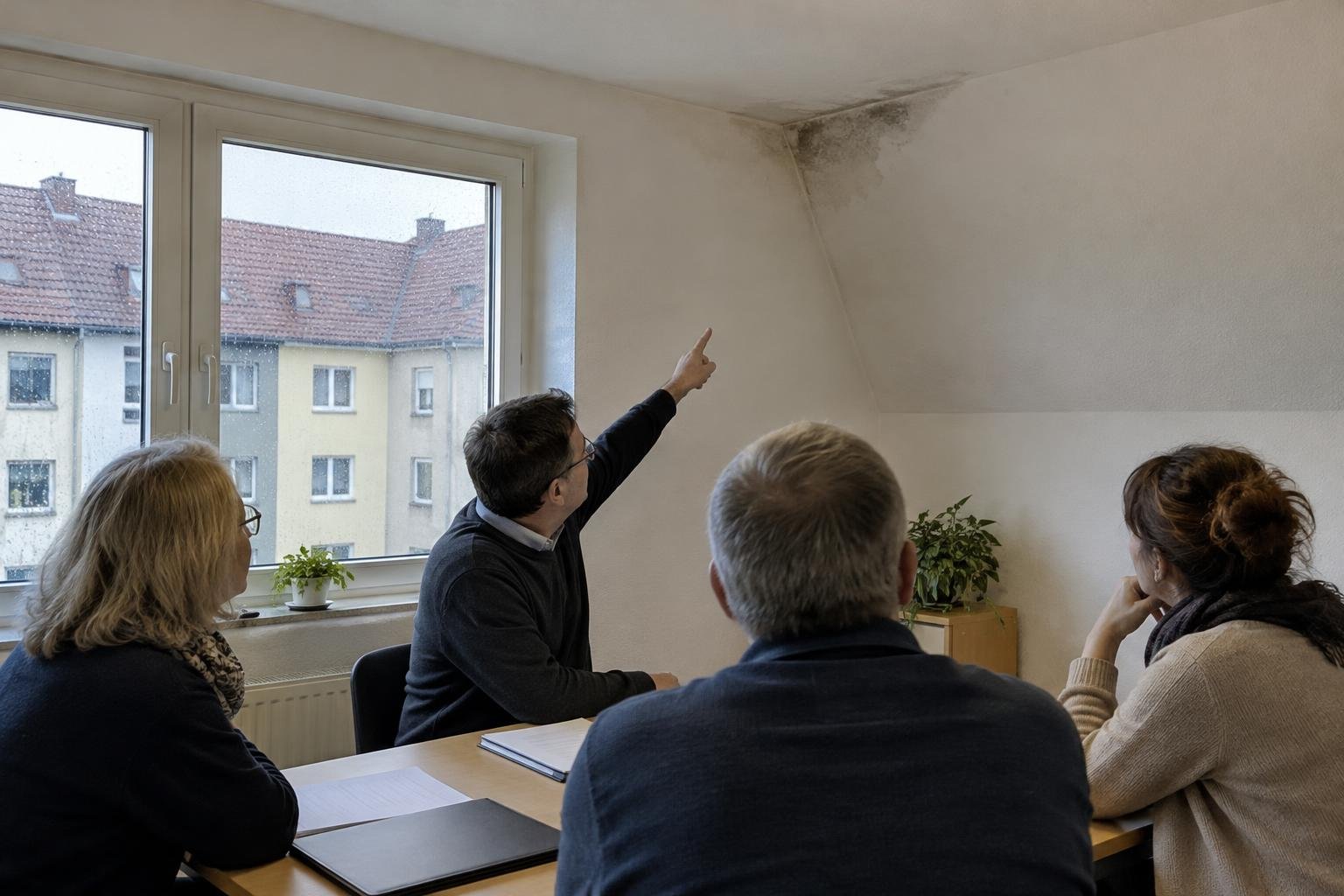
Windows, balconies and water damage: who pays in an owners’ association?
External windows are common property, even when they are in your flat. Understand ownership and cost allocation, with a comparison of two window replacement cost rules.
 Nadeem Shahid
Investment Advisor at InvestImmo
Your tenant reports that the bedroom window no longer closes and is letting in a draught. Your first thought is a window installer. Your second should be the declaration of division [Teilungserklärung]. Although the external window is in your flat, it forms part of the common property [Gemeinschaftseigentum]. If you replace it without authorisation, you could be left paying the bill yourself.
The question of who pays has two parts. Who owns the component? And who bears the costs under the community rules [Gemeinschaftsordnung] and resolutions?
01The basic rule under § 5 WEG
Individually owned property comprises your rooms and components that can be altered, removed or installed without adversely affecting the common property or other owners beyond the legally permitted extent and without changing the building’s external appearance (§ 5(1) WEG). Anything necessary for the building’s integrity or safety, or serving shared use, must be common property, even if it is inside your flat (§ 5(2) WEG).
An initial question is therefore: does an alteration affect the external appearance, structural stability or a shared function? If so, that points towards common property. If it affects only your flat, individual ownership may be possible; location inside the flat is not decisive on its own.
The reverse is also possible. Owners can agree that components which could be individually owned will instead form part of the common property (§ 5(3) WEG). However, anything protected by § 5(2) cannot be made individually owned property.
„What happens after major damage, such as roof damage or a water leak — does every owner have to contribute extra?“
A useful question when buying: if the maintenance reserve, insurance proceeds and other available funds are insufficient, a special levy [Sonderumlage] may be needed. The association must resolve how to fund the work. Each owner’s contribution depends on the applicable cost allocation rule, not necessarily their co-ownership share. An adequately funded maintenance reserve can make such additional payments less frequent, but cannot rule them out.
02What belongs to whom: an overview
The table shows the general allocation. In each case, the component’s function and the declaration of division need to be considered. The declaration cannot turn mandatory common property into individually owned property.
| Component | General allocation | Reason |
|---|---|---|
| External windows, including frames and glass | Common property | Shape the façade and protect the building |
| Internal window sill | Individual ownership possible | Provided it has no shared function or external effect |
| Roller shutters, external blinds | Usually common property | External appearance; individual internal operating components require separate assessment |
| Flat entrance door | Common property | Boundary with the communal stairwell and shared functions |
| Balcony: slab, waterproofing, parapet, railings | Common property | Structural stability, waterproofing, façade |
| Balcony: finish above the waterproofing | Individual ownership possible | Provided it has no waterproofing or other shared function |
| Load-bearing walls, structural floors, screed | Load-bearing walls and structural floors: common property; screed depends on function | Structural stability; assess the screed’s acoustic and fire protection functions in particular |
| Non-load-bearing internal walls, floor finishes, tiles | Individual ownership possible | Provided only the flat is affected and there is no shared function |
| Risers, main pipe runs | Common property | Serve several flats |
| Branch pipework serving only your flat | Case-by-case assessment | Exclusive supply is not enough; check location, function and allocation |
| Radiators | Depends on function and the declaration of division | For one-pipe systems, assess effects on the overall system in particular |
| Roof, façade, stairwell, central heating plant | Common property | Shared use and building integrity |
03Ownership and costs are separate questions
Who owns a component is one question. Who pays for it may be another. There are three routes:
- Statutory rule. All owners bear the costs of common property according to their co-ownership shares (§ 16(2), sentence 1 WEG).
- Declaration of division or community rules. The community rules may require individual owners to bear particular costs for their flat’s windows, entrance door or balcony, even though these remain common property. The wording and scope of the valid provision are decisive.
- Resolution. Since 2020, owners have been able to resolve by a simple majority to allocate individual costs or specified types of costs differently (§ 16(2), sentence 2 WEG), for example for an upcoming window replacement. The resolution must meet the legal requirements for proper management.
Always read both the ownership allocation in the declaration of division and the cost provisions in the community rules and register of resolutions [Beschluss-Sammlung]. A valid rule making each owner responsible for the replacement costs of their flat’s windows substantially changes the calculation, as the example below shows. A clause dealing only with maintenance should not automatically be treated as a comprehensive obligation to pay replacement costs.
If you want more than the association plans to do
Some owners want to replace their windows earlier or install better ones, such as triple glazing, while the association is still waiting. As external windows are common property, an appropriate decision by the association is required. Where the work constitutes a structural alteration, it can be authorised by resolution (§ 20(1) WEG). An individual owner granted permission for such an alteration generally bears its costs and is alone entitled to its benefits (§ 21(1) WEG). The same resolution should address future maintenance and cost allocation. Otherwise, disputes may arise later over who pays for repairs.
You have more freedom with individually owned property. Works going beyond maintenance do not require permission if they cause no other owner a disadvantage exceeding what is unavoidable in orderly communal living (§ 13(2) WEG). A new floor finish may therefore be your responsibility, but acoustic protection and other owners’ rights still matter. Intervening in screed that performs a shared function is a different matter. Discuss unclear cost provisions and any work you plan to commission independently with a lawyer.
04Water damage: who pays for what?
Water damage brings together ownership, cause, liability and insurance. Proper management includes adequate insurance of the common property at reinstatement value (§ 19(2), no. 3 WEG). Buildings insurance may cover insured escape-of-water damage to the building, including affected parts of individually owned property. The policy determines which losses are insured. For the allocation of excesses, the applicable cost rules and resolutions also need to be checked; the location of the leak alone is not decisive.
- 01Limit the damage
Turn off the water and inform neighbours. If common property faces imminent damage, any owner may immediately take necessary action (§ 18(3) WEG).
- 02Inform the managing agent
The agent should coordinate notification to the buildings insurer and the necessary leak detection and drying within their authority.
- 03Establish the cause
Is the leak in a riser or a pipe serving one flat? Check ownership, insurance cover, cost allocation rules and potential liability claims. Ownership of the leaking pipe alone does not determine responsibility for all uninsured consequential losses.
- 04Provide access
You must allow access to your flat for legally required works where the statutory conditions are met (§ 14(1), no. 2 WEG). If an interference that must be tolerated exceeds a reasonable level, appropriate financial compensation may be claimed (§ 14(3) WEG).
- 05Involve the tenant
Damage to the tenant’s furniture and belongings may be covered by their contents insurance, depending on the policy; liability claims may also arise. A substantial impairment of the agreed use of the flat may entitle the tenant to a rent reduction.
05Worked example: three old windows, two cost rules
Sandra owns a rented flat with three windows dating from the 1990s in a building with 40 windows. Her co-ownership share is 60/1,000. The example assumes a uniform cost of €1,400 per window, including installation, with no additional costs. The name, building and price are fictional. This is a simplified illustrative calculation, not a statement of market prices or a forecast.
Option A applies the statutory rule. The association replaces all 40 windows for €56,000 and allocates the costs by ownership share. Option B assumes the same replacement of all 40 windows, but a valid provision in the community rules assigns each owner the replacement costs for their flat’s windows.
| A: Allocation by ownership share | B: Each owner bears their windows’ costs | |
|---|---|---|
| Total project cost | €56,000 | €56,000 |
| Calculation of Sandra’s share | €56,000 × 60/1,000 | 3 × €1,400 |
| Sandra’s share before tax | €3,360 | €4,200 |
| Taxable income after deduction | €56,640 | €55,800 |
| Income tax before the additional deduction | €14,233 | €14,233 |
| Income tax after the additional deduction | €12,956 | €12,643 |
| Income tax saving at €60,000 taxable income before deduction | €1,277 | €1,590 |
| Sandra’s cost after income tax | €2,083 | €2,610 |
Option B costs Sandra more because three of the 40 equally priced windows represent 7.5% of the total cost, whereas her co-ownership share is only 6%. Conversely, individual cost allocation may be cheaper if the costs of the windows assigned to her flat are below her share of the overall cost. Window area alone does not determine this.
If the replacement is paid from the maintenance reserve [Erhaltungsrücklage], paying into that reserve is not itself deductible. Only Sandra’s share of actual expenditure by the association that qualifies for tax relief may be taken into account; the full service charge [Hausgeld] is not the relevant amount (German Federal Fiscal Court [BFH], judgment of 14 January 2025, IX R 19/24). Whether an immediate deduction or depreciation is required depends on the tax classification. Discuss this with your tax adviser.
06Who particularly needs to consider this?
- You are buying in an older building where windows, balconies or pipework will soon need attention.
- Your flat has more windows than average or a large balcony.
- The community rules are old and contain specific cost provisions.
- A new-build property with outstanding rights to claim against the developer for defects: check scope, deadlines and enforceability.
- The association has recently refurbished windows and balconies: check workmanship, funding and remaining requirements.
07Risks and common mistakes
Arranging work without authority. Owners who replace common property without the required authorisation and outside an emergency risk bearing the costs themselves. They may also have to reverse the work, for example where it involves an unauthorised façade alteration.
Incorrect ownership assumptions. Treating external windows or a flat entrance door as individually owned property can confuse responsibility for the work with responsibility for its cost. This may lead to disputes and additional expense.
Underestimating the reserve. If windows, balconies and pipework need replacement in the coming years and the reserve is small, a special levy may be necessary. Meeting minutes and the financial position report [Vermögensbericht] can indicate funding needs before purchase, but do not replace a technical condition assessment.
Not checking insurance. Excesses, exclusions and changes in buildings insurance premiums may affect your costs through service charges and additional payments.
FAQFrequently asked questions
Are windows common property or individually owned?
External windows, including their frames and glass, are common property, even when they are in your flat. They shape the external appearance and protect the building (§ 5 WEG). An internal window sill may be individually owned if it performs no shared function.
Who pays for new windows in an individually owned flat?
Owners generally bear the costs according to their co-ownership shares. A valid agreement may assign particular replacement costs to individual owners. A lawful resolution can also change the allocation (§ 16(2), sentence 2 WEG). Individual responsibility for costs does not automatically authorise an owner to arrange replacement independently.
Is a balcony individually owned property?
The balcony space and a surface finish with no shared function may be individually owned. The slab, waterproofing, parapet and railings are common property. The component’s function and the legally permissible allocation in the declaration of division are decisive.
Who pays for water damage in an individually owned flat?
Buildings insurance pays for insured losses within the agreed policy terms. For excesses and uninsured costs, ownership, cost allocation rules and potential liability claims must be considered; the location of the leak alone is not decisive. Damage to a tenant’s belongings may be covered by their contents insurance.
Can I arrange to replace my window myself?
As external windows are common property, you need appropriate authorisation from the association. If common property faces imminent damage, you may take necessary action to prevent it (§ 18(3) WEG). This does not automatically justify replacing an entire window. Without the required authorisation, you risk bearing the costs yourself.
Is a flat entrance door common property?
The door between a flat and the communal stairwell is common property. A different description in the declaration of division cannot turn mandatory common property into individually owned property. Cost allocation may nevertheless be regulated separately.
Can I deduct repair costs for common property from tax?
For a rented property, your share of qualifying repair expenditure may be deductible. Whether immediate deduction or depreciation is required depends on its classification. Contributions to the maintenance reserve are not immediately deductible; what matters is the association’s actual qualifying expenditure, not the full service charge. Discuss the classification with your tax adviser.
08Further reading
- Glossary: Common property
- Glossary: Individually owned property
- Glossary: Declaration of division
- Riser replacement: costs and process for owners
- Planning property maintenance costs
- Glossary: Acquisition-related production costs
09Sources
- § 5 WEG (scope of individually owned property), § 1 WEG, § 13 WEG, § 14 WEG, § 16 WEG, § 18 WEG, § 19 WEG, § 20 WEG, § 21 WEG
- § 6 EStG (subsection 1, no. 1a, acquisition-related production costs)
- BFH, judgment of 14 January 2025, IX R 19/24
- § 32a EStG (2026 income tax tariff)
- Simplified illustrative calculation: 40 windows at €1,400 each, co-ownership share of 60/1,000; income tax under § 32a(1) EStG for 2026 with individual assessment and €60,000 taxable income before the additional deduction.
This guide provides general information. Consult a lawyer about the legal circumstances of your case and your tax adviser about its tax treatment.
Writes about Investment properties, New builds and renovation and Financing.
Nadeem is a qualified insurance and finance merchant, spent around eight years self-employed in the insurance and finance industry and has specialised in investment property since 2024. He writes about new builds, renovation, financing and the running costs of rented property.
This guide does not replace tax or legal advice. All figures are example calculations with disclosed assumptions.