Extraordinary owners’ meetings: invitations, notice and when they are worthwhile
The roof is leaking, but the next meeting is eight months away. More than a quarter of the owners can request an additional meeting. We explain invitations and notice periods and compare illustrative rental losses.
 Andriy Bezborodko
Managing Director of the InvestImmo Group
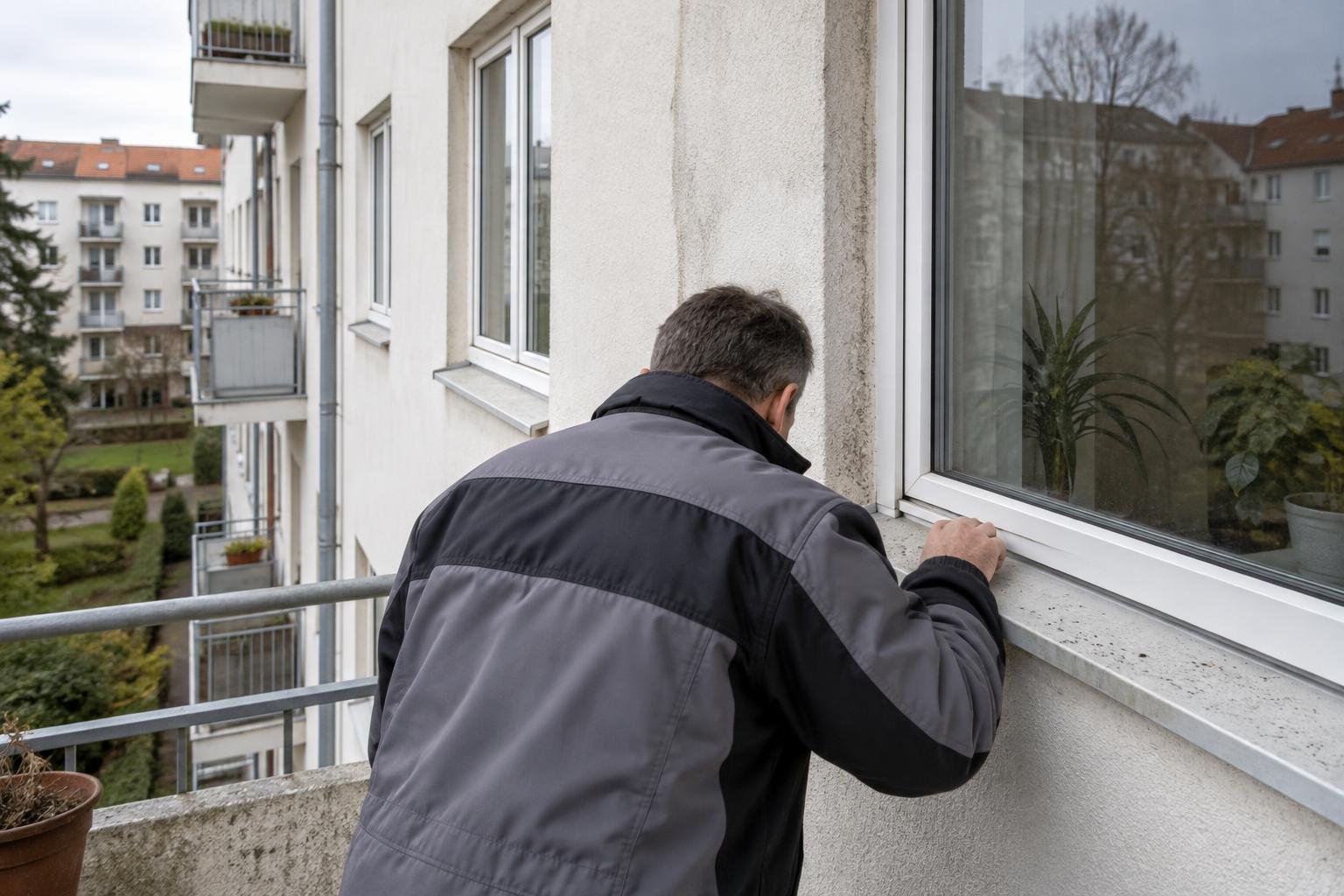
Your tenant sends a photograph. There is a water stain on the sloping bedroom ceiling, and it is growing. In the fictional example below, the managing agent replies that roof repairs will cost around €38,000 and require a resolution. The next owners’ meeting is in June. It is October.
Waiting eight months could mean a rent reduction, an unhappy tenant and worsening damage. An extraordinary owners’ meeting is one possible route to an earlier decision. Necessary emergency measures must not simply be postponed until then.
01Ordinary and extraordinary meetings
The Act does not expressly distinguish between the two terms. It requires the managing agent to convene a meeting at least once a year (section 24(1) WEG) and to convene additional meetings in certain circumstances (section 24(2) WEG). In practice, the annual meeting is called ordinary and an additional meeting extraordinary.
| Ordinary meeting | Extraordinary meeting | |
|---|---|---|
| Reason | annual business, particularly resolutions based on the annual accounts and budget | urgent individual matters, damage, replacement of the managing agent |
| Who convenes it | normally the managing agent | normally the managing agent, on request or on their own initiative |
| Decision-making powers | statutory powers; subjects of resolutions must be announced | the same rules |
| Costs | as set out in the management contract, potentially included in the basic fee | an additional fee may apply under the management contract |
The same rules apply at an extraordinary meeting as at an ordinary one. Most resolutions require a simple majority of the votes cast (section 25(1) WEG). Since the 2020 reform, the Act has not required a minimum number of attendees. A meeting can adopt valid resolutions even if only three owners attend. Check for contrary provisions in the community’s agreements; no majority resolution can be passed without votes being cast.
02Who may convene an extraordinary meeting?
The managing agent normally issues the invitation. They must do so if an agreement between the owners requires a meeting in specified circumstances, or if more than a quarter of the apartment owners request one (section 24(2) WEG). The request must be in text form, for example a joint email, and state its purpose and reasons. It must be clear which owners support it.
The relevant measure is the number of owners, not the size of their co-ownership shares. More than a quarter means that exactly a quarter is not enough. The table below assumes that each flat belongs to a different individual. Where an owner holds several flats, or there are different joint ownership arrangements, the count needs separate assessment.
| Owners in the community | One quarter | Required: more than one quarter | |
|---|---|---|---|
| Small building | 8 | 2 | 3 |
| Medium-sized building | 12 | 3 | 4 |
| Development | 20 | 5 | 6 |
| Larger development | 40 | 10 | 11 |
If the managing agent wrongfully refuses, or there is no managing agent, the advisory board’s chair, their deputy or an owner authorised by resolution may issue the invitation (section 24(3) WEG). An individual owner without the relevant authority cannot do so merely because a request has been made. If they nevertheless convene a meeting, its resolutions may be open to challenge. Court assistance may be necessary if the statutory alternatives are unavailable. Seek advice from a German lawyer [Rechtsanwalt] in this situation.

03What should the invitation include?
Whether the meeting is ordinary or extraordinary, its invitation must comply with certain rules. Otherwise, resolutions may be challenged.
- 01Text form
The invitation must be issued in text form (section 24(4) WEG). An email can suffice, but delivery to every owner entitled to an invitation must be ensured.
- 02Notice period
Except in cases of particular urgency, the notice period should be at least three weeks (section 24(4) WEG). Receipt of the invitation matters, not merely when it was sent. Check for contrary provisions in the community’s agreements. A leaking roof may establish particular urgency; the specific need for action is decisive.
- 03Venue and time
Both must be reasonable in the circumstances of the community. A weekday meeting at 10 am in another town could be problematic, but is not automatically impermissible for that reason alone.
- 04Agenda
Every subject on which a resolution is proposed must be identified (section 23(2) WEG). ‘Any other business’ is generally insufficient for specific substantive resolutions.
- 05Proposed resolutions and supporting documents
Quotations, cost estimates and proposed funding from the maintenance reserve [Erhaltungsrücklage] or a special levy [Sonderumlage] should enable an informed decision. The documents required, and when they must be available, depend on the proposed resolution.
- 06Online participation
If the community has approved electronic participation in an in-person meeting (section 23(1), second sentence, WEG), the invitation or accompanying information should explain how to join. Fully virtual meetings have additional requirements.
- 07Proxy form
This is not mandatory, but helps owners who cannot attend. Proxy authorisation must be in text form (section 25(3) WEG); any restrictions on who may act as a proxy must be observed.
The managing agent chairs the meeting unless it resolves otherwise (section 24(5) WEG). Minutes recording the resolutions must be prepared without undue delay (section 24(6) WEG). Resolutions must also be entered in the register of resolutions [Beschluss-Sammlung], which every owner may inspect.
04How the meeting works
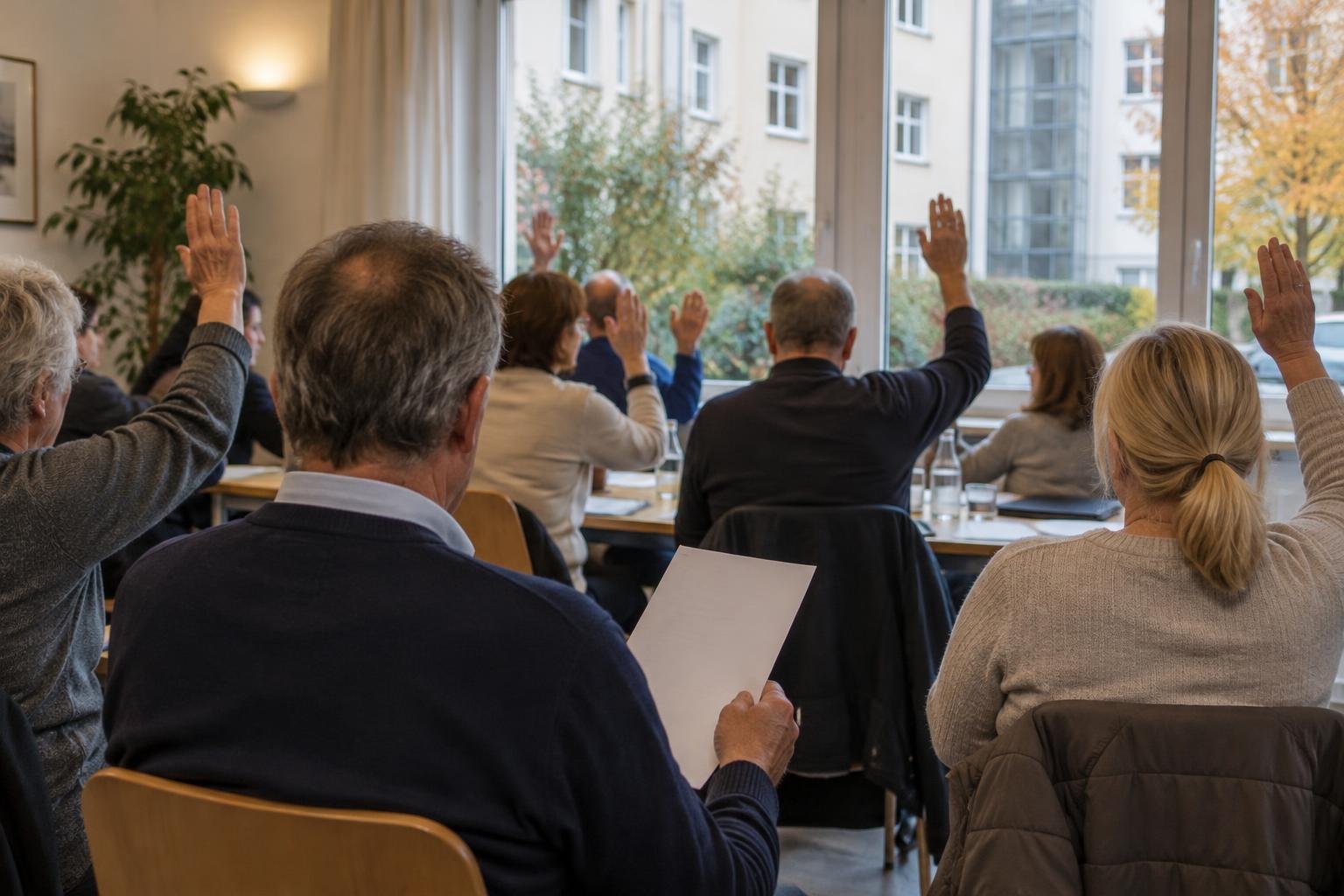
An extraordinary meeting follows the same procedure as the annual meeting, often with a shorter agenda. The chair, usually the managing agent, opens the meeting, checks that it was properly convened and examines proxy authorisations. Agenda items are then considered in order. Each item involves an explanation, questions and discussion, followed by a vote on a specific proposed resolution.
Pay attention to the wording of the proposal. The decision concerns what was put to the vote, for example: ‘The community appoints Company X to carry out the roof repairs at the quoted price of €38,000, funded from the maintenance reserve.’ The chair establishes and announces the result. The resolution is then documented in the minutes and the register of resolutions. The one-month period for a challenge is linked to adoption of the resolution.
05The cost of waiting: a worked example
Returning to the leaking roof, Jonas owns the top-floor flat and lets it for €780 a month excluding service charges. His co-ownership share [Miteigentumsanteil] is 38/1,000. The calculation assumes a monthly rental loss of €156. Arithmetically, that is 20% of the rent excluding service charges, but it is not a legally established rent reduction: the assessment base for a rent reduction is generally the gross rent, including agreed operating charges. The example therefore uses a fixed loss amount without determining a specific rent reduction percentage.
The name is fictional, and the figures are an illustration rather than a forecast. The appropriate reduction depends on the specific defect. Our rent reduction table provides context, not a binding percentage for this case. A German lawyer can advise you on disputes over whether a rent reduction is justified and its appropriate amount.
Option A is to wait: the roof repairs are not approved until the ordinary meeting in June. Option B is an extraordinary meeting: owners request it in October, it takes place in mid-November, and the roof is watertight in January. For the cost comparison, A assumes eight full-month equivalents of rental loss and B assumes three, independently of exact calendar dates. Approval in June does not mean that the damage is repaired immediately. The loss periods are simplified assumptions, not promised repair times. In this example, the management contract provides for a total additional meeting fee of €450, assumed to be allocated according to co-ownership shares.
Illustrative calculation, simplified: For the additional after-tax comparison, we assume a uniform tax effect of 30% across the entire change in income. We also assume that Jonas can deduct his share of the additional management fee immediately as an expense against rental income. His personal income tax tariff, solidarity surcharge and church tax are not calculated.
| A: Wait | B: Extraordinary meeting | |
|---|---|---|
| Assumed rental loss of €156 per month | −€1,248.00 | −€468.00 |
| Share of additional management fee: 38/1,000 of €450 | €0.00 | −€17.10 |
| Loss before tax | −€1,248.00 | −€485.10 |
| Tax relief at an assumed tax effect of 30% | +€374.40 | +€145.53 |
| Loss after tax in the simplified example | −€873.60 | −€339.57 |
The difference before tax is exactly €762.90, or €763 rounded. At the assumed tax effect of 30%, the after-tax benefit is €534.03, or €534 rounded. Lower taxable rental income and deductible management costs may reduce income tax. That is why the after-tax benefit in this example is smaller than the before-tax benefit. The actual effect depends on factors including other income, the personal tax tariff and the tax treatment of the costs. The calculation also excludes possible consequential damage and effects on the tenancy: moisture entering the insulation, mould or the tenant giving notice.
For the investment assessment, contributions to the maintenance reserve are not deductible from rental income when paid into the reserve. Only actual expenditure that qualifies for tax relief can be taken into account. Nor is the entire owners’ service charge [Hausgeld] automatically deductible. Repair or refurbishment expenditure also needs assessment to establish whether it is immediately deductible maintenance expenditure or must be capitalised. Ask a German tax adviser [Steuerberater] to assess the specific tax treatment and your personal tax position.

06When action is needed even sooner
An extraordinary meeting takes time to organise and requires notice. You might, for example, allow four to six weeks as a simplified planning assumption. This is not a statutory period; the actual time needed depends on the circumstances. Genuine emergencies have faster options.
- Emergency measures by the managing agent. The agent may take measures necessary to avert detriment (section 27(1), no. 2, WEG). These may include temporarily sealing the roof. Whether more extensive work is permissible without a prior resolution depends on its necessary scope and urgency.
- Emergency measures by any owner. Where damage to the common property is imminent, any owner may take the measures necessary to avert it without consent (section 18(3) WEG). Limit action to what is necessary and document everything.
- Written resolution without a meeting [Umlaufbeschluss]. A resolution without a meeting is generally valid if all owners consent in text form (section 23(3) WEG). This can be quick in a small community whose owners agree. Without a special majority arrangement, even one missing consent prevents adoption. For an individual subject, the owners can resolve that a majority of the votes cast will suffice in the subsequent written procedure.
07When an extraordinary meeting may be worthwhile
- Damage to the common property is worsening or reducing your rental income.
- The managing agent is to be removed and a successor is ready.
- A deadline is approaching, for example for funding or a quotation.
- The matter concerns preferences without time pressure, such as appearance or house rules.
- The ordinary meeting is only a few weeks away.
- Documents needed for a decision are still missing; if the matter is urgent, obtaining them must be accelerated.
08Risks and limitations
Additional costs. The management contract may provide for an extra fee for another meeting. An owner’s share depends on the fee and the applicable allocation basis. The community generally bears the costs; they are not automatically charged only to those requesting the meeting.
Procedural errors. Shortening the notice period without particular urgency, or describing proposed resolution subjects unclearly, risks a challenge and legal uncertainty.
No majority. The meeting may decide differently from what you want. Support from more than a quarter of the owners for convening a meeting is not a majority for your substantive proposal.
Disagreements within the community. Requesting a meeting against opposition may strain relationships. Where damage is involved, the need for action may nevertheless outweigh that concern; matters of taste call for especially careful assessment of urgency.
FAQFrequently asked questions
When must an extraordinary owners’ meeting be convened?
When an agreement between the owners requires one in specified circumstances, or more than a quarter of the apartment owners request one in text form, stating its purpose and reasons (section 24(2) of the German Apartment Ownership Act, Wohnungseigentumsgesetz, WEG). The managing agent may also convene one on their own initiative.
How much notice is required for an owners’ meeting?
Except in cases of particular urgency, the notice period should be at least three weeks (section 24(4) WEG). Receipt of the invitation matters, not merely when it was sent. Check for contrary provisions in the community’s agreements.
Does the invitation need to be a signed letter?
No. Since the 2020 reform, text form has been sufficient, for example an email or an unsigned letter. Delivery to every owner entitled to an invitation must be ensured.
What happens if the managing agent refuses to convene the meeting?
If there is no managing agent, or the agent wrongfully refuses, the chair of the owners’ advisory board, their deputy or an owner authorised by resolution may convene it (section 24(3) WEG). Court assistance may be necessary if those alternatives are unavailable. Seek advice from a German lawyer in this situation.
How many owners must attend for the meeting to make decisions?
Since the 2020 reform, there has been no statutory minimum attendance requirement. A meeting with few attendees can adopt valid resolutions. Check for contrary provisions in the community’s agreements; no majority resolution can be passed without votes being cast.
Who pays for an extraordinary owners’ meeting?
The community generally pays. Whether the managing agent can charge an additional fee depends on the contract. Costs are allocated using the applicable allocation basis, normally co-ownership shares unless a valid alternative applies.
Can owners vote on matters that are not on the agenda?
Section 23(2) WEG requires the subject of a resolution to be identified when the meeting is convened. A resolution on an unannounced subject may be open to challenge. Proceedings must be brought within one month of adoption, with the grounds submitted within two months (section 45 WEG). If you intend to challenge a resolution, contact a German lawyer promptly.
09Further reading
- Apartment owners’ community: rights and duties
- Glossary: owners’ meeting
- Glossary: written resolution without a meeting
- Glossary: owners’ advisory board
- Rent reductions: a table for landlords
- Glossary: special levy
10Sources
- Section 24 WEG (convening meetings, notice, chairing and minutes), section 23 WEG (identifying resolution subjects and resolutions without meetings), section 25 WEG, section 18 WEG, section 27 WEG, section 45 WEG
- Section 32a EStG (statutory income tax tariff; the simplified example instead uses an assumed tax effect of 30%)
- Worked example: own calculation using the assumptions stated in the article.
This guide provides general information and does not replace advice on individual legal or tax matters. Figures are illustrative assumptions, not a forecast. Consult a German lawyer for individual legal questions and a German tax adviser for tax questions.
Writes about Taxes, AfA (depreciation), Financing and Investment concept.
Andriy is Managing Director of the InvestImmo Group and has been an entrepreneur in the property industry since 2020. His experience in estate agency, property marketing and his own investments shapes his view on property selection and long-term investment concepts. His team handles the personal advice for investors.
This guide does not replace tax or legal advice. All figures are example calculations with disclosed assumptions.