Nürnberg for Property Investors: All 10 Districts Compared 2026
Nürnberg’s districts differ less in price than in building age, households and new construction. We compare all ten statistical districts using official figures and run the numbers for the same flat in three districts.
 Michael Pauker
Investment Advisor at InvestImmo
You have settled on Nürnberg as your investment location. Now it is time to choose a district: Altstadt or Südstadt, Langwasser or Thon? In many large cities, prices differ by thousands of euros per square metre between districts. In Nürnberg, the picture is different.
Asking prices across the larger areas are close together, and the rent index provides for just one location premium of 6% for Old Town and inner city. The districts differ much more markedly in the age of their buildings, household sizes and the new housing being built by 2033.
Here, we compare all ten statistical districts using official city figures. There is no ranking. At the end, we calculate the figures for the same flat in three districts, before and after tax.
01Nürnberg’s ten districts: the comprehensive comparison table
The table summarises the subdistrict data sheets from the Office for Urban Research and Statistics for each statistical district (as at 31.12.2025). The final column shows how many people the city expects to accommodate in new buildings by 2033.
| Statistical district | Population 2025 | Change since 2015 | People per household | Homes | Older housing built up to 1948 | Unemployed per 100 working-age residents | Residents of new homes by 2033 |
|---|---|---|---|---|---|---|---|
| 0 Old Town and inner city | 58,562 | +0.3% | 1.57 | 34,824 | 21.9% | 6.5 | 2,480 |
| 1 Weiterer Innenstadtgürtel Süd | 98,903 | +4.0% | 1.75 | 50,475 | 32.8% | 8.3 | 3,550 |
| 2 Weiterer Innenstadtgürtel West/Nord/Ost | 93,002 | +3.8% | 1.80 | 50,655 | 32.8% | 6.7 | 2,730 |
| 3 Südöstliche Außenstadt | 48,767 | +0.1% | 2.02 | 24,229 | 5.4% | 5.5 | 1,980 |
| 4 Südliche Außenstadt | 51,672 | +4.0% | 2.08 | 25,301 | 17.6% | 4.0 | 11,350 |
| 5 Südwestliche Außenstadt | 48,296 | +4.8% | 2.00 | 25,281 | 10.7% | 5.2 | 1,730 |
| 6 Westliche Außenstadt | 34,441 | +8.9% | 1.98 | 16,686 | 23.1% | 6.0 | 12,280 |
| 7 Nordwestliche Außenstadt | 35,464 | +6.3% | 2.04 | 17,707 | 10.1% | 2.9 | 8,960 |
| 8 Nordöstliche Außenstadt | 29,521 | +5.0% | 1.96 | 14,955 | 29.1% | 5.0 | 1,510 |
| 9 Östliche Außenstadt | 49,285 | +6.5% | 2.01 | 25,291 | 15.4% | 3.8 | 2,550 |
| Nürnberg | 547,913 | +4.0% | 1.87 | 285,404 | 22.1% | 5.9 | around 49,000 |
Residents with their main residence registered in the population register; homes in residential buildings. Unemployed people under Books II and III of the Social Code (SGB II and III) per 100 residents aged 15 to 64, aggregated from subdistrict figures and not comparable with the unemployment rate published by the Agentur für Arbeit. Residents of new homes according to the small-area population projection for 2025 to 2033. Own compilation, as at 14.10.2026.
Two patterns stand out. The city centre and the surrounding inner-city belt have the smallest households and the highest proportion of older housing. And new construction over the coming years is concentrated in three outer districts, not in the centre.
02Purchase prices: what is substantiated and what is not
This is where things become awkward for investors. Nürnberg’s property valuation committee publishes its property market report only for a fee; average prices by district are not freely available. What is substantiated is the headline data cited by the city in its 2025 housing report.
There were 5,621 purchase contracts in 2025. Existing owner-occupied flats cost between €1,800 and €6,800/m², averaging 4% more than in the previous year. New-build flats ranged from €4,600 to €9,500/m², with one-room apartments accounting for around half of them.
According to this source, the difference between the most and least expensive areas is around €400/m², or just over 10%. By contrast, the official range of €1,800 to €6,800/m² shows how widely individual flats vary in price. In Nürnberg, the difference is driven primarily by the year of construction, condition and immediate surroundings, and less by the district.
For your purchase decision, this means that an advertised price by district tells you little. Check the standard land value for the location with the property valuation committee and compare flats built in the same year. If you are assessing several flats in Nürnberg, the property market report, with its prices broken down by submarket, is worth obtaining.
03Rents: what the rent index allows by location
The city of Nürnberg does not publish rents by district. The qualified rent index for 2026 calculates the comparative rent using a base rent determined by floor area, plus premiums and deductions. For a 55 m² flat, the base rent is €10.18/m².
| Feature according to the 2026 rent index | Premium or deduction |
|---|---|
| Old Town and inner city district | +6% |
| Residential location with advantages (near a park, tram or underground station, on a side street) | +2% |
| Residential location with disadvantages (main road, commercial area, long distances to amenities) | −2% |
| Built between 1919 and 1948 | −8% |
| Built between 1949 and 1976 | −6% |
| Built between 1996 and 2006 | +9% |
| Built in 2017 or later | +23% |
Source: City of Nürnberg’s 2026 rent index, as at 01.08.2026, extract. The Altstadt zone is defined by streets and is not identical to statistical district 0.
Nürnberg is subject to the rent brake and a cap on rent increases of 15% over three years until 31.12.2029. When a property is re-let, the rent may be no more than 10% above the comparative rent. Flats first occupied and let after 01.10.2014 are exempt.
Enter the purchase price and actual rent; the calculator shows the gross and net rental yields.
04Population, households and new housing by district
Between 2015 and 2025, Nürnberg’s population grew by 4.0% to 547,913. Growth was strongest in Westliche Außenstadt (+8.9%), Östliche Außenstadt (+6.5%) and Nordwestliche Außenstadt (+6.3%). Altstadt and Südöstliche Außenstadt, which includes Langwasser, remained almost unchanged.
Household size indicates where small flats are in demand. In Old Town and inner city, an average of 1.57 people live in each household, compared with 1.75 to 1.80 in the inner-city belt. All outer districts have around two people per household, with 2.08 in Südliche Außenstadt.
A high volume of new construction means two things for investors. The area grows and gains better services and amenities. At the same time, new rental homes come onto the market, competing with older flats for tenants.
For the social profile, we cite only official figures. At the end of 2025, the number of registered unemployed people per 100 working-age residents ranged from 2.9 in Nordwestliche Außenstadt to 8.3 in Innenstadtgürtel Süd. This describes differences in the tenant population, not the quality of the districts. When letting your property, what matters is the income of the individual household, which you check during tenant selection.
05Four types of district for property investors
In its population projections, the city itself groups the ten districts into four categories. We use the same classification. Each type suits different investors.
Type 1: the city centre and inner-city belt
Districts 0 to 2 extend from Altstadt, St. Johannis and Gostenhof through Südstadt to St. Leonhard, Maxfeld and Gleißhammer. Around 250,000 people live here in small households, and almost a third of the flats date from before 1949. Households here are the smallest in the city.
- You want to let small flats to single people.
- You are deliberately buying an older property, taking its maintenance needs into account.
- You allow for tenant turnover.
- You are looking for a flat that needs no refurbishment.
- You base your calculations on advertised rents rather than the local reference rent table.
Type 2: Südliche Außenstadt
Between Hasenbuck, Gartenstadt, Werderau and Katzwang, Nürnberg is seeing its greatest physical expansion. Lichtenreuth is being developed on the former freight station site, with housing and the campus of Technische Universität Nürnberg. The city expects new housing for more than 11,000 people here by 2033.
- You are considering a new-build property with declining-balance depreciation.
- You are investing in a growing neighbourhood and have patience.
- You want couples and families as tenants.
- You are wary of competition from numerous new rental flats.
- You expect a completed, established neighbourhood.
Type 3: the south-western and eastern outer districts
These include Langwasser and Altenfurt in the south-east, Eibach and Röthenbach in the south-west, Ziegelstein and Schoppershof in the north-east, and Mögeldorf, Erlenstegen and Laufamholz in the east. In Südöstliche Außenstadt, which includes the large Langwasser housing estate built in the 1960s and 1970s, only 5% of homes are older properties. In the east, the population has grown by 6.5% since 2015, and unemployment is low.
- You are looking for two- to three-room flats for couples and families.
- You carefully check the reserves and refurbishment status of large residential complexes.
- You prefer a more settled tenant base with longer tenancies.
- You are mainly looking for single people as tenants.
- You are counting on a location premium in the local reference rent table.
Type 4: the northern and western outer districts
Westliche Außenstadt, including Eberhardshof, Muggenhof and Höfen, and Nordwestliche Außenstadt, including Thon, Buch and Schniegling, have been growing for years. The city expects Westliche Außenstadt to see more new construction than any other district by 2033. Nordwestliche Außenstadt has the lowest unemployment in the city.
- You want to buy in growing districts with good transport links.
- You compare new-build and existing properties in the same neighbourhood.
- You expect stable households as tenants.
- You want to rule out supply pressure from new construction.
- You interpret the highest asking price as a sign of higher rent.
06Worked example: the same flat in three districts
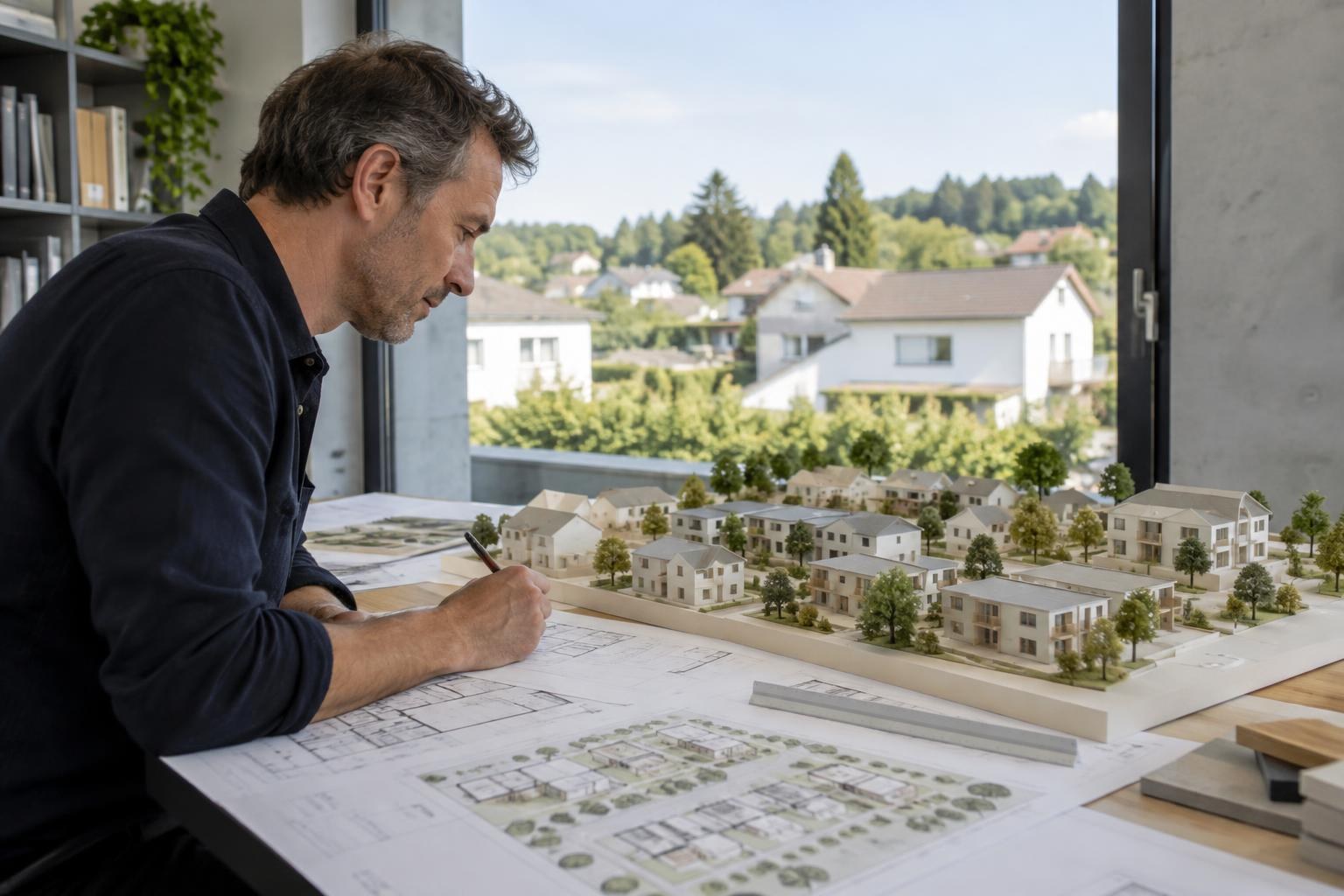
Take Jonas. He is employed, single and has a taxable income of €60,000. He buys a tenanted, two-room flat of 55 m² dating from the 1960s and compares Altstadt, Nordwestliche Außenstadt and Südstadt. The name is fictional, and the figures are a worked example, not a forecast.
The purchase prices are asking prices for the areas of Mitte, Nordwestliche Außenstadt and Süd, because official district-level prices are unavailable. For rent, we use the 2026 local reference rent table: a base of €10.18/m², −6% for the year of construction, +6% in Altstadt, then 10% on top under the rent cap rules. This gives €11.20/m² in Altstadt and €10.53/m² in the other two districts.
| Altstadt | Nordwestliche Außenstadt | Südstadt | |
|---|---|---|---|
| Purchase price per m² (asking price) | €4,004 | €4,144 | €3,743 |
| Purchase price for 55 m² | €220,220 | €227,920 | €205,865 |
| Property transfer tax 3.5% | €7,708 | €7,977 | €7,205 |
| Notary and land registry (around 1.8%) | €3,964 | €4,103 | €3,706 |
| Total costs | €231,892 | €240,000 | €216,776 |
| Rent excluding service charges per m² | €11.20 | €10.53 | €10.53 |
| Annual rent excluding service charges | +€7,392 | +€6,950 | +€6,950 |
| Service charges not recoverable from tenants | −€924 | −€924 | −€924 |
| Interest (3.8%) | −€8,368 | −€8,661 | −€7,823 |
| Principal repayment (2%) | −€4,404 | −€4,558 | −€4,117 |
| Cash flow before tax | −€6,304 | −€7,193 | −€5,914 |
| Depreciation at 2% on 75% of total costs | €3,478 | €3,600 | €3,252 |
| Rental profit/loss for tax purposes | −€4,916 | −€5,773 | −€4,587 |
| Tax saving (2026 tax rates) | +€1,855 | +€2,170 | +€1,734 |
| Cash flow after tax | −€4,449 | −€5,023 | −€4,180 |
| Per month | around −€370 | around −€420 | around −€350 |
| Gross rental yield | 3.4% | 3.0% | 3.4% |
Jonas has to contribute money every month in all three districts: around €350 to €420 after tax. In each case, around €340 to €380 of this is principal repayment, which reduces his outstanding debt. Excluding principal repayments, the flat would almost break even after tax in Altstadt and Südstadt.
Altstadt performs no worse than Südstadt. The asking price there is around 7% higher, but the local reference rent table also allows around 6% more rent. Nordwestliche Außenstadt has the highest price, but the local reference rent table provides no location premium there.
The differences between districts in Nürnberg are small. Had Jonas bought a property built in the 2000s rather than the 1960s, the permitted rent would be 15 percentage points higher, but the purchase price would also be higher. Our guide to paying tax on rental income shows how much you could save in tax at your income level.
The calculation is not a recommendation for any particular district. It shows that in Nürnberg, the building, its year of construction and the purchase price of the individual flat have a greater impact than the district. You can find city-wide figures, a new-build calculation and the rules for landlords on our investment properties in Nürnberg page.
07Risks when choosing a district in Nürnberg
Each district has its own risks. Some apply to all of them.
- Lack of official district-level prices: Asking prices across the different areas are close together and reveal little about the price actually paid for your flat. The official range is €1,800 to €6,800/m².
- Building age: A third of the flats in the inner-city belt date from before 1949. Roofs, pipework and heating systems put pressure on reserves there, and the local reference rent table applies a deduction of 6% to 8% for these construction years.
- New construction in the neighbourhood: Housing for a combined total of more than 32,000 people is being built in Westliche Außenstadt, Südliche Außenstadt and Nordwestliche Außenstadt by 2033. This adds supply with which your flat will compete for tenants.
- Local reference rent table and rent cap: Rents for new tenancies are capped until the end of 2029, while increases for existing tenancies are limited to 15% over three years.
- Interest rates: With gross yields of between 3.0% and 3.4%, every percentage-point change in interest rates has a substantial impact on the calculation.
- Large residential complexes: In Langwasser and other housing estates from the 1960s and 1970s, the owners' association's reserves and refurbishment plan determine the costs over the coming years.
- Use of housing for other purposes: Short-term letting and prolonged vacancy require a permit in Nürnberg.
08Other locations
You can find figures for Nürnberg as a whole, the rules for landlords and a new-build calculation on our investment properties in Nürnberg page. Our analysis of München for property investors compares the districts of the state capital. Other cities in Bavaria are covered in our Bavaria overview, and all cities in our 2026 city comparison.
FAQFrequently asked questions
Which Nürnberg district is best for property investors?
There is no single best district. The city centre has the smallest households and therefore the broadest demand for small flats, but also a large proportion of older buildings. The outer districts in the west, north-west and south are growing, but are also seeing substantial new supply. The decisive factors are the building, its year of construction and the price of the individual flat.
Where are flats cheapest in Nürnberg?
The Gutachterausschuss does not publish official average prices by district free of charge. According to asking prices from Engel & Völkers, in the third quarter of 2026 the areas Süd (€3,743/m²) and Südöstliche Außenstadt (€3,789/m²) had the lowest prices, while Nordwestliche Außenstadt (€4,144/m²) had the highest.
How many districts does Nürnberg have?
For statistical purposes, Nürnberg is divided into ten statistical districts and 87 statistical subdistricts. There are also many historic neighbourhood names, such as Gostenhof, St. Johannis and Langwasser, which do not constitute separate administrative units.
What are rental yields like in Nürnberg’s districts?
In our example calculation for a 55 m² flat built in the 1960s, the gross rental yield ranges from 3.0% in Nordwestliche Außenstadt to 3.4% in Altstadt and Südstadt. The calculation is based on asking prices and rents according to the rent index plus 10%.
Is a flat in Langwasser worthwhile as an investment?
Langwasser is a large housing estate built in the 1960s and 1970s. In the Südöstliche Außenstadt district, an average of around two people live in each household, and there are hardly any older buildings. The rent index provides no location premium there. Whether an investment is worthwhile depends on the purchase price, the reserve fund and the owners’ association’s renovation plan.
Does the rent brake apply throughout Nürnberg?
Yes. The Bavarian Tenant Protection Ordinance covers the entire city. The rent brake and the cap on rent increases of 15% over three years apply until 31 December 2029.
Where is Nürnberg growing?
Between 2015 and 2025, Westliche Außenstadt (+8.9%), Östliche Außenstadt (+6.5%) and Nordwestliche Außenstadt (+6.3%) grew the most. By 2033, the city expects the greatest growth driven by new construction in Westliche Außenstadt, Südliche Außenstadt and Nordwestliche Außenstadt.
09Further reading
- Investment properties in Nürnberg: figures and locations
- A flat as an investment: advantages and disadvantages
- Paying tax on rental income
- Rental yield calculator
- Property purchase costs calculator
- Property transfer tax in Bavaria
10Sources
All sources accessed on 14 October 2026.
- Office for Urban Research and Statistics für Nürnberg und Fürth, District data sheets 2025 (87 statistical districts, as at 31 December 2025) and District data sheets 2015
- Office for Urban Research and Statistics, Small-area population projection for Nürnberg 2025–2033 (10 September 2025)
- Stadt Nürnberg, Stab Wohnen, Housing report 2025 (property market data based on the property market report published by the expert valuation committee)
- Stadt Nürnberg, Rent index 2026 (as at 1 August 2026)
- Engel & Völkers, Property prices in Nürnberg (asking prices, updated 12 October 2026, market source)
- Gutachterausschuss Nürnberg, Property market report 2025, table of contents (available for a fee)
- Bayerische Staatsregierung, Tenant Protection Ordinance, Law and Ordinance Gazette (GVBl.) 2025, p. 718; Stadt Nürnberg, Unauthorised use of residential property for other purposes
- Section 32a of the Income Tax Act (EStG) (2026 tax rates), Section 7 of the Income Tax Act (EStG) (depreciation), Section 556d of the German Civil Code (BGB) (rent cap)
- Summary of district data sheets by neighbourhood, gross rental yields and illustrative calculation: own calculations, as at 14 October 2026
Disclaimer: This page provides general information and does not constitute investment, tax or legal advice. All figures are accompanied by their source and reference date; the illustrative calculation is based on disclosed assumptions and is not a forecast. As at 14 October 2026.
Writes about Financing and calculations, Taxes and Care properties.
Michael combines his experience as a banker and former portfolio manager at a family office with his practice as a property investor himself. He writes about robust calculations, financing, risks and strategic portfolio building.
This guide does not replace tax or legal advice. All figures are example calculations with disclosed assumptions.