Buy-to-Let Property in Celle: Figures, Locations and a Realistic Calculation
A medium-sized town north of Hanover with many inbound commuters, low rents and a high rate of home ownership. We lay out the available figures and run the numbers for an existing flat and a new build.
 Eduard Winter
Investment Advisor at InvestImmo
Celle is located around 40 kilometres north-east of Hanover, on the edge of the Lüneburg Heath. The town is a district capital, the seat of the Oberlandesgericht (Higher Regional Court) and a place of work for the surrounding area: every day, almost 8,000 more people commute in than out. At the same time, rents are low, and almost half of all flats are owner-occupied.
For investors, Celle is therefore not a classic rental market. On this page, we disclose which figures are available and which are missing, and run the numbers for an existing flat and a new-build using the qualified Mietspiegel (rent index).
01Celle in figures
All the values we use for our assessment, with their source and date. Values for the district and asking prices from portals are marked as such.
| Metric | Value | Source, as at |
|---|---|---|
| Population (official) | 66,930 | Federal Statistical Office, municipal directory, 31 December 2025 |
| Population 2015 (based on 2011 Census) | 69,748 | Federal Statistical Office, 31 December 2015 |
| Forecast 2024–2040 | −2.1% | State Office for Statistics of Lower Saxony, W2 variant |
| Households | 33,183 | 2022 Census |
| Share of one-person households | 47.2% | 2022 Census |
| Housing stock | 36,639 | 2022 Census |
| Vacancy rate | 5.2% | 2022 Census, as at 15 May 2022 |
| Share of rented flats | 49.3% | 2022 Census, own calculation |
| Employees subject to social security contributions at place of work | 34,350 | Federal Employment Agency, 30 June 2025 |
| Inbound commuters / Outbound commuters | 18,700 / 10,720 | Federal Employment Agency, 30 June 2025 |
| Unemployment rate, Celle district | 6.1% | Federal Employment Agency via Deutschlandatlas, 2025 annual average (district value) |
| Avg. rent of existing contracts | €6.40/m² | 2022 Census |
| Rent index, base rent for 65 m² | €5.80/m² | Qualified Mietspiegel 2024 |
| Asking rent, Celle district | €8.44/m² | BBSR via Deutschlandatlas, 2025 (district value) |
| Asking price for existing flat | €2,230/m² | Property portal, analysis of 2025 listings (not official) |
| Purchase price for new-build flat, Celle district | €3,060/m² | Upper Valuation Committee for Property Values in Lower Saxony, 2025 (district value) |
| Mietpreisbremse (rent brake) | No | Lower Saxony Tenant Protection Ordinance, list of municipalities |
| Kappungsgrenze (capping limit) | 20% | § 558 BGB |
| Property transfer tax in Lower Saxony | 5.0% | Lower Saxony state law |
02Population and demand
At the end of 2025, Celle had an official population of 66,930. In 2015, the figure was 69,748. Part of the difference is due to the 2022 Census, which recalculated the population figures. Since then, the number has been almost stable, with around 100 new residents in the last year. According to the Deutschlandatlas, the average development between 2019 and 2024 was minus 0.07% per year.
The State Office for Statistics of Lower Saxony forecasts an almost unchanged population for the town until 2030 and a 2.1% decrease by 2040. In-migration will compensate for most of the excess of deaths over births: plus 9.6% from migration, minus 11.7% from more deaths than births.
Celle is a town of homeowners. In the 2022 Census, 47.9% of flats were owner-occupied, and only 49.3% were rented. The average flat size is 95 m². Nevertheless, almost one in two households is a one-person household (47.2%), which supports the demand for smaller rental flats.
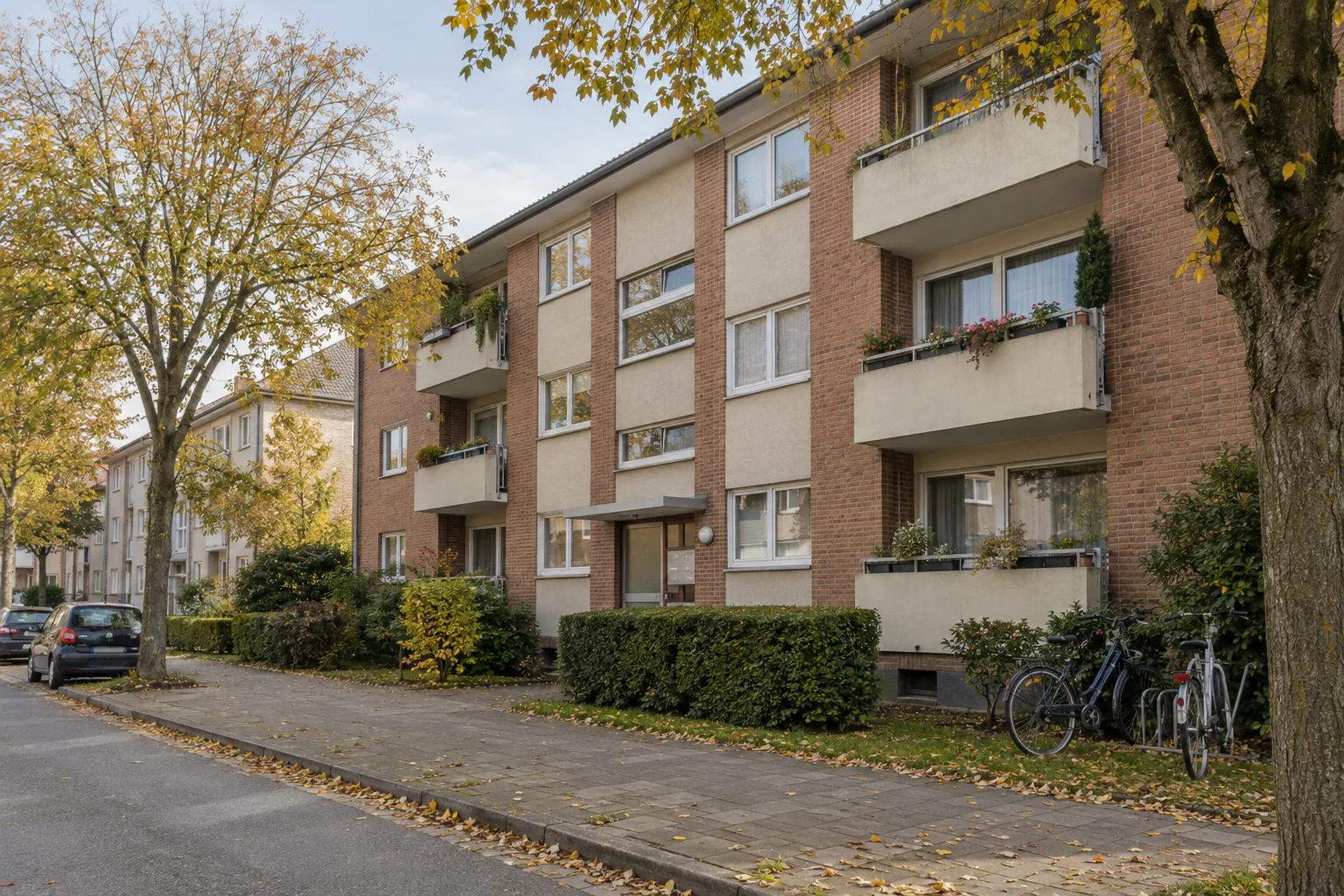
A large part of the housing stock dates from the 1950s to the 1970s, totalling over 20,000 flats. The largest group consists of flats from the 1960s.
03Economy and job market
Celle is a place of work. On 30 June 2025, 34,350 employees subject to social security contributions worked in the town, while 26,370 lived there. 18,700 people commute in, 10,720 commute out, a surplus of almost 8,000. In addition to public administration and the judiciary, including the Higher Regional Court, industry and services shape the job market.
We do not have an unemployment rate for the town alone. In the Celle district, the annual average for 2025 was 6.1%. There is no major university in Celle, so students play a negligible role as a target group.
The commuter surplus is an argument for landlords: some of the people who work in Celle are looking for a flat nearby. At the same time, the low rents show that many prefer to live in the surrounding area or in their own home.
04Rents, purchase prices and rental yield
Celle has a qualified Mietspiegel, created by DOMUS Consult based on a survey of 4,000 households, as at December 2024. The base rent depends on the size: €8.47/m² for 30 m², €6.26/m² for 45 m², and €5.80/m² for 65 m². In addition, there are premiums, such as plus 4.3% for buildings from 1977 to 1993, plus 12.6% for 1994 to 2006, plus 47.2% for 2021 to 2023, plus 4% for a balcony and plus 6.1% for a fitted kitchen. Residential location A adds a 4.5% premium.
Listings show significantly higher rents. The BBSR quotes an average asking rent of €8.44/m² for the Celle district for 2025. In the 2022 Census, tenants in the town paid an average of €6.40/m² in existing contracts.
There is a gap in the data for purchase prices. We could not find any freely accessible official figures for existing flats in the town of Celle. For 2025, portals analysed asking prices averaging around €2,230/m². Asking prices are often higher than the prices actually paid. For new flats, the Upper Valuation Committee for Property Values in Lower Saxony quotes an average price of €3,060/m² for the Celle district in 2025, significantly below the state average of €4,150/m².
The purchase price and rent determine the purchase price multiplier, the reciprocal of which is the gross rental yield.
With rents from the Mietspiegel, the gross yield on an existing flat is just over 3% if the asking price is paid. Anyone who buys below the asking price improves the yield accordingly. You can check your own figures with the Rental Yield Calculator.
05Districts at a glance
There are no freely available official prices or rents per district for Celle. The Mietspiegel only distinguishes between residential location A, with a 4.5% premium, and residential locations B and C; a residential location map shows the classification. The table therefore only describes the character of each area.
| District | Character | More suitable for |
|---|---|---|
| Altstadt and Blumlage | Centre with shopping areas and short distances, dense development | Single people, older tenants |
| Neuenhäusen | West of the old town, near the train station, a mix of apartment buildings | Commuters, professionals |
| Hehlentor and Klein Hehlen | North of the River Aller, residential areas of different ages | Couples, families |
| Vorwerk and Heese | Residential areas with post-war multi-storey housing | Price-conscious tenants |
| Westercelle and Altencelle | Southern districts, rather quiet, many single-family homes | Families |
| Wietzenbruch | Western district, more village-like | Families, longer tenancies |
When buying in Celle, comparison with prices actually paid is crucial. Ask the Gutachterausschuss (Valuation Committee) for comparison factors or for information from their purchase price collection before you accept an asking price.
06Rules for landlords in Celle
Celle is not listed in the Lower Saxony Tenant Protection Ordinance. This means:
- No Mietpreisbremse (rent brake): When signing a new lease, you are not bound to a rent that is 10% above the local comparable rent.
- Kappungsgrenze (capping limit) of 20%: In an existing tenancy, the rent may not be increased by more than 20% within three years, and only up to the level of the local comparable rent.
- Qualified Mietspiegel: This is the benchmark for rent increases in existing tenancies, and you must state its values in a rent increase request.
When buying in Lower Saxony, you pay 5.0% Grunderwerbsteuer (property transfer tax). On top of that come notary and land registry fees and, depending on the property, an estate agent. For a purchase price of €144,950, ancillary costs are around 6.9% without an agent. The Ancillary Purchase Costs Calculator will work out your own costs, and our article on notary fees explains the notary's charges.

07Example calculation: a tenanted flat in Celle
Let's take Thomas, 47, single, an administrative employee with a taxable income of €60,000. He buys a tenanted 65 m² flat, built in 1965, with a balcony, for €144,950. This corresponds to the average asking price in 2025 of €2,230/m². The rent, at €6.03/m², matches the Mietspiegel value for this flat. The name is fictional; the figures are a calculation example and not a forecast.
| Purchase price (65 m² × €2,230/m², asking price) | €144,950.00 |
|---|---|
| Property transfer tax Lower Saxony 5.0% | €7,248.00 |
| Notary and land registry (with Grundschuld (land charge) of €144,950) | €2,821.00 |
| Ancillary purchase costs from equity | €10,069.00 |
| Loan (purchase price) | €144,950.00 |
| Interest 3.8% and principal repayment 1.5% (assumption) | €7,682.00 per year |
| per year | per month | |
|---|---|---|
| Net cold rent (€6.03/m², Mietspiegel 2024) | €4,703.00 | €392.00 |
| Interest | −€5,508.00 | −€459.00 |
| Principal repayment | −€2,174.00 | −€181.00 |
| Non-apportionable costs (management, sinking fund, assumption) | −€1,320.00 | −€110.00 |
| Cash flow before tax | −€4,299.00 | −€358.00 |
| Depreciation at 2% on the building's value component (80%, assumption) | €2,466.00 | €206.00 |
| Loss from letting (rent − interest − costs − depreciation) | −€4,591.00 | −€383.00 |
| Tax savings (2026 tax rate, excluding church tax) | +€1,735.00 | +€145.00 |
| Cash flow after tax | −€2,564.00 | −€214.00 |
After tax, Thomas has a monthly shortfall of around €214. €181 per month goes towards principal repayment; without it, there would be a small deficit of around €32. In Celle, the rent according to the Mietspiegel does not quite cover the interest payments.
This shows how heavily the calculation depends on the purchase price. If Thomas pays 10% less than the asking price, his monthly interest and principal repayments fall by around €64. Our article on how to declare rental income for tax explains how rental income is taxed.
A rent at the level of listings would significantly improve the calculation, but for a 1960s flat, this can only be justified with modernisation, according to the Mietspiegel. It is more realistic to negotiate on the purchase price.
For comparison: a new-build flat in Celle
What changes if Thomas buys a newly built 45 m² flat instead? The Upper Valuation Committee for Property Values in Lower Saxony quotes an average price of €3,060/m² for new freehold flats in the Celle district in 2025. That comes to €137,700. He pays the property transfer tax (€6,885) and the notary and land registry fees (€2,616) from his equity. We assume a rent of €9.47/m², the Mietspiegel value for a 45 m² flat built between 2021 and 2023 with a balcony.
| per year | per month | |
|---|---|---|
| Net cold rent (45 m² × €9.47/m², Mietspiegel 2024) | €5,114.00 | €426.00 |
| Interest (3.8% on €137,700) | −€5,233.00 | −€436.00 |
| Principal repayment (1.5%) | −€2,066.00 | −€172.00 |
| Non-apportionable service charge (€1.20/m², assumption) | −€648.00 | −€54.00 |
| Cash flow before tax | −€2,832.00 | −€236.00 |
| Declining-balance depreciation at 5% on the building's value component (80%, assumption) | €5,855.00 | €488.00 |
| Loss from letting (rent − interest − service charge − depreciation) | −€6,622.00 | −€552.00 |
| Tax savings (2026 tax rate, excluding church tax) | +€2,479.00 | +€207.00 |
| Cash flow after tax | −€353.00 | −€29.00 |
With these figures, the new-build performs significantly better: the depreciation is more than twice as high as for the existing property (€5,855 vs. €2,466), the Mietspiegel allows for almost 50% more rent for recently built properties, and the gross rental yield of 3.7% is higher than that of the existing flat. After tax, Thomas only has a shortfall of around €29 per month. The catch: the price of €3,060/m² is an average for the entire district. If the flat in the town costs €4,000/m², the post-tax shortfall rises to around €115 per month, and the gross rental yield falls to 2.8%.
Flats first let after 1 October 2014 are permanently exempt from the rent brake (§ 556f BGB), although it does not apply in Celle anyway. The tax savings will decrease in subsequent years because the declining-balance depreciation is calculated on the residual value.
08Opportunities and risks in Celle
There are verifiable points in Celle's favour. The town is a place of work with almost 8,000 more inbound than outbound commuters, it has a qualified Mietspiegel that makes calculations verifiable, and the property transfer tax at 5.0% is below the rate in many other federal states. According to the Mietspiegel, recently built properties achieve significantly higher rents.
On the other hand, there are equally clear drawbacks:
- Low rents for existing stock: Base rent of €5.80/m² for a 65 m² flat, with no premium for older buildings.
- Vacancy rate of 5.2%: Of which 987 flats have been empty for a year or more.
- Slightly negative forecast: Minus 2.1% by 2040.
- High owner-occupier rate: The rental market is smaller than in comparable towns.
- Lack of official prices for existing properties: You must check purchase prices against comparable data yourself.
- Interest rate risk: An extra percentage point on the follow-on interest rate for a €144,950 loan would cost around €121 per month.
- You are looking for an employment hub with verifiable rents.
- You check purchase prices against comparable data from the Valuation Committee.
- You can find a new-build flat at a price close to the district average.
- You intend to hold the property for the long term.
- You want to base your calculations on asking rents from listings.
- You are counting on a growing population.
- You have no reserves for vacancies or a special levy.
- You are dependent on a specific level of value appreciation.
The general pros and cons of a freehold flat as an investment are outlined in our article Buying a flat as an investment: Pros and cons.
09Other locations
Other cities in Lower Saxony: Overview Lower Saxony · Braunschweig · Göttingen · Hanover · Hildesheim · Lüneburg · Oldenburg · Osnabrück · Salzgitter · Wilhelmshaven · Wolfsburg
All locations compared: Where is a buy-to-let property worthwhile? A 2026 city comparison · Which federal state is suitable? All 16 compared
FAQFrequently asked questions
Is a flat in Celle a worthwhile buy-to-let investment?
With financing, you would have a monthly after-tax shortfall of around €214 for an existing flat at the asking price and a rent in line with the rent index, of which €181 goes towards repaying the principal. A new build at the district's average price is significantly more profitable. Points in favour of Celle include jobs and a verifiable rent index; points against include low existing rents.
What is the rental yield in Celle?
The gross yield is around 3.2% to 3.4% for an existing flat at the asking price, if you calculate using the rent index or census rent data. A new build at the district's average price achieves around 3.7% with a rent in line with the rent index.
How much does a flat cost in Celle?
For new flats in the Celle district, the Obere Gutachterausschuss Niedersachsen (Upper Valuation Committee of Lower Saxony) states an average price of €3,060/m² for 2025. We could not find any freely available official figures for existing flats in the town itself; listings in 2025 averaged around €2,230/m².
Is there a rent cap (Mietpreisbremse) in Celle?
No. Celle is not listed in the Lower Saxony Tenant Protection Ordinance (Niedersächsische Mieterschutzverordnung). The general cap (Kappungsgrenze), which limits rent increases to 20% within three years, applies.
Is there a rent index (Mietspiegel) in Celle?
Yes, the town of Celle has a qualified rent index (qualifizierter Mietspiegel) for 2024, as of December 2024. It applies to flats between 25 and 130 m² in multi-family homes and calculates the standard local comparative rent (Vergleichsmiete) based on size, year of construction, amenities, modernisation, and location.
Which districts in Celle are interesting for property investors?
That depends on the target group. Altstadt, Blumlage and Neuenhäusen appeal to single people and commuters, while Westercelle, Altencelle and Wietzenbruch are more suited to families. There are no official prices per district; the rent index distinguishes 'Location A' (Wohnlage A), which carries a 4.5% surcharge.
How high are the ancillary purchase costs in Celle?
In Lower Saxony, the Grunderwerbsteuer (property transfer tax) is 5.0%. Notary and land registry fees, including financing, amount to around 1.9%. For a purchase price of €144,950, this totals around €10,070, or 6.9%, excluding estate agent fees.
10Further reading
- Buying a flat as an investment: Pros and cons
- How to declare rental income for tax
- Notary fees when buying property
- Special and declining-balance depreciation
- Rental Yield Calculator
- Ancillary Purchase Costs Calculator
- Property transfer tax in Lower Saxony
11Sources
All sources accessed on 16 October 2026.
- City of Celle, Qualified Mietspiegel 2024 for non-price-restricted housing, as at December 2024 (DOMUS Consult)
- Upper Valuation Committee for Property Values in Lower Saxony, Presentation of state property market data 2026, 2 February 2026 (new freehold flats 2025, Celle district)
- State Office for Statistics of Lower Saxony, 5th regionalised population forecast, W2 variant, Celle (town)
- Federal Statistical Office, municipal directory, municipalities as at 31 December 2015 and 31 December 2025
- Federal and State Statistical Offices, 2022 Census (as at 15 May 2022): Regional table on buildings and dwellings and Regional table on households
- Federal Employment Agency, Municipal data on employees subject to social security contributions by place of residence and work, as at 30 June 2025
- BBSR and Federal Employment Agency via Deutschlandatlas, data tables (asking rents 2025 and unemployment rate 2025 for Celle district, population development for Celle; as at 25 September 2026)
- Property portal, Property prices Celle, asking prices for flats 2025 (not official)
- Lower Saxony Tenant Protection Ordinance, Nds. GVBl. 2024 No. 122, amended Nds. GVBl. 2025 No. 93 (list of municipalities, Celle not included)
- Property transfer tax in Lower Saxony 5.0%, Lower Saxony Act on the Tax Rate for Property Transfer Tax
- § 556d BGB, § 556f BGB, § 558 BGB, § 558d BGB, § 32a EStG (2026 tax rate), § 7 EStG (para. 4 and 5a), § 7b EStG, § 34 GNotKG (Table B)
- All example calculations, purchase price multipliers and yields: own calculation, as at 16 October 2026
Disclaimer: This page provides general information and does not constitute investment, tax or legal advice. All figures are example calculations with disclosed assumptions or official values with a specified date, as at 16 October 2026.
Writes about Taxes, AfA (depreciation), Existing properties and Portfolio building.
Since 2020, Eduard has bought seven properties of his own and supported more than 150 clients. He writes about tax levers, property documents and portfolio building – with honest numbers instead of rosy projections.
This guide does not replace tax or legal advice. All figures are example calculations with disclosed assumptions.