Investment Properties in Reutlingen: Figures, Locations and an Honest Calculation
A growing city with industry, a university of applied sciences and comparatively affordable flats, but also low rents in the rent index. We have compiled the official figures and provide an honest financial calculation for a flat.
 Michael Pauker
Investment Advisor at InvestImmo
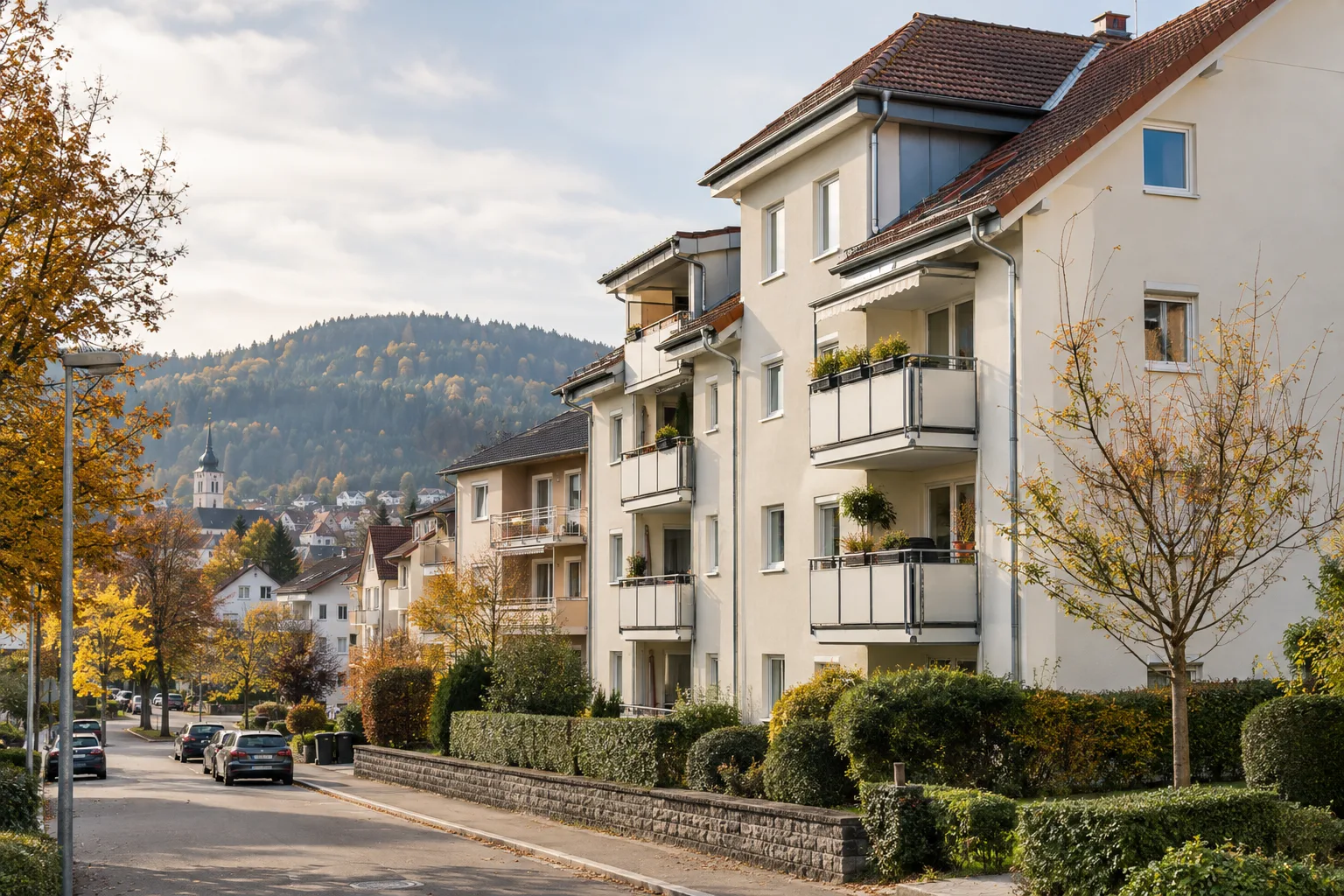
Reutlingen rarely tops property investors’ lists. Stuttgart is better known, while Tübingen has the university. Yet with around 119,000 residents, Reutlingen is the largest city in the Neckar-Alb region and has been growing for years.
The city is attractive to investors because existing flats cost noticeably less here than in Stuttgart or Esslingen. The downside: rents in the local rent index are also lower, and the largest employer is cutting jobs.
We have compiled the official figures and finish by running the numbers for an existing flat and a new-build flat.
01Reutlingen in figures
All the figures used in our assessment, with sources and reference dates.
| Indicator | Value | Source, reference date |
|---|---|---|
| Residents (official) | 119,040 | Statistisches Bundesamt, register of municipalities, 31.12.2025 |
| Change 2013–2023 | +6.4% | Wegweiser Kommune (Bertelsmann Stiftung) |
| Forecast 2020–2040 | +5.8% | Wegweiser Kommune |
| Households | 53,718 | 2022 Census |
| Share of single-person households | 39.2% | 2022 Census |
| Housing stock | 56,237 | 2022 Census |
| Vacancy rate | 3.1% | 2022 Census, reference date 15.05.2022 |
| Share of rented dwellings | 50.3% | 2022 Census, own calculation |
| Employees subject to social insurance contributions, by place of work | 54,184 | Bundesagentur für Arbeit, 30.06.2025 |
| Inbound / outbound commuters | 31,798 / 26,840 | Bundesagentur für Arbeit, 30.06.2025 |
| Unemployment rate in the Balingen-Reutlingen employment agency district | 4.4% | Agentur für Arbeit, September 2026 |
| Rent index average | €9.39/m² | Qualified rent index 2025 |
| Rent index: 65 m², built in 1974–1979 | €8.41/m² | Qualified rent index 2025, Table 1 |
| Purchase price of a flat built in 1971–1980 | around €2,800/m² | Gutachterausschuss, Property Market Report 2025, data for 2024 |
| Purchase price of a new-build flat | around €6,250/m² | Gutachterausschuss, Property Market Report 2025, data for 2024 |
| Rent controls on new lettings | yes, until 31.12.2026 | Baden-Württemberg Rent Limitation Ordinance, Law Gazette 2025 No. 144 |
| Cap on rent increases | 15% | Baden-Württemberg Rent Increase Cap Ordinance, Law Gazette 2025 No. 145 |
| Property transfer tax in Baden-Württemberg | 5.0% | since 05.11.2011 |
02Population and demand
At the end of 2025, Reutlingen officially had 119,040 residents. The continuous data series from Wegweiser Kommune shows growth from 111,357 residents in 2013 to 118,528 in 2023, an increase of 6.4%. By 2040, Bertelsmann Stiftung expects a further 5.8% increase compared with 2020. The official figures from 2022 onwards are based on the census and are only comparable with older figures to a limited extent.
Reutlingen has a stronger owner-occupier presence than many other large cities. In the 2022 Census, 46.2% of dwellings were occupied by their owners, while only 50.3% were rented out. Single-person households accounted for 39.2% of households, less than in university cities such as neighbouring Tübingen. Demand is therefore not limited to small flats, but also includes homes for couples and families.
Vacancy was low. On the census reference date, 3.1% of dwellings were vacant, equivalent to 1,856 homes. Only 427 of these had been vacant for less than three months, while 939 had stood empty for a year or longer.
Very few new homes have been added recently. Across the entire area covered, the Gutachterausschuss recorded just 22 new-build flat sales in 2023 and 47 in 2024, down from 80 in 2022. It describes a new-build market that has “virtually ground to a halt”.
03Economy, labour market and commuters
Reutlingen is an employment centre. On 30.06.2025, 54,184 employees subject to social insurance contributions worked in the city, while 49,206 lived there. Every day, 31,798 people commute into the city and 26,840 commute out.
Commuting patterns show where Reutlingen’s connections lie. According to the commuting atlas published by the statistical offices (reporting year 2024), Tübingen is the most important destination for people working outside Reutlingen, with 4,555 employed people commuting there; Stuttgart ranks second with 2,951. Reutlingen is therefore not a suburb of Stuttgart, but a centre in its own right between the state capital, the university city and the Swabian Alb.
The largest employer is Bosch. According to a zdfheute report from July 2025, the company employs around 10,000 people in Reutlingen and manufactures semiconductors there, among other products. In the same report, Bosch announced plans to cut up to 1,100 jobs by the end of 2029, primarily in control unit manufacturing. For landlords, this is a serious warning sign: when such a large employer shrinks, the number of households looking for a home nearby also falls.
The unemployment rate in the Agentur für Arbeit Balingen-Reutlingen district stood at 4.4% in September 2026. The agency does not publish a separate figure for the city in its press release.
According to higher education directories, Hochschule Reutlingen has around 5,000 students. They generate demand for small flats, but have less influence on the market than in Tübingen.
04Rents, purchase prices and rental yields
Reutlingen has a qualified rent index, valid from 01.02.2025 to 31.01.2027. The average rent across all flats surveyed is €9.39/m². For a 65 m² flat in an average location, it lists rents of €8.15/m² (1949–1973), €8.41/m² (1974–1979) or €8.64/m² (1985–1990), depending on the year of construction. Small new-build flats command considerably more: a 45 m² flat built between 2022 and 2024 is listed at €12.83/m². The 2022 Census recorded €8.05/m² across all ongoing tenancies.
The purchase prices come from the 2025 Property Market Report published by the Gemeinsamer Gutachterausschuss bei der Stadt Reutlingen. It presents prices by year of construction in a chart, covering 2024 and the entire area including Pliezhausen, Walddorfhäslach and Wannweil. Reading from the chart gives figures of around €2,850/m² for flats built before 1970, around €2,800/m² for 1971 to 1980, around €3,150/m² for 1981 to 1990, around €3,400/m² for 1991 to 2000 and around €6,250/m² for new builds. Existing flats became around 10% cheaper in 2023 and around 4% cheaper in 2024.
The purchase price and rent determine the purchase price-to-annual-rent ratio; its reciprocal is the gross rental yield.
The gross yield is below 4% in almost every case. The reason is the rent: rents for existing properties in Reutlingen are lower than in Ludwigsburg or Esslingen, while purchase prices are not lower to the same extent. Check your own figure using the rental yield calculator.
05Neighbourhoods at a glance
The property valuation committee does not publish prices by neighbourhood. The rent index assesses an address’s location using a street directory with residential location categories. The table therefore describes only the character of each area.
| Neighbourhood | Character | More suitable for |
|---|---|---|
| Innenstadt | Old town and city centre with the main railway station, shopping streets and administrative offices | Single people, commuters, small flats |
| Hohbuch | Residential area around the university campus | Students; allow for tenant turnover |
| Orschel-Hagen | Large housing estate in the north with many flats dating from the 1960s and 1970s | Lower-cost entry; examine the condition of the communal property carefully |
| Betzingen | Western neighbourhood with an established village centre and commercial premises nearby | Local employees, families |
| Sondelfingen | North-eastern neighbourhood, relatively quiet, with blocks of flats and detached houses | Couples and families |
| Rommelsbach | Northern neighbourhood towards Tübingen and Metzingen | Commuters travelling in either direction |
| Ringelbach and Storlach | Residential neighbourhoods close to the city centre with a mix of housing stock | Working professionals, short journeys |
| Voller Brunnen | Residential area outside the city centre with terraced houses and blocks of flats | Families, longer tenancies |
The rent index assigns each street to a residential location category through its street directory. Anyone assessing a flat should look up the address in the street directory and use the city’s free online calculator to establish the local comparable rent. This determines the rent permitted for a new tenancy.
06Rules for landlords in Reutlingen
Reutlingen is one of the 130 municipalities in Baden-Württemberg with a tight housing market. Three rules follow from this.
- Rent brake: For a new tenancy, the rent must not exceed the local comparable rent by more than 10%. Exemptions apply to flats first occupied and let after 1 October 2014, and to the first letting after comprehensive modernisation. You may continue charging a higher rent paid by the previous tenant.
- Rent increase cap: During an ongoing tenancy, the rent may rise by no more than 15% over three years and must never exceed the local comparable rent.
- Notice protection period: If a rented flat is converted into an individually owned unit, the buyer must wait five years before terminating the tenancy on the grounds of personal use.
When buying in Baden-Württemberg, you pay 5.0% property transfer tax. Notary and land registry fees, including those for financing, amount to around 1.6 to 1.8% of the purchase price, plus estate agent fees depending on the property. Calculate your own figures with the purchase costs calculator; our article on notary fees explains the individual notary charges.
07Worked example: a rented flat in Reutlingen
Take Thomas, 47, single, a technician with a taxable income of €60,000. He buys a rented flat measuring 65 m², built in 1975, for €182,000. This equates to around €2,800/m², the property valuation committee’s figure for this year of construction. The rent is exactly at the rent index level. The name is fictional, and the figures are a worked example, not a forecast.
| Purchase price (65 m² × around €2,800/m²) | €182,000 |
|---|---|
| Property transfer tax in Baden-Württemberg, 5.0% | €9,100 |
| Notary and land registry (with a land charge of €182,000) | €3,233 |
| Purchase costs funded from equity | €12,333 |
| Loan (purchase price) | €182,000 |
| Interest at 3.8% and principal repayment at 1.5% (assumption) | €9,646 per year |
| per year | per month | |
|---|---|---|
| Net rent excluding heating and service charges (€8.41/m², 2025 rent index) | €6,560 | €547 |
| Interest | −€6,916 | −€576 |
| Principal repayment | −€2,730 | −€228 |
| Costs not recoverable from tenants (management, reserve fund, assumption) | −€1,320 | −€110 |
| Cash flow before tax | −€4,406 | −€367 |
| Depreciation at 2% on the building share (70%, assumption) | €2,706 | €226 |
| Rental loss (rent − interest − costs − depreciation) | −€4,383 | −€365 |
| Tax saving (2026 tax rates, excluding church tax) | +€1,658 | +€138 |
| Cash flow after tax | −€2,748 | −€229 |
Thomas contributes around €229 a month out of his own pocket, after tax. Of this, €228 goes towards principal repayment. Excluding principal repayment, the calculation roughly breaks even after tax.
This illustrates Reutlingen’s fundamental problem. At an interest rate of 3.8%, the rent of €8.41/m² does not even cover the interest. Only the tax saving makes up the shortfall. Our article on taxing rental income explains how rental income is taxed.
The interest rate has almost three times the impact of the potential rent increase when letting to a new tenant. Anyone buying in Reutlingen should therefore choose a long fixed-rate period and factor in refinancing from the outset.
For comparison: a new-build flat in Reutlingen
What changes if Thomas buys a newly built flat? For new-build flats, the property valuation committee reports around €6,250/m² in 2024, based on just under 50 sales across the entire area. For 45 m², this gives a price of €281,250. We use the rent index figure for 45 m² and a construction year between 2022 and 2024: €12.83/m². Because the flat is first let after 1 October 2014, it is permanently exempt from the rent brake (§ 556f of the German Civil Code (BGB)).
| per year | per month | |
|---|---|---|
| Net rent excluding heating and service charges (45 m² × €12.83/m², 2025 rent index) | €6,928 | €577 |
| Interest (3.8% on €281,250) | −€10,688 | −€891 |
| Principal repayment (1.5%) | −€4,219 | −€352 |
| Service charges not recoverable from tenants (€1.20/m², assumption) | −€648 | −€54 |
| Cash flow before tax | −€8,626 | −€719 |
| Declining-balance depreciation at 5% on the building share (80%, assumption) | €11,938 | €995 |
| Rental loss (rent − interest − service charges − depreciation) | −€16,345 | −€1,362 |
| Tax saving (2026 tax rates, excluding church tax) | +€5,844 | +€487 |
| Cash flow after tax | −€2,782 | −€232 |
After tax, the two flats are almost level: an out-of-pocket contribution of around €232 for the new build and around €229 for the existing property. However, the route to that result differs. For the new build, depreciation is more than four times as high (€11,938 rather than €2,706), and there is little maintenance in the first few years. In return, the price per square metre is more than double, the gross rental yield falls to around 2.5% rather than 3.6%, and Thomas contributes around €719 rather than €367 a month before tax. The tax saving decreases each year because declining-balance depreciation is calculated on the remaining book value.
08Opportunities and Risks in Reutlingen
There are verifiable points in Reutlingen’s favour. The city has been growing for years and is expected to continue growing. It is an employment centre in its own right, with more commuters travelling in than out, and has good connections to Tübingen and Stuttgart. Vacancy rates were low at the time of the census, and very few new homes are being built. Existing flats cost less than those in the area surrounding Stuttgart.
There are equally clear points against it:
- Low rents for existing properties: €8 to €9/m² according to the rent index for flats built between the 1950s and the 1990s.
- Dependence on Bosch: A large proportion of industrial jobs depend on one company, which plans to cut up to 1,100 jobs by 2029.
- Regulated rents: The rent brake and the 15% cap on rent increases limit the scope for increases.
- Falling prices up to 2024: Existing flats became cheaper in 2023 and 2024. This may offer a buying opportunity, but it is not an indication of future performance.
- Renovation requirements: The property valuation committee explicitly identifies the high proportion of properties requiring renovation as a market factor.
- Interest rates and vacancies: A higher refinancing rate increases the amount you need to contribute, while every month a property stands empty costs you the full rent.
- You can afford to contribute €200 to €250 a month over several years.
- You are looking for a location with its own economy and growth, rather than just a suburb.
- You thoroughly check the building’s condition and the maintenance reserve.
- You plan around a long fixed-rate period and regulated rents.
- You expect positive cash flow from the first month.
- You have no reserve for vacancies or a special levy.
- Dependence on one major employer concerns you.
- You depend on a particular level of capital growth.
Our article Buying a Flat as an Investment discusses the general advantages and disadvantages of owning a rental flat.
09Other Locations
Other cities in Baden-Württemberg: Overview of Baden-Württemberg · Esslingen am Neckar · Freiburg im Breisgau · Heidelberg · Heilbronn · Karlsruhe · Konstanz · Ludwigsburg · Mannheim · Pforzheim · Stuttgart · Tübingen · Ulm
All locations compared: Where Is Property Investment Worthwhile? Cities Compared in 2026 · Which Federal State Is Suitable? All 16 Compared
FAQFrequently asked questions
Is a flat in Reutlingen worthwhile as an investment?
That depends on the purchase price, rent and condition. Reutlingen is growing, has few vacant properties and provides local employment. However, at around €2,800/m² and a rent in line with the rent index, the gross rental yield is only around 3.6%. If you finance the purchase, you will need to cover a monthly shortfall in most cases, even after tax.
What is the rental yield in Reutlingen?
Gross yields are generally between about 3.3% and 3.6% for existing flats, rising to around 4.0% for a new letting at the rent cap limit. New-build flats yield around 2.5%. These figures are based on 2024 purchase prices from the property valuation committee and the 2025 rent index.
How much does a flat cost to buy in Reutlingen?
According to the 2025 property market report, existing flats cost around €2,800 to €3,400/m² in 2024, depending on their construction year; flats built between 2001 and 2021 cost around €4,200/m², and new-build flats around €6,250/m². These figures apply to the area covered by the property valuation committee, including three neighbouring municipalities.
Is there a rent cap in Reutlingen?
Yes. For a new letting, the rent must not exceed the local comparable rent specified in the rent index by more than 10%. The regulation applies until 31 December 2026, and an extension until the end of 2029 is at the draft stage. New-build properties first let after 1 October 2014 are exempt.
How much is rent in Reutlingen?
The 2025 rent index states an average rent of €9.39/m². For a 65 m² flat built in the 1970s in an average residential location, the figure is €8.41/m²; for a small new-build flat, it is up to €12.83/m². The rent index is valid until 31 January 2027.
Which neighbourhoods in Reutlingen are worth considering for property investors?
That depends on the target group. Hohbuch, around the university of applied sciences, is suitable for students, while the city centre, with its main railway station, suits commuters. Orschel-Hagen offers more affordable flats in larger developments, where the state of the owners’ association is particularly important. Check the address’s residential location classification in the rent index’s street directory.
How much are the additional purchase costs in Reutlingen?
Property transfer tax in Baden-Württemberg is 5.0%. Notary and land registry fees, including those associated with financing, amount to around 1.6% to 1.8% of the purchase price. For a purchase price of €182,000, the additional costs excluding estate agent fees are around €12,330, or 6.8%.
10Further Reading
- Buying a Flat as an Investment: Advantages and Disadvantages
- Paying Tax on Rental Income
- Notary Fees When Buying Property
- Rental Yield Calculator
- Property Purchase Costs Calculator
- Property Transfer Tax in Baden-Württemberg
11Sources
All sources accessed on 14 October 2026.
- Gemeinsamer Gutachterausschuss bei der Stadt Reutlingen, Property Market Report 2025 on the Property Market in 2023/2024 (online version), Chapters 4.1 and 4.7
- Stadt Reutlingen, Qualified Rent Index 2025, valid from 1 February 2025 to 31 January 2027, and Rent Index 2027 (announcement of a new edition)
- Statistische Ämter des Bundes und der Länder, 2022 Census, regional tables on buildings and dwellings and on households, municipality of Reutlingen, reference date 15 May 2022
- Statistisches Bundesamt, Municipal Directory, Extract as at 31 December 2025
- Bertelsmann Stiftung, Municipal Guide: Reutlingen (population 2013–2023, forecast for 2040)
- Statistische Ämter des Bundes und der Länder, Commuter Atlas, reporting year 2024, commuter flows in Baden-Württemberg
- Bundesagentur für Arbeit, Municipal Data on Employees Subject to Social Security Contributions by Place of Residence and Work, reference date 30 June 2025
- Agentur für Arbeit Balingen-Reutlingen, Press Release No. 63: Unemployment Falls After the Summer Holidays, 30 September 2026
- zdfheute, Bosch Plans to Cut up to 1,100 Jobs in Reutlingen, July 2025
- State of Baden-Württemberg, Rent Limitation Ordinance (GBl. 2025 No. 144) and Rent Increase Cap Ordinance (GBl. 2025 No. 145); Public Participation Portal: Extension of Rent Limits, draft dated 22 September 2026
- Section 558 of the German Civil Code (BGB), Section 556d of the German Civil Code (BGB), Section 556f of the German Civil Code (BGB), Section 32a of the Income Tax Act (EStG) (2026 tax scale), Section 7 of the Income Tax Act (EStG), Section 7b of the Income Tax Act (EStG), Court and Notary Costs Act (GNotKG), Table B
- All illustrative calculations, purchase price multiples and yields: own calculations, as at 14 October 2026
Disclaimer: This page provides general information and does not constitute investment, tax or legal advice. All figures are either illustrative calculations with disclosed assumptions or official figures with their reference dates stated, as at 14 October 2026.
Writes about Financing and calculations, Taxes and Care properties.
Michael combines his experience as a banker and former portfolio manager at a family office with his practice as a property investor himself. He writes about robust calculations, financing, risks and strategic portfolio building.
This guide does not replace tax or legal advice. All figures are example calculations with disclosed assumptions.