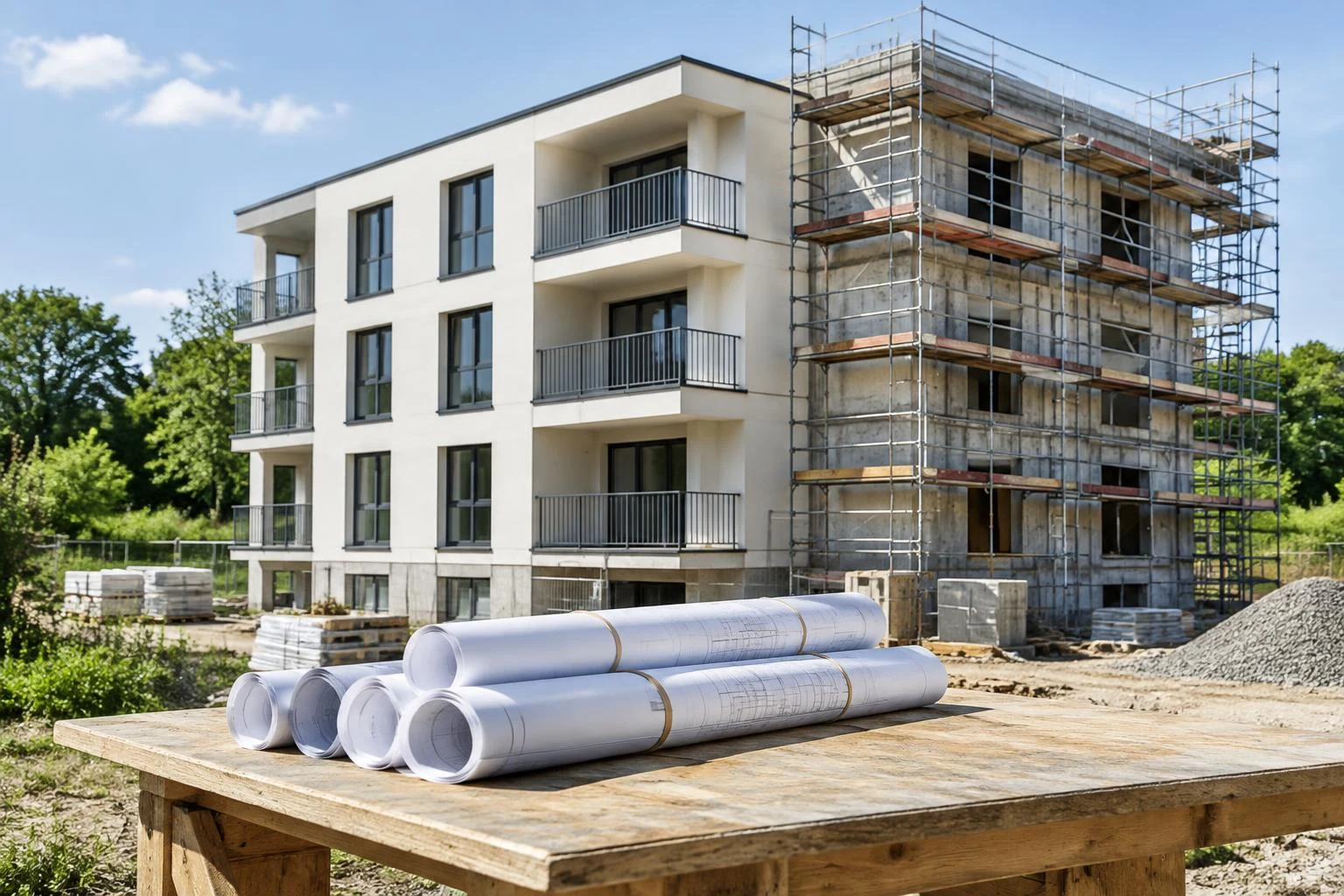
First occupancy: letting a new-build flat for the first time
A first new-build letting requires attention to the rent-cap exemption and disclosure duty, the lack of operating-cost history and possible handover delays. We explain the planning and funding required for the first part-year using a simplified worked example before tax.
 Rula Mama
Investment Advisor at InvestImmo
The handover date is set, and you will receive the keys in six weeks. Now you want to let the flat as quickly as possible. Every month without a tenant costs you interest and owners’ service charges [Hausgeld]. But when should you advertise? What rent should you charge? And what happens if the handover is delayed?
The first letting of a new-build flat lacks important reference points. There is no previous rent to use as a guide and no operating-cost statement from the previous year. The planned move-in date may also change. However, the new-build exemption from the rent cap on new tenancies can offer flexibility that is not necessarily available for existing homes.
01What first occupancy means
For tenants, first occupancy is a feature of the property: nobody has lived in the flat before, and everything is new. Adverts often say “first occupancy after refurbishment”, which is something different. This guide is about genuinely new-build homes.
For landlords, the new-build exemption is legally important. In designated areas, the rent cap on new tenancies generally limits the rent for a new letting to no more than 10% above the local comparable rent [ortsübliche Vergleichsmiete] (§ 556d BGB). It does not apply to homes first used and let after 1 October 2014 (§ 556f, sentence 1 BGB). This exemption also applies to subsequent lettings of the same home. The details are explained in the glossary under rent cap on new tenancies.
02Setting the right rent
Without the rent cap on new tenancies, you have more freedom when setting the initial rent. Freedom does not mean there are no limits. Subject to its further conditions, § 5 WiStG concerns rents that exceed the usual charges for comparable accommodation by more than 20% as a result of exploiting a shortage of accommodation. The provision also contains an exception for charges needed to cover ongoing expenses, provided there is no gross disproportion. The 20% threshold is therefore not a universal rent ceiling. A breach can attract a fine of up to €50,000, and the tenant may also have repayment claims. Separate rules on usurious rents must also be considered. Ask a German lawyer to assess legal borderline cases.
Alongside the legal restrictions, financial viability matters. Setting the rent too high can prolong the search for a tenant or encourage later tenant turnover. Useful guides include the local rent reference table [Mietspiegel], where relevant to the property, listings for comparable new-build homes on property portals and the experience of local property managers. Asking rents should not, however, be equated with rents actually agreed.
And how will the rent develop afterwards? There are three options:
| Model | How the rent increases | Who it suits |
|---|---|---|
| Comparable rent (§ 558 BGB) | Increase up to the local comparable rent, subject to the statutory cap on increases and further legal conditions | Those who want flexibility |
| Stepped rent [Staffelmiete] (§ 557a BGB) | Fixed increases agreed in the contract | Those who want predictability |
| Index-linked rent [Indexmiete] (§ 557b BGB) | Adjustment based on the consumer price index, subject to the legal requirements | Those who want a link to price movements |
For new-build flats with an initial rent above the local comparable rent, it may take time before an increase under § 558 BGB becomes possible. A stepped rent fixes the amounts; an index-linked rent instead specifies the adjustment mechanism, not the future rent amounts. A falling index may also allow a rent reduction. Calculate your own scenario using the index-linked rent calculator. A German lawyer can advise you on legally compliant contractual wording.

03Coordinating the tenancy start and handover
An important new-build risk lies in the timetable: the developer gives you a date, you advertise, and a tenant gives notice on their existing flat. The handover is then delayed, for example by six weeks.
„From day one of completion or day one of the purchase?“
This illustrative planning question concerns when rental income begins. Neither purchase nor completion alone creates an entitlement to rent. The agreed tenancy start and provision of the flat in accordance with the contract are what matter. Loan interest accrues on amounts drawn down under the financing terms; commitment interest may also apply. You need funds to bridge any gap between handover and the start of the tenancy.
Here is how to reduce the risk of a vacant flat or a move-in that falls through:
- Advertise once the date is reliable. Six to eight weeks before handover can be a planning assumption if the developer has announced the acceptance date in writing and construction progress supports it. Written notice does not guarantee the date.
- Allow a buffer before the tenancy starts. Two to four weeks after the planned acceptance date can serve as a buffer. Whether that is enough to remedy minor defects depends on the circumstances.
- Address the move-in date in the contract. Discuss with a German lawyer how delayed completion can be addressed in the agreement, and keep the tenant openly informed. A tenant left without accommodation because of a delay may be entitled to damages if the relevant conditions are met.
- Ensure acceptance and readiness before the tenant moves in. Plan the tenant’s handover only once you have taken over the flat and it is usable as agreed in the tenancy contract. The construction acceptance checklist explains how to prepare for acceptance.
04Worked example: the first year with and without a vacancy
In this example, Katharina has bought a 65 m² new-build flat for €340,000 and borrowed €306,000 at an assumed interest rate of 3.8%, with an initial principal repayment rate of 1.5%. These are calculation assumptions, not current mortgage offers. A higher interest rate makes the calculation less favourable. Handover is on 1 March. She lets it for a rent excluding operating costs [Kaltmiete] of €13.50/m², or €877.50 a month. The monthly owners’ service charge is €260, of which €60 cannot be passed on to the tenant in this example. Katharina is fictional; the figures form a simplified worked example, not a forecast.
We compare two scenarios for the ten months to the end of the year. In scenario A, the tenancy starts on 1 March, assuming the flat is provided on time and in the agreed condition, without an additional buffer. In scenario B, the flat stands empty for two months because Katharina only advertises it after handover. During the vacancy, she pays the entire owners’ service charge herself.
The simplified cash flow calculation assumes that the remaining €200 of the monthly owners’ service charge consists entirely of recoverable costs covered by the tenant’s payments while the flat is let. It allows for no differences arising from the annual reconciliation. Interest and principal repayments are calculated for ten months on the unchanged opening loan balance of €306,000: €306,000 × 3.8% × 10/12 = €9,690 and €306,000 × 1.5% × 10/12 = €3,825. The changing interest and principal components of an amortising loan are ignored. Full drawdown at the beginning of the period is assumed; earlier financing costs, acquisition outlays and other unspecified costs are excluded.
| A: tenant from March | B: two months vacant | |
|---|---|---|
| Rent excluding operating costs | €8,775 | €7,020 |
| Owners’ service charges she pays herself | −€600 | −€1,000 |
| Interest at 3.8%, simplified calculation | −€9,690 | −€9,690 |
| Principal repayments at 1.5%, simplified calculation | −€3,825 | −€3,825 |
| Cash flow before tax | −€5,340 | −€7,495 |
Before tax, Katharina has to contribute just over €5,300 in the simplified example even without a vacancy, averaging €534 a month over the ten months considered. This reflects expenditure, including interest and principal repayments, that the rental income does not cover. Principal repayments reduce her loan balance but remain a monthly cash outflow she must fund.
Cash flow and taxable profit or loss are not the same: principal repayments are not deductible income-related expenses [Werbungskosten]. Eligible depreciation, by contrast, can reduce the taxable rental result without a corresponding cash outflow in that year. Any tax relief depends on factors including depreciation eligibility, the building’s share of acquisition costs, deductible expenditure and personal income circumstances.
In particular, owners’ service charges paid by the landlord cannot simply be deducted in full as income-related expenses. Payments into the unit owners’ association’s maintenance reserve [Erhaltungsrücklage] are not immediately tax-deductible when contributed. Only actual expenditure that qualifies for tax relief can be recognised under the applicable rules. Tax planning therefore depends on the individual service-charge components and the work actually paid for from the reserve. A potential tax refund is also no substitute for a cash reserve; its timing depends on the tax process. Ask a German tax adviser to prepare your individual after-tax calculation.
Under the stated assumptions, two months vacant cost Katharina €2,155 before tax: €1,755 in lost rent and €400 in additional recoverable costs paid by the owner. Any additional tax relief reflects both lower income and additional deductible expenditure, not simply higher deductible expenses. Discuss the effect in your circumstances with your German tax adviser.
Run your own figures through the cash flow calculator.
Enter the purchase price, rent, interest, principal repayments and owners’ service charges to model cash flow. After-tax results depend on tax eligibility and the correct allocation of costs. Discuss the tax effects with your German tax adviser.
05Operating costs in the first year
For an existing flat, the latest statement can provide a reference point. For a new build, initially there is often only the annual budget of the unit owners’ association, prepared by the developer or the first property manager. This is an estimate and may differ from the eventual actual costs.
Base the tenant’s advance payments on expected operating costs that can validly be passed on to them, not on the entire owners’ service charge. Management expenses and maintenance reserve contributions are not recoverable operating costs. Advance payments must be reasonable; a blanket uplift is no substitute for a transparent estimate. A large balancing payment after the first year can strain the relationship. A heating system that is not yet optimally adjusted can also affect costs.
The statement must generally reach the tenant no later than twelve months after the end of the accounting period. Additional claims are then excluded unless the landlord is not responsible for the delay (§ 556(3) BGB). For the first part-year, allocate costs from the tenancy start according to the applicable allocation and consumption rules; not every cost item can simply be divided by the number of months. A German lawyer can help with legal questions about recoverable costs or claims for additional payments.

06Defects in the first year
Defects may emerge in a new build during the first few months: a sticking door, a dripping waste trap or heating that runs too hot or too cold. The tenant contacts you, not the developer. Document the defect, pass it on to the responsible contracting party and set a reasonable deadline where required. Your obligations to the tenant continue independently of the developer’s handling of the matter.
The tenant must generally allow necessary maintenance work (§ 555a BGB); statutory notice requirements and duties of consideration still apply. An impairment of the agreed use that is more than insignificant can justify a rent reduction. Whether you can recover lost rent from the developer depends on the contractual and statutory conditions for a claim; a rent reduction alone does not create an automatic right to reimbursement. Keep a written record of everything, as described in the guide to new-build defect liability. Handover to the tenant should follow the same approach as any other letting, with a properly completed property handover report. Consult a German lawyer if there is a dispute over rent reductions or damages.
- 01Establish the market rent
Use a relevant rent reference table, comparable new builds and a local property manager’s assessment.
- 02Choose a rent model
Compare comparable-rent, stepped-rent and index-linked arrangements and their respective requirements.
- 03Estimate operating costs
Read the annual budget, identify recoverable costs and set reasonable advance payments.
- 04Confirm the date
Obtain written confirmation of the acceptance date, check construction progress and allow a buffer before the tenancy starts.
- 05Advertise
For example, six to eight weeks before a reliably planned handover, with a floor plan and a note that this will be the first occupancy.
- 06Provide the disclosure
Explain the new-build exemption from the rent cap on new tenancies in text form before the tenant makes their contractual declaration.
- 07Select a tenant
Use an application form, proof of income and credit checks to the extent legally permitted, as explained in the tenant selection guide.
- 08Document the handover
Record the condition, meter readings, keys and deposit agreement; respect the tenant’s statutory payment rights.
07Let it yourself or appoint professionals?
- You live nearby and can conduct viewings yourself.
- You have let property before and know the local market.
- You want to save the letting commission.
- You live far away or have little time.
- You are letting for the first time and want organisational support; discuss legal questions with a German lawyer.
- You are buying several flats in the same building.
If you appoint a letting agent to find a tenant, you pay the agreed commission. The agent cannot charge the tenant for this when acting on the landlord’s instructions (§ 2(1a) WoVermittG). Commission relating to a letting can generally qualify as a deductible income-related expense; discuss its tax treatment with your German tax adviser. The property management guide explains the cost of ongoing management.
08Risks when letting for the first time
A longer vacancy than planned. If many flats in a new development come onto the market at the same time, additional competition may arise. Test a scenario with, for example, two to three months vacant; the reserve you need depends on the property and your financing.
Setting the rent too high. An ambitious initial rent can make marketing harder or encourage tenant turnover. Changes of tenant involve work and may result in vacancy periods.
A delayed handover. Construction delays can mean interest costs without rental income and additional obligations towards a tenant who has already committed.
Additional operating-cost payments. An annual budget that is too low can lead to balancing payments. Not every additional cost can be passed on to the tenant.
Tax assumptions. Declining-balance depreciation at 5% annually under § 7(5a) EStG has several requirements. These include, in particular, the statutory windows for the start of construction or the purchase contract after 30 September 2023 and before 1 October 2029. For a purchase, acquisition for tax purposes must occur by the end of the year of completion. The physical key-handover date alone is not decisive. If acquisition for tax purposes moves into the following year, eligibility may be lost. Depreciation applies to the building component, including its share of ancillary acquisition costs, not to the land. Deducting expenses during a vacancy also requires demonstrable intent to let and expenditure that qualifies for deduction. Keep adverts and enquiries; reserve contributions are not deductible merely when paid in. Discuss the appropriate depreciation method, its calculation basis and deductible costs with your German tax adviser.
FAQFrequently asked questions
What does first occupancy mean for a flat?
The flat is being lived in for the first time. In a new build, nobody has lived there before. “First occupancy after refurbishment”, by contrast, refers to a renovated existing flat.
Does the rent cap on new tenancies apply to new-build flats?
No, provided the flat was first used and let after 1 October 2014 (§ 556f, sentence 1 BGB). This also applies to subsequent changes of tenant. A landlord wishing to rely on the exemption must inform the tenant, without being asked, in text form before the tenant makes their contractual declaration. If disclosure was omitted altogether, the exemption can be relied on only two years after the missing information is supplied; if only the form was defective, it can be relied on once that defect is remedied. A German lawyer can advise you on the contractual wording.
How much rent can I charge for a first letting?
Legal restrictions remain even without the rent cap on new tenancies. Subject to further conditions, § 5 WiStG covers rents more than 20% above the usual rent where a shortage of accommodation is exploited. The provision contains an exception for certain cost-covering charges, so 20% is not a universal rent ceiling. Separate rules on usurious rents also apply. Assess financial viability and ask a German lawyer to assess legal borderline cases.
When should I advertise a new-build flat?
Once construction progress and written notice of the planned date make the handover timetable appear reliable. Six to eight weeks before handover can be a planning assumption. Two to four weeks between planned acceptance and the tenancy start is a possible buffer, not a guarantee that the flat will be ready on time.
How should I set operating-cost payments for a first letting?
Set reasonable advance payments based on the expected recoverable operating costs in the annual budget. The entire owners’ service charge is not a suitable basis: management costs and maintenance reserve contributions cannot be passed on to the tenant. As there are no previous annual statements, document the estimate transparently.
Can I deduct costs incurred while the flat is vacant before its first letting?
Interest relating to the letting, advertising costs and other eligible expenditure can generally qualify as deductible expenses where an intention to let can be demonstrated. Owners’ service charges are not deductible in full as a matter of course. Contributions to the unit owners’ association’s maintenance reserve are not immediately deductible; only actual qualifying expenditure can be recognised under the applicable rules. Keep adverts, enquiries and records of viewing appointments. Discuss the tax treatment of your costs with your German tax adviser.
Who pays the letting agent for the first letting?
If the landlord appoints the agent to find a tenant, the landlord pays the agreed commission. The agent cannot charge the tenant a commission for that work (§ 2(1a) WoVermittG).
09Further reading
- Letting a flat
- Tenancy agreement: clauses
- Stepped rent
- Local comparable rent
- Glossary: rent cap on new tenancies
- Calculator: property cash flow
10Sources
- § 556d BGB, § 556f BGB and § 556g BGB (rent cap on new tenancies, new-build exemption, disclosure duty)
- § 556 BGB (deadline for operating-cost statements)
- § 555a BGB (duty to allow maintenance work)
- § 5 WiStG 1954 (excessive rent)
- § 2 WoVermittG (principle that the party commissioning the agent pays)
- § 7 EStG (declining-balance depreciation under subsection 5a)
- Simplified worked example: cash flow before tax based on the assumptions stated in the article.
This guide provides general information and is not a substitute for individual legal, tax or investment advice. The worked example is not a return forecast. Discuss tax questions with your German tax adviser and legal questions with your German lawyer.
Writes about Existing properties, Investment calculations and Property assessment.
Rula has worked in financial services since 2021. He focuses on existing investment properties, transparent calculations and an honest assessment of building condition and running costs.
This guide does not replace tax or legal advice. All figures are example calculations with disclosed assumptions.