
Landlord access in Germany: when you may enter
There is no general right to an annual inspection. A specific reason can justify access, but notice and reasonable arrangements remain essential. Rules, limits and a vacancy calculation.
 Eduard Winter
Investment Advisor at InvestImmo
Your tenant has given notice and will leave in three months. You would like to show prospective tenants around so that the flat does not stand empty. But your message receives the same reply for the third time: “That doesn’t suit me.”
As a landlord, you need to distinguish ownership from the tenant’s right to control access to their home. You own the flat, but your tenant controls access. A specific, objective reason can establish a right of access; notice, reasonable arrangements and the individual circumstances remain essential.
01Why there is no general right to inspect
Under the tenancy agreement, you grant the tenant exclusive use of the flat (§ 535 of the German Civil Code [BGB]). The home is protected by Germany’s constitution (Art. 13 of the Basic Law [GG]). As the Federal Court of Justice [BGH] puts it, your tenant is entitled to be left in peace there.
In 2014, the court therefore held that there is no right to inspect a flat without a particular reason at fixed intervals of, for example, one or two years. A standard-form tenancy clause allowing a general inspection “to check the condition of the flat” does not establish such a right either (VIII ZR 289/13).
An obligation to allow access can arise as an ancillary contractual duty under the principle of good faith (§ 242 BGB). It generally requires a specific, objective reason and advance notice. The legitimate interests of both parties must also be weighed.
02Reasons that can justify access
According to the court, an objective reason can arise from the proper management of the flat. The following situations may qualify.
| Reason | Example | Points to consider |
|---|---|---|
| Sale | Prospective buyers, the bank’s valuer | Group appointments together and inform the tenant beforehand |
| Re-letting | The tenant has given notice and prospective replacements wish to view | Can establish a right of access during the notice period |
| Repairs and maintenance | Heating, windows, pipework | Give timely notice under § 555a BGB; observe statutory exceptions |
| Modernisation | New windows, insulation, bathroom works, where legally classified as modernisation | Generally give notice of the works in text form at least three months in advance (§ 555c BGB); assess preparatory inspections separately |
| Readings and servicing | Meters, smoke alarms, heating servicing | May be carried out by service providers |
| Suspected damage | Damp in the flat below, a report of mould | Requires specific indications, not mere suspicion |
Simple curiosity about what the flat looks like is not a reason. Nor is a feeling that the tenant might be neglecting it. You need specific indications, such as credible complaints from neighbours about smells or visible damp.
Tenants generally have to tolerate maintenance and repair works (§ 555a BGB). They must also generally tolerate modernisation, although they can raise an objection based on unreasonable hardship where the statutory conditions are met (§ 555d BGB). Where works must be tolerated, this can include the access necessary to carry them out. The three-month notice period for modernisation does not automatically apply to every preparatory inspection; § 555c BGB also provides for exceptions.

03Notice, timing and duration
The law does not specify a fixed notice period for ordinary inspections. Appropriate notice, timing and duration depend on the reason, urgency and the tenant’s circumstances. The timings below are planning suggestions, not fixed statutory notice periods or universally binding visiting hours.
- 01Give notice in good time
For sale or letting viewings, aim to allow several days to around a week and agree the appointment. This amount of notice will not be sufficient in every case. Urgent repairs may justify shorter notice.
- 02Keep a written record
Use an email or letter stating the reason, proposed appointment and who will attend. This provides a record; text form is not a universal statutory requirement for ordinary inspections.
- 03Choose reasonable times
For example, you could suggest Monday to Friday between 10 am and 1 pm or 3 pm and 6 pm, if convenient for the tenant. Arrange Sundays and public holidays only by agreement.
- 04Keep it brief
For a straightforward viewing, you might allow 30 to 45 minutes. The time actually required and reasonable depends on the purpose.
- 05Be considerate
Offer two or three appointments. An evening or Saturday may suit a working tenant better.
How often visits are reasonable depends on their purpose. A sale or re-letting may require several appointments. Group prospective buyers or tenants together where this is reasonable for the tenant. A group viewing with four interested parties can reduce the number of appointments, but not every tenant will prefer it to individual visits.
04Emergencies and spare keys
An immediate danger can justify access without advance notice where this is necessary and proportionate to avert the danger. If water is coming through the ceiling, there is a fire or you smell gas, contact the appropriate emergency services or fire brigade. Do not put yourself at risk. Try to contact the tenant where this will not delay essential help, and document the reason and action taken. An emergency is not a blanket authorisation to enter for any purpose.
Outside such emergencies, there is a clear boundary. You may keep a spare key only with the tenant’s consent. Even then, you may not use it to enter without the relevant permission. Unauthorised entry can lead to a criminal complaint for unlawful entry (§ 123 of the German Criminal Code [StGB]) and civil consequences. Whether damages, a rent reduction or termination without notice are justified depends on the applicable conditions and circumstances. If a dispute arises over unauthorised entry, consult a lawyer.
05If the tenant refuses an inspection
If the tenant rejects every reasonable appointment despite a legitimate right of access and without sufficient grounds for refusal, they may be breaching their tenancy obligations. Your response should reflect the individual circumstances.
Start with a conversation. The refusal may stem from a concern, such as strangers entering the home or the possibility of losing the tenancy. A telephone call may help clarify this.
Then make a written request. State the reason, offer two or three appointments and set a reasonable deadline for a response. Ask for alternatives where appropriate. Explain that you may otherwise seek to enforce a legitimate entitlement through the courts.
Issue a formal warning. Persistent, unjustified refusal may warrant a formal warning. Termination is possible only subject to further conditions and an assessment of the individual case; consult a lawyer before taking this step. Our guide to formally warning a tenant explains the structure of a warning.
Bring a claim. You can seek a court order requiring the tenant to allow a legitimate inspection. An interim injunction additionally requires particular urgency and compliance with the other legal requirements. The possibility of a buyer withdrawing is not automatically enough; spreading damage may establish a different degree of urgency. If a culpable breach causes a provable loss, such as lost rent, a claim for damages may arise. Causation, the amount of the loss and reasonable steps to mitigate it must be considered.
The 2014 court case also illustrates the importance of the reason for and scope of access, alongside both parties’ conduct. It does not establish a blanket right to terminate a tenancy following an access dispute. Discuss the appropriate course of action in your case with a lawyer.
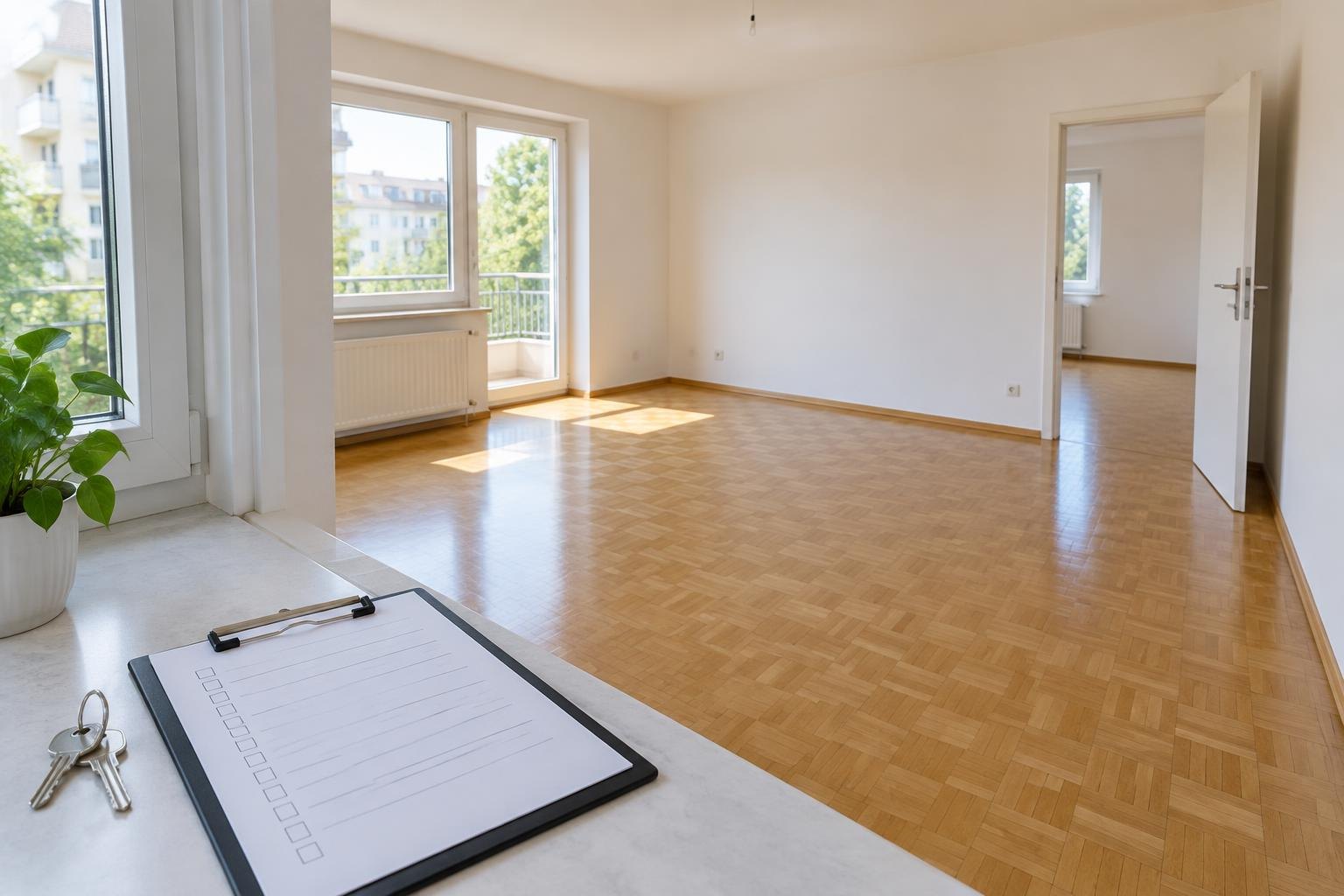
06Worked example: two months’ vacancy following refused viewings
Illustrative calculation, simplified. Mr Kaya lets a flat for €720 a month excluding operating costs, plus a €190 advance payment towards those costs. His tenant gives the required notice but refuses to admit prospective tenants during the notice period. In this example, Mr Kaya can show the flat only after the tenant leaves, and the new tenant moves in two months later. Mr Kaya is fictional, and the figures are model assumptions rather than a forecast. The proposition that the refusal caused the entire vacancy is an assumption of the example, not legal proof.
He has borrowed €175,000 at 3.8% interest, with initial annual capital repayments of 1.5%. For simplicity, both scenarios use €6,650 in annual interest and €2,625 in annual capital repayments, calculated on €175,000. The calculation does not model reductions in the outstanding loan during the year. The 3.8% rate is solely an illustrative assumption, not a statement about current mortgage offers.
The model also assumes €1,000 a year in actual, tax-deductible costs that cannot be recovered from tenants. These exclude contributions to the maintenance reserve of a condominium owners’ association [Wohnungseigentümergemeinschaft, WEG]. Such contributions are not immediately deductible against rental income; what matters is the subsequent use of the funds and the tax treatment of the expenditure. The entire owners’ service charge [Hausgeld] is not a blanket deduction.
The €190 monthly operating-cost advance does not establish the actual costs of the vacant flat. The model separately assumes that the owner incurs €190 in operating costs in each of the two vacant months, totalling €380. During occupied periods, the corresponding recoverable costs and reimbursements are assumed to balance out. The actual amounts are established from the accounts.
For the tax effect, the model assumes a flat 40% tax saving on every euro of rental loss calculated for tax purposes. Losses are assumed to be fully usable in the same year; church tax and the solidarity surcharge are excluded. The model also assumes €3,500 in allowable annual depreciation [Absetzung für Abnutzung, AfA]. Depreciation depends on the depreciable tax basis and the statutory conditions, not on the loan amount. The flat 40% assumption does not reproduce the progressive income tax tariff under § 32a of the German Income Tax Act [EStG] and is not a statement about Mr Kaya’s actual tax rate.
| Continuously let | Vacant for two months | |
|---|---|---|
| Rent excluding operating costs | €8,640 | €7,200 |
| Interest (simplified: 3.8% of €175,000) | −€6,650 | −€6,650 |
| Capital repayments (simplified: 1.5% of €175,000) | −€2,625 | −€2,625 |
| Non-recoverable costs, assumed fully deductible | −€1,000 | −€1,000 |
| Operating costs during vacancy, separately assumed | €0 | −€380 |
| Cash flow before tax | −€1,635 | −€3,455 |
| Taxable rental result with assumed €3,500 depreciation [AfA] | −€2,510 | −€4,330 |
| Tax saving, assumed at a flat 40% of the loss | +€1,004 | +€1,732 |
| Cash flow after tax, simplified | −€631 | −€1,723 |
Under these assumptions, two months’ vacancy worsens pre-tax cash flow by €1,820. The additional tax saving assumed at the flat rate is €728, leaving an additional after-tax cost of €1,092. A potential damages claim cannot simply be equated with this after-tax difference. It depends particularly on a culpable breach, a provable connection with the vacancy, the amount of the loss and mitigation. Ask a lawyer to assess any such claim.
A practical rule follows. When a tenant gives notice, discuss viewing appointments as early as possible, perhaps that same week, and keep a written record of your requests. Our guide to finding a replacement tenant explains how to plan the wider changeover.
07Choosing the appropriate approach
- The tenant is cooperative but has limited time.
- The visit concerns meter readings, servicing or a small repair.
- You can group appointments together, for example through an agreed group viewing.
- The tenant rejects every reasonable appointment without sufficient grounds.
- A buyer may withdraw or damage is spreading; legal urgency requires a separate assessment.
- You have made several written requests with reasonable response deadlines.
08Risks and common mistakes
Inspections without a reason. A standard-form clause permitting a general inspection “once a year” without an objective reason does not establish such a right. Our guide to invalid tenancy clauses discusses other potentially problematic provisions.
Using a spare key. Entering on your own initiative without consent or a legally justifying emergency can constitute a serious contractual breach and may be a criminal offence.
Taking photographs without consent. You should not photograph an occupied flat and personal belongings for sales particulars without the tenant’s consent. Where appropriate, use suitable floor plans or photographs taken before the tenancy that you are entitled to use. Necessary documentation of damage requires a separate assessment; it does not create a blanket permission to take marketing photographs. A lawyer can advise if a dispute arises over necessary photographs.
Too many appointments. Five individual appointments in one week may be unreasonable. Group visits together where possible and agree arrangements that limit the disruption.
Vacancy and tax. Where a continuing intention to let can be demonstrated, interest, allowable depreciation and deductible costs may remain eligible during a vacancy. Advertisements and documented appointments can provide evidence. Capital repayments are not deductible against rental income. Maintenance-reserve contributions are not immediately deductible; the entire owners’ service charge is not a blanket deduction either. Discuss the tax treatment with your tax adviser. For an overview of your responsibilities, see landlords’ rights and obligations.
FAQFrequently asked questions
May a landlord inspect the flat once a year?
Not simply to carry out a general inspection without a specific reason. Germany’s Federal Court of Justice has rejected a general right to inspect at fixed intervals. A standard-form tenancy clause does not establish such a right either. An entitlement to access generally requires a specific, objective reason, notice and reasonable arrangements.
How much notice must a landlord give before an inspection?
There is no fixed statutory notice period for ordinary inspections. Where possible, allow several days to around a week and agree the appointment; appropriate notice depends on the reason and circumstances. Modernisation works generally require notice in text form at least three months in advance, subject to statutory exceptions. This period does not automatically apply to preparatory inspections. An immediate danger may justify immediate access where necessary to avert it.
May a landlord keep a spare key?
Only with the tenant’s consent. That does not create a general permission to enter the flat. Entry without the relevant consent or a legally justifying emergency can have criminal and civil consequences. Damages, a rent reduction or termination each require further conditions to be met. If a dispute arises, consult a lawyer.
Must a tenant allow viewings when the flat is being sold?
A planned sale can establish a right of access. The viewing must be announced in good time and be reasonable, taking both parties’ interests into account. Appointments should be grouped together where possible. Where the conditions of § 566 BGB are met, the buyer takes over the existing tenancy; the sale alone does not end the agreement.
Does the tenant have to be present?
No. They can appoint someone they trust or voluntarily hand over a key for the agreed appointment. They do not have to let the landlord enter alone, but must enable legitimate access under reasonable conditions.
What if the tenant refuses every inspection?
Make a written request stating the reason, offering reasonable appointments and setting a reasonable response deadline. Persistent, unjustified refusal may warrant a formal warning and a court claim requiring access. An interim injunction requires particular urgency and further legal conditions. Damages require, in particular, a culpable breach and a loss demonstrably caused by it. Discuss legal action with a lawyer.
May a landlord take photographs during an inspection?
Photographs of an occupied flat and personal belongings for marketing should be taken only with the tenant’s consent. Alternatives include suitable floor plans or photographs from before the tenancy that you are entitled to use. Necessary photographs documenting damage require a separate assessment and do not automatically permit publication. A lawyer can advise if a dispute arises over necessary photographs.
09Further reading
- Selling a tenanted flat
- Replacement tenants: what landlords should consider
- Landlords’ rights and obligations
- Formally warning a tenant
- Invalid tenancy agreement clauses
10Sources
- BGH, judgment of 4 June 2014, VIII ZR 289/13 (no right to inspect without a reason)
- § 242 BGB and § 535 BGB (good faith and granting use of the property)
- § 555a BGB, § 555c BGB, § 555d BGB (maintenance, notice of modernisation and the obligation to tolerate it)
- Art. 13 GG (inviolability of the home) and § 123 StGB (unlawful entry)
- § 32a EStG (income tax tariff; the illustrative calculation instead uses a simplified, flat tax effect)
- Worked example: own simplified model calculation assuming a flat 40% tax saving
Note: This guide provides general information and does not replace individual legal, tax or investment advice. Timings for ordinary inspections are planning suggestions, not fixed legal requirements. The figures are model assumptions, not a forecast. Your personal tax effect depends particularly on your income, allowable deductions and ability to use losses. Consult a lawyer or tax adviser respectively about your individual legal and tax circumstances.
Writes about Taxes, AfA (depreciation), Existing properties and Portfolio building.
Since 2020, Eduard has bought seven properties of his own and supported more than 150 clients. He writes about tax levers, property documents and portfolio building – with honest numbers instead of rosy projections.
This guide does not replace tax or legal advice. All figures are example calculations with disclosed assumptions.