Garden Maintenance Costs: What German Landlords Can Recover
Which maintenance costs tenants pay, how public and private gardens affect recovery, and what tree felling means for the annual statement.
 Nadeem Shahid
Investment Advisor at InvestImmo
01When garden maintenance counts as an operating cost
A tenant lives on the third floor and does not use the garden. Nevertheless, a “garden maintenance” item in their annual operating cost statement may be justified. What matters is the tenancy agreement, the nature of the work and which property the maintained areas serve – not simply personal use.
Section 2 no. 10 of the German Operating Costs Ordinance covers the maintenance of landscaped areas, including the replacement of plants and woody vegetation. It also includes maintaining playgrounds, including replacing sand, and maintaining areas, access paths and driveways that do not serve public traffic.
Under section 1 BetrKV, operating costs must be recurring. This does not mean every task must be performed annually. Work recurring at longer intervals can also form part of routine property management. This does not, however, turn repairs or capital expenditure into operating costs.
02Which garden costs landlords can recover
The following classification assumes a valid agreement to pass on operating costs and an area attributable to the rented property. The requirement to manage costs economically also applies.
| Cost item | Recoverable from tenants? | Important distinction |
|---|---|---|
| Mowing, fertilising and watering lawns | Generally yes | Routine maintenance; do not charge for water twice |
| Trimming hedges and shrubs | Generally yes | Including disposal of cuttings |
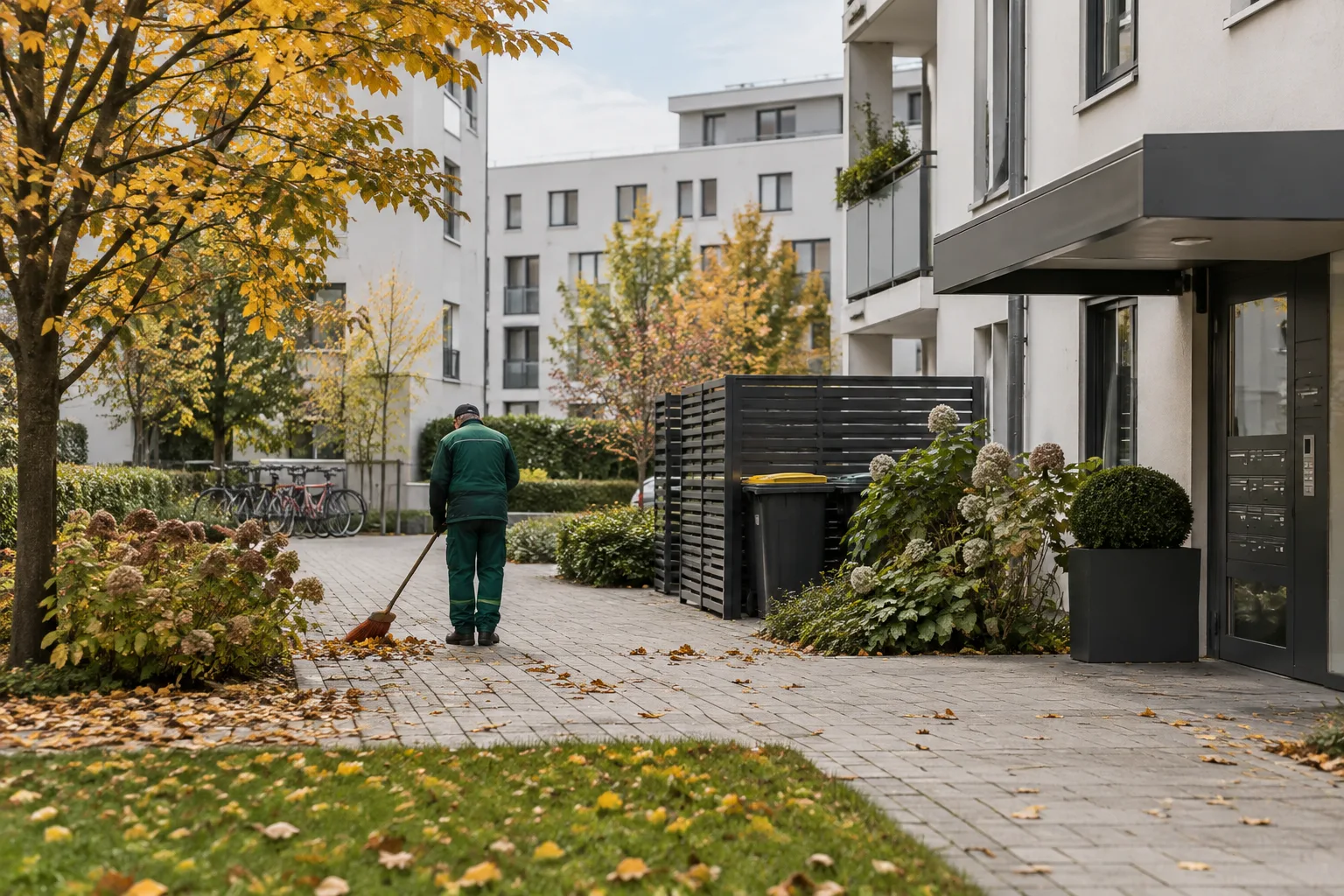
| Removing leaves | Generally yes | On associated green areas and non-public paths |
| Replacing dead plants | Generally yes | Replacement planting, not a fundamental redesign |
| Replacing playground sand | Generally yes | Expressly included in section 2 no. 10 BetrKV |
| Felling a decaying tree that is no longer structurally stable | Generally yes | Federal Court of Justice, VIII ZR 107/20 |
| Removing litter and dog waste left by third parties | Generally yes | On outdoor areas attributable to the rented property |
| Creating a garden or fundamentally redesigning it | No | Not routine maintenance |
| Repairing play equipment, fences or paths | No | Repairs |
| Purchasing a lawnmower or other equipment | No | Purchase costs are not recurring maintenance costs |
| Maintaining green areas dedicated to public use | No | Insufficient connection to the rented property |
Separate maintenance from capital expenditure
Creating new garden areas or installing a terrace does not constitute recoverable garden maintenance. If an invoice includes both routine maintenance and redesign work, the costs must be separated transparently. The description “gardening work” alone is not sufficient to classify them.
Double charging must also be avoided. If gardening work is already included under caretaker costs, the same services must not appear again under garden maintenance. Section 2 no. 14 BetrKV rules out counting them twice. Our guide to caretaker costs explains this further.
03Must tenants pay if they do not use the garden?
Generally, yes. Under the Federal Court of Justice’s judgment of 26 May 2004, VIII ZR 135/03, recovering garden maintenance costs does not depend on whether an individual tenant actually uses, or can use, the garden. A well-maintained communal green area can also enhance the residential setting of the other flats.
Gardens reserved for exclusive use are different: where a garden area is available only to the landlord or another tenant, its maintenance costs must not be allocated to the remaining tenants. Developments with both communal greenery and private garden sections therefore need a transparent separation of costs.
If a tenant is to maintain the garden assigned to their flat, the tenancy agreement should clearly describe the tasks. A general garden maintenance clause does not automatically cover demanding or hazardous work such as tree felling. Such measures should be addressed separately and carried out by specialist contractors where appropriate.
04Distinguishing publicly accessible areas
The absence of a fence does not automatically make a green area public. What matters is whether its designated purpose makes it available for use by the general public – for example, through a relevant planning provision or a dedication by the owner. This intended use may also be apparent from the circumstances.
If this means the necessary connection to the rented property is missing, maintenance costs cannot be recovered from tenants. The relevant Federal Court of Justice judgment is dated 10 February 2016, VIII ZR 33/15.
This must be distinguished from removing litter or dog waste left by third parties on outdoor areas belonging to the rented property. Such cleaning costs can be recoverable. However, this is not a blanket exception for areas dedicated to public use: their costs do not become recoverable simply because the work involves removing litter.
Landlords should consider separating invoices by area and service. This allows communal gardens, exclusively used garden sections and public areas to be treated separately.
05Tree felling: when it counts as garden maintenance
The cost of felling a decaying tree that is no longer structurally stable can qualify as recoverable garden maintenance. The Federal Court of Justice confirmed this in its judgment of 10 November 2021, VIII ZR 107/20. Neither fulfilling a duty to keep the property safe nor the long intervals between such felling operations prevents that classification.
This does not mean every tree-felling operation is recoverable. Removing a tree as part of a fundamental redesign of the grounds, for example, is not routine garden maintenance.
To support a transparent statement of costs, landlords should:
- obtain documentation of the tree’s condition and the reason for felling it;
- separate the invoice from redesign or construction work;
- comply with any permit requirements and nature conservation rules;
- inform tenants early if substantial costs are foreseeable.
Advance notice can help communication, but it replaces neither an agreement to pass on the costs nor a properly prepared annual statement.
06Worked example: a normal year and a year with tree felling
All the following figures are assumptions, not market prices or cost commitments. The example concerns a rented, individually owned flat measuring 90 m² in a development with 20 flats and a total residential floor area of 1,500 m². The costs shown are allocated by residential floor area both within the owners’ association and in the tenant’s statement.
The flat’s share is:
90 m² ÷ 1,500 m² = 6%.
Assume annual recoverable maintenance costs of €4,800 for the associated communal grounds. In addition, and not included in that amount, maintaining a play area dedicated to public use costs €600. In the exceptional year, the necessary felling of a decaying lime tree that is no longer structurally stable costs a further €3,000. All amounts are total costs including any applicable VAT.
| Flat’s share of costs | Normal year | Year with felling |
|---|---|---|
| Routine garden maintenance: 6% × €4,800 | €288 | €288 |
| Tree felling: 6% × €3,000 | €0 | €180 |
| Amount recoverable from the tenant | €288 | €468 |
| Public play area: 6% × €600, not recoverable | €36 | €36 |
| Owner’s total allocated costs | €324 | €504 |
What this means for advance payments and cash flow
Assume the tenant’s operating cost advances include a notional €24 per month for garden maintenance. This produces €24 × 12 = €288 annually, covering a normal year in the model.
In the year with tree felling, recoverable garden costs exceed this allowance by €180. Whether the tenant actually owes a balancing payment depends on the complete annual operating cost statement, including all advance payments and other cost items.
The €36 for the public play area remains the owner’s responsibility in both years. The additional €180 for felling is recoverable in the example, but the owner may need to fund it before recovering payment. When the owners’ association requires payment depends on its funding arrangements and resolutions; felling a tree does not automatically increase the monthly owners’ contribution, known as Hausgeld, immediately.
For tax purposes, maintenance costs borne by the owner can generally qualify as deductible rental expenses if sufficiently connected with the letting activity. Paying money into the association’s maintenance reserve does not, by itself, create an immediate deduction. Recoverability from tenants and tax deductibility must be assessed separately.
07Rented flats: owners’ contributions are not the same as operating costs
The owners’ association’s annual statement is an important starting point, but it cannot simply be passed on unchanged to the tenant. It may also contain management costs, repairs and other non-recoverable items.
The allocation rules are:
- General default: Without a different agreement, operating costs are allocated by residential floor area; recorded consumption or recorded causation must be reflected under section 556a(1) of the German Civil Code (BGB).
- Rented, individually owned flats: Without a different agreement, section 556a(3) BGB generally applies the owners’ association’s allocation basis. If that basis is inequitable, the statutory fallback under subsection 1 applies.
- Tenancy agreement: A valid agreement specifying a different allocation basis must be observed.
Further explanations are available in our guide to operating cost allocation.
An exclusive use right does not automatically create a maintenance obligation
An exclusive use right over a garden initially determines who may use it. Responsibility for maintenance and costs must be established from the declaration of division, the community rules and any valid resolutions. An exclusive use right alone does not automatically impose comprehensive responsibility for costs.
Regardless of the internal allocation within the owners’ association, the maintenance costs of a garden reserved exclusively for another flat cannot simply be passed on to the remaining tenants. Reviewing the documents early is useful when purchasing; see buying a flat with a garden.
08Checklist for the annual operating cost statement
- Check the agreement: Does the tenancy agreement cover garden maintenance as an operating cost?
- Identify the areas: Distinguish communal areas, exclusive-use areas and areas dedicated to public use.
- Separate the services: Distinguish maintenance and replacement planting from new installations, redesign and repairs.
- Avoid double counting: Do not charge twice for caretaker services or water consumption.
- Observe economic reasonableness: The service scope, need and price must be proportionate. Choosing the cheapest provider is not compulsory.
- Check the allocation and records: Calculate each share transparently and retain invoices and supporting documentation.
- Meet the deadline: The annual statement must generally reach the tenant no later than twelve months after the end of the accounting period. Additional payment claims are normally excluded after that if the landlord is responsible for the delay.
Our guide to section 556 BGB explains agreements, economic reasonableness and annual statements. Practical guidance is also available in operating cost statements for landlords.
09Assess garden costs before buying
Routine garden maintenance is often recoverable, but the answer depends on the agreement, the areas involved and the specific work. An investment calculation must also include non-recoverable costs and any need to fund expenses before recovering them.
In a free initial consultation, we discuss how owners’ contributions and operating costs interact for a rented flat, and which owner-borne costs to allow for. Request an initial consultation.
FAQFrequently asked questions
Can landlords recover garden maintenance through operating costs?
Generally yes, if a valid agreement allows operating costs to be passed on. Section 2 no. 10 BetrKV covers routine garden maintenance, replacement of plants and woody vegetation, and playground maintenance including sand replacement. Creating a garden, fundamentally redesigning it and carrying out repairs are not covered.
Must tenants pay for garden maintenance if they do not use the garden?
Generally yes. Actual use or the ability to use communal green areas is not decisive. Important exclusions include maintenance costs for garden areas available exclusively to the landlord or another tenant.
Are tree-felling costs recoverable from tenants?
Felling a decaying tree that is no longer structurally stable can qualify as recoverable garden maintenance. The Federal Court of Justice confirmed this in judgment VIII ZR 107/20. Felling a tree as part of a fundamental redesign of the grounds, however, is not routine maintenance.
Can a landlord pass on the cost of creating a garden?
Not as operating costs. Creating a garden or fundamentally redesigning it is not routine maintenance. If an invoice also includes maintenance work, the recoverable services must be separated from the capital expenditure.
What rules apply to publicly accessible green areas?
Accessibility alone does not mean an area is dedicated to public use. If its designated purpose makes it available for use by the general public, its maintenance costs are not recoverable. Removing litter left by third parties on associated private outdoor areas can be recoverable, but this does not create a blanket exception for public areas.
How are garden maintenance costs allocated between flats?
A valid agreement takes priority. Without a different arrangement, residential floor area is the general default. For rented, individually owned flats, the owners’ association’s allocation basis generally applies under section 556a(3) BGB. If that basis is inequitable, subsection 1 applies. Non-recoverable costs must be excluded regardless of the allocation basis.
Writes about Investment properties, New builds and renovation and Financing.
Nadeem is a qualified insurance and finance merchant, spent around eight years self-employed in the insurance and finance industry and has specialised in investment property since 2024. He writes about new builds, renovation, financing and the running costs of rented property.
This guide does not replace tax or legal advice. All figures are example calculations with disclosed assumptions.