Investment Property in Albstadt: Location Strengths, Areas and Yields
The largest town in the Zollernalbkreis is growing, is an industrial centre in its own right and has purchase prices far below those in Stuttgart or Tübingen. We present the official figures, compare them with the region and run the numbers for an existing flat and a new-build.
 Andriy Bezborodko
Managing Director of the InvestImmo Group
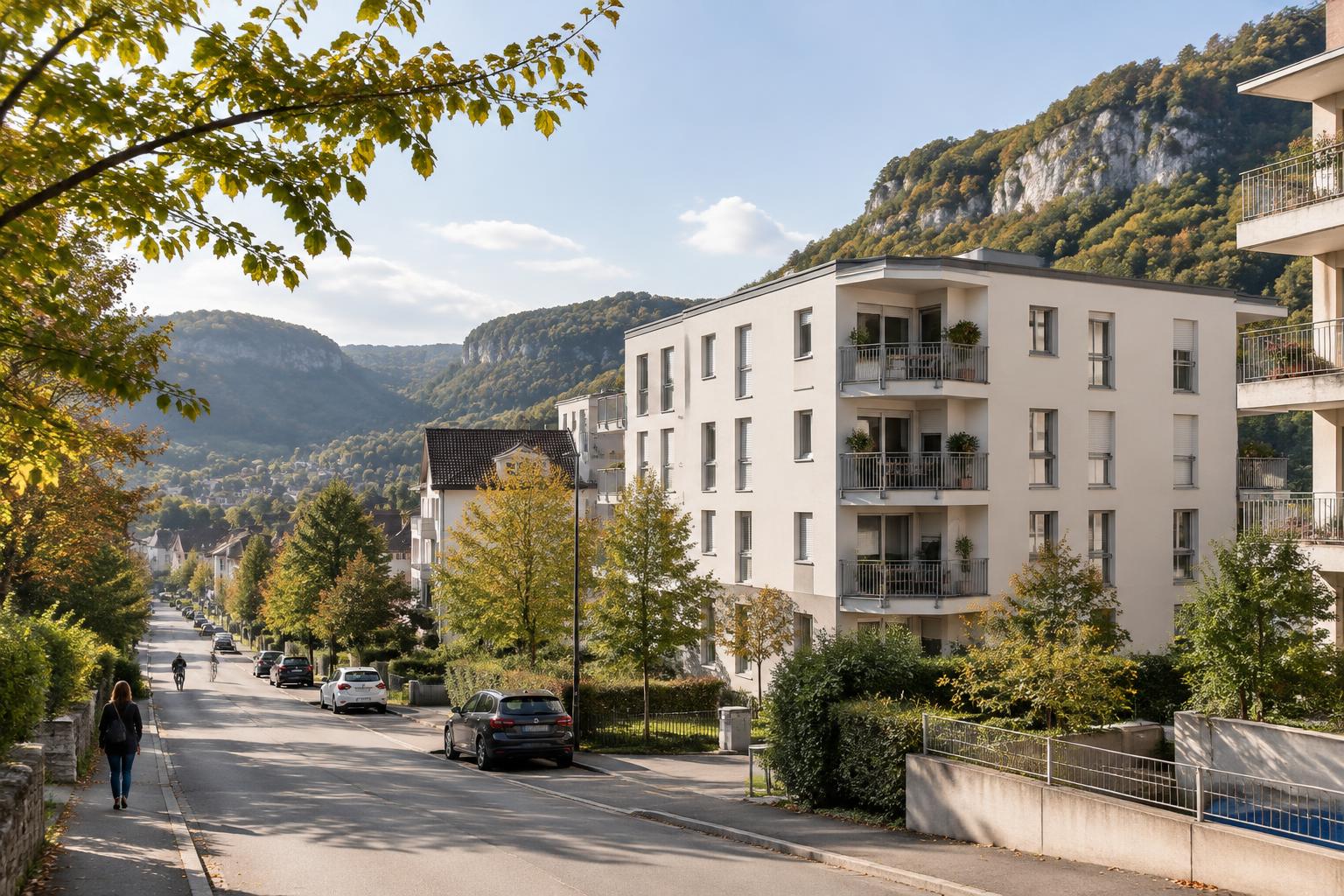
Anyone looking for a flat as an investment in Stuttgart, Tübingen or Reutlingen will soon encounter purchase prices of €3,000 to over €4,000/m². To the south, on the Swabian Alb, lies Albstadt. Here, existing flats are advertised at around €2,000/m², or roughly half as much.
Albstadt is not a suburb. The city has 47,000 residents, is the largest in Zollernalbkreis and has more jobs than employed residents. We have compiled the official figures to show what makes the location attractive, where its limitations lie and what a calculation using actual rent index figures looks like.
01Albstadt in figures
All the figures we use in our assessment, with sources and reference dates.
| Indicator | Value | Source, reference date |
|---|---|---|
| Population (official) | 47,047 | Federal Statistical Office, municipal directory, 31 December 2025 |
| Population in 2015 (based on the 2011 Census) | 44,431 | Federal Statistical Office, 31 December 2015 |
| Population change, 2019–2024 | +0.64% per year | BBSR via Deutschlandatlas |
| Households | 21,640 | 2022 Census |
| Share of single-person households | 39.6% | 2022 Census |
| Housing stock | 23,722 | 2022 Census |
| Share of rented dwellings | 38.0% | 2022 Census, own calculation |
| Vacancy rate (residential buildings excluding halls of residence) | 6.2% | 2022 Census, reference date 15 May 2022 |
| Average rent under existing contracts | €6.68/m² | 2022 Census |
| Rent index: 60–70 m², built in 1970–1979 | €6.19/m² | Albstadt Rent Index 2024 |
| Advertised rent in Zollernalbkreis | €9.77/m² | BBSR via Deutschlandatlas, 2025 |
| Asking price for a flat built in 1970–1999 | €1,973/m² | immoportal.com, 1 October 2026 |
| Employees subject to social security contributions, by place of work | 19,587 | Federal Employment Agency, 30 June 2025 |
| Inbound / outbound commuters | 9,462 / 8,811 | Federal Employment Agency, 30 June 2025 |
| Unemployment rate in Zollernalbkreis | 4.6% | Federal Employment Agency via Deutschlandatlas, 2025 |
| Students at the Albstadt campus | 1,392 | Baden-Württemberg State Statistical Office, winter semester 2024/25 |
| Rent brake | no | Baden-Württemberg Rent Limitation Ordinance, until 31 December 2026 |
| Cap on rent increases | 20% | Section 558 of the German Civil Code (BGB), Albstadt not included in the state ordinance |
| Property transfer tax in Baden-Württemberg | 5.0% | State Act of 26 October 2011 |
02Albstadt compared with Stuttgart, Tübingen and Reutlingen
Albstadt’s strongest selling point is its price. Based on advertised prices, an existing flat here costs roughly half as much as in Tübingen and less than half as much as in Stuttgart. Rents are also lower, but not to the same extent. This means rental income is higher relative to the purchase price.
| Albstadt | Reutlingen | Tübingen | Stuttgart | |
|---|---|---|---|---|
| Purchase price of an existing flat | €1,973/m² | €2,800/m² | €3,905/m² | €4,226/m² |
| Rent according to the rent index | €6.19/m² | €8.41/m² | €9.78/m² | €11.15/m² |
| Gross rental yield (own calculation) | 3.8% | 3.6% | 3.0% | 3.2% |
| Advertised rent across the district, 2025 | €9.77/m² | €11.88/m² | €12.59/m² | €16.02/m² |
| Vacancy rate, 2022 Census | 6.2% | 3.1% | 2.7% | 3.5% |
| District unemployment rate, 2025 | 4.6% | 4.7% | 3.6% | 6.6% |
Albstadt’s strength lies in its lower entry price and its own employment base. However, the comparison figures do not represent identical flats on offer or a promise of returns. Historical vacancy levels and differing rent levels show how important it is to choose the right immediate location and examine the specific tenancy agreement.
03Population and demand
At the end of 2025, Albstadt officially had 47,047 residents, 2,616 more than in 2015. That is an increase of 5.9% in ten years. The two figures are not entirely comparable because the 2022 Census recalculated population figures throughout Germany. Nevertheless, the trend is clear: according to Deutschlandatlas, Albstadt grew by an average of 0.64% per year between 2019 and 2024, most recently rising from 46,950 (2024) to 47,047.
Growth is driven by inward migration. In 2024, Zollernalbkreis recorded 33 more people moving in from other parts of Germany than moving out per 10,000 residents. The State Statistical Office does not make a separate forecast for Albstadt freely available. For the state as a whole, it expects all 44 urban and rural districts to grow by 2045, by between 3.1% and 5.5% depending on the district.
In the 2022 Census, 39.6% of households consisted of people living alone, and 38% of dwellings were rented. Albstadt is a city of homeowners, with a smaller rental market than university cities.
04Economy, university and labour market
Albstadt is an industrial centre with pulling power of its own. On 30 June 2025, 19,587 employees subject to social security contributions worked in the city, more than were registered as living there. Every day, 9,462 people commute in and 8,811 commute out. According to the city authorities, Albstadt is the third-strongest economic centre in the Neckar-Alb region, after Reutlingen and Tübingen.
According to the city authorities, the most important sectors are technical textiles, toolmaking and mechanical engineering, and precision and security technology. One of the major employers is Groz-Beckert, a manufacturer of machine needles and precision components for the textile industry headquartered in Albstadt. At the end of 2024, 2,194 of its 9,419 employees worldwide worked there. Ebingen is also home to Effeff, a manufacturer of door locks and electric door strikes that has been part of the Assa-Abloy Group since 2005.
Albstadt-Sigmaringen University of Applied Sciences has its Engineering and Computer Science faculties in Albstadt. In the winter semester of 2024/25, 1,392 people studied there, with 2,610 across both campuses combined. This creates additional, albeit modest, demand for small flats.
The unemployment rate in Zollernalbkreis averaged 4.6% in 2025, roughly the same as in the district of Reutlingen and significantly below Stuttgart. The downside of being an industrial city is dependence on a small number of sectors. When textiles and mechanical engineering struggle, Albstadt feels the effects sooner than an administrative centre or university city.
05Quality of Life, Transport and Urban Development
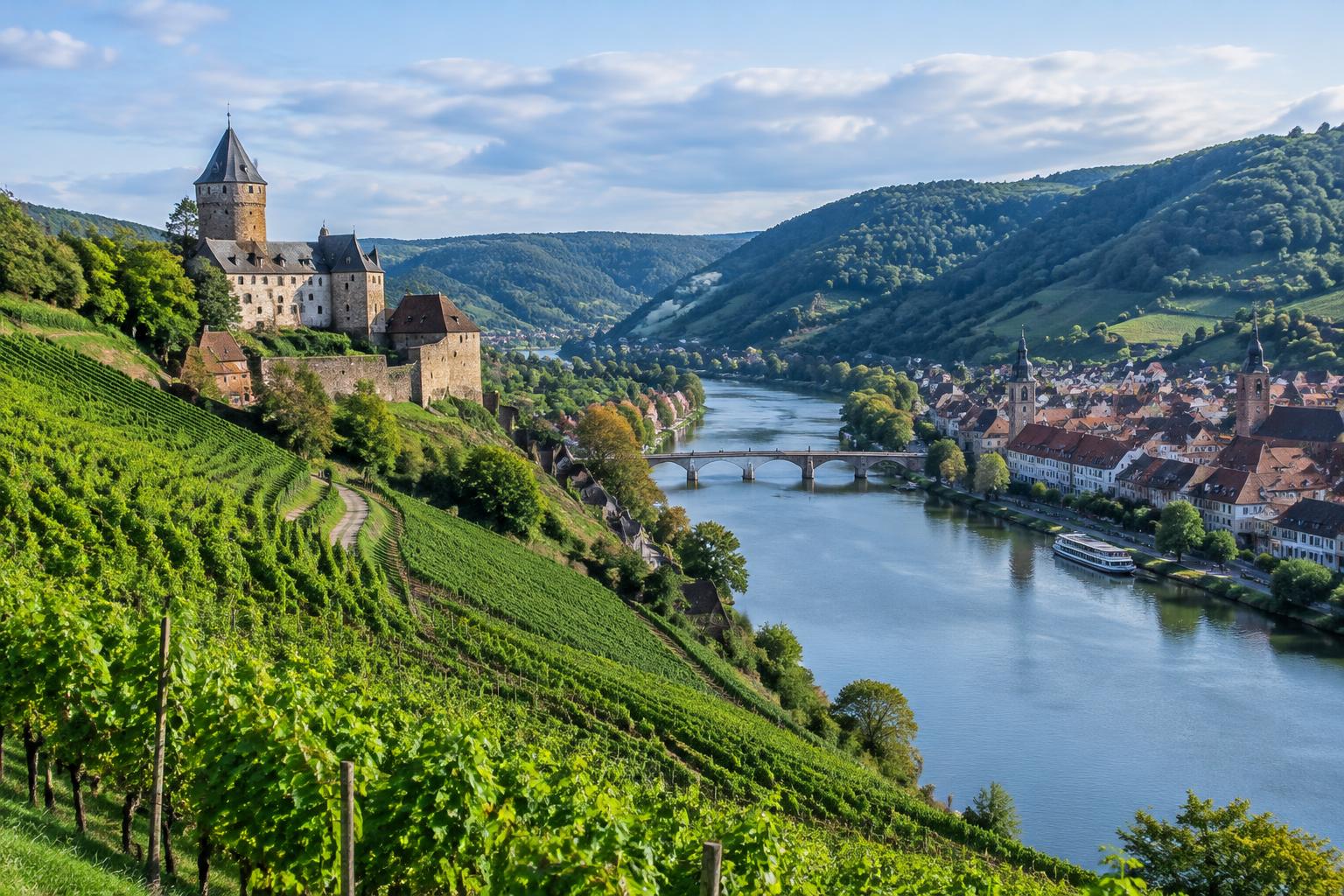
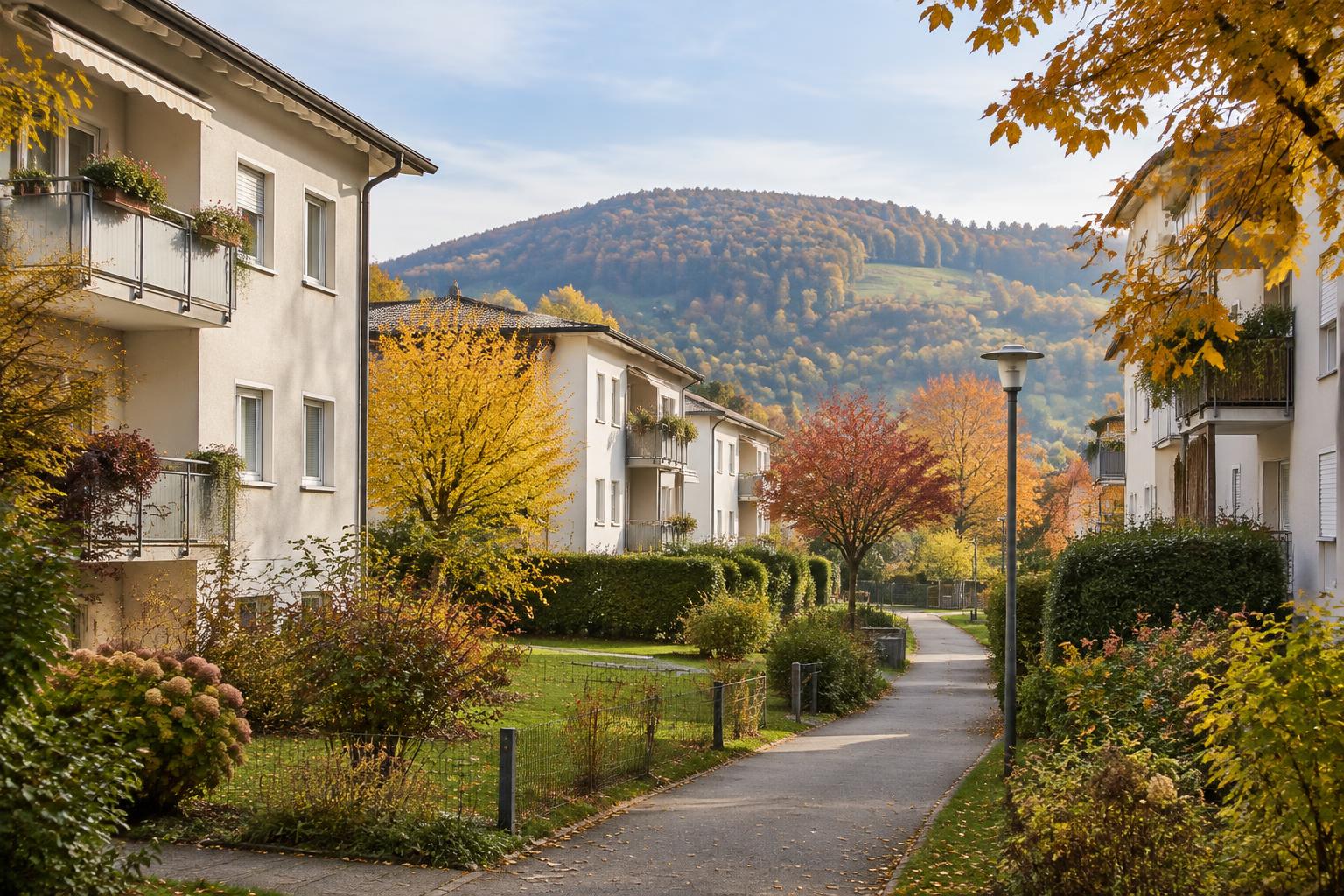
Albstadt lies in the south-western Swabian Alb, at elevations of up to just under 1,000 metres. According to its own figures, the town owns 5,744 hectares of forest, the third-largest municipal forest holding in Baden-Württemberg. It is known for its premium “Traufgänge” hiking trails, mountain biking routes and, in winter, 116 kilometres of cross-country ski trails and six ski lifts.
The town gives the following distances: Tübingen 45 km, Reutlingen 54 km, Lake Constance 66 km, Stuttgart 84 km. Albstadt-Ebingen is on the Zollernalbbahn railway line towards Tübingen and Sigmaringen. There are plans to reactivate the disused Talgangbahn line from Ebingen to Onstmettingen, but these are still at the planning stage, with no firm date set (as at 12 October 2026).
Albstadt’s urban development strategy focuses on its town centres. The town has four regeneration areas: southern Tailfingen town centre, the area around Ebingen station, Hufeisen Ebingen and Truchtelfingen district centre. In these areas, it supports the renewal of buildings and public spaces. It has invited concept-based bids for two plots in Ebingen (Landgraben 3, Pfarrstraße 30), while new residential areas are being planned on the outskirts.
06Rents, Purchase Prices and Rental Yields
Albstadt has a qualified rent index, which the municipal council recognised on 10 April 2025. It is based on a survey with a reference date of 1 January 2024 and is valid for two years from its effective date. The base rent depends on size and year of construction. For a flat measuring 60 to 70 m², it is €6.19/m² if built between 1970 and 1979, and €6.76/m² if built between 1990 and 1999. A small new-build flat measuring 45 to 50 m² (built between 2020 and 2023) has a base rent of €9.28/m². A 4% premium applies to flats in Ebingen, with further premiums and deductions for amenities and location.
Advertised rents are considerably higher. The BBSR reports an asking rent of €9.77/m² for the Zollernalbkreis district in 2025. The rent index also reflects older tenancy agreements with low rents.
There is no public market report on purchase prices in Albstadt. The joint property valuation committee provides information from its purchase price database only on application. We therefore use asking prices from immoportal.com (as at 1 October 2026): flats built between 1970 and 1999 are advertised at an average of €1,973/m², those built between 2000 and 2015 at €2,535/m², and those built from 2016 onwards at €3,208/m². Across all flats, average asking prices have fallen from €2,394 to €2,106/m² since 2023. Actual purchase prices may differ.
The purchase price and rent determine the purchase price multiplier; its reciprocal is the gross rental yield.
Even using the rent from the rent index, Albstadt outperforms the comparison towns. The top bar is a scenario using the district-wide asking rent, not a verified rent for a new letting of the specific flat. Base your calculations on what the tenant actually pays under the tenancy agreement. Check your own figure with the rental yield calculator.
07Districts at a Glance
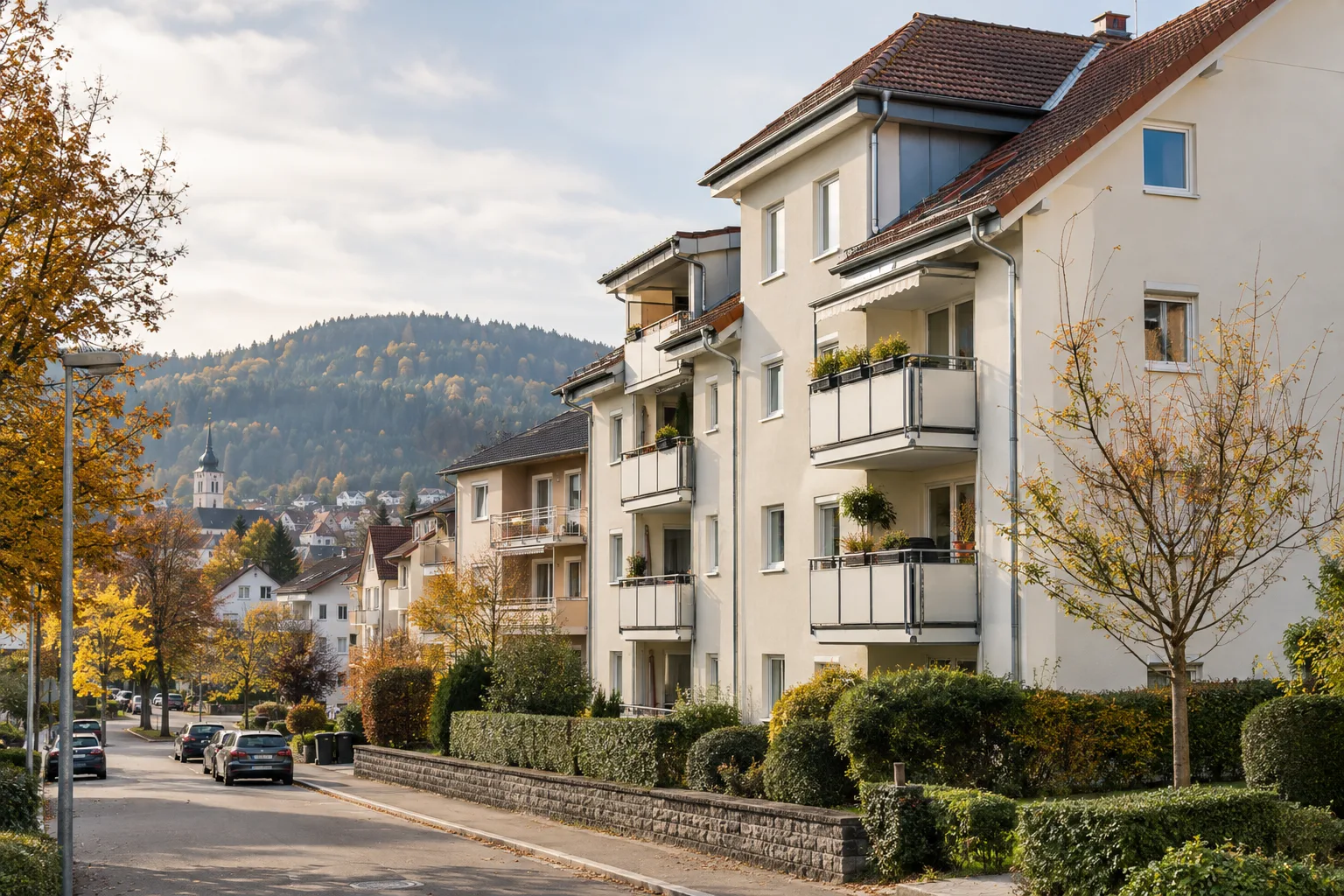
Albstadt was formed in 1975 from nine municipalities, which still have their own local centres. There are no official prices or rents for individual districts. The rent index distinguishes only between Ebingen and the other districts. The table therefore describes their character.
| District | Character | More suitable for |
|---|---|---|
| Ebingen | largest district, town centre, railway station, home to major employers; 4% premium in the rent index; two regeneration areas | Working professionals, people living alone, students |
| Tailfingen | second centre in the Talgang valley, shops and industry; southern town centre regeneration area | Working professionals, couples |
| Truchtelfingen | between Ebingen and Tailfingen; district centre regeneration area | Couples, families |
| Onstmettingen | northern end of the Talgang valley, close to the Albtrauf escarpment; terminus of the planned Talgangbahn railway | Families, nature lovers |
| Lautlingen and Laufen | in the Eyach valley towards Balingen, more village-like | Families, commuters travelling towards Balingen |
| Pfeffingen, Margrethausen, Burgfelden | small districts, predominantly houses with one or two dwellings | Families, longer tenancies |
In every district, the individual address matters. The rent index provides for premiums where a grocery shop and other shops are within walking distance.
08Rules for Landlords in Albstadt
Albstadt is not included in either the state’s rent control ordinance or its rent increase cap ordinance, both of which apply until 31 December 2026. Nor is Albstadt included in the draft successor regulations applying from 2027 (as at 13 October 2026). This results in two rules that are more favourable to landlords than those in Stuttgart, Tübingen or Reutlingen:
- No rent brake: For a new letting, the rent is not capped at 10% above the rent index. The Economic Offences Act imposes a limit where rent is more than 20% above the local comparable rent and a shortage of supply is being exploited.
- 20% rent increase cap: Under an existing tenancy agreement, rent may rise by up to 20% over three years, but no higher than the local comparable rent. In the towns and cities covered by the state ordinance, the cap is 15%.
When buying in Baden-Württemberg, you pay 5.0% property transfer tax. On top of this, notary and land registry fees amount to around 2% of the purchase price if you use financing, plus estate agent fees depending on the property. At a purchase price of €118,380, this means purchase costs of around 7.0%, excluding estate agent fees. The purchase costs calculator works out your own costs, while our article on notary fees explains the individual notary charges.

09Worked example: a rented flat in Albstadt
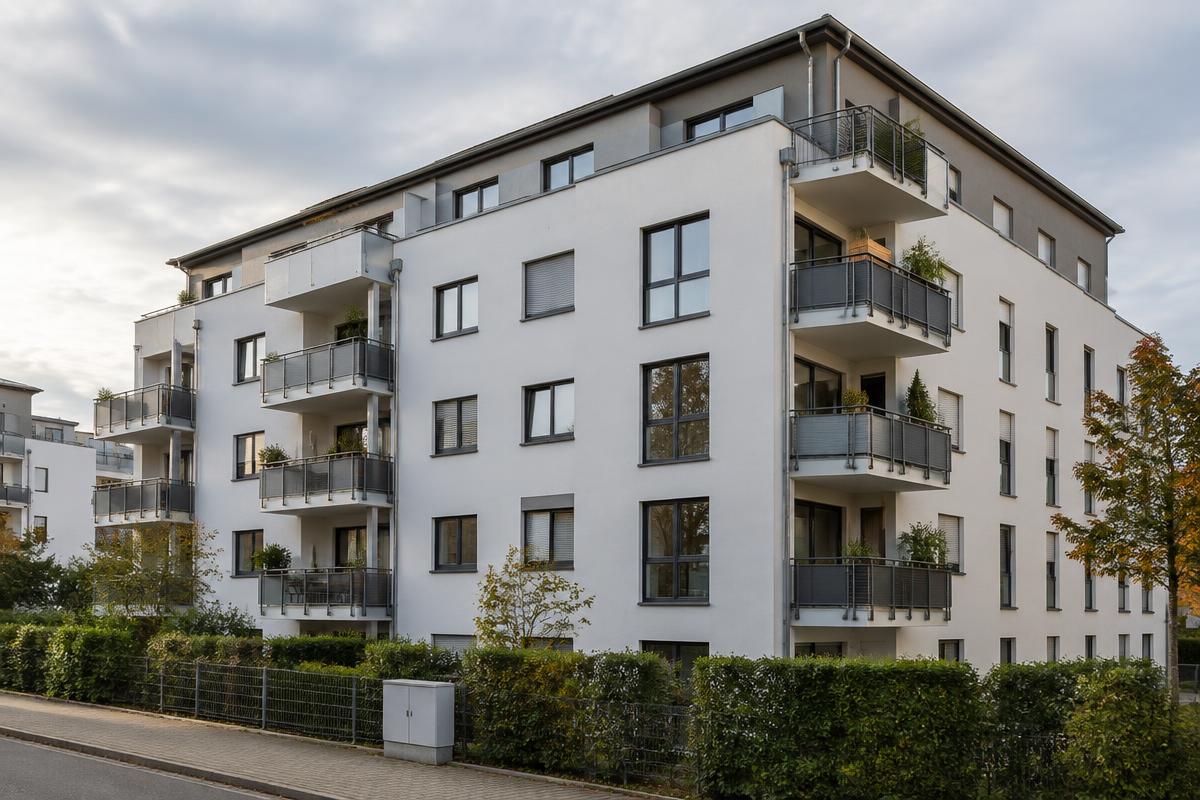
Let us take Jana, 38, single, an engineer with a taxable income of €60,000. She buys a rented flat with 60 m² of floor space, built in 1975, for €118,380. This corresponds to the asking price for flats of this age. At €6.19/m², the rent exactly matches the rent index figure for this size and year of construction, without any supplements. The name is fictional, and the figures are a worked example, not a forecast.
| Purchase price (60 m² × €1,973/m²) | €118,380 |
|---|---|
| Property transfer tax in Baden-Württemberg, 5.0% | €5,919 |
| Notary and land registry (with a land charge of €118,380) | €2,410 |
| Purchase costs paid from own funds | €8,329 |
| Loan (purchase price) | €118,380 |
| Interest at 3.8% and principal repayment at 1.5% (assumption) | €6,274 per year |
| per year | per month | |
|---|---|---|
| Net rent excluding service charges (€6.19/m², 2024 rent index) | €4,457 | €371 |
| Interest | −€4,498 | −€375 |
| Principal repayment | −€1,776 | −€148 |
| Non-recoverable costs (management, reserve contribution, assumption) | −€1,200 | −€100 |
| Cash flow before tax | −€3,017 | −€251 |
| Depreciation at 2% on the building component (80%, assumption) | €2,015 | €168 |
| Rental loss (rent − interest − costs − depreciation) | −€3,257 | −€271 |
| Tax saving (2026 tax rates, excluding church tax) | +€1,238 | +€103 |
| Cash flow after tax | −€1,779 | −€148 |
Jana contributes around €148 per month after tax. Approximately the same amount goes towards principal repayment, reducing her outstanding loan. Excluding principal repayment, the ongoing balance after tax is close to break-even in this example. This illustrates the advantage of a low entry price, not the financial viability of a specific property on offer.
Our article Tax on rental income explains how rental income is taxed.
Interest rates and changes of tenant have the greatest impact on the figures. As no rent brake applies, a change of tenant can improve the figures. As vacancy is higher than in the region, it can equally worsen them if the flat remains empty for longer.
For comparison: a new-build flat in Albstadt
What changes if Jana buys a newly built flat with 45 m² of floor space instead? There are no published statistics for first sales of new-build properties in Albstadt. Flats built from 2016 onwards are advertised at an average of €3,208/m², while new developments are generally priced higher. We therefore assume €4,000/m², or €180,000. She pays the property transfer tax (€9,000) and notary and land registry costs (€3,233) from her own funds. For rent, we use the advertised rent for flats built from 2016 onwards: €11.05/m².
| per year | per month | |
|---|---|---|
| Net rent excluding service charges (45 m² × €11.05/m², advertised rent) | €5,967 | €497 |
| Interest (3.8% on €180,000) | −€6,840 | −€570 |
| Principal repayment (1.5%) | −€2,700 | −€225 |
| Non-recoverable service charges (€1.20/m², assumption) | −€648 | −€54 |
| Cash flow before tax | −€4,221 | −€352 |
| Declining-balance depreciation at 5% on the building component (80%, assumption) | €7,648 | €637 |
| Rental loss (rent − interest − service charges − depreciation) | −€9,169 | −€764 |
| Tax saving (2026 tax rates, excluding church tax) | +€3,392 | +€283 |
| Cash flow after tax | −€829 | −€69 |
Depreciation in the first year is almost four times as high as for the existing flat (€7,648 rather than €2,015), and maintenance costs are usually minimal in the first few years. At 3.3%, the gross rental yield is lower than for the existing flat because the purchase price per m² is twice as high. Before tax, Jana contributes around €352 per month; after tax, around €69, or around €80 less than for the existing property. Every additional €500/m² on the purchase price costs around €99 per month for 45 m². The tax saving decreases in subsequent years because declining-balance depreciation is calculated on the remaining book value.
10The location’s strengths and what we look for in a property
There are verifiable factors in Albstadt’s favour. The city has grown by 5.9% since 2015 and has more jobs than employed residents. Internationally active companies Groz-Beckert and Effeff are based in the city, and the university of applied sciences trains engineers and computer scientists. Existing flats cost around half as much as in Tübingen, and the gross rental yield exceeds the regional level even when using rent index rents. Under the version of the regulations cited, Albstadt is not subject to the rent brake. For existing tenancies, a rent increase cap of 20% over three years generally applies, subject to the local comparable rent and other statutory requirements.
To ensure that the location’s advantages suit your investment, we check the following points in particular for each property on offer:
- Vacancy of 6.2% in the 2022 census, almost twice as high as in Reutlingen. A flat that becomes vacant may remain empty for longer.
- Target group and resale: 38% of flats were rented out at the time of the census. Rental demand and future saleability need to be checked for the specific flat size, address and price positioning; the proportion alone does not establish the number of buyers.
- Low rent index rents: Within an existing tenancy, rent can only rise as far as the comparable rent.
- Dependence on industry: Textiles and mechanical engineering are sensitive to economic cycles and the global market.
- No public forecast for the city, and a district where 23% of residents are aged 65 or over.
- No official purchase prices: Check the price of your flat by obtaining information from the purchase price register.
- You want to enter the market at a low purchase price and can cover a manageable monthly shortfall.
- You are looking for an industrial location with its own employment base.
- You intend to hold the flat for the long term and allow for changes of tenant.
- You compare the rent stated in the purchase contract with the rent index.
- You want to base your calculations on advertised rents rather than the contractual rent.
- You have no reserve to cover several months of vacancy.
- You intend to sell the flat again in a few years.
- You depend on a particular change in property value.
Our article A flat as an investment covers the general advantages and disadvantages of investing in a flat.
11Other Locations
Other cities in Baden-Württemberg: Overview of Baden-Württemberg · Esslingen am Neckar · Freiburg im Breisgau · Heidelberg · Heilbronn · Karlsruhe · Konstanz · Ludwigsburg · Mannheim · Pforzheim · Reutlingen · Stuttgart · Tübingen · Ulm
All locations compared: Where is property investment worthwhile? Cities compared in 2026 · Which federal state is suitable? All 16 compared
FAQFrequently asked questions
Is a flat in Albstadt a worthwhile investment?
That depends on the purchase price, rent and your tax position. In our example, a single female buyer with €60,000 in taxable income contributes around €148 a month after tax towards an existing 60 m² flat, exactly matching the amount of principal she repays. Albstadt's strengths include low purchase prices, jobs and no rent brake, but its historical vacancy rate of 6.2% (2022 Census) requires careful assessment of the immediate location and the flat.
What rental yield can you achieve in Albstadt?
Around 3.8% gross for an existing flat if the rent matches the local rent index, and around 4.5% if it is 20% higher when let to a new tenant. This is based on an asking price of €1,973/m². In Stuttgart, Tübingen and Reutlingen, comparable figures range from 3.0% to 3.6%.
How much does a flat cost to buy in Albstadt?
According to immoportal.com, flats were advertised at an average of €2,106/m² in October 2026, with those built between 1970 and 1999 at €1,973/m² and those built from 2016 onwards at €3,208/m². These are asking prices. You can obtain actual purchase prices from Gutachterausschuss Albstadt by requesting information from its purchase price register.
Does Albstadt have a rent brake?
No. Albstadt is not listed in the Baden-Württemberg Rent Limitation Ordinance, which applies until 31 December 2026, and is not included in the draft for 2027 onwards either. For an existing tenancy, the rent increase cap is generally 20% over three years, subject to a ceiling of the local comparable rent and further statutory conditions.
Which districts in Albstadt are of interest to property investors?
For small flats, Ebingen is particularly relevant, with its town centre, railway station, university of applied sciences and major employers. Tailfingen and Truchtelfingen are the next centres in the Talgang valley. There are no official prices for individual districts, so assess each address separately.
How much are the additional purchase costs in Albstadt?
Property transfer tax is 5.0%, plus around 2% for the notary and land registry. On a purchase price of €118,380, this comes to around €8,330 excluding estate agent fees.
12Further Reading
- Buying a flat as an investment: advantages and disadvantages
- Paying tax on rental income
- Notary fees when buying property
- Special depreciation allowances and declining-balance depreciation
- Rental yield calculator
- Property purchase costs calculator
- Property transfer tax in Baden-Württemberg
13Sources
All sources accessed on 15 October 2026.
- Federal Statistical Office, register of municipalities, municipalities as at 31 December 2015, 31 December 2024 and 31 December 2025
- Federal and State Statistical Offices, 2022 Census (reference date: 15 May 2022): Regional table of buildings and dwellings and Regional table of households
- EMA-Institut für empirische Marktanalysen, Documentation for the Albstadt 2024 rent index (qualified rent index, recognised on 10 April 2025), Table 8 and upward and downward adjustments
- Federal Employment Agency, Municipal data on employees subject to social security contributions by place of residence and work, reference date: 30 June 2025
- BBSR and Federal Employment Agency via Deutschlandatlas, data tables (population trends 2019–2024, advertised rents 2025, unemployment rate 2025, migration and age structure 2024; as at 25 September 2026)
- Baden-Württemberg State Statistical Office, Students at higher education institutions in Baden-Württemberg in the winter semester 2024/25, 23 October 2025; Regionalised population projections to 2045, 6 May 2025
- immoportal.com, Property prices in Albstadt (asking prices and advertised rents, as at 1 October 2026)
- City of Albstadt, City profile, facts and figures, Business location, Building and housing (urban regeneration areas, development areas), Sustainable urban development (concept-based land allocations), Property valuation committee office
- Groz-Beckert, Health and Education Centre brochure (employees as at 31 December 2024)
- echo24.de, Disused railway lines in Baden-Württemberg, as at 12 October 2026 (Talgangbahn)
- Rent Limitation Ordinance and Baden-Württemberg Rent Increase Cap Ordinance, Law Gazette 2025 Nos. 144 and 145, valid until 31 December 2026; draft successor regulation, Beteiligungsportal Baden-Württemberg, 22 September 2026
- Comparative figures for Stuttgart, Tübingen and Reutlingen: property valuation committees and rent indices as cited on our pages for Stuttgart, Tübingen and Reutlingen
- Section 556d BGB, Section 556f BGB, Section 558 BGB, Section 5 WiStG, Section 32a EStG (2026 tax schedule), Section 7 EStG (subsections 4 and 5a), Section 7b EStG, Section 34 GNotKG (Table B)
- All example calculations, purchase price-to-rent multiples and yields: own calculations, as at 15 October 2026
Disclaimer: This page provides general information and does not constitute investment, tax or legal advice. All figures are example calculations with disclosed assumptions, official figures or clearly identified advertised figures with a stated reference date, as at 15 October 2026.
Writes about Taxes, AfA (depreciation), Financing and Investment concept.
Andriy is Managing Director of the InvestImmo Group and has been an entrepreneur in the property industry since 2020. His experience in estate agency, property marketing and his own investments shapes his view on property selection and long-term investment concepts. His team handles the personal advice for investors.
This guide does not replace tax or legal advice. All figures are example calculations with disclosed assumptions.