Carbon costs for landlords: tiers and calculations for 2026
Since 2023, landlords have borne their statutory share of carbon costs. We explain the tiered model, billing and two simplified examples.
 Nadeem Shahid
Investment Advisor at InvestImmo
You own a rented flat, and a line in the heating bill now represents a cost you must bear yourself. The tenant pays only part of the carbon costs. You bear the statutory landlord share.
For residential buildings, that share depends particularly on the billed CO2 emissions per square metre. Insulation, heating technology, consumption and weather can all affect this figure. Actual CO2 emissions remain decisive after a heating system is replaced: a new gas or oil boiler alone neither determines a particular band nor provides an exemption from cost sharing.
01What the Carbon Dioxide Cost Allocation Act covers
Heating oil and natural gas have been subject to a carbon price under Germany’s Fuel Emissions Trading Act [Brennstoffemissionshandelsgesetz, BEHG] since 2021. Suppliers pass these costs on through their fuel prices. Before statutory cost sharing was introduced, tenants could bear the full amount where the heating-cost agreement allowed this.
For billing periods beginning on or after 1 January 2023, the CO2KostAufG generally requires landlords to bear their statutory share. Tenants can influence their heating habits, while landlords can influence a building’s energy performance. The intention is to give both parties an incentive.
The Act covers residential and commercial premises within its scope, including certain district heating supplies from installations covered by emissions trading (section 2). Not every heat supply is automatically covered. Section 8 generally provides for equal sharing in non-residential buildings; residential buildings follow the tiered model. The building’s classification is therefore also decisive for commercially used premises.
02The tiered model: ten bands based on building emissions
For the heating bill, the landlord calculates the building’s CO2 emissions in kilograms per square metre of residential floor area per year (section 5(1)). This figure determines the applicable band in the table annexed to the Act.
| CO2 emissions per m² of residential floor area per year | Tenant share | Landlord share |
|---|---|---|
| below 12 kg | 100% | 0% |
| 12 to below 17 kg | 90% | 10% |
| 17 to below 22 kg | 80% | 20% |
| 22 to below 27 kg | 70% | 30% |
| 27 to below 32 kg | 60% | 40% |
| 32 to below 37 kg | 50% | 50% |
| 37 to below 42 kg | 40% | 60% |
| 42 to below 47 kg | 30% | 70% |
| 47 to below 52 kg | 20% | 80% |
| 52 kg or more | 5% | 95% |
A well-insulated building with gas heating may fall into a lower band; an unrenovated building with oil heating may reach a high band. Age and heating technology alone do not determine the classification. With a central supply, the building-wide figure generally applies, rather than the consumption of your individual flat. Where tenants arrange their own supply, the separate calculation under section 6 must be considered.
Section 9 provides relief where public-law requirements prevent substantial improvements to the building’s energy performance or its heating and hot-water supply. If the statutory conditions are met for one of these areas, the landlord share is halved (section 9(1)). If both areas are affected, the landlord share is removed (section 9(2)). An obligation to connect to and use a district heating network may be relevant, but does not automatically qualify for relief. The landlord must substantiate the conditions. Consult a lawyer if you need advice on whether relief applies to your circumstances.
03How landlords allocate carbon costs
For a central supply, allocation forms part of the annual heating bill.
- 01Collect invoices
Suppliers must disclose the statutory information on CO2 quantities, carbon costs, emission factors and energy content (section 3(1)). Corresponding disclosure requirements apply to qualifying heat supplies.
- 02Attribute emissions to the billing period
If supply and billing periods differ, quantities must be attributed appropriately (section 5(1)). For heating oil, stocks and actual consumption are particularly relevant. If the billing period is not twelve months, the statutory adjustment to the band thresholds must also be considered.
- 03Divide by residential floor area
Divide the attributed CO2 quantity by the building’s residential floor area to obtain the figure per m², rounded to one decimal place.
- 04Identify the band
The resulting figure determines the percentage in the table, using adjusted thresholds where necessary.
- 05Deduct and disclose the landlord share
The landlord deducts their share from the carbon costs and allocates only the remaining amount using the applicable heating-cost allocation key. The bill must disclose the tenant share, classification and calculation basis (section 7(3)).
If the landlord fails to calculate the tenant share or omits the required information, the tenant may reduce their share of the heating costs by 3% (section 7(4)). The calculation is based on the heating costs allocated to the tenant, not merely their carbon costs. If tenants arrange their own supply, for example through an individual gas boiler, they calculate the share under section 6 and assert their reimbursement claim in text form within twelve months of receiving the supplier’s bill (section 6(2)).
For a centrally heated rented flat in a jointly owned building, the property manager for the owners’ association [Wohnungseigentümergemeinschaft, WEG] generally supplies the building data. Billing the tenant also requires the costs attributable to the flat and the applicable allocation key.
04Worked example: the same flat in two buildings
In this fictional example, Martina Brandt owns a rented flat measuring 70 m² in a building with 900 m² of residential floor area. We compare two cases with different heating systems and energy performance. The name and circumstances are fictional; the figures are not a forecast.
Simplified illustrative calculation: For an unrenovated building with oil heating, we assume annual CO2 emissions of 53,526 kg. For an insulated building with a condensing gas boiler, we assume 26,121 kg. Both emissions figures are chosen solely for the calculation, not as typical consumption or emissions values for these building categories. In an actual bill, emissions are determined using the relevant supplier data and consumption during the billing period.
| Oil-heated building, unrenovated | Gas-heated building, renovated | |
|---|---|---|
| Building CO2 emissions, assumed | 53,526 kg | 26,121 kg |
| CO2 per m² of residential floor area | 59.5 kg | 29.0 kg |
| Band | 52 kg or more | 27 to below 32 kg |
| Building carbon costs (€60/t plus 19% VAT) | €3,821.76 | €1,865.04 |
| Share attributed to the 70 m² flat | €297.25 | €145.06 |
| Landlord pays | −€282.39 (95%) | −€58.02 (40%) |
| Tenant pays | €14.86 | €87.04 |
On these assumptions, Ms Brandt bears almost five times as much in the oil-heated building as in the gas-heated building. With consumption, emission factors and the allocation key unchanged, the amount rises proportionately with the assumed carbon price.
She cannot pass approximately €282 a year on to the tenant in the oil-heated example. That equates to just over €23 a month less pre-tax cash flow than if all costs could be recovered. Carbon costs borne by the landlord and attributable to letting can generally qualify as deductible rental expenses [Werbungskosten]; eligibility and the correct accounting for costs and reimbursements are decisive.
Simplified illustrative tax calculation: Assuming a tax saving of 30% of deductible expenses, a cost of €282.39 produces a saving of €84.72 and a remaining cost of €197.67. The 30% figure is solely a calculation assumption and is not associated with any particular income. Your actual saving depends on your personal tax position. Ask your tax adviser to tailor the after-tax calculation to your circumstances.
What does this mean for a purchase? Carbon costs form one part of ongoing expenditure. A high band can justify closer examination of the building envelope, heating system and potential investment needs; it does not, by itself, establish a specific refurbishment requirement. Works may be financed through the owners’ association’s maintenance reserve [Erhaltungsrücklage] or a special levy [Sonderumlage]. Contributions to that reserve are not immediately tax-deductible. Only actual expenditure on eligible works may qualify; the entire owners’ service charge [Hausgeld] is not automatically deductible either. Discuss the tax treatment of expenditure with your tax adviser.
05New gas and oil heating: what matters for your calculations
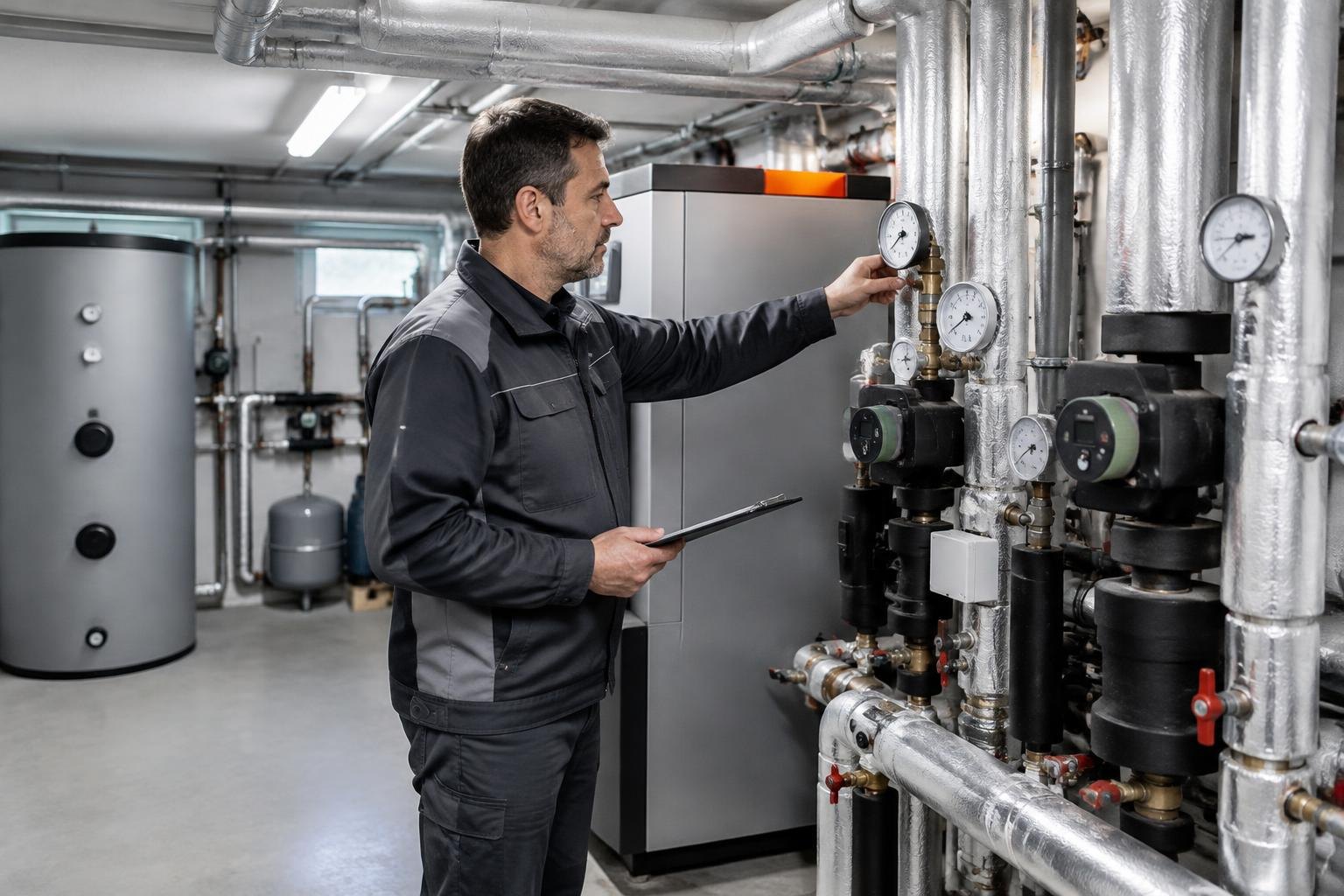
A new heating system can reduce fuel consumption. However, it does not change the statutory allocation percentage simply because it has been newly installed. The standard classification of a residential building depends on its CO2 emissions per square metre of residential floor area during the billing period.
You should therefore distinguish between two questions: what requirements apply to installing and operating the heating system? And how are qualifying carbon costs shared between landlord and tenant? Requirements for heating systems arise in particular under Germany’s Building Energy Act [Gebäudeenergiegesetz, GEG]. Carbon cost allocation does not replace those requirements. Consult a lawyer where necessary for advice on the legal requirements for a specific heating replacement.
Both the absolute emissions quantity and the band matter for your financial assessment. Lower consumption can reduce carbon costs. If emissions also fall below a band threshold, the landlord’s percentage decreases as well. The following example illustrates this combined effect for the gas-heated building. Whether a particular measure achieves the assumed savings depends on the building, technology and use.
| CO2 per m² a year | Landlord share for the flat | |
|---|---|---|
| Starting case: 26,121 kg CO2 | 29.0 kg | €58.02 (40%) |
| 10% less CO2: 23,508.9 kg | 26.1 kg | €39.17 (30%) |
| 20% less CO2: 20,896.8 kg | 23.2 kg | €34.81 (30%) |
With 10% lower emissions, the building’s figure falls from 29.0 to 26.1 kg CO2 per m² a year. This reduces the landlord’s percentage from 40% to 30%. Ms Brandt’s share falls by €18.86 a year, or 32.5%, in the calculation. With 20% lower emissions, her annual saving compared with the starting case is €23.21, or 40%. These amounts also demonstrate why carbon costs alone are not enough to justify investment in a heating system.
A comparison of heating systems should consider capital expenditure, operating costs, building suitability and legal obligations. Alongside fuel, operating costs include other tariff components, maintenance and, where applicable, standing charges. These items are not the same as carbon costs. Savings on the landlord’s share are therefore only one component of the overall calculation. Further considerations are covered in our guide to heat pumps in blocks of flats.
06When the tiered model deserves attention
- You are buying a rented flat in an older building with oil or gas heating.
- Your owners’ association is planning to replace the heating system.
- You let a building with individual gas boilers and tenants are claiming reimbursement.
- For heating supplied exclusively by electricity or a heat pump, the heating electricity does not generate BEHG fuel costs to be shared under the CO2KostAufG. Cost allocation for any additional fossil-fuel heat source requires separate consideration.
- A new building with high energy performance may fall into a lower band; the billed CO2 emissions remain decisive.
- If you occupy one of two flats in the building yourself, carbon cost sharing still applies. Section 7(2) concerns the allocation of the remaining costs under the relevant agreement, not a general exemption.
07Risks: what could change the calculation
Future carbon prices are not a fixed planning assumption. The 2026 price corridor cannot be treated as a permanent price assumption for a long-term investment. Model different price scenarios rather than assuming a guaranteed increase. The sensitivity calculation illustrates the price effect with emissions unchanged; it does not predict the actual price that will apply in future.
Consumption and band classification can change. Weather, heating habits and energy improvements affect annual emissions. Particularly close to a band threshold, a change can also shift the landlord’s percentage. You should therefore assess whether a single billing year’s classification is suitable as a long-term assumption for your purchase appraisal.
Billing errors create additional costs. Failure to allocate the costs or provide mandatory information may allow the tenant to reduce their heating-cost share by 3%. If that share is €1,100, the reduction is €33. Whether this exceeds the landlord’s carbon-cost share depends on the individual case. A lawyer can assist with disputes over billing.
High heating costs may affect lettability. They can increase prospective tenants’ overall housing costs. However, a high carbon band alone does not establish likely void periods or a particular refurbishment requirement.
FAQFrequently asked questions
Does the landlord have to pay the carbon tax?
The landlord bears the statutory share of carbon costs for qualifying fuel and heat supplies. For residential buildings, the tiered model generally sets the landlord share between 0% below 12 kg and 95% from 52 kg CO2 per m² of residential floor area per year. Public-law restrictions may provide relief under the conditions in section 9 CO2KostAufG. A lawyer can advise on these conditions.
What is the carbon price in 2026?
The BEHG price corridor for 2026 is €55–65 per tonne. The simplified examples use its midpoint of €60 plus 19% VAT, giving €71.40 per tonne. Actual allocation must use carbon costs calculated under the legislation and disclosed by the supplier. Separate rules govern cost calculation for district heating. The fixed BEHG price in 2025 was €55 per tonne.
Where can I find the CO2 quantity?
On invoices from qualifying fuel or heat suppliers. Section 3 CO2KostAufG governs disclosures including CO2 quantities, carbon costs, emission factors and energy content. For a centrally heated, individually owned flat, the property manager generally provides the building data.
What happens if the heating bill omits the carbon cost allocation?
If the landlord fails to calculate the tenant share or omits mandatory information, the tenant may reduce their share of the heating costs by 3% under section 7(4) CO2KostAufG. The reduction applies to the heating costs allocated to that tenant, not merely the carbon costs. For a heating-cost share of €1,100, this amounts to €33. A lawyer can assist with billing disputes.
Does the tiered model also apply to a new gas boiler?
Yes, a new gas boiler alone does not create an exception to the tiered model. For residential buildings, the billed CO2 emissions per m² of residential floor area per year are generally decisive. Lower consumption can reduce absolute carbon costs and potentially the landlord’s percentage. Requirements for installation and operation under the Building Energy Act must be considered separately. A lawyer can advise on legal questions concerning a specific heating replacement.
Can I deduct my carbon-cost share for tax purposes?
Carbon costs borne by the landlord and attributable to letting can generally qualify as deductible rental expenses. The actual saving depends on your individual tax position. Contributions to the maintenance reserve are not immediately deductible; only actual expenditure on eligible works may qualify. Discuss the tax treatment with your tax adviser.
Does the Act also cover commercial tenants?
Yes, where the premises and supplies fall within its scope. Section 8 CO2KostAufG generally provides for equal sharing in non-residential buildings. Commercial premises within a residential building generally follow the tiered model; the building’s classification is decisive. A lawyer can advise on questions concerning the legal classification.
08Further reading
- Heating bills for landlords
- Refurbishment obligations after purchase
- Energy performance certificates for landlords
- Operating costs that cannot be passed on to tenants
- Deductible rental expenses
- Identifying a maintenance backlog
09Sources
- Carbon Dioxide Cost Allocation Act, including the annex containing the tiered model and the rules on billing, tenant-arranged supplies and statutory relief.
- Fuel Emissions Trading Act, section 10(2) on fixed prices and the 2026 price corridor.
- Emissions Reporting Ordinance 2030, Annex 2, Part 4 on standard values for calculating fuel emissions. This article’s illustrative calculations explicitly use assumed emissions quantities.
- Building Energy Act (GEG) on energy requirements for buildings and heating systems.
- Illustrative calculations: our own calculations using the stated assumptions; not forecasts for individual buildings or future carbon prices.
This guide provides general information. Consult a lawyer or tax adviser for advice on the legal and tax implications of your individual circumstances.
Writes about Investment properties, New builds and renovation and Financing.
Nadeem is a qualified insurance and finance merchant, spent around eight years self-employed in the insurance and finance industry and has specialised in investment property since 2024. He writes about new builds, renovation, financing and the running costs of rented property.
This guide does not replace tax or legal advice. All figures are example calculations with disclosed assumptions.