Investment property in Friedrichshafen: figures, locations and an honest calculation
Existing flats from around €2,700/m², high rent index levels and a strong industrial location on Lake Constance, but new-build prices around €6,900/m², rent controls and dependence on a few large employers. We set out the official figures and work through a flat's finances.
 Eduard Winter
Investment Advisor at InvestImmo
Friedrichshafen is the largest town on the German shore of Lake Constance and, unlike many places around the lake, is primarily an industrial centre. Several large companies in propulsion technology, aerospace and mechanical engineering have factories or their headquarters here. Over ten years, the town has grown by around 3,700 residents, and more than 23,000 employees commute in every day.
For property investors, this is an unusual combination: a lakeside location and high rents on the one hand, and purchase prices for older flats still below €3,000/m² on the other. New-build flats, by contrast, cost almost €7,000/m². A cap on rents for new tenancies [Mietpreisbremse] and a 15% limit on rent increases within existing tenancies [Kappungsgrenze] also apply. We set out all the figures and work through the numbers for an existing flat and a new-build flat.
01Friedrichshafen in figures
All the figures used in our assessment, with sources and dates.
| Indicator | Value | Source, date |
|---|---|---|
| Residents (official figure) | 62,781 | Federal Statistical Office, municipal register, 31 December 2025 |
| Residents in 2015 (based on the 2011 Census) | 59,108 | Federal Statistical Office, 31 December 2015 |
| Households | 29,829 | 2022 Census |
| Share of single-person households | 43.4% | 2022 Census |
| Housing stock | 31,773 | 2022 Census |
| Vacancy rate | 3.5% | 2022 Census, reference date 15 May 2022 |
| Share of rented homes | 55.7% | 2022 Census, our own calculation |
| Employees subject to social security contributions, by workplace | 39,471 | Federal Employment Agency, 30 June 2025 |
| Inbound / outbound commuters | 23,056 / 11,612 | Federal Employment Agency, 30 June 2025 |
| Unemployment rate, Bodenseekreis | 3.8% | Federal Employment Agency via Deutschlandatlas, 2025 annual average (district figure) |
| Average rent under existing tenancy agreements | €8.53/m² | 2022 Census |
| Rent index, average across all rents | €9.97/m² | Qualified rent index 2026 |
| Asking rent, Bodenseekreis | €13.20/m² | BBSR via Deutschlandatlas, 2025 (district figure) |
| Purchase price of an existing flat, built up to 1980 | €2,712/m² | Eastern Bodenseekreis property valuation committee [Gutachterausschuss], 2024 (56 transactions) |
| Purchase price of a new-build flat | €6,924/m² | Eastern Bodenseekreis property valuation committee, reference date 1 January 2025 (31 transactions) |
| Cap on rents for new tenancies | yes, until 31 December 2026 | Baden-Württemberg rent limitation ordinance |
| Limit on rent increases within existing tenancies | 15%, until 31 December 2026 | Baden-Württemberg rent increase limitation ordinance |
| Property transfer tax [Grunderwerbsteuer], Baden-Württemberg | 5.0% | Baden-Württemberg state legislation |
02Population and demand
At the end of 2025, Friedrichshafen had 62,781 residents, around 3,700 more than at the end of 2015. The census means the comparison is not entirely exact, but the town has clearly grown. In 2025, the population remained virtually unchanged. The Bodenseekreis district gains residents through moves within Germany, but recorded a small net loss through international migration in 2024.
The State Statistical Office does not make a separate forecast for Friedrichshafen freely available. For Baden-Württemberg, it expects all 44 urban and rural districts to grow by 2045, by between 3.1% and 5.5% depending on the district. At 24.4%, however, the share of residents aged over 65 in the Bodenseekreis is high.
For landlords, the composition of the market matters. In the 2022 Census, 55.7% of homes were rented, while 43.4% of households consist of one person. There has been substantial recent construction: almost 2,200 homes date from 2016 onwards.
03Economy and labour market
Friedrichshafen is an industrial town. On 30 June 2025, 39,471 employees subject to social security contributions worked in the town, while 28,023 lived there. More than 23,000 people commute in and more than 11,600 commute out. Automotive supplier ZF has its group headquarters here, alongside companies in propulsion technology, aerospace and mechanical engineering, as well as Zeppelin University and a campus of Baden-Württemberg Cooperative State University.
The unemployment rate in the Bodenseekreis averaged 3.8% in 2025, and purchasing power is high. This strength is also the main risk: the labour market is shaped by a small number of large employers, some in the automotive supply industry, which is under pressure. Job cuts at any of these companies would directly affect demand for rented homes.
04Rents, purchase prices and rental yields
Friedrichshafen has a qualified rent index, with a version updated using the consumer price index in force since 1 August 2026 and valid until 31 July 2028. The average rent excluding charges is €9.97/m². The base table distinguishes between sizes and twelve construction-age categories, with additions and deductions for fixtures and fittings, modernisation and location, including proximity to the lake and lake views.
According to BBSR, the asking rent in the Bodenseekreis was €13.20/m² in 2025; no town-level figure is available. Under existing tenancy agreements, tenants in Friedrichshafen paid an average of €8.53/m² at the time of the 2022 Census.
Purchase prices come from the Eastern Bodenseekreis property valuation committee's 2025 property market report. The analysis of existing flats covers 2024 and excludes flats in buildings directly on the lakefront.
The purchase price and rent determine the price-to-rent ratio [Kaufpreisfaktor]; its reciprocal is the gross rental yield.
The district's asking rent is not achievable for a flat from the 1970s in this example: the cap on rents for new tenancies generally limits a new rent to 10% above the local comparable rent [ortsübliche Vergleichsmiete]. Check your own figures with the rental yield calculator.
05Overview of Friedrichshafen's neighbourhoods
Official purchase prices by neighbourhood are not available for Friedrichshafen. However, the rent index assesses location using points: flats no more than 100 metres from the lake receive +3 points, an unobstructed lake view +4 points and an unobstructed mountain view +1 point. Commercial areas and lower-ground-floor flats attract deductions.
| Area | Character | More suitable for |
|---|---|---|
| Town centre, near the lake | Centre with lakeside promenade, harbour and railway station, high demand | Single people, couples, older residents |
| Nordstadt, Allmannsweiler | Residential areas with many blocks of flats, close to industrial sites | Working residents, commuters |
| Fischbach, Manzell | Western lakeside districts with quieter residential settings | Families, couples |
| Ailingen, Ettenkirch, Raderach, Kluftern | Incorporated districts further inland | Families, longer tenancies |
For small flats, the central area near the railway station is particularly worth considering. Lakeside locations substantially increase rent index values and purchase prices, but generally not yields.
06Rules for landlords in Friedrichshafen
Friedrichshafen is covered by Baden-Württemberg's rent limitation ordinance and rent increase limitation ordinance. Both apply until 31 December 2026. In September 2026, the state government put draft extensions from 2027 out for consultation. Whether Friedrichshafen remains covered will only be certain once the legislation is officially promulgated.
- Cap on rents for new tenancies: When a property is re-let, the rent may be no more than 10% above the local comparable rent. Exceptions include homes first occupied and let after 1 October 2014 and comprehensively modernised homes.
- Limit on rent increases within existing tenancies of 15%: Under an existing tenancy agreement, rent may rise by no more than 15% over three years, and only up to the local comparable rent.
- Qualified rent index: Its figures must be cited with every rent increase. The range of local comparable rents extends around 22% either side of the calculated value.
When buying in Baden-Württemberg, you pay 5.0% property transfer tax. Notary and land registry fees are additional, as are estate agent fees where applicable. At a purchase price of €170,856, purchase costs [Kaufnebenkosten] excluding an estate agent are around 6.9%. The purchase costs calculator works out your own costs, while our guide to notary fees explains the individual notarial charges.
07Worked example: a tenanted flat in Friedrichshafen
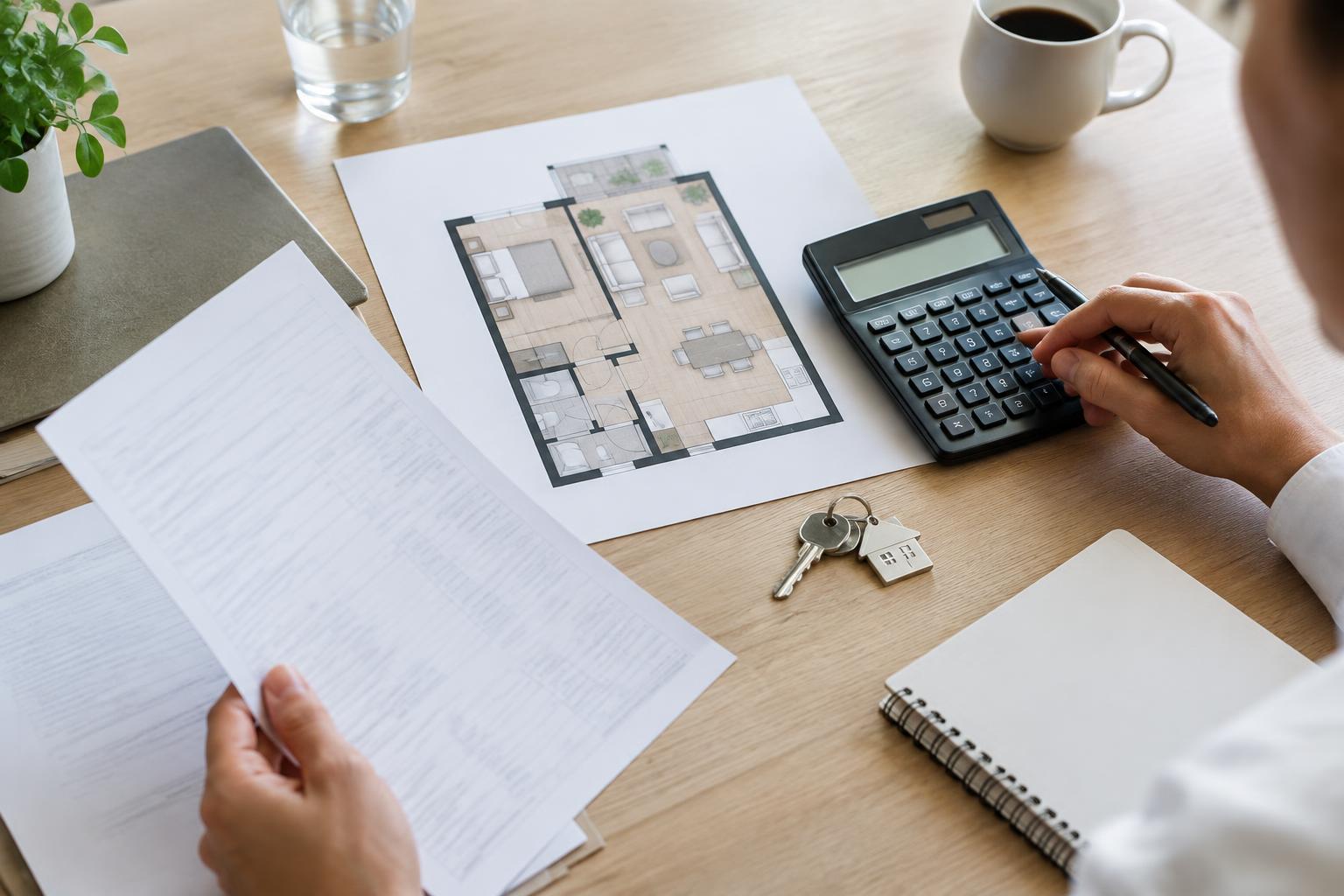
Take Florian, 40, single, a design engineer with taxable income of €60,000. He buys a tenanted 63 m² flat built in 1974, without direct lake frontage, for €170,856. This corresponds to the property valuation committee's average price for flats built up to 1980 (€2,712/m²). The rent of €9.64/m² is the rent index figure for this size and construction year with a fitted kitchen and tiled or parquet flooring (€9.18/m² plus 5%). The name is fictional, and the figures are a worked example, not a forecast.
| Purchase price (63 m² × €2,712/m²) | €170,856 |
|---|---|
| Property transfer tax, Baden-Württemberg, 5.0% | €8,543 |
| Notary and land registry fees (with a land charge [Grundschuld] of €170,856) | €3,233 |
| Purchase costs paid from equity | €11,775 |
| Loan (purchase price) | €170,856 |
| Interest 3.8% and principal repayment [Tilgung] 1.5% (assumption) | €9,055 per year |
| per year | per month | |
|---|---|---|
| Net rent excluding heating and service charges (€9.64/m², rent index 2026) | €7,288 | €607 |
| Interest | −€6,493 | −€541 |
| Principal repayment | −€2,563 | −€214 |
| Costs not recoverable from tenants (management, reserve fund, assumption) | −€1,320 | −€110 |
| Cash flow before tax | −€3,088 | −€257 |
| Depreciation [Abschreibung] of 2% on the building element (80%, assumption) | €2,906 | €242 |
| Rental loss (rent − interest − costs − depreciation) | −€3,430 | −€286 |
| Tax saving (2026 tax rates, excluding church tax) | +€1,304 | +€109 |
| Cash flow after tax | −€1,784 | −€149 |
Florian contributes around €149 a month after tax. Principal repayments account for €214 a month; without them, there would be a surplus of around €65. The rent therefore covers interest and ongoing costs, provided the flat remains let and no major refurbishment is required. For a building from the 1970s, it is worth examining the reserve fund and planned works.
Our guide to tax on rental income explains how rental income is taxed.
For comparison: a new-build flat in Friedrichshafen
According to the property valuation committee, new-build flats cost an average of €6,924/m² as at 1 January 2025, based on 31 sales and a range from around €5,000 to almost €12,900/m². For Florian, we calculate a 45 m² flat at the average price. We assume rent of €14.11/m²: the rent index figure for flats of 45 to 50 m² built between 2021 and 2024 (€13.19/m²), with high-quality fixtures and fittings (+7%). Homes first occupied and let after 1 October 2014 are permanently exempt from the cap on rents for new tenancies (Section 556f of the German Civil Code, BGB).
| per year | per month | |
|---|---|---|
| Net rent excluding heating and service charges (€14.11/m², rent index 2026 with addition) | €7,619 | €635 |
| Interest 3.8% | −€11,840 | −€987 |
| Principal repayment 1.5% | −€4,674 | −€389 |
| Costs not recoverable from tenants (assumption) | −€648 | −€54 |
| Cash flow before tax | −€9,542 | −€795 |
| Declining-balance depreciation [degressive AfA] of 5% on the building element (80%) | €13,222 | €1,102 |
| Tax saving (2026 tax rates) | +€6,413 | +€534 |
| Cash flow after tax | −€3,129 | −€261 |
Before tax, the new build costs Florian three times as much per month at −€795 as the existing flat (−€257). After tax, the monthly shortfall of −€261 remains significantly higher than for the existing flat (−€149), even though declining-balance depreciation offsets a large share. The gross yield of 2.4% is substantially lower than for the existing property (4.3%). On the other hand, the cap on rents for new tenancies does not apply, and repairs are usually minimal in the first few years. As depreciation decreases each year, the required contribution rises over time if all other assumptions remain unchanged.
An additional special depreciation allowance [Sonder-AfA] under Section 7b EStG may be available if, among other conditions, the building meets the Efficiency House 40 standard with QNG certification, construction costs do not exceed €5,200 per m² and no more than €4,000 per m² is used as the assessment basis. It is not included in our calculation. Read more in our guide to special and declining-balance depreciation; the depreciation calculator works out your own depreciation.
08Opportunities and risks in Friedrichshafen
Friedrichshafen has evidence-based strengths: growth, low vacancy, a large net inflow of commuters, low unemployment and high rents according to the rent index. Relative to these factors, older flats remain moderately priced.
There are equally clear counterpoints:
- Dependence on industry: A small number of large employers, some in the automotive supply industry.
- Cap on rents for new tenancies and 15% limit on rent increases: Scope to increase rent is limited.
- Very expensive new builds: Gross yields of around 2.5%, with a noticeable contribution required after tax.
- Older housing stock: Lower prices, but often a need for refurbishment.
- Changing regulation: The state ordinances expire at the end of 2026, and the extension has not yet been officially promulgated.
- You want a sought-after location with high purchasing power.
- You are buying an older flat whose refurbishment status is clear.
- You calculate the rent index figure, including all points, in advance.
- You have a reserve for special assessments [Sonderumlagen].
- You base your calculation on the district's asking rent.
- You are uncomfortable with a location's dependence on a small number of employers.
- You cannot afford a monthly contribution.
- You depend on a particular increase in property value.
Our guide to buying a flat as an investment explains the general advantages and disadvantages of investing in an individually owned flat [Eigentumswohnung].
09More locations
More towns and cities in Baden-Württemberg: Overview of Baden-Württemberg · Albstadt · Esslingen am Neckar · Freiburg im Breisgau · Göppingen · Heidelberg · Heilbronn · Karlsruhe · Konstanz · Ludwigsburg · Mannheim · Offenburg · Pforzheim · Ravensburg · Reutlingen · Stuttgart · Tübingen · Ulm
Compare all locations: Where is investment property worth considering? Towns and cities compared in 2026 · Which German state is suitable? All 16 compared
FAQFrequently asked questions
Is a flat in Friedrichshafen worthwhile as an investment?
In our example of an existing flat built up to 1980, the rent index rent covers interest and costs. You contribute around €149 a month after tax, while €214 goes towards principal repayment. New builds are significantly more expensive and require a contribution of around €261 after tax in our example.
What is the rental yield in Friedrichshafen?
Gross yields are around 4.3% for flats built up to 1980 at rent index levels, around 3.7% for those built between 1981 and 1990, and around 2.4% for new builds.
How much does a flat cost in Friedrichshafen?
In 2024, existing flats without direct lake frontage cost between €2,712/m² (built up to 1980) and €4,937/m² (built between 2011 and 2023), depending on construction year. New-build flats averaged €6,924/m² as at 1 January 2025.
Does Friedrichshafen have a cap on rents for new tenancies?
Yes, until 31 December 2026 under Baden-Württemberg's rent limitation ordinance, alongside a 15% limit on rent increases within existing tenancies. An extension from 2027 is at the draft stage but has not yet been officially promulgated.
Does Friedrichshafen have a rent index?
Yes, a qualified rent index, updated as at 1 August 2026 and valid until 31 July 2028. The average across all rents is €9.97/m².
Which Friedrichshafen neighbourhoods are worth considering for property investors?
For small flats, the central area near the railway station is worth considering; for families, Fischbach or inland districts such as Ailingen may be more suitable. Proximity to the lake raises rents and prices, but rarely yields.
How much are property purchase costs in Friedrichshafen?
Baden-Württemberg charges 5.0% property transfer tax, plus just under 2% for notary and land registry fees. At a purchase price of €170,856, costs excluding an estate agent are around €11,780, or 6.9%.
10Further reading
- Buying a flat as an investment: advantages and disadvantages
- Tax on rental income
- Notary fees when buying property
- Special and declining-balance depreciation
- Rental yield calculator
- Purchase costs calculator
- Property transfer tax in Baden-Württemberg
11Sources
All sources accessed on 19 October 2026.
- Eastern Bodenseekreis property valuation committee, Property Market Report 2025 (reference date 1 January 2025), Sections 2.4 and 2.5
- Town of Friedrichshafen, Qualified Rent Index 2026, valid from 1 August 2026 to 31 July 2028, Tables 1 and 2
- Baden-Württemberg State Statistical Office, Regional population projections to 2045, 6 May 2025
- Federal Statistical Office, municipal register, municipalities as at 31 December 2015 and 31 December 2025
- Federal and State Statistical Offices, 2022 Census (reference date 15 May 2022): Regional table of buildings and dwellings and regional table of households
- Federal Employment Agency, Municipal data on employees subject to social security contributions by place of residence and workplace, reference date 30 June 2025
- BBSR and Federal Employment Agency via Deutschlandatlas data tables (Bodenseekreis: asking rents 2025, unemployment rate 2025, net migration and age structure 2024, disposable income 2023; as at 25 September 2026)
- State of Baden-Württemberg, Rent limitation ordinance (Law Gazette 2025 No. 144) and rent increase limitation ordinance (Law Gazette 2025 No. 145), both valid from 1 January 2026 to 31 December 2026
- Baden-Württemberg property transfer tax of 5.0%, Act of 26 October 2011 (Law Gazette p. 493)
- Section 556d BGB, Section 556f BGB, Section 558 BGB, Section 558d BGB, Section 32a EStG (2026 tax rates), Section 7 EStG (subsections 4 and 5a), Section 7b EStG, Section 34 GNotKG (Table B)
- All worked examples, price-to-rent ratios and yields: our own calculations, as at 19 October 2026
Note: This page provides general information and does not constitute investment, tax or legal advice. All figures are either illustrative calculations with disclosed assumptions or official figures with the relevant date stated. Information as at 19 October 2026.
Writes about Taxes, AfA (depreciation), Existing properties and Portfolio building.
Since 2020, Eduard has bought seven properties of his own and supported more than 150 clients. He writes about tax levers, property documents and portfolio building – with honest numbers instead of rosy projections.
This guide does not replace tax or legal advice. All figures are example calculations with disclosed assumptions.