Investment Property in Offenburg: Figures, Locations and an Honest Calculation
Population growth of 8.5% over ten years, a large net inflow of commuters and resale flats at around €2,200/m²—but also rent controls and a rent index with substantial deductions for older flats. We set out the official figures and work through a flat's finances.
 Michael Pauker
Investment Advisor at InvestImmo
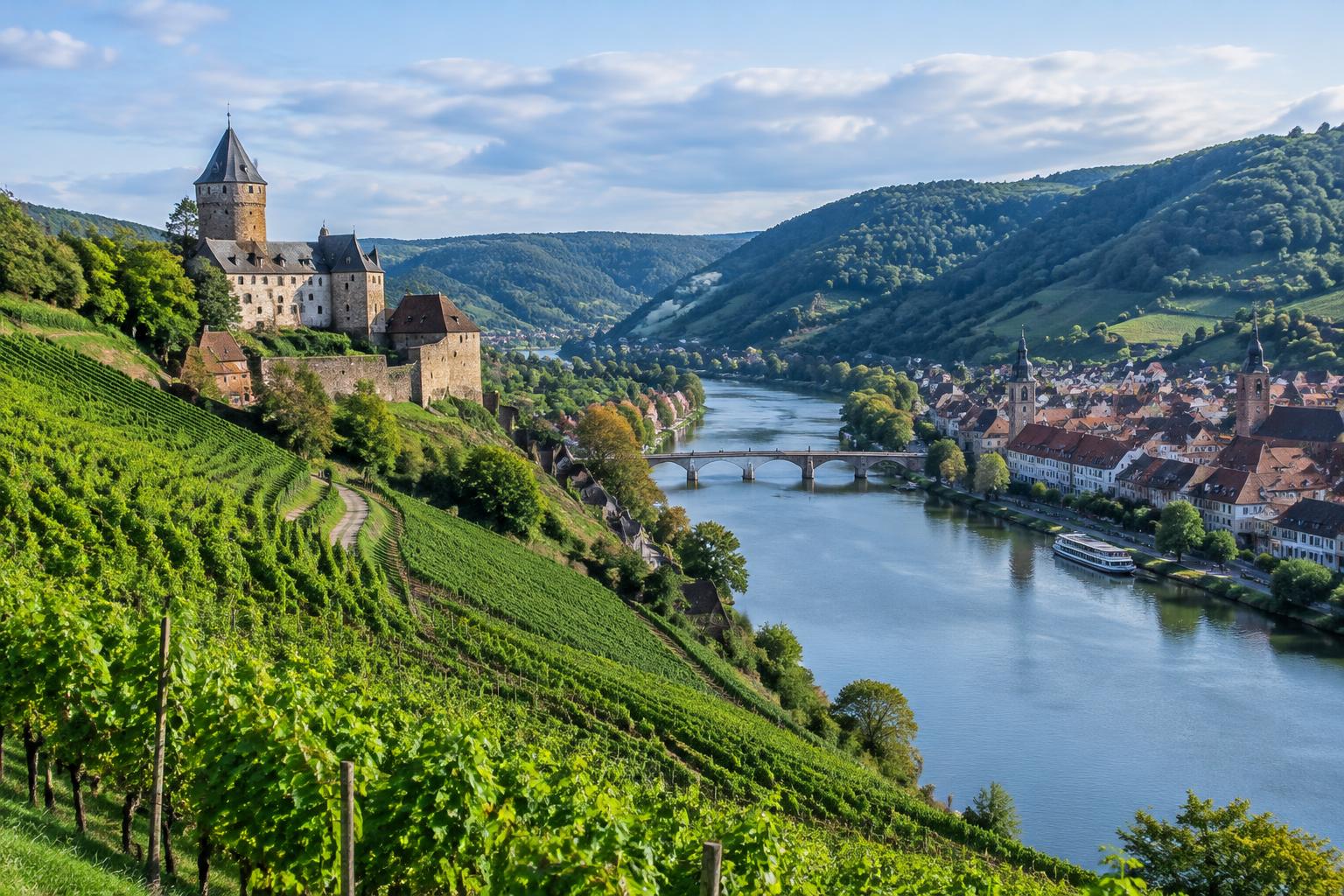
Offenburg is the main regional centre of the Ortenau, between the Black Forest and the Rhine, half an hour from Strasbourg. The city's population has grown by around 5,000 in ten years, and significantly more people commute into it each day than commute out. The unemployment rate in the Ortenau district is 4.1%.
Offenburg is of interest to property investors because resale flats built between the 1950s and 1970s still cost around €2,200/m² on average. At the same time, the rent brake [Mietpreisbremse] and a 15% cap on rent increases [Kappungsgrenze] apply, and the new rent index makes substantial downward adjustments for older buildings. We set out both sides and work through the figures for an existing flat and a new-build flat.
01Offenburg in figures
All the figures used in our assessment, with sources and dates.
| Indicator | Value | Source, date |
|---|---|---|
| Residents (official) | 63,437 | Federal Statistical Office, municipal directory, 31.12.2025 |
| Residents in 2015 (based on the 2011 census) | 58,465 | Federal Statistical Office, 31.12.2015 |
| Households | 29,327 | 2022 census |
| Share of single-person households | 40.8% | 2022 census |
| Housing stock | 30,765 | 2022 census |
| Vacancy rate | 3.3% | 2022 census, reference date 15.05.2022 |
| Share of rented homes | 57.4% | 2022 census, our own calculation |
| Employees subject to social security contributions, by workplace | 43,653 | Federal Employment Agency, 30.06.2025 |
| Inbound / outbound commuters | 29,213 / 11,868 | Federal Employment Agency, 30.06.2025 |
| Unemployment rate, Ortenau district | 4.1% | Federal Employment Agency via Deutschlandatlas, 2025 annual average (district figure) |
| Average rent under existing tenancy agreements | €7.04/m² | 2022 census |
| Rent index, base rent for 65 m² | €7.82/m² | Qualified rent index 2026 |
| Asking rent, Ortenau district | €10.66/m² | BBSR via Deutschlandatlas, 2025 (district figure) |
| Purchase price of resale flats, built 1950–1977 | €2,181/m² | Offenburg-Kinzigtal property valuation committee [Gutachterausschuss], 2025 (131 transactions) |
| Purchase price of flats built from 2020 onwards | €4,662/m² | Offenburg-Kinzigtal property valuation committee, 2025 (55 transactions) |
| Rent brake | yes, until 31.12.2026 | Baden-Württemberg rent limitation ordinance |
| Cap on rent increases | 15%, until 31.12.2026 | Baden-Württemberg rent increase cap ordinance |
| Property transfer tax [Grunderwerbsteuer], Baden-Württemberg | 5.0% | Baden-Württemberg state law |
02Population and demand
At the end of 2025, Offenburg had 63,437 residents, around 5,000 more than at the end of 2015. The census means the comparison is not entirely exact, but growth is nevertheless clear and continuing: around 440 residents were added in 2025 alone. The Ortenau district gains residents through moves both within Germany and from abroad.
The State Statistical Office does not make a separate forecast for Offenburg freely available. For Baden-Württemberg, it expects all 44 urban and rural districts to grow by 2045, by between 3.1 and 5.5% depending on the district.
For landlords, the structure matters. At the 2022 census, 57.4% of homes were rented, and 40.8% of households consist of one person. There has also been considerable recent construction: around 1,800 homes, just under 6% of the stock, were built from 2016 onwards.
03Economy and labour market
Offenburg is an employment centre for the whole Ortenau region. On 30.06.2025, 43,653 employees subject to social security contributions worked in the city, while 26,290 lived there. Well over 29,000 people commute in and just under 12,000 commute out. The city is home to the publishing group Hubert Burda Media, alongside retail and wholesale trade, logistics, industry and the Ortenau district administration. Offenburg University of Applied Sciences generates additional demand for small flats.
The Ortenau district's unemployment rate averaged 4.1% in 2025. Offenburg is on the A5 motorway and the Rhine Valley railway, with long-distance train services stopping in the city. Strasbourg is around 30 minutes away by car. Many commuters live in the surrounding area; some would live closer to work if suitable homes were available.
04Rents, purchase prices and rental yields
Offenburg has a qualified rent index, updated using the consumer price index with effect from 01.06.2026 and valid until 31.05.2028. It uses a base rent according to size (€7.98/m² for 45 m², €7.82/m² for 65 m²), with percentage additions and deductions. The most important are:
Asking rents are higher: according to BBSR, rents for re-let homes in the Ortenau district were €10.66/m² in 2025; no city-level figure is available. Under existing tenancy agreements, Offenburg tenants paid an average of €7.04/m² at the 2022 census.
The purchase prices come from the 2025 annual report of the joint Offenburg-Kinzigtal property valuation committee. It covers Offenburg and the municipalities of the Kinzig valley; the report does not publish separate city figures. In 2025, individually owned flats [Eigentumswohnungen] cost the following on average:
The purchase price and rent determine the price-to-rent ratio [Kaufpreisfaktor]; its reciprocal is the gross rental yield.
The district's asking rent is not achievable for the example flat from the 1960s in Offenburg unless an exemption from the rent brake applies: the rent brake limits the rent under a new tenancy to 10% above the local comparable rent [ortsübliche Vergleichsmiete], or around €8.72/m² in our example. Check your own figures with the rental yield calculator.
05Overview of Offenburg's neighbourhoods
Official purchase prices by neighbourhood are not available for Offenburg. However, the rent index divides the city into three residential location zones: zone 1 is the standard category, zone 2 receives a 10% addition and zone 3 an 11% addition. There is also +4% for flats within a walking distance of no more than 500 metres from the city centre, +5% for locations at least 180 metres above the German Normalnull elevation datum, i.e. on the hillsides, and −3% for railway noise. Each address is classified in the street directory.
| Area | Character | More suitable for |
|---|---|---|
| Innenstadt | Historic centre with a pedestrian zone and railway station, short distances | Single people, students, commuters |
| Nordweststadt, Uffhofen | Dense residential areas with blocks of flats, close to railway lines and commercial premises | Working tenants, budget-conscious renters |
| Oststadt, Albersbösch | Established, quieter residential neighbourhoods with a mixed housing stock | Couples, families |
| Zell-Weierbach, Fessenbach, Rammersweier | Districts on vineyard slopes, higher elevations | Families, longer tenancies |
| Bühl, Weier, Bohlsbach, Elgersweier, Zunsweier | Districts on the plain with their own centres | Families, commuters with cars |
For a 74 m² flat, zone and location additions can easily amount to €50 to €100 in monthly rent. Check the address classification before using a rental figure in your calculations.
06Rules for landlords in Offenburg
Offenburg is included in Baden-Württemberg's rent limitation ordinance and rent increase cap ordinance. Both apply until 31.12.2026. In September 2026, the state government submitted draft extensions from 2027 for consultation. Whether Offenburg remains covered will only be certain once the ordinances are promulgated.
- Rent brake: For a new tenancy, the rent must not exceed the local comparable rent by more than 10%. Exemptions apply, among other cases, to homes first occupied and let after 01.10.2014 and to comprehensively modernised homes.
- Cap on rent increases of 15%: Under an existing tenancy agreement, the rent may rise by no more than 15% over three years, and only up to the local comparable rent.
- Qualified rent index: You must cite its figures with every rent increase. The range extends from −15 to +16% around the calculated figure.
When buying in Baden-Württemberg, you pay 5.0% property transfer tax. Notary and land registry fees are added, as well as estate agent fees depending on the property. At a purchase price of €161,394, ancillary purchase costs [Kaufnebenkosten] excluding an estate agent are around 6.9%. The purchase costs calculator works out your own costs, while our article on notary fees explains the individual notarial charges.
07Worked example: a tenanted flat in Offenburg
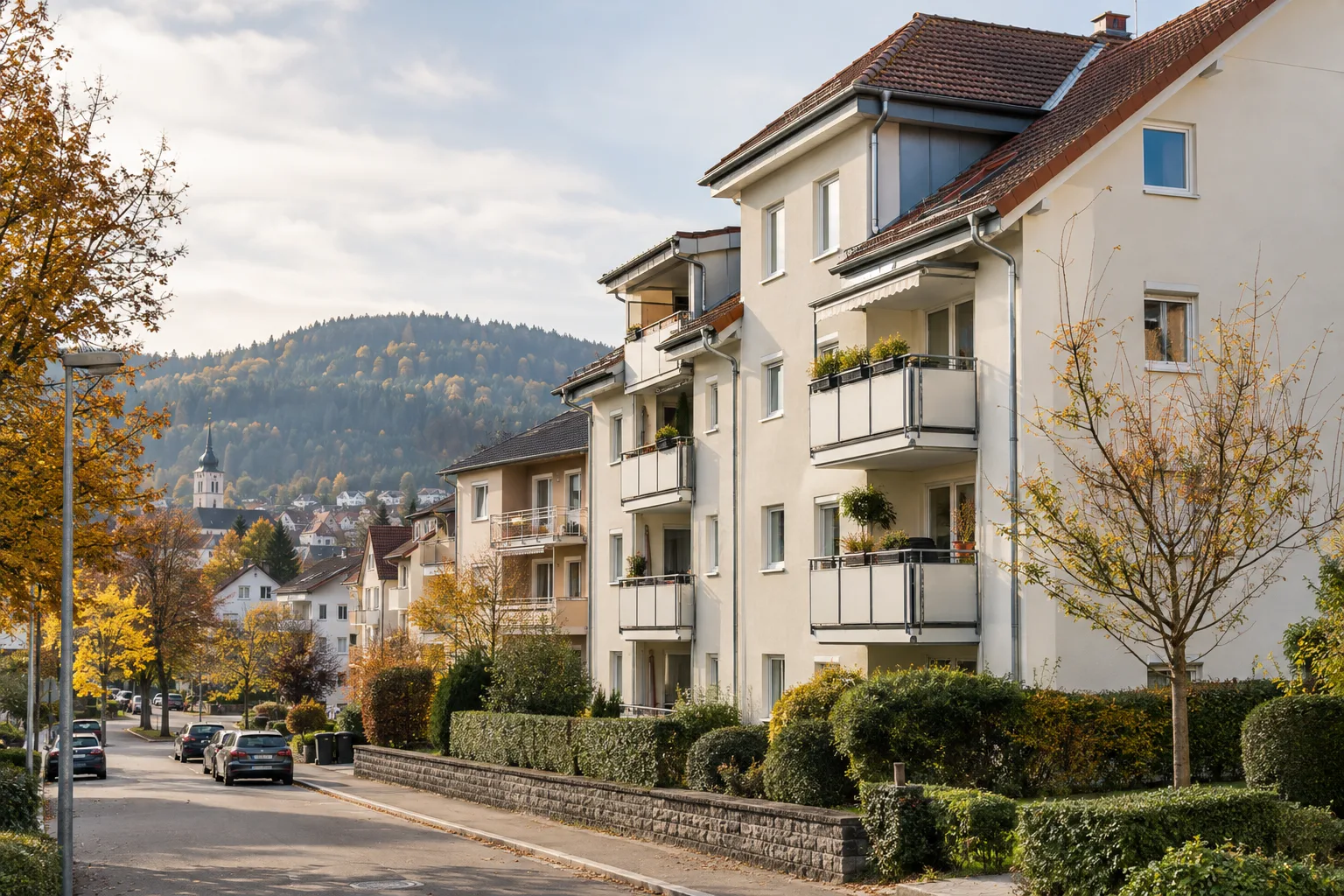
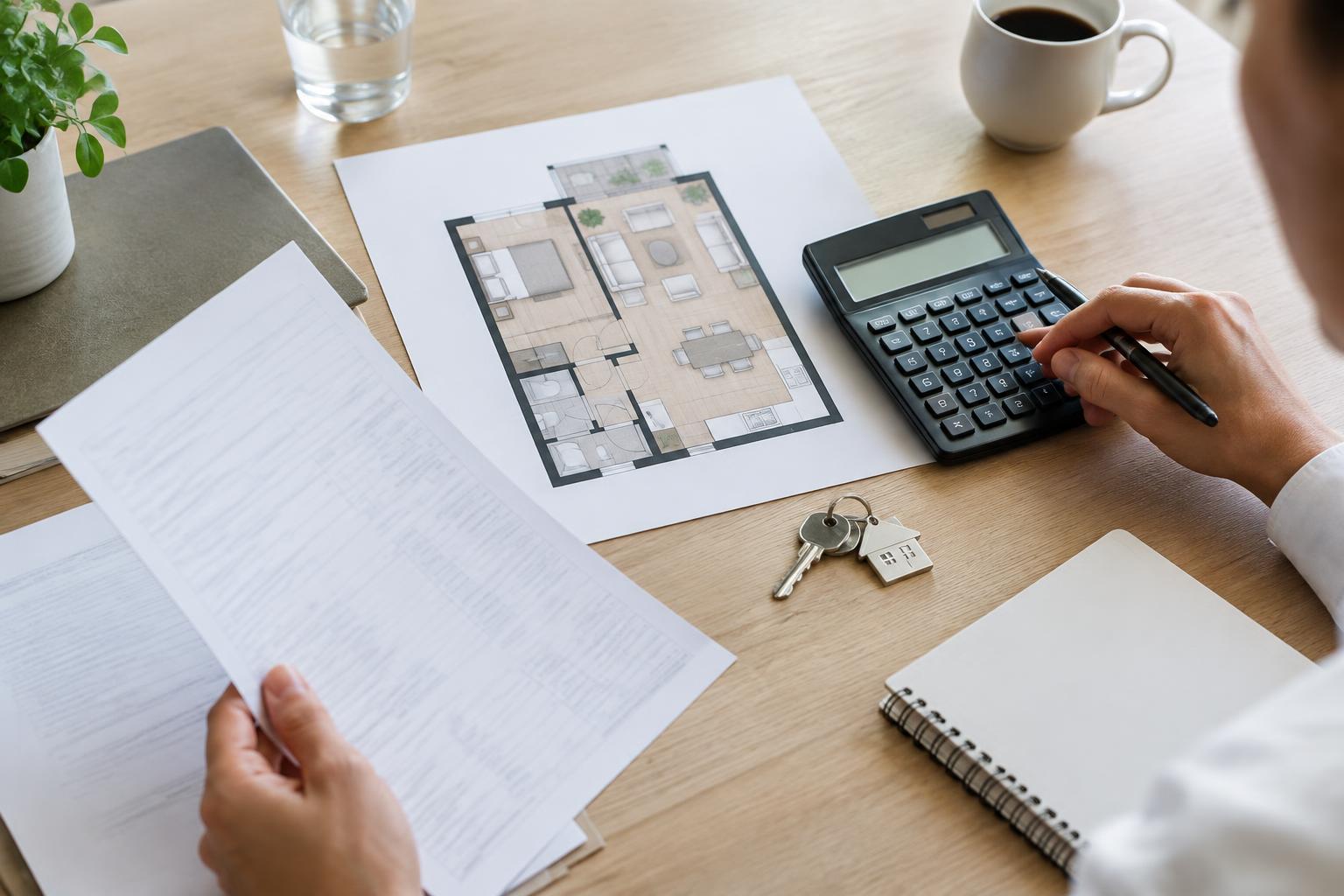
Take Lukas, 36, single, an industrial engineer with taxable income of €60,000. He buys a tenanted 74 m² flat, built in 1968, for €161,394. This matches the 2025 average price for flats built between 1950 and 1977 (€2,181/m²). The rent of €7.93/m² is the rent-index figure for this flat in zone 1 with a fitted kitchen: base rent €7.85/m², −11% for the year of construction and +12% for the kitchen. The name is fictitious; the figures are a worked example, not a forecast.
| Purchase price (74 m² × €2,181/m²) | €161,394 |
|---|---|
| Property transfer tax, Baden-Württemberg, 5.0% | €8,070 |
| Notary and land registry (with a land charge [Grundschuld] of €161,394) | €3,027 |
| Ancillary purchase costs funded from equity | €11,097 |
| Loan (purchase price) | €161,394 |
| Interest 3.8% and principal repayment [Tilgung] 1.5% (assumption) | €8,554 per year |
| per year | per month | |
|---|---|---|
| Net rent excluding service charges (€7.93/m², rent index 2026) | €7,042 | €587 |
| Interest | −€6,133 | −€511 |
| Principal repayment | −€2,421 | −€202 |
| Non-recoverable costs [nicht umlagefähige Kosten] (management, reserve fund, assumption) | −€1,500 | −€125 |
| Cash flow before tax | −€3,012 | −€251 |
| Depreciation [Abschreibung] of 2% on the building component (80%, assumption) | €2,745 | €229 |
| Rental loss (rent − interest − costs − depreciation) | −€3,336 | −€278 |
| Tax saving (2026 tax scale, excluding church tax) | +€1,268 | +€106 |
| Cash flow after tax | −€1,744 | −€145 |
Lukas contributes around €145 a month after tax. Principal repayment accounts for €202 a month; without it, there would be a surplus of around €56. In this example, the rent therefore covers interest and costs, provided the flat is let and no major refurbishment is required.
In a building from the 1960s, the roof, windows and heating system are often due for replacement or have already been renewed. External wall insulation installed since 2002 adds +7% under the rent index, while a comprehensive refurbishment [Kernsanierung] adds +13%. Ask about the refurbishment status and the maintenance reserve [Rücklage]. Our article on tax on rental income explains how rental income is taxed.
For comparison: a new-build flat in Offenburg
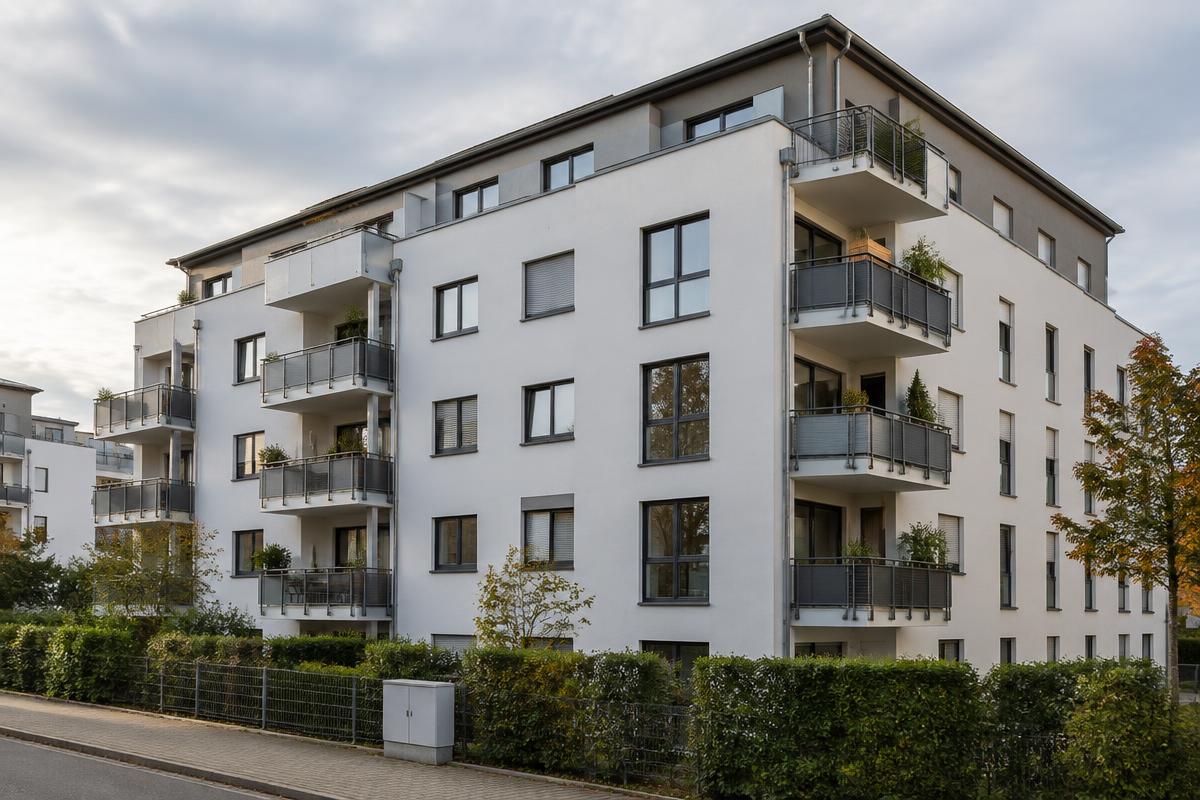
Flats built from 2020 onwards cost an average of €4,662/m² in 2025, with an average size of 72 m². For Lukas, we calculate a 45 m² flat at this price. We assume a rent of €11.01/m²: the base rent for 45 m² (€7.98/m²), with additions for construction between 2016 and 2023 (+23%), a fitted kitchen (+12%) and a flat without thresholds (+3%). Homes first occupied and let after 01.10.2014 are permanently exempt from the rent brake (§ 556f of the German Civil Code, BGB).
| per year | per month | |
|---|---|---|
| Net rent excluding service charges (€11.01/m², rent index 2026 with additions) | €5,945 | €495 |
| Interest 3.8% | −€7,972 | −€664 |
| Principal repayment 1.5% | −€3,147 | −€262 |
| Non-recoverable costs (assumption) | −€648 | −€54 |
| Cash flow before tax | −€5,821 | −€485 |
| Declining-balance depreciation [degressive Abschreibung] of 5% on the building component (80%) | €8,916 | €743 |
| Tax saving (2026 tax scale) | +€4,240 | +€353 |
| Cash flow after tax | −€1,581 | −€132 |
Before tax, the new build requires almost twice the monthly contribution at −€485 compared with the existing flat (−€251); after tax, it is slightly lower at −€132 (−€145). This is due to declining-balance depreciation. At 2.8%, the gross yield is significantly lower than for the existing flat (4.4%). In return, the new build is not subject to the rent brake, and repairs are usually minimal in the early years. As depreciation decreases each year, the tax benefit declines over time.
An additional special depreciation allowance [Sonderabschreibung] under § 7b EStG may be available if, among other requirements, the property meets the Efficiency House 40 [Effizienzhaus 40] standard with QNG certification, construction costs do not exceed €5,200 per m² and no more than €4,000 per m² is used as the assessment basis. It is not included in our calculation. Read more in our article on special and declining-balance depreciation, and calculate your own depreciation using the depreciation calculator.
08Opportunities and risks in Offenburg
There are verifiable factors in Offenburg's favour: clear growth, a large net inflow of commuters, low vacancy, low unemployment and a price level for older flats at which rent covers interest and costs in our worked example.
The counterpoints are equally clear:
- Rent brake and 15% cap on rent increases: There is limited scope to increase rents.
- Rent-index deductions for older buildings: −11 to −16% for flats built between 1949 and 1983.
- Refurbishment needs: Many affordable flats date from the 1950s to the 1970s.
- Expensive new builds: above €4,600/m², with gross yields below 3%.
- Changing regulation: The state ordinances expire at the end of 2026; their extension has not yet been promulgated.
- You are looking for a growing location with a strong labour market.
- You calculate the rent-index rent for the specific flat before buying.
- You check the refurbishment status and maintenance reserve for older flats.
- You have a reserve for special levies [Sonderumlagen].
- You base your calculations on asking rents from across the district.
- You want a flat that requires no attention from you.
- You cannot afford a monthly cash contribution.
- You depend on a particular increase in property value.
Our article on buying a flat as an investment covers the general advantages and disadvantages of this type of property investment.
09More locations
More cities in Baden-Württemberg: Overview of Baden-Württemberg · Albstadt · Esslingen am Neckar · Freiburg im Breisgau · Friedrichshafen · Göppingen · Heidelberg · Heilbronn · Karlsruhe · Konstanz · Ludwigsburg · Mannheim · Pforzheim · Ravensburg · Reutlingen · Stuttgart · Tübingen · Ulm
Compare all locations: Where is property investment worthwhile? City comparison 2026 · Which federal state is suitable? All 16 compared
FAQFrequently asked questions
Is a flat in Offenburg worthwhile as an investment?
In our example of a resale flat built between 1950 and 1977, the rent-index rent covers interest and costs. You contribute around €145 a month after tax, while €202 goes towards principal repayment. New builds are considerably more expensive, and their financial viability depends primarily on depreciation allowances.
What rental yields are available in Offenburg?
Gross yields are around 4.4% for a flat from the 1960s at the rent-index rent with a fitted kitchen, rising to 4.8% at the rent brake limit. New builds yield around 2.8%.
How much does a flat cost in Offenburg?
In 2025, prices in the Offenburg-Kinzigtal area ranged from €2,181/m² for flats built between 1950 and 1977 to €4,662/m² for those built from 2020 onwards. Flats built between 1991 and 2019 cost €3,081/m².
Does the rent brake apply in Offenburg?
Yes, until 31.12.2026 under Baden-Württemberg's rent limitation ordinance. A 15% cap on rent increases also applies. An extension from 2027 has been drafted but has not yet been promulgated.
Does Offenburg have a rent index?
Yes, it has a qualified rent index, updated with effect from 01.06.2026 and valid until 31.05.2028. The city also provides a free online calculator.
Which Offenburg neighbourhoods are of interest to property investors?
The city centre and nearby neighbourhoods are suitable for small flats, while families may prefer districts on the vineyard slopes, such as Zell-Weierbach or Fessenbach. The rent index provides additions for zones 2 and 3 and for hillside locations.
How high are ancillary purchase costs in Offenburg?
Baden-Württemberg charges 5.0% property transfer tax, with notary and land registry fees adding just under 2%. On a purchase price of €161,394, costs excluding an estate agent are around €11,100, or 6.9%.
10Further reading
- Buying a flat as an investment: advantages and disadvantages
- Tax on rental income
- Notary fees when buying property
- Special and declining-balance depreciation
- Rental yield calculator
- Purchase costs calculator
- Property transfer tax in Baden-Württemberg
11Sources
All sources accessed on 19.10.2026.
- Joint Offenburg-Kinzigtal property valuation committee, annual report 2025, Figure 6 (individual flat ownership)
- City of Offenburg, qualified rent index 2026, valid from 01.06.2026 to 31.05.2028, Tables 1 to 3
- Baden-Württemberg State Statistical Office, regionalised population projection to 2045, 06.05.2025
- Federal Statistical Office, municipal directory, municipalities as at 31.12.2015 and 31.12.2025
- Federal and state statistical offices, 2022 census (reference date 15.05.2022): regional table of buildings and dwellings and regional table of households
- Federal Employment Agency, municipal data on employees subject to social security contributions by place of residence and workplace, reference date 30.06.2025
- BBSR and Federal Employment Agency via Deutschlandatlas data tables (Ortenau district: asking rents 2025, unemployment rate 2025, net migration 2024; as at 25.09.2026)
- State of Baden-Württemberg, rent limitation ordinance (State Law Gazette 2025 No. 144) and rent increase cap ordinance (State Law Gazette 2025 No. 145), both valid from 01.01.2026 to 31.12.2026
- Baden-Württemberg property transfer tax 5.0%, Act of 26.10.2011 (State Law Gazette, p. 493)
- § 556d BGB, § 556f BGB, § 558 BGB, § 558d BGB, § 32a EStG (2026 tax scale), § 7 EStG (subsections 4 and 5a), § 7b EStG, § 34 GNotKG (Table B)
- All worked examples, price-to-rent ratios and yields: our own calculations, as at 19.10.2026
Please note: This page provides general information and does not constitute investment, tax or legal advice. All figures are either illustrative calculations with disclosed assumptions or official figures with their reference dates stated. Information as at 19.10.2026.
Writes about Financing and calculations, Taxes and Care properties.
Michael combines his experience as a banker and former portfolio manager at a family office with his practice as a property investor himself. He writes about robust calculations, financing, risks and strategic portfolio building.
This guide does not replace tax or legal advice. All figures are example calculations with disclosed assumptions.