Investment Property in Solingen: Figures, Locations and an Honest Calculation
Between Düsseldorf, Köln and Wuppertal, with purchase prices starting at around €1,900/m² and no rent brake. We have compiled the official figures for Solingen and worked through an honest calculation for a tenanted flat.
 Romolo Marini
Investment Advisor at InvestImmo
Anyone looking for a flat as an investment in Düsseldorf or Köln will soon encounter purchase prices at which the numbers barely stack up. Solingen is 25 kilometres away and costs a fraction of the price. Others have noticed this too: in 2025, almost one in three buyers of property in Solingen came from outside the city.
Whether that makes Solingen a good choice depends on more than the price per square metre. The city is a residential base for commuters, its industry is under pressure, and the state population forecast projects a slight long-term decline.
We have compiled the official figures and, at the end, run through the numbers for an existing flat and a new-build flat, including the monthly cash contribution required.
01Solingen in figures
All the figures we use for our assessment, with sources and reference dates.
| Indicator | Value | Source, reference date |
|---|---|---|
| Population (official) | 164,621 | Statistisches Bundesamt, register of municipalities, 31.12.2025 |
| Population on 31.12.2015 | 158,726 | Statistisches Bundesamt, based on the 2011 Census |
| Change 2015–2025 | +3.7% | Own calculation, census basis changed |
| Forecast 2023–2050 | −5.1% | IT.NRW, population projection 2024–2050 |
| Households | 79,045 | 2022 Census |
| Share of single-person households | 42.7% | 2022 Census |
| Housing stock | 83,726 | 2022 Census |
| Vacancy rate | 3.8% | 2022 Census, reference date 15.05.2022 |
| Share of rented dwellings | 60.8% | 2022 Census |
| Employees subject to social security contributions working in the city | 51,870 | Bundesagentur für Arbeit, 30.06.2025 |
| Inbound / outbound commuters | 19,680 / 32,214 | Bundesagentur für Arbeit, 30.06.2025 |
| Unemployment rate | 9.0% | Bergische IHK, August 2026 |
| Average net rent excluding service charges in apartment buildings sold | €7.20/m² | Gutachterausschuss Solingen, 2025 |
| Average net rent excluding service charges across all rented dwellings | €6.38/m² | 2022 Census |
| Asking rent | €9.03/m² | BBSR via Deutschlandatlas, 2025 |
| Purchase price of resale flat built up to 1969 | €1,870/m² | Gutachterausschuss Solingen, 2025 |
| Purchase price of resale flat built in 1970–1979 | €2,110/m² | Gutachterausschuss Solingen, 2025 |
| Purchase price of new build (first occupancy) | €4,430/m² | Gutachterausschuss Solingen, 2025 |
| Resale flats sold | 517 | Gutachterausschuss Solingen, 2025 |
| Cap on rents for new lettings | No | North Rhine-Westphalia Tenant Protection Ordinance, Solingen not included |
| Cap on rent increases for existing tenancies | 20% | Section 558(3) BGB |
| Property transfer tax in North Rhine-Westphalia | 6.5% | Since 01.01.2015 |
02Population and demand
At the end of 2025, Solingen had 164,621 residents, around 1,000 fewer than a year earlier. Over ten years, however, the population has grown: at the end of 2015 it stood at 158,726, an increase of 3.7%. The comparison is slightly imperfect because the older figure is still based on the 2011 Census.
Looking ahead, the state statistical office IT.NRW expects a slight decline. By 2050, Solingen's population is projected to fall to around 157,600, 5.1% fewer than in 2023. Without inward migration, the decline would be considerably greater: deaths exceed births by an amount equivalent to 14.5% of the population, with net migration gains offsetting 9.4 percentage points of this.
Some of this inward migration comes from the Rhine corridor. According to the Gutachterausschuss, around 30% of property buyers in 2025 lived outside Solingen, almost two-thirds of them in Köln or Düsseldorf. Solingen therefore benefits from housing becoming more expensive in its large neighbouring cities.
Households are slightly larger than in major cities. Single-person households account for 42.7%, almost exactly the national average. Solingen is more a city for couples and families than for students; it has no higher education institution of its own.
03Economy and labour market
Solingen has been the city of blades for centuries. Cutlery, metalworking and automotive suppliers continue to shape its economy today. Retail, services and the Städtische Klinikum also contribute.
On 30.06.2025, 51,870 employees subject to social security contributions worked in Solingen. At the same time, 64,382 Solingen residents held such jobs, a considerably higher number. A total of 32,214 people commuted out of the city for work, while only 19,680 commuted in. Solingen is therefore primarily a residential base. Many people work in Düsseldorf, Köln, Wuppertal or Leverkusen.
According to Bergische IHK, the unemployment rate in August 2026 was 9.0%, compared with a state average of 8.0%. The annual average for 2025 was 8.5%. For landlords, this means that demand depends less on jobs in Solingen than on access to neighbouring cities. Some tenants, however, have tight budgets.
Industry is under pressure, as in many cities with automotive suppliers. Letting property in Solingen therefore means relying more on commuters than on growth in the local economy.
04Rents, purchase prices and rental yields
Solingen has a 2024 rent index, which the Gutachterausschuss also uses. As a guide to rents under existing tenancies, the property market report gives the average net rent excluding service charges in apartment buildings sold in 2025: €7.20/m². In the 2022 Census, the average rent across all rented dwellings was €6.38/m². New listings in 2025 had an average asking rent of €9.03/m².
Good data is available on purchase prices. In 2025, the Gutachterausschuss analysed exactly 517 resale flats, considerably more than in the previous year. Prices rise with the year of construction: €1,870/m² for properties built up to 1969, €2,110/m² for those built in the 1970s, €2,590/m² for those built in the 1990s and €3,720/m² for those built from 2010 onwards. New-build flats for first occupancy cost an average of €4,430/m².
The purchase price and rent determine the purchase price-to-rent multiple; its reciprocal is the gross rental yield. We have calculated both for a flat built in the 1970s using three rent assumptions.
With a typical rent under an existing tenancy, the gross yield is around 4%. Only a rent at the level of current asking rents takes it above 5%. For a new letting, this is permitted in Solingen; under an ongoing tenancy, getting there takes years. Check your own figures with the rental yield calculator.
05Overview of city districts
Solingen is divided into five city districts, which developed from formerly independent towns. The Gutachterausschuss publishes prices by district as standard property values on BORIS.NRW, not in the report. We therefore describe their character.
| City district | Character | More suitable for |
|---|---|---|
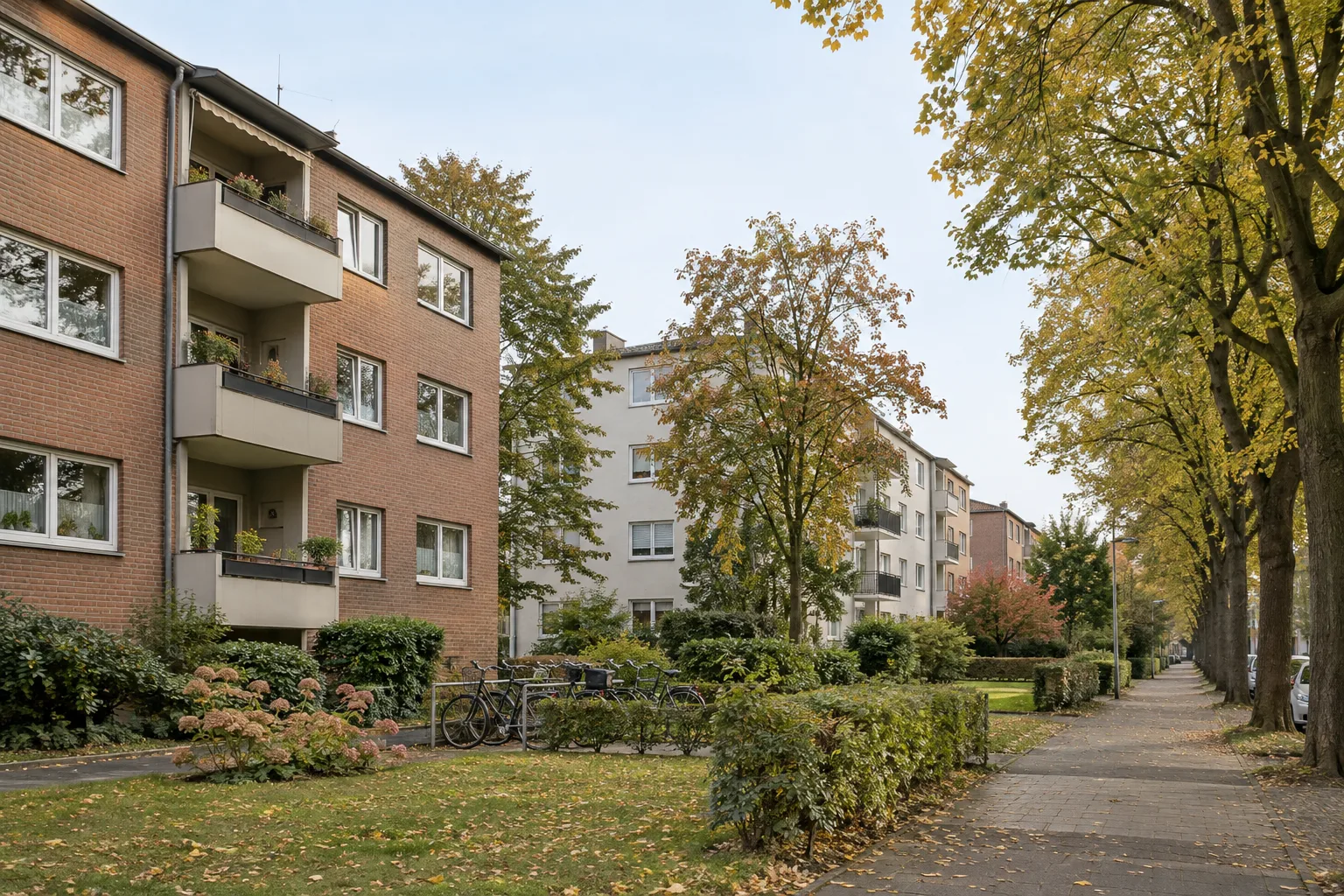
| Solingen-Mitte | City centre with shopping streets, administrative offices and extensive post-war development | Single people, small flats; check condition |
| Ohligs, Aufderhöhe, Merscheid | Western part of the city, with the main railway station in Ohligs and rail connections to Düsseldorf and Köln | Commuters, couples |
| Wald | West of the centre, established residential neighbourhoods with period properties and apartment buildings | Families and working professionals |
| Gräfrath | Historic centre in the north, quiet and green | Couples and families |
| Burg und Höhscheid | Southern area on the Wupper, partly rural, around Schloss Burg | Families, small rental market |
Rail connections are a genuine location criterion in Solingen. Flats within easy reach of the main railway station or S-Bahn stops are easier to let to commuters than properties on the outskirts.
06Rules for landlords in Solingen
Solingen is not subject to a rent brake. Since 2025, the NRW Tenant Protection Ordinance has covered 57 municipalities, including Düsseldorf, Köln, Leverkusen and Langenfeld, but not Solingen. The reduced rent increase cap of 15% does not apply here either.
This gives rise to two rules. For a new tenancy, the rent can be freely agreed, subject only to the prohibitions on excessive rents and rent usury. For an existing tenancy, the rent may rise by no more than 20% over three years and must never exceed the local comparable rent according to the rent index.
When buying in North Rhine-Westphalia, you pay 6.5% property transfer tax, one of the highest rates in Germany. On top of this, notary and land registry fees amount to around 2% of the purchase price if you use financing, plus estate agent fees depending on the property. Work out your purchase costs with the purchase costs calculator; our article on notary fees explains the individual notarial charges.
07Worked example: a tenanted flat in Solingen
Take Thomas, 42, single, employed in Düsseldorf with a taxable income of €60,000. He buys a tenanted 60 m² flat built in 1975 in Ohligs. The purchase price of €126,600 matches the average established by the Gutachterausschuss for flats from the 1970s in 2025. The rent of €7.20/m² matches the average existing rent in the blocks of flats sold in 2025. The name is fictional, and the figures are a worked example, not a forecast.
| Purchase price (60 m² × €2,110/m²) | €126,600 |
|---|---|
| Property transfer tax in North Rhine-Westphalia, 6.5% | €8,229 |
| Notary and land registry (with a land charge of €126,600) | €2,616 |
| Purchase costs paid from equity | €10,845 |
| Loan (purchase price) | €126,600 |
| Interest at 3.8% and principal repayment at 1.5% (assumption) | €6,710 per year |
| per year | per month | |
|---|---|---|
| Net rent excluding heating and service charges (€7.20/m²) | €5,184 | €432 |
| Interest | −€4,811 | −€401 |
| Principal repayment | −€1,899 | −€158 |
| Non-recoverable costs (management, reserve fund, assumption) | −€1,200 | −€100 |
| Cash flow before tax | −€2,726 | −€227 |
| Depreciation at 2% on the building component (80%, assumption) | €2,186 | €182 |
| Rental loss (rent − interest − costs − depreciation) | −€3,013 | −€251 |
| Tax saving (2026 tax rates, excluding church tax) | +€1,147 | +€96 |
| Cash flow after tax | −€1,579 | −€132 |
In this example, Thomas contributes around €132 a month after tax. Of this, €158 goes towards principal repayment, and therefore towards his own wealth. Excluding principal repayment, a small surplus of around €27 a month remains. The rent therefore only just covers interest and ongoing costs.
Why is it worth looking at purchase costs? With property transfer tax at 6.5%, Thomas pays around €1,900 more tax in NRW than a buyer in Thuringia or Saxony-Anhalt would at the same price. Our article on taxing rental income explains how rental income is taxed.
Rent and interest have roughly the same impact on the figures. A flat already let at close to the asking rent level can achieve positive cash flow before principal repayment in Solingen.
For comparison: a new-build flat in Solingen
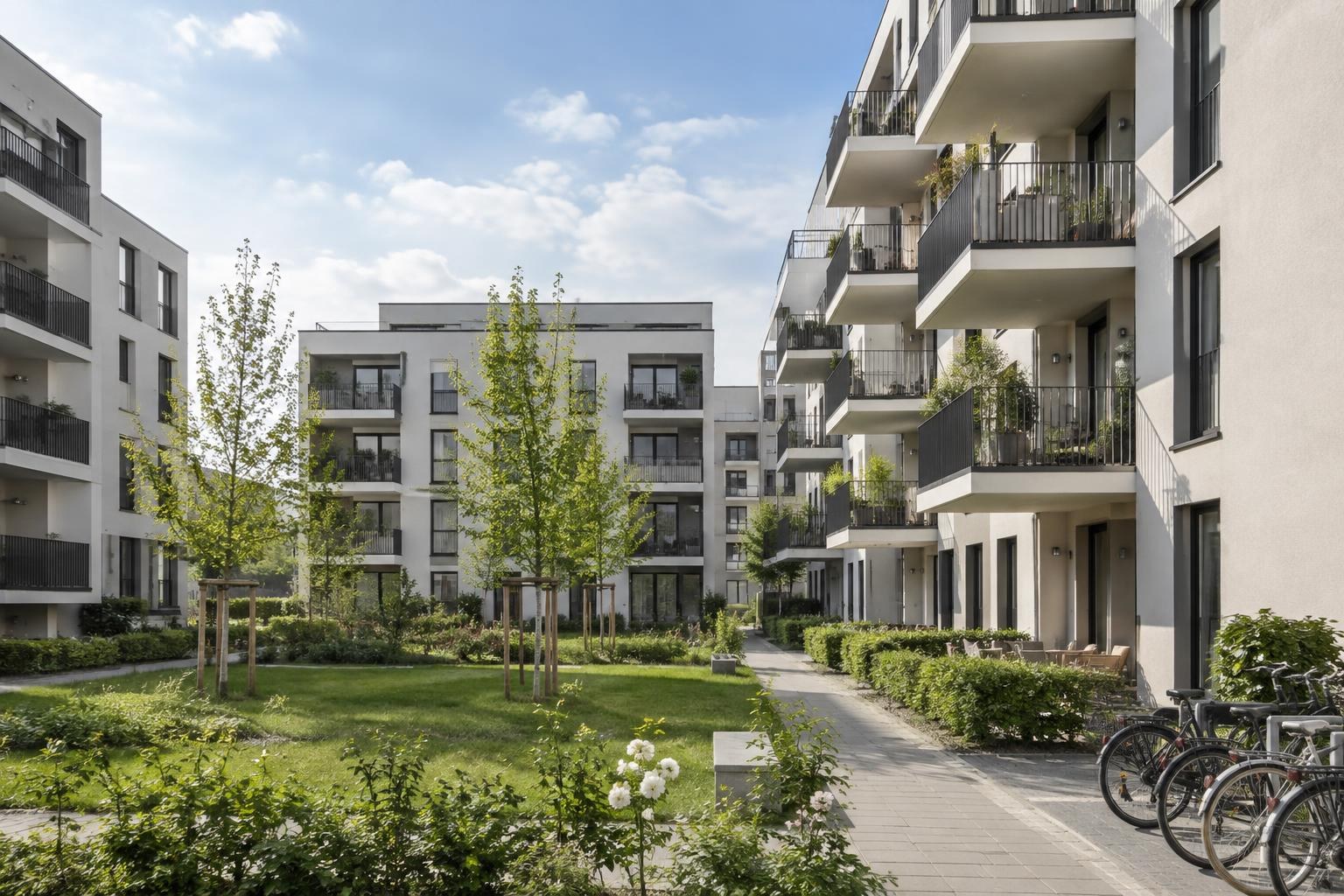
What changes if Thomas buys a newly built 45 m² flat? The Gutachterausschuss established an average of €4,430/m² for first-occupancy properties in 2025, based on 36 sales across eight developments. That gives a purchase price of €199,350. Thomas pays the property transfer tax (€12,958) and notary and land registry fees (€3,438) from equity. We assume a rent of €12.72/m², the average for new listings of flats built from 2016 onwards according to the portal immoportal.com in October 2026. There is no official new-build rental benchmark for Solingen.
| per year | per month | |
|---|---|---|
| Net rent excluding heating and service charges (45 m² × €12.72/m², asking rent) | €6,869 | €572 |
| Interest (3.8% on €199,350) | −€7,575 | −€631 |
| Principal repayment (1.5%) | −€2,990 | −€249 |
| Non-recoverable service charges (€1.20/m², assumption) | −€648 | −€54 |
| Cash flow before tax | −€4,345 | −€362 |
| Declining-balance depreciation at 5% on the building component (80%, assumption) | €8,586 | €716 |
| Rental loss (rent − interest − service charges − depreciation) | −€9,941 | −€828 |
| Tax saving (2026 tax rates, excluding church tax) | +€3,664 | +€305 |
| Cash flow after tax | −€681 | −€57 |
Depreciation in the first year is almost four times as high as for the existing flat (€8,586 rather than €2,186), and maintenance costs are usually minimal in the first few years. However, the price per square metre is more than twice as high, and the gross rental yield falls to around 3.4% rather than 4.1%, even though we are using an asking rent here. Before tax, Thomas contributes around €362 a month; after tax, around €57. The tax saving falls in subsequent years because declining-balance depreciation is calculated on the remaining value. You should check whether €12.72/m² is actually achievable for the specific flat. Solingen has no rent brake; for flats first occupied and let after 1 October 2014, it would in any case be permanently inapplicable under section 556f BGB.
08Opportunities and Risks in Solingen
There are verifiable points in Solingen’s favour. Purchase prices are well below those in Düsseldorf and Köln, the vacancy rate of 3.8% indicates a balanced market, and the population has grown by 3.7% over ten years. Buyer activity reflects demand from the Rhine corridor. There is no cap on rents for new tenancies, and with more than 500 flat sales a year, the market is large enough to support a later sale.
There are equally clear counterpoints:
- Labour market: Unemployment is around 9%, above the state average; industry, including automotive suppliers, is under pressure.
- Commuter city: Demand depends on good connections to Düsseldorf and Köln, rather than on local jobs.
- Long-term forecast: IT.NRW expects the population to fall by around 5% by 2050.
- High purchase costs: Property transfer tax of 6.5% makes buying more expensive than in many other federal states.
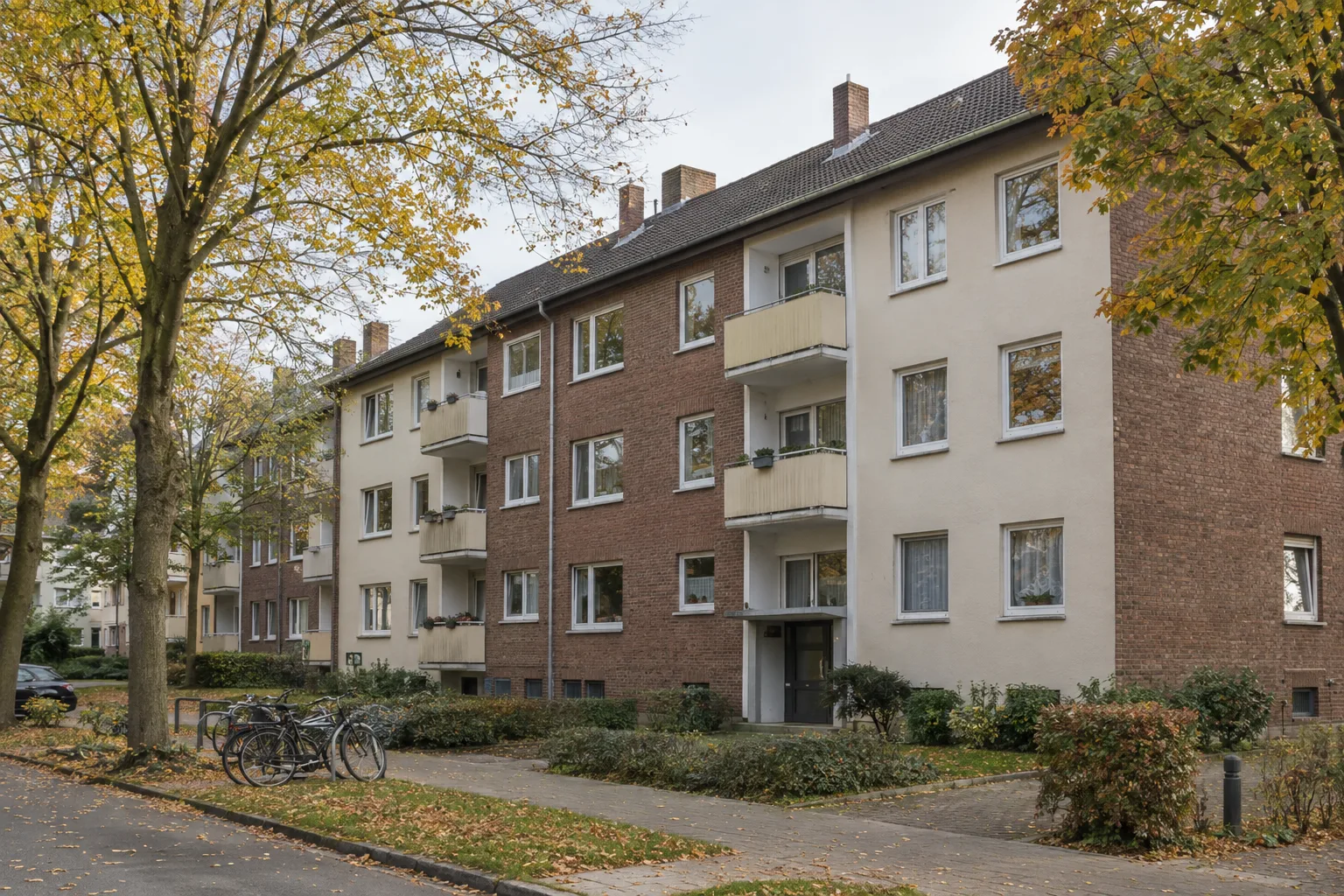
- Older housing stock: Many flats date from the 1950s to the 1970s; refurbishment work can trigger special levies.
- Interest rates and vacancies: A higher refinancing rate increases the monthly top-up required, while every month of vacancy costs the full rental income.
- You can afford a monthly top-up of €100 to €200 over several years.
- You want to let to commuters and pay attention to rail connections.
- You check the tenancy agreement, reserve fund and refurbishment status before buying.
- You take a long-term view and are not banking on rapid price increases.
- You expect positive cash flow after mortgage principal repayments from the first month.
- You are banking on a growing local economy.
- You have no reserve for vacancies or a special levy.
- You depend on a particular level of capital appreciation.
You can read about the general advantages and disadvantages of a flat as an investment in our article Buying a Flat as an Investment.
09Other Locations
Other cities in North Rhine-Westphalia: Overview of North Rhine-Westphalia · Aachen · Bielefeld · Bochum · Bonn · Dortmund · Duisburg · Düsseldorf · Essen · Gelsenkirchen · Hamm · Krefeld · Köln · Leverkusen · Mönchengladbach · Mülheim an der Ruhr · Münster · Neuss · Oberhausen · Paderborn · Recklinghausen · Siegen · Troisdorf · Wuppertal
All locations compared: Where Is Property Investment Worthwhile? Cities Compared in 2026 · Which Federal State Is Suitable? All 16 Compared
FAQFrequently asked questions
Is a flat in Solingen worthwhile as an investment?
That depends on the individual flat. Solingen has moderate purchase prices, a balanced housing market and no rent brake. For a flat built in the 1970s costing €2,110/m², with an existing rent of €7.20/m², the gross rental yield is around 4%. With financing, you will in many cases need to contribute some money yourself.
How much does a flat cost to buy in Solingen?
According to the 2026 Property Market Report, resale flats in 2025 cost between €1,870/m² (built up to 1969) and €3,720/m² (built from 2010 onwards), depending on the year of construction. New-build flats for first occupation cost €4,430/m².
What is the rental yield in Solingen?
Around 3.6% to 5.1% gross for a flat built in the 1970s, depending on whether you calculate using the census rent (€6.38/m²), the existing rent reported by the property valuation committee (€7.20/m²) or the advertised rent (€9.03/m²).
Does Solingen have a rent brake?
No. Solingen is not listed in the North Rhine-Westphalia Tenant Protection Ordinance. For new lettings, the rent can be freely agreed, subject only to the rules against excessive rents and rent usury. For existing tenancies, rent increases are capped at 20% over three years.
Which districts in Solingen are of interest to property investors?
For commuters, Ohligs, with its main railway station, is particularly attractive, as are Wald and the city centre. Gräfrath and Burg are quieter, with smaller rental markets. In every district, pay attention to the journey to the nearest railway station.
How much are the additional purchase costs in Solingen?
Property transfer tax in North Rhine-Westphalia is 6.5%. Notary and land registry fees, including those associated with financing, amount to around 2% of the purchase price. For a purchase price of €126,600 without an estate agent, these costs total around €10,850, or 8.6%.
Does Solingen have a rent index?
Yes. Solingen has a rent index from 2024, which the property valuation committee also uses. It forms the basis for rent increases during an existing tenancy. As a guide to existing rents, the 2026 Property Market Report gives an average net rent excluding heating and service charges of €7.20/m² in the blocks of flats sold in 2025.
How is Solingen's population changing?
At the end of 2025, Solingen had 164,621 residents, 3.7% more than at the end of 2015. The state statistical office IT.NRW forecasts a decline to around 157,600 residents by 2050, 5.1% fewer than in 2023. Without people moving into the city, the decline would be significantly larger.
10Further Reading
- Buying a Flat as an Investment: Advantages and Disadvantages
- Tax on Rental Income
- Notary Fees When Buying Property
- Rental Yield Calculator
- Purchase Costs Calculator
- Property Transfer Tax in North Rhine-Westphalia
11Sources
All sources accessed on 14 October 2026.
- Gutachterausschuss für Grundstückswerte in der Klingenstadt Solingen, Property Market Report 2026 (reporting year 2025, published 20 March 2026), chapters 2.1, 3.4, 5.2.2.1 and 6.1
- IT.NRW on behalf of MWIKE NRW, Population Projections for North Rhine-Westphalia, 2024 to 2050/2070
- Statistische Ämter des Bundes und der Länder, 2022 Census (reference date 15 May 2022): Regional Table: Buildings and Dwellings and Regional Table: Households
- Statistisches Bundesamt, Register of Municipalities, municipalities as at 31 December 2015, 31 December 2024 and 31 December 2025
- BBSR and Bundesagentur für Arbeit via Deutschlandatlas, Data Tables (as at 25 September 2026)
- Bundesagentur für Arbeit, Municipal Data on Employees Subject to Social Insurance Contributions, reference date 30 June 2025
- Bergische IHK, Current Economic Data (unemployment rate, August 2026)
- Landesregierung NRW, NRW Tenant Protection Ordinance (MietSchVO NRW), GV. NRW. 2025 p. 111, amended by GV. NRW. 2025 p. 848
- immoportal.com, Solingen Rent Index, asking rents by year of construction, as at 1 October 2026 (market source)
- Property transfer tax in North Rhine-Westphalia: 6.5%, Act of 25 July 2011 (GV. NRW. p. 389), as amended on 18 December 2014 (GV. NRW. p. 954)
- Section 558 BGB, Section 556d BGB, Section 556f BGB, Section 32a EStG (2026 tax rates), Section 7 EStG (subsections 4 and 5a), Section 7b EStG, Section 34 GNotKG (Table B)
- All illustrative calculations, purchase price-to-rent multiples and yields: own calculations, as at 14 October 2026
Disclaimer: This page provides general information and does not constitute investment, tax or legal advice. All figures are illustrative calculations with disclosed assumptions or official figures with their reference dates stated, as at 14 October 2026.
Writes about Financing and Taxes.
Romolo brings almost 17 years of banking and financing experience, including leading around 145 sales staff, to his work. He writes about financing, taxes and property decisions that fit your life for the long term.
This guide does not replace tax or legal advice. All figures are example calculations with disclosed assumptions.