Buy-to-Let Properties in Hagen: Figures, Locations and an Honest Calculation
Low purchase prices, a qualified Mietspiegel (rent index) and gross yields of around 5%, but also high vacancy rates and a high unemployment rate. We reveal the official figures and run the numbers on a tenanted flat.
 Eduard Winter
Investment Advisor at InvestImmo
Anyone looking for a flat in Hagen will find prices that have not been seen in Cologne or Düsseldorf for years. In 2025, an existing flat cost around €1,535 per square metre on average. This means that the rent in relation to the purchase price is significantly higher than in most major cities.
That is one half of the story. The other half can be found in the census and labour market statistics: a high vacancy rate, many old buildings and an unemployment rate of 12.3%. On this page, we will place both side by side and run the numbers for a tenanted flat using figures from the Gutachterausschuss (Expert Committee for Property Values).
01Hagen in figures
All the values we use for our assessment, with their source and date.
| Metric | Value | Source, as of |
|---|---|---|
| Population (official) | 189,983 | Federal Statistical Office, municipal directory, 31 December 2025 |
| Population 2015 (based on 2011 Census) | 189,044 | Federal Statistical Office, 31 December 2015 |
| Forecast 2023–2050 | −2.6% | IT.NRW, projection 2024 to 2050/2070 |
| Households | 93,614 | Census 2022 |
| Share of single-person households | 46.9% | Census 2022 |
| Housing stock | 101,079 | Census 2022 |
| Vacancy rate | 5.8% | Census 2022, reference date 15 May 2022 |
| Share of rented flats | 67.5% | Census 2022, own calculation |
| Employees subject to social security contributions at place of work | 67,787 | Federal Employment Agency, 30 June 2025 |
| Inbound / Outbound commuters | 29,471 / 33,369 | Federal Employment Agency, 30 June 2025 |
| Unemployment rate | 12.3% | Federal Employment Agency via Deutschlandatlas, 2025 annual average |
| Avg. rent of existing contracts | €5.39/m² | Census 2022 |
| Rent index, built 1949–1977, average fit-out | €6.10/m² | Qualified Rent Index 2025 |
| Asking rent (re-letting) | €7.19/m² | BBSR via Deutschlandatlas, 2025 |
| Purchase price for existing flat (average) | €1,535/m² | Gutachterausschuss Hagen, 2025, own calculation from turnover and area |
| Purchase price for tenanted flat | €1,333/m² | Gutachterausschuss Hagen, 2025 |
| New-build flats sold | 0 | Gutachterausschuss Hagen, 2024 and 2025 |
| Rent brake | no | MietSchVO NRW, municipal list |
| Rent increase cap | 20% | § 558 BGB |
| Property transfer tax North Rhine-Westphalia | 6.5% | State law NRW |
02Population and demand
At the end of 2025, Hagen officially had a population of 189,983, almost exactly the same as ten years earlier (189,044). In the last year, the number fell slightly, by around 400 people. The city is growing only through immigration from abroad. In terms of internal migration within Germany, Hagen is losing residents, with a net loss of around 13 per 10,000 inhabitants in 2024.
IT.NRW forecasts a nearly stable population for Hagen until 2030 and a decline of 2.6% by 2050. This is not a collapse, but it is not a tailwind either. Those who buy in Hagen are buying into a market that is more likely to stagnate in terms of volume.
For landlords, the structure is what counts. At the time of the 2022 census, 67.5% of flats were rented out, while only 28% were owner-occupied. Almost one in two households (46.9%) consists of a single person. This means there is a broad tenant base for small and medium-sized flats.
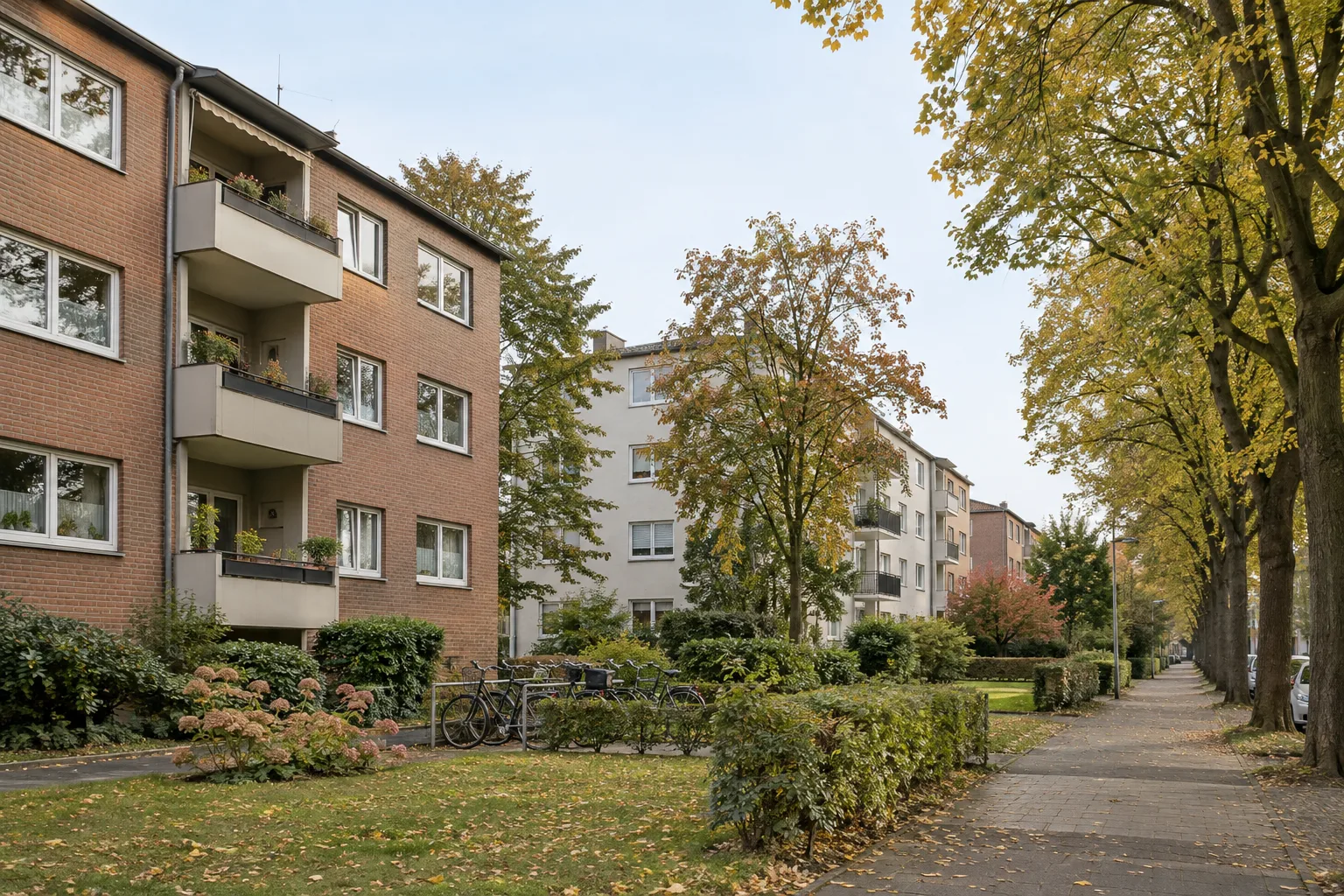
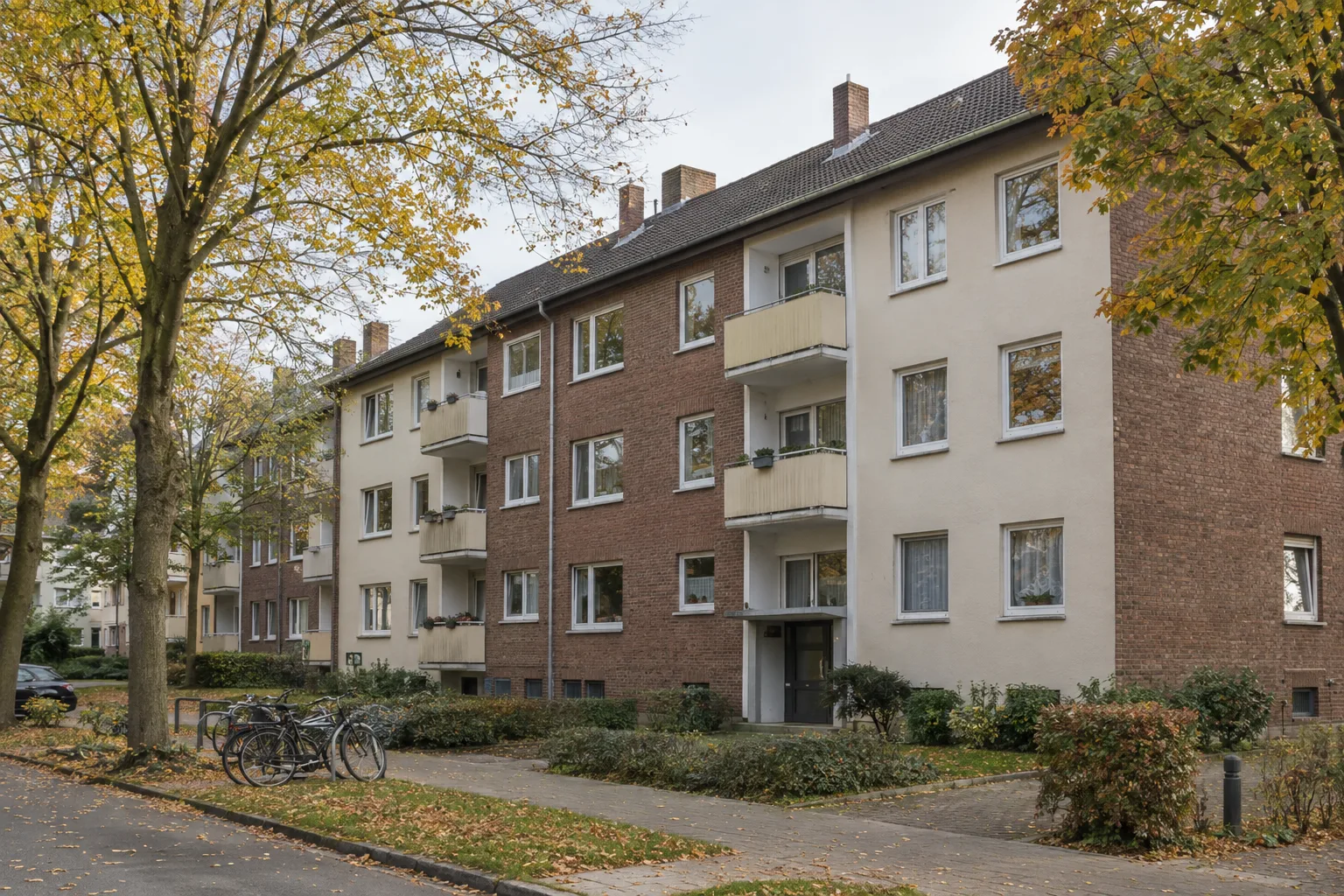
The housing stock is old. Most flats date from the 1950s and 1960s, totalling over 42,000. Little new construction is taking place: according to the Expert Committee for Property Values, there has been practically no new construction of flats for sale since 2023 because the necessary rents would be above the level typical for Hagen.
03Economy and labour market
Hagen is located on the south-eastern edge of the Ruhr area, at the transition to the Sauerland region, and is well connected via the A1 and A45 motorways and the central railway station. On 30 June 2025, there were 67,787 employees subject to social security contributions working in the city, while 71,685 lived there. More people commute out (33,369) than in (29,471). Hagen is therefore a place of residence for many who work in Dortmund, the Ennepe-Ruhr-Kreis or the Märkischer Kreis.
The unemployment rate was 12.3% on average in 2025. This is significantly higher than in the neighbouring Ennepe-Ruhr-Kreis, where it is 7.3%. For landlords, this has two implications: for tenants on social benefits, the Jobcenter only covers rent up to a reasonableness limit, which caps the achievable rent. And loss of rent and tenant turnover are more likely than in cities with low unemployment.
The FernUniversität in Hagen (University of Hagen) is well-known throughout Germany, but its students predominantly learn from home and do not move to Hagen for their studies. You should therefore not factor in any significant demand for student accommodation as seen in traditional university cities.
04Rents, purchase prices and rental yield
Hagen has a qualified Mietspiegel (rent index), created by the Expert Committee for Property Values based on around 9,700 responses, valid from 1 October 2025 to 30 September 2027. For a standard flat between 46 and 119 m² with an average fit-out, the rent is €5.85/m² for buildings constructed up to 1948, €6.10/m² for those built between 1949 and 1977, and €6.35/m² for those built between 1978 and 1994. Small flats up to 45 m² can have a surcharge of up to 8%, while basic residential locations can have a discount of up to 5%.
Asking rents are somewhat higher. The Federal Institute for Research on Building, Urban Affairs and Spatial Development (BBSR) quotes an average of €7.19/m² for newly advertised flats in 2025. In the 2022 census, tenants in existing contracts paid an average of only €5.39/m².
The purchase prices are taken from the Property Market Report 2026 of the Expert Committee for Property Values, meaning they are from actual purchase contracts. In 2025, 465 existing flats were resold for a total of €54.4 million with a living area of 35,441 m². This results in an average of around €1,535/m². Prices rose by an average of around 10% compared to 2024. Flats that were sold while tenanted cost an average of €1,333/m² with an actual rent of €5.96/m².
The purchase price multiplier is derived from the purchase price and the rent; its reciprocal is the gross rental yield.
The yields are higher than in most major German cities. Part of this is the price for the risks we describe below. Check your own figures with the rental yield calculator.
05A look at the city districts
Official rents for each city district are not available for Hagen. The rent index uses a residential location rating for each standard land value zone (Bodenrichtwertzone), which you can look up via the BORIS NRW portal. For a model flat of 85 m² built in 1966, the Expert Committee for Property Values shows how much the location affects the price: €1,370/m² in a basic location, €1,575/m² in a mid-range location and €1,795/m² in a prime location.
| City district | Character | More suitable for |
|---|---|---|
| Hagen-Mitte | City centre with central station, many post-war multi-storey residential buildings, mixed residential locations | Single people, commuters |
| Hagen-Nord | Boele and Vorhalle, residential areas near the A1 and the Ruhr, mix of apartment buildings and single-family houses | Families, professionals |
| Haspe | western district with its own centre and older housing stock | price-conscious tenants |
| Eilpe/Dahl | Valley locations in the south, some with a village feel, Emst with higher-rated residential locations | Couples, families |
| Hohenlimburg | independent district in the east with an old town centre and the Lenne valley | longer tenancies, families |
When buying in Hagen, the individual building is what counts. The difference between a basic and a prime location is around 30% in the price model, and up to 20 percentage points in the rent index. In locations with high long-term vacancy, a flat can become expensive despite a low price.
06Rules for landlords in Hagen
Hagen is not listed in the Tenant Protection Ordinance (Mieterschutzverordnung) of the state of North Rhine-Westphalia. From this follows:
- No Mietpreisbremse (rent brake): When starting a new tenancy, you are not bound by the 10% cap above the local comparable rent. However, a rent significantly above the rent index is hardly achievable on the Hagen market.
- Kappungsgrenze 20% (rent increase cap): In an existing tenancy, the rent may be increased by a maximum of 20% within three years, and only up to the local comparable rent according to the rent index.
- Rent index as the benchmark: Because the rent index is qualified, you must cite its values for any rent increase, even if you justify the increase on other grounds.
When you buy in North Rhine-Westphalia, you pay 6.5% Grunderwerbsteuer (property transfer tax), one of the highest rates in Germany. In addition, there are notary and land registry fees and, depending on the property, an estate agent. At low purchase prices, the fixed notary fees have a greater impact: for a purchase price of €86,645, the incidental costs are around 8.8% without an agent. Our incidental purchase costs calculator will work out your own costs, and our article on notary fees explains the notary's line items.
07Example calculation: a tenanted flat in Hagen
Let's take Markus, 38, single, an electrical engineer with a taxable income of €60,000. He buys a tenanted flat of 65 m² for €86,645. The price and rent correspond to the average for tenanted flats sold in Hagen in 2025: €1,333/m² and €5.96/m² net cold rent. The name is fictional; the figures are an example calculation and not a forecast.
| Purchase price (65 m² × €1,333/m²) | €86,645 |
|---|---|
| Property transfer tax North Rhine-Westphalia 6.5% | €5,632 |
| Notary and Land Registry (with land charge of €86,645) | €1,999 |
| Incidental purchase costs from equity | €7,631 |
| Loan (purchase price) | €86,645 |
| Interest 3.8% and principal repayment 1.5% (assumption) | €4,592 per year |
| per year | per month | |
|---|---|---|
| Net cold rent (€5.96/m², sample from Expert Committee for Property Values 2025) | €4,649 | €387 |
| Interest | −€3,293 | −€274 |
| Principal repayment | −€1,300 | −€108 |
| Non-apportionable costs (management, sinking fund, assumption) | −€1,320 | −€110 |
| Pre-tax cash flow | −€1,263 | −€105 |
| Depreciation 2% on the building's share (80%, assumption) | €1,498 | €125 |
| Rental loss (Rent − Interest − Costs − Depreciation) | −€1,462 | −€122 |
| Tax savings (2026 tax rate, excluding church tax) | +€561 | +€47 |
| After-tax cash flow | −€702 | −€59 |
After tax, Markus has a shortfall of around €59 per month. €108 per month goes towards principal repayment; without it, there would be a surplus of around €50. In Hagen, the rent therefore covers interest and running costs, provided the flat is let and no major repairs are due.
This is precisely the catch. €110 per month for management and the sinking fund is rather tight for a building from the 1960s. If a roof or heating system needs to be replaced, a special levy can wipe out a whole year's calculation. Our article on taxing rental income explains how rental income is taxed.
Two months of vacancy cost almost as much as one percentage point more in interest. In a city with a 5.8% vacancy rate, this is not a theoretical risk. You should plan for a reserve to cover tenant turnover and check how long the flat was last vacant.
And a new-build flat in Hagen?
A comparison with a new-build flat is barely possible in Hagen. The Expert Committee for Property Values did not register a single sale of a newly built flat in 2024 and 2025, and only one in 2023. The last reliable figures date from 2019 and 2020, when mainly retirement-friendly flats were sold for an average of around €3,100 to €3,250/m². This means there is no current, official basis for a calculation using declining-balance depreciation.
08Opportunities and risks in Hagen
There are demonstrable points in Hagen's favour. Purchase prices are low, the rent covers interest and management costs on average, and the qualified rent index makes calculations verifiable. The population has been stable for ten years, as is the forecast until 2030. Prices for existing flats started to rise again in 2025, which points to functioning demand.
Against this, there are equally clear points:
- Vacancy rate of 5.8%: More than half of these had been vacant for a year or more at the time of the census.
- Unemployment rate of 12.3%: Loss of rent and tenant turnover are more likely.
- Old housing stock: Many buildings from the 1950s and 1960s, with corresponding needs for roofing, façades and heating.
- Slightly decreasing population: IT.NRW expects a decrease of 2.6% by 2050.
- High incidental purchase costs: 6.5% property transfer tax plus notary fees, totalling almost 9% for low purchase prices.
- Hardly any new construction: Modern flats are scarce, and old ones must compete through modernisation.
- You want to get started with little capital and hold a property without a large monthly contribution.
- You thoroughly read the service charge statement, sinking fund details and minutes of the owners' association meetings.
- You have a reserve for vacancies and special levies.
- You base your rent calculation on the rent index, not on property listings.
- You are looking for a hands-off property.
- You are banking on rents rising above the rent index level.
- You have no reserve for renovations to the building.
- You are dependent on a specific level of capital appreciation.
Our article Buy-to-let flats: pros and cons discusses the general advantages and disadvantages of a flat as an investment property.
09Other locations
Other cities in North Rhine-Westphalia: Overview North Rhine-Westphalia · Aachen · Bergisch Gladbach · Bielefeld · Bochum · Bonn · Bottrop · Dortmund · Duisburg · Düsseldorf · Essen · Gelsenkirchen · Gütersloh · Hamm · Krefeld · Cologne · Leverkusen · Moers · Mönchengladbach · Mülheim an der Ruhr · Münster · Neuss · Oberhausen · Paderborn · Recklinghausen · Remscheid · Siegen · Solingen · Troisdorf · Witten · Wuppertal
All locations compared: Where is a buy-to-let property worthwhile? Cities compared 2026 · Which federal state is suitable? All 16 compared
FAQFrequently asked questions
Is a flat in Hagen a worthwhile buy-to-let investment?
Based on average figures, a tenanted flat in Hagen almost pays for itself. In our example, you have a monthly shortfall of around €59 after tax, of which €108 goes towards paying off the principal. In return, you bear higher risks of vacancy, rent arrears and refurbishment than in more expensive cities.
What is the rental yield in Hagen?
Gross rental yield is around 4.8% to 5.4%, depending on whether you calculate using the rent index or the actual rents of tenanted flats. Using asking rents from listings, you can achieve around 5.6%, but this rent is not achievable for every flat.
How much does a freehold flat in Hagen cost?
According to the Gutachterausschuss (expert committee for property valuation), existing flats cost an average of around €1,535/m² in 2025. Flats sold with tenants in situ were priced at €1,333/m². Depending on the location and year of construction, the committee's pricing model ranges from around €1,235 to over €2,300/m².
Is there a Mietpreisbremse (rent brake) in Hagen?
No. Hagen is not included in the Mieterschutzverordnung (tenant protection ordinance) of the state of North Rhine-Westphalia. The general Kappungsgrenze (rent increase cap) of 20% over three years applies, and rent increases are only possible up to the ortsübliche Vergleichsmiete (local comparative rent).
Is there a Mietspiegel (rent index) in Hagen?
Yes, there is a qualified Mietspiegel 2025, valid from 1 October 2025 to 30 September 2027. It is compiled by the Gutachterausschuss and differentiates between properties built up to 1994 and from 1995, fittings, location and size. For a flat built between 1949 and 1977 with average fittings, the baseline value is €6.10/m².
Which districts in Hagen are of interest to buy-to-let investors?
That depends on the target group. The city centre offers many small flats for single people, while Emst, Hohenlimburg and parts of Hagen-Nord appeal more to families. There are no official prices per district; the residential quality of any given address can be found on BORIS NRW.
How high are the incidental costs of purchase in Hagen?
In North Rhine-Westphalia, the Grunderwerbsteuer (property transfer tax) is 6.5%. Notary and Grundbuch (land register) fees cost over 2% for lower purchase prices when financing is involved. For a purchase price of €86,645, the costs without an estate agent are around €7,630, or 8.8%.
10Further reading
- Buy-to-let flats: pros and cons
- How to declare rental income for tax purposes
- Notary fees when buying property
- Special and declining-balance depreciation
- Rental yield calculator
- Incidental purchase costs calculator
- Property transfer tax in North Rhine-Westphalia
11Sources
All sources accessed on 16 October 2026.
- Gutachterausschuss für Grundstückswerte in der Stadt Hagen (Expert Committee for Property Values in the City of Hagen), Property Market Report 2026 (reporting period 2025), chapters 3.4, 6.1 and 11.2
- City of Hagen, Qualified Rent Index 2025, valid from 1 October 2025 to 30 September 2027
- IT.NRW on behalf of MWIKE NRW, Population projection for North Rhine-Westphalia 2024 to 2050/2070
- Federal Statistical Office, municipal directory, municipalities as of 31 December 2015 and 31 December 2025
- Federal and State Statistical Offices, Census 2022 (reference date 15 May 2022): Regional table on buildings and housing and Regional table on households
- Federal Employment Agency, Municipal data of employees subject to social security contributions by place of residence and work, reference date 30 June 2025
- BBSR and Federal Employment Agency via Deutschlandatlas, data tables (Asking rents 2025, unemployment rate 2025, net migration 2024; as of 25 September 2026)
- State Government of NRW, Tenant Protection Ordinance NRW (MietSchVO NRW), GV. NRW. 2025 p. 111, amended GV. NRW. 2025 p. 848 (municipal list, Hagen not included)
- Property transfer tax North Rhine-Westphalia 6.5%, Act of 25 July 2011 (GV. NRW. p. 389) as amended on 18 December 2014 (GV. NRW. p. 954)
- § 556d BGB, § 556f BGB, § 558 BGB, § 558d BGB, § 32a EStG (2026 tax rate), § 7 EStG (paras. 4 and 5a), § 7b EStG, § 34 GNotKG (Table B)
- All example calculations, purchase price multipliers and yields: own calculation, as of 16 October 2026
Disclaimer: This page provides general information and does not constitute investment, tax or legal advice. All figures are example calculations with disclosed assumptions or official data with a stated reference date, as of 16 October 2026.
Writes about Taxes, AfA (depreciation), Existing properties and Portfolio building.
Since 2020, Eduard has bought seven properties of his own and supported more than 150 clients. He writes about tax levers, property documents and portfolio building – with honest numbers instead of rosy projections.
This guide does not replace tax or legal advice. All figures are example calculations with disclosed assumptions.