Buy-to-let properties in Moers: Figures, locations and an honest calculation
A medium-sized town on the Lower Rhine with many commuters, moderate prices and very little new construction. We reveal the figures from the expert committee and run the numbers for a second-hand flat and a new-build.
 Eduard Winter
Investment Advisor at InvestImmo
Moers lies on the left bank of the Rhine, right next to Duisburg, and with a population of just over 100,000, it is the largest town in the Wesel district. Many who live here work in Duisburg, Krefeld or Düsseldorf. For investors, this means that demand depends less on jobs in the town itself and more on good accessibility and affordable housing.
Prices are significantly lower than those along the Rheinschiene, but above the Ruhr area average. New construction of condominiums has almost come to a halt. We will disclose the figures from the Gutachterausschuss (property valuation committee) and run the numbers for an existing flat and a new-build.
01Moers in figures
All the figures we use for our assessment, with their source and date. Values that are only available for the Wesel district are marked as a district value.
| Metric | Value | Source, as of |
|---|---|---|
| Population (official) | 101,298 | Federal Statistical Office, municipal directory, 31 December 2025 |
| Population 2015 (based on 2011 Census) | 104,529 | Federal Statistical Office, 31 December 2015 |
| Forecast 2023–2050, Wesel district | −4.2% | IT.NRW, projection 2024 to 2050/2070 (district value) |
| Households | 48,768 | 2022 Census |
| Share of single-person households | 41.8% | 2022 Census |
| Housing stock | 52,191 | 2022 Census |
| Vacancy rate | 3.3% | 2022 Census, reference date 15 May 2022 |
| Share of rented dwellings | 57.3% | 2022 Census, own calculation |
| Employees subject to social security contributions at place of work | 36,921 | Federal Employment Agency, 30 June 2025 |
| Inbound / Outbound commuters | 24,760 / 26,151 | Federal Employment Agency, 30 June 2025 |
| Unemployment rate, Wesel district | 7.3% | Federal Employment Agency via Deutschlandatlas, annual average 2025 (district value) |
| Average rent for existing contracts | €6.26/m² | 2022 Census |
| Average rent for rented flats | €7.50/m² | Moers Property Valuation Committee, sales 2024–2025 |
| Asking rent, Wesel district | €8.84/m² | BBSR via Deutschlandatlas, 2025 (district value) |
| Purchase price for an existing flat, built 1950–1974 | €1,840/m² | Moers Property Valuation Committee, 2025 |
| Purchase price for a rented flat | €1,925/m² | Moers Property Valuation Committee, 2024–2025 |
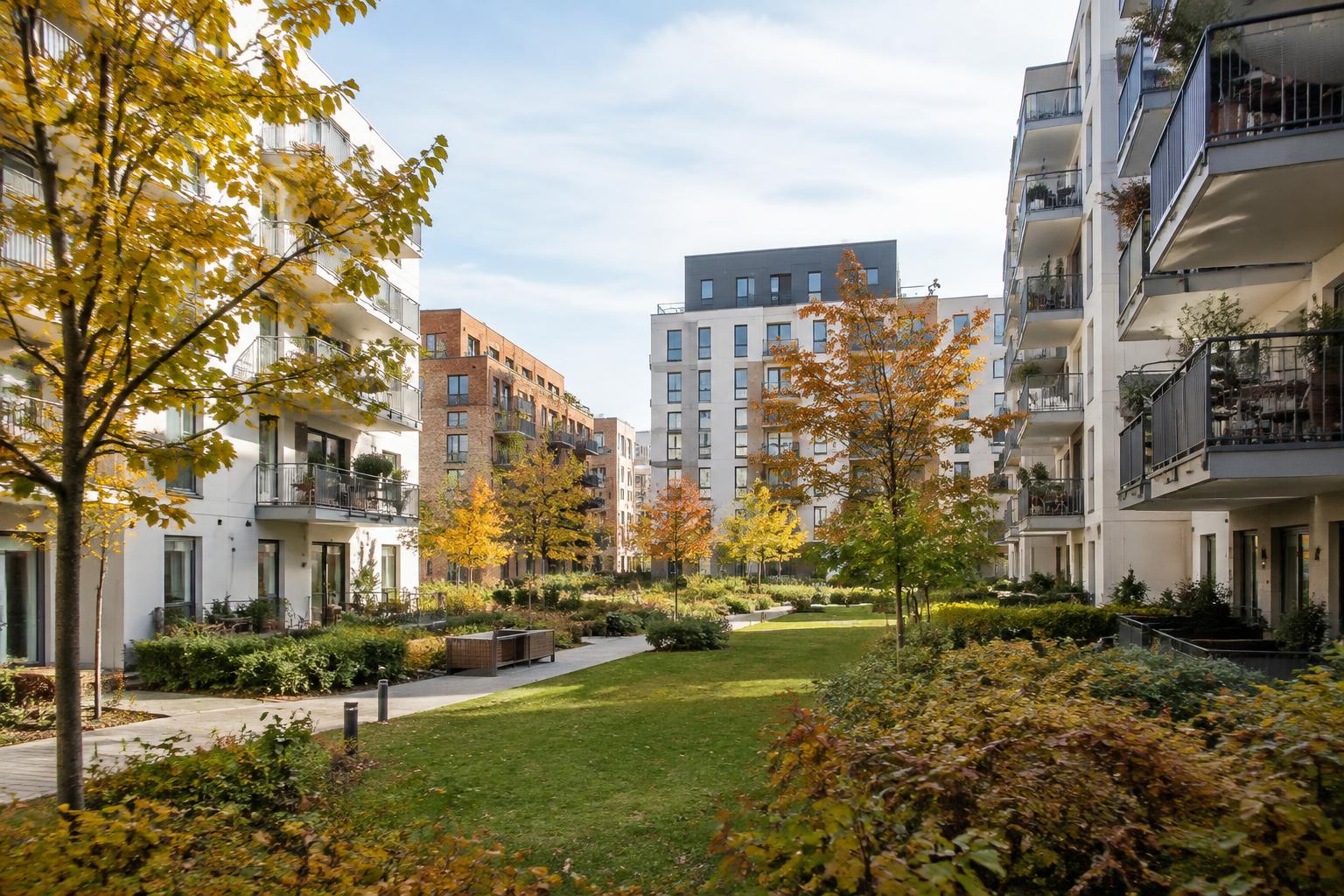
| Purchase price for a new-build flat (first sale) | €4,440/m² | Moers Property Valuation Committee, 2025, 5 sales |
| Mietpreisbremse (rent price cap) | no | MietSchVO NRW, list of municipalities |
| Kappungsgrenze (rent increase cap) | 20% | § 558 BGB |
| Property transfer tax for North Rhine-Westphalia | 6.5% | State law NRW |
02Population and demand
At the end of 2025, Moers had an official population of 101,298. In 2015, the figure was 104,529. Part of the difference is due to the 2022 Census, which recalculated population figures nationwide. In the last year, the population decreased by around 200 people. According to Deutschlandatlas, Moers grew by an average of 0.1% per year between 2019 and 2024, meaning it was almost stable.
We do not have a specific forecast for Moers. For the Wesel district, IT.NRW expects a slight decline by 2040 and a fall of 4.2% by 2050. For a landlord, this indicates that demand is more likely to remain constant than to grow.
The vacancy rate is low. In the 2022 Census, 3.3% of dwellings were vacant, significantly fewer than in Duisburg or Hagen. 57.3% of dwellings were rented, and 41% were owner-occupied. This makes Moers more of a town of homeowners and families than a typical city.
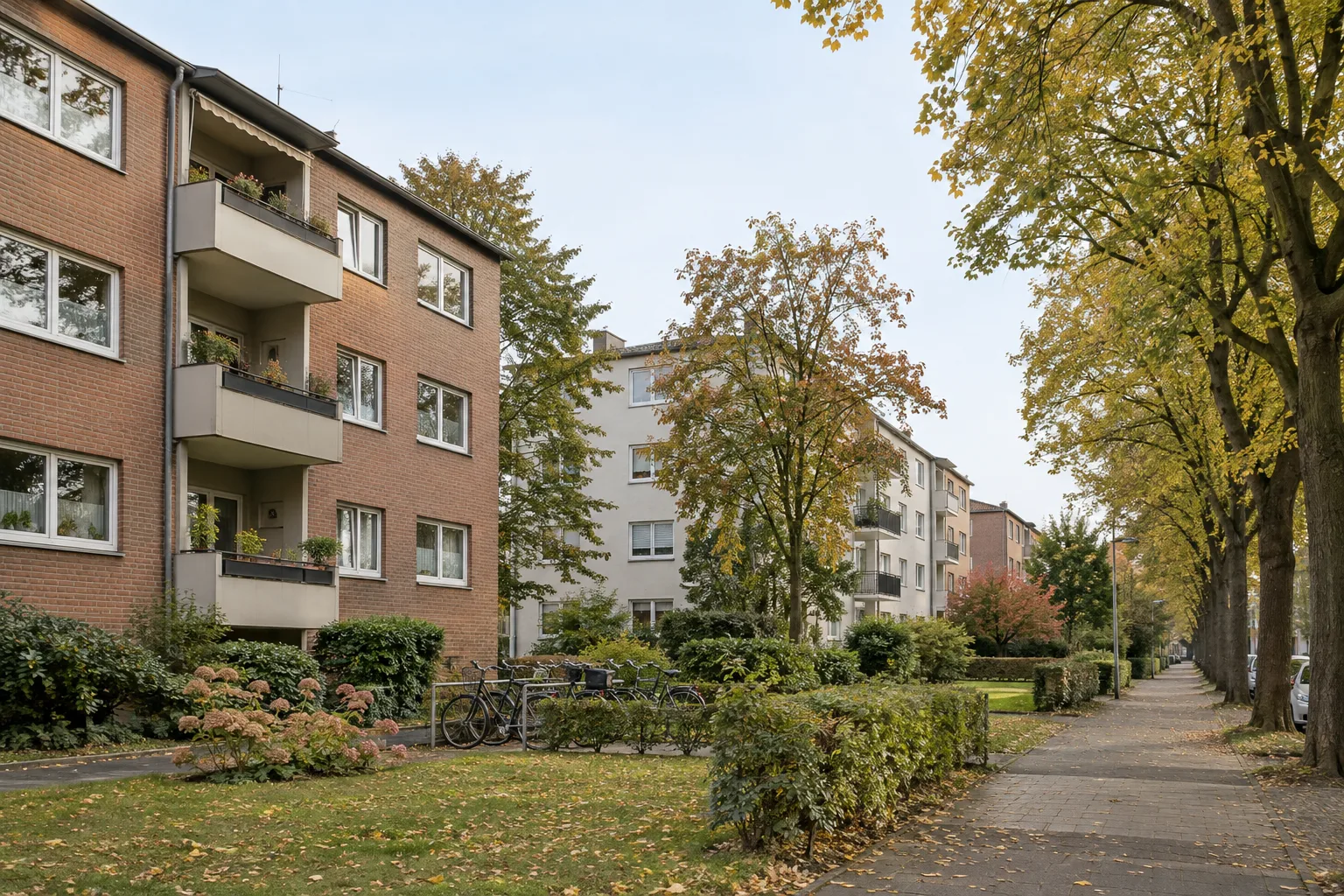
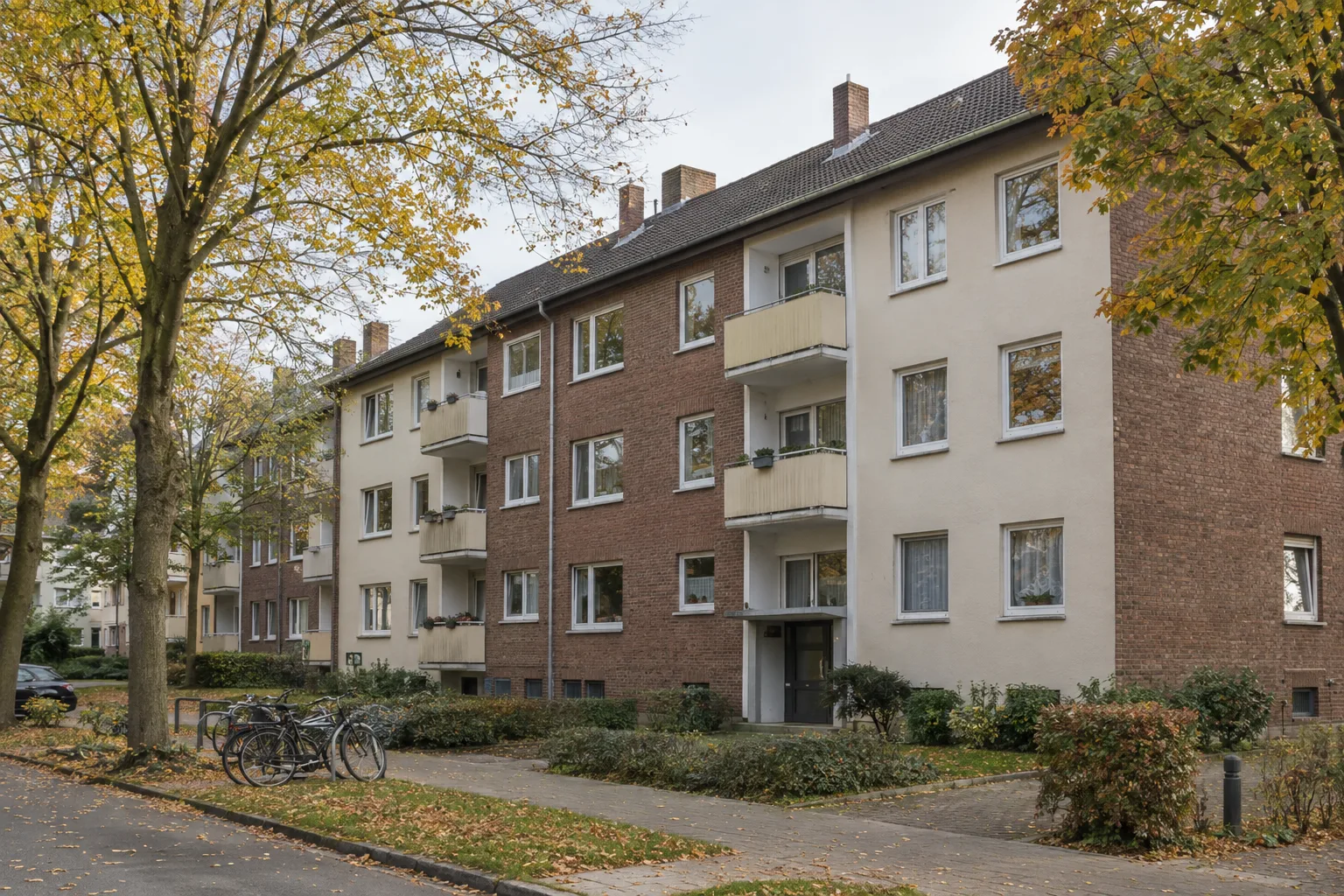
The housing stock predominantly dates from the years 1950 to 1979, totalling over 28,000 dwellings. New condominiums are hardly being built anymore: in 2025, only five new-build flats were sold for the first time. The transaction volume from first sales was €1.8 million, compared to €39 million in 2017.
03Economy and job market
Moers is a commuter town. On 30 June 2025, 38,312 employees subject to social security contributions lived in the town, while 36,921 worked there. 24,760 people commute in daily and 26,151 commute out. This shows two things: Moers is itself a place of work with many jobs, and at the same time, it is home to many who work in neighbouring cities.
We do not have an unemployment rate for the town alone. In the Wesel district, the annual average for 2025 was 7.3%.
For landlords, the proximity to Duisburg is the most important factor. Those who work there and are looking for a quieter residential area often end up in Moers. This supports the demand for medium-sized and family flats, less so for micro-apartments.
04Rents, purchase prices and rental yield
Moers has a Mietspiegel (rent index), which is published by Haus & Grund Grafschaft Moers and the Mieterbund Rhein-Ruhr. The property valuation committee is not involved in its creation. For our calculation, we therefore use a figure from the property market report: in 85 rented flats that were sold in 2024 and 2025, the average net rent was €7.50/m².
According to the BBSR, listings in the Wesel district had an average asking rent of €8.84/m² in 2025. In the 2022 Census, tenants in Moers were paying €6.26/m² for existing contracts.
The purchase prices come from actual purchase agreements. In 2025, flats from the years 1950 to 1974 cost an average of €1,840/m², up from €1,580/m² in the previous year. Flats from the years 1975 to 1994 were priced at €2,320/m², and those from 1995 to 2009 at €2,640/m². For new flats, buyers paid between €4,110 and €4,900/m², with an average of €4,440/m².
The purchase price and the rent determine the rent multiplier, and its reciprocal is the gross rental yield.
The newer the building, the lower the gross yield. Older flats generate more rent per euro invested, but also require more maintenance. You can check your own figures with the rental yield calculator.
05Districts at a glance
The property valuation committee does not publish official rent or purchase price figures for each district. The table therefore only describes their character.
| District | Character | More suitable for |
|---|---|---|
| Moers-Mitte | City centre with old town and castle park, short distances, many apartment blocks | Single people, older tenants |
| Asberg | East of the city centre, towards Duisburg, mixed development | Commuters, couples |
| Meerbeck | District with housing estates from the mining era and a large stock of rental housing | Families, price-conscious tenants |
| Repelen | Northern district with its own centre and residential areas of different ages | Families |
| Kapellen | South-western district, rather quiet, with detached and multi-family houses | Families, longer-term tenants |
| Hülsdonk and Schwafheim | Residential areas in the south, predominantly residential use | Families, professionals |
When buying in Moers, the year of construction and the condition are what count most. There is an average difference of around €800/m² between a flat from the 1960s and one from the 2000s, while the rent differs far less.
06Rules for landlords in Moers
Moers is not listed in the tenant protection ordinance (Mieterschutzverordnung) of the state of North Rhine-Westphalia. This means:
- No Mietpreisbremse (rent price cap): When starting a new tenancy, you are not bound to a maximum of 10% above the local comparable rent.
- Kappungsgrenze (rent increase cap) of 20%: In an existing contract, the rent may be increased by a maximum of 20% within three years, and only up to the local comparable rent.
- Rent index as justification: In Moers, a rent increase in an existing contract is usually justified using the rent index from the associations or by citing comparable properties.
When buying in North Rhine-Westphalia, you pay 6.5% property transfer tax. On top of this come notary and land registry fees, and depending on the property, an estate agent. For a purchase price of €125,125, the ancillary costs are around 8.6% without an agent. The ancillary purchase costs calculator will work out your own costs, and our article on notary fees explains the notary's charges.

07Example calculation: a rented flat in Moers
Let's take Daniel, 36, single, a logistics planner with a taxable income of €60,000. He buys a rented flat of 65 m² for €125,125. The price and rent correspond to the average for rented flats sold in Moers in 2024 and 2025: €1,925/m² and €7.50/m². The name is fictional; the figures are an example calculation and not a forecast.
| Purchase price (65 m² × €1,925/m²) | €125,125 |
|---|---|
| Property transfer tax North Rhine-Westphalia 6.5% | €8,133 |
| Notary and land registry (with land charge of €125,125) | €2,616 |
| Ancillary purchase costs from equity | €10,749 |
| Loan (purchase price) | €125,125 |
| Interest 3.8% and principal repayment 1.5% (assumption) | €6,632 per year |
| per year | per month | |
|---|---|---|
| Net rent (€7.50/m², sales 2024–2025) | €5,850 | €488 |
| Interest | −€4,755 | −€396 |
| Principal repayment | −€1,877 | −€156 |
| Non-apportionable costs (management, sinking fund, assumption) | −€1,320 | −€110 |
| Cash flow before tax | −€2,102 | −€175 |
| Depreciation at 2% on the building's share (80%, assumption) | €2,161 | €180 |
| Loss from letting (rent − interest − costs − depreciation) | −€2,386 | −€199 |
| Tax saving (2026 tax rate, excluding church tax) | +€911 | +€76 |
| Cash flow after tax | −€1,191 | −€99 |
After tax, Daniel contributes around €99 per month. €156 per month goes towards principal repayment; without it, there would be a small surplus of around €57. The rent covers interest and running costs, while he pays part of the principal repayment himself.
What affects this calculation the most? In Moers, interest and rent have an almost equal impact. Our article on tax on rental income explains how rental income is taxed.
If a flat's actual rent is closer to the level of older, existing contracts, the calculation quickly turns negative. Therefore, be sure to ask to see the tenancy agreement and the rent development over the last few years.
For comparison: a new-build flat in Moers
What changes if Daniel buys a newly built 45 m² flat instead? For first sales in 2025, the property valuation committee determined an average of €4,440/m², based on just five sales. This results in a price of €199,800. He pays the property transfer tax (€12,987) as well as notary and land registry fees (€3,438) out of equity. A new-build rent for Moers is not published. We will use the average asking rent in the Wesel district of €8.84/m², which includes all construction years. For a new-build, this is likely a lower-end estimate.
| per year | per month | |
|---|---|---|
| Net rent (45 m² × €8.84/m², asking rent Wesel district 2025) | €4,774 | €398 |
| Interest (3.8% on €199,800) | −€7,592 | −€633 |
| Principal repayment (1.5%) | −€2,997 | −€250 |
| Non-apportionable service charge (€1.20/m², assumption) | −€648 | −€54 |
| Cash flow before tax | −€6,464 | −€539 |
| Declining-balance depreciation at 5% on the building's share (80%, assumption) | €8,606 | €717 |
| Loss from letting (rent − interest − service charge − depreciation) | −€12,072 | −€1,006 |
| Tax saving (2026 tax rate, excluding church tax) | +€4,406 | +€367 |
| Cash flow after tax | −€2,058 | −€171 |
In the first year, the depreciation is about four times as high as for the existing flat (€8,606 instead of €2,161), and maintenance is usually negligible in the first few years. However, the price per square metre is more than double, and with our rent assumption, the gross rental yield drops to 2.4%. After tax, Daniel contributes around €171 per month, a good €70 more than for the existing property. Flats first let after 1 October 2014 are permanently exempt from the rent price cap (§ 556f BGB), which does not apply in Moers anyway. The tax saving will decrease in subsequent years because declining-balance depreciation is calculated on the residual value.
08Opportunities and risks in Moers
There are verifiable points in favour of Moers. The vacancy rate is low at 3.3%, the town is well connected to a large job market via its proximity to Duisburg, and purchase prices are in a range where the rent covers the running costs. The market picked up in 2025: 28% more purchase agreements than in the previous year and rising prices for existing flats.
On the other hand, there are equally clear points against it:
- Slightly decreasing population: around 3,200 fewer inhabitants since 2015 (partly due to the recalculation in the 2022 Census), with a forecast for the Wesel district of minus 4.2% by 2050.
- Old housing stock: The majority of flats date from the years 1950 to 1979.
- Hardly any new construction: Only five first sales in 2025; new flats are expensive and rare.
- High ancillary purchase costs: 6.5% property transfer tax plus notary fees, around 8.6% in our example.
- Interest rate risk: One percentage point more on the follow-on interest rate costs around €104 per month for a €125,125 loan.
- You are looking for a flat with stable letting prospects in a commuter location.
- You can afford a monthly contribution of around €100 for several years.
- You thoroughly check the year of construction, service charge and sinking fund before buying.
- You intend to hold the property for the long term.
- You expect a positive cash flow from the very first month.
- You are banking on a growing population.
- You have no reserves for vacancies or a special levy.
- You are dependent on a specific level of capital appreciation.
Our article Buy-to-let flat: pros and cons discusses the general advantages and disadvantages of a flat as an investment property.
09Other locations
Other cities in North Rhine-Westphalia: Overview North Rhine-Westphalia · Aachen · Bergisch Gladbach · Bielefeld · Bochum · Bonn · Bottrop · Dortmund · Duisburg · Düsseldorf · Essen · Gelsenkirchen · Gütersloh · Hagen · Hamm · Krefeld · Cologne · Leverkusen · Mönchengladbach · Mülheim an der Ruhr · Münster · Neuss · Oberhausen · Paderborn · Recklinghausen · Remscheid · Siegen · Solingen · Troisdorf · Witten · Wuppertal
All locations in comparison: Where is a buy-to-let property worthwhile? Cities in comparison 2026 · Which federal state is suitable? All 16 in comparison
FAQFrequently asked questions
Is a flat in Moers a worthwhile buy-to-let investment?
Based on average values, a tenanted flat in Moers requires a post-tax monthly contribution of around €99, of which €156 goes towards repaying the principal. Moers benefits from a low vacancy rate and its location next to Duisburg, but the city has a slightly declining population.
What is the rental yield in Moers?
The gross yield is around 4.7% to 4.9% for second-hand flats built between 1950 and 1974, if you calculate using the actual rents of tenanted properties. For more recent properties it drops to below 4%, and for new-builds to around 2.4%.
How much does a freehold flat cost in Moers?
According to the expert committee, second-hand flats in 2025 cost between €1,840/m² (built 1950 to 1974) and €3,700/m² (built 2010 to 2023), depending on the year of construction. New flats were sold for €4,110 to €4,900/m².
Is there a 'Mietpreisbremse' (rent cap) in Moers?
No. Moers is not listed in the 'Mieterschutzverordnung' (Tenant Protection Ordinance) of North Rhine-Westphalia. The general 'Kappungsgrenze' (rent increase cap) of 20% over three years applies.
Is there a 'Mietspiegel' (rent index) in Moers?
Yes. The 'Mietspiegel' for privately financed housing is published by Haus & Grund Grafschaft Moers and the Mieterbund Rhein-Ruhr. The expert committee is not involved in its creation.
Which districts in Moers are interesting for buy-to-let investors?
That depends on the target group. The town centre and Asberg appeal to individuals and commuters, while Repelen, Kapellen, Hülsdonk and Schwafheim tend to attract families. Official prices per district are not available in figures.
How high are the incidental costs of purchase in Moers?
In North Rhine-Westphalia, 'Grunderwerbsteuer' (property transfer tax) is 6.5%. Notary and land registry fees are around 2% if financing is involved. For a purchase price of €125,125, the costs without an estate agent are around €10,750, or 8.6%.
10Further reading
- Buy-to-let flat: pros and cons
- How to declare rental income for tax purposes
- Notary fees for property purchase
- Special depreciation and declining-balance depreciation
- Rental yield calculator
- Ancillary purchase costs calculator
- Property transfer tax in North Rhine-Westphalia
11Sources
All sources accessed on 16 October 2026.
- Property Valuation Committee for the City of Moers, Grundstücksmarktbericht 2026 (reporting period 2025), chapters 2, 3.4, 6.1 and 9.1
- IT.NRW on behalf of the MWIKE NRW, Bevölkerungsvorausberechnung für Nordrhein-Westfalen 2024 bis 2050/2070 (Wesel district)
- Federal Statistical Office, municipal directory, municipalities on 31 December 2015 and 31 December 2025
- Statistical Offices of the Federation and the Länder, 2022 Census (reference date 15 May 2022): Regional table Buildings and Dwellings and Regional table Households
- Federal Employment Agency, Municipal data on employees subject to social security contributions by place of residence and work, reference date 30 June 2025
- BBSR and Federal Employment Agency via Deutschlandatlas, data tables (Asking rents 2025 and unemployment rate 2025 for the Wesel district, population development Moers; as of 25 September 2026)
- State Government of NRW, Mieterschutzverordnung NRW (MietSchVO NRW), GV. NRW. 2025 p. 111, amended GV. NRW. 2025 p. 848 (list of municipalities, Moers not included)
- Property transfer tax North Rhine-Westphalia 6.5%, Act of 25 July 2011 (GV. NRW. p. 389) in the version of 18 December 2014 (GV. NRW. p. 954)
- § 556d BGB, § 556f BGB, § 558 BGB, § 32a EStG (2026 tax rate), § 7 EStG (paras. 4 and 5a), § 7b EStG, § 34 GNotKG (Table B)
- All example calculations, rent multipliers and yields: own calculation, as of 16 October 2026
Disclaimer: This page is for general information purposes only and does not constitute investment, tax or legal advice. All figures are example calculations with disclosed assumptions or official data with the specified date, as of 16 October 2026.
Writes about Taxes, AfA (depreciation), Existing properties and Portfolio building.
Since 2020, Eduard has bought seven properties of his own and supported more than 150 clients. He writes about tax levers, property documents and portfolio building – with honest numbers instead of rosy projections.
This guide does not replace tax or legal advice. All figures are example calculations with disclosed assumptions.