Investment Property in Herne: Figures, Locations and an Honest Calculation
Resale flats at around €1,500/m², a qualified rent index and more arrivals than departures, but also unemployment of 12.2% and an ageing housing stock. We set out the official figures and run the numbers for a tenanted flat.
 Herbert Gotschy
Investment Advisor at InvestImmo
Herne is a city many investors know only from the motorway. Between Bochum, Gelsenkirchen, Recklinghausen and Castrop-Rauxel, just over 156,000 people live in an area of only 51 square kilometres. With 3,039 residents per square kilometre, Herne is one of Germany’s most densely populated cities.
For property investors, the price level is particularly interesting. In 2025, a resale flat in a post-war building changed hands for an average of around €1,550 per square metre. At the same time, Herne attracts more people from other parts of Germany than it loses. On the other side of the equation are unemployment of over 12%, a very old housing stock and rents below the average among its larger Ruhr neighbours. We set these factors side by side and run the numbers for a flat using figures from the local property valuation committee [Gutachterausschuss].
01Herne in figures
All the figures used in our assessment, with sources and dates.
| Indicator | Value | Source, date |
|---|---|---|
| Residents (official) | 156,266 | Federal Statistical Office, municipal directory, 31 December 2025 |
| Residents in 2015 (based on the 2011 Census) | 155,851 | Federal Statistical Office, 31 December 2015 |
| Forecast 2023–2050 | −0.5% | IT.NRW, population projection 2024 to 2050/2070 |
| Net internal migration | +35 per 10,000 residents | BBSR via Deutschlandatlas, 2024 |
| Households | 77,670 | 2022 Census |
| Share of single-person households | 47.3% | 2022 Census |
| Housing stock | 82,502 | 2022 Census |
| Vacancy rate | 4.4% | 2022 Census, reference date 15 May 2022 |
| Share of rented homes | 69.4% | 2022 Census, our own calculation |
| Employees subject to social insurance contributions, by workplace | 52,391 | Federal Employment Agency, 30 June 2025 |
| Inbound / outbound commuters | 31,039 / 36,991 | Federal Employment Agency, 30 June 2025 |
| Unemployment rate | 12.2% | Federal Employment Agency via Deutschlandatlas, annual average 2025 |
| Average rent under existing tenancies | €5.71/m² | 2022 Census |
| Rent index, 60–115 m², built 1960–1969 (base rate) | €5.54/m² | Qualified rent index 2025 |
| Asking rent (reletting) | €7.68/m² | BBSR via Deutschlandatlas, 2025 |
| Purchase price of resale flats, built 1946–1978 | €1,549/m² | Herne property valuation committee, 2025 (146 transactions) |
| Purchase price of newly built flats | €3,269/m² | Herne property valuation committee, 2025 (11 transactions) |
| Rent brake [Mietpreisbremse] | no | NRW Tenant Protection Ordinance, list of municipalities |
| Cap on rent increases [Kappungsgrenze] | 20% | Section 558 BGB |
| Property transfer tax [Grunderwerbsteuer], North Rhine-Westphalia | 6.5% | NRW state legislation |
02Population and demand
At the end of 2025, Herne’s official population was 156,266. This is roughly the same as ten years earlier. The comparison is not exact, however, because the 2015 figure was still based on the 2011 Census, whereas the latest figure is based on the 2022 Census. Over the last year, the city’s population grew by just over 400.
The source of that growth is noteworthy. Unlike many Ruhr cities, Herne gains residents through moves within Germany. In 2024, net inward migration was around 35 people per 10,000 residents. Housing costs are a plausible reason: people working in Bochum or Dortmund can find cheaper flats in Herne a short distance away. IT.NRW forecasts slight population growth up to 2040 and an almost unchanged population by 2050 (−0.5%).
For landlords, the make-up of demand matters. In the 2022 Census, 69.4% of homes were rented, while only just over a quarter were owner-occupied. Single-person households account for 47.3% of all households. Small and medium-sized flats therefore have a broad tenant base.
The housing stock is old. Almost 16,000 homes were built before 1919, and just under 20,000 in the 1950s. According to the census, only around 900 homes have been added since 2016. Modern, energy-efficient homes are therefore scarce in Herne, while older flats that have not been refurbished face greater challenges.
03Economy and labour market
Herne lies in the heart of the Ruhr region, on the A42 and A43 motorways, with the Rhine–Herne Canal and two railway stations in Herne and Wanne-Eickel. On 30 June 2025, 52,391 employees subject to social insurance contributions worked in the city, while 58,316 lived there. Significantly more people commute out (36,991) than in (31,039). Herne is therefore primarily a residential base for people working in neighbouring cities.
The unemployment rate averaged 12.2% in 2025, and around 16.8% of residents received minimum-income benefits. This has two implications for landlords. For tenants receiving basic income support [Bürgergeld], the Jobcenter only covers rent up to a reasonable-cost limit, capping achievable rents in part of the market. In addition, missed rent payments and tenant turnover are more likely than in cities with low unemployment.
Herne does not have its own university. However, Ruhr University Bochum is within commuting distance, as are the higher education institutions in Gelsenkirchen and Dortmund. You should not expect demand on the scale of a traditional university city: small flats are more likely to attract working people and older residents.
04Rents, purchase prices and rental yields
Herne introduced its first qualified rent index on 1 January 2025. It is valid until 31 December 2026 and is based on a survey conducted in 2024. For flats between 60 and 115 m², it gives base rates of €5.40/m² (built between 1940 and 1959), €5.54/m² (1960 to 1969) and €6.17/m² (1985 to 1999). The base rate describes a basic flat without floor coverings or a balcony. Supplements apply, for example, to laminate or tiles (+€0.29/m²), a balcony (+€0.19/m²), central heating (+€0.11/m²) and thermally insulating windows (+€0.15/m²). A typical flat from the 1960s with all four features therefore comes to €6.28/m².
Asking rents are higher. BBSR reports an average of €7.68/m² for newly advertised flats in 2025. Under existing tenancy agreements, tenants paid an average of only €5.71/m² at the time of the 2022 Census.
Purchase prices come from the valuation committee’s 2026 property market report and are therefore based on actual sale contracts. In 2025, 523 resale flats were sold, 12% more than in the previous year. Prices fell slightly, by around 2%. Depending on the year of construction, buyers paid the following averages:
Purchase price and rent determine the purchase price multiplier [Kaufpreisfaktor]; its reciprocal is the gross rental yield [Bruttomietrendite].
The valuation committee itself calculates a gross income multiplier of 20.6 for tenanted flats, also equivalent to around 4.9%. Yields are higher than in most major cities; part of that difference compensates for the risks discussed below. Check your own figures with the rental yield calculator.
05Overview of Herne’s districts
Herne has four boroughs: Herne-Mitte, Wanne, Eickel and Sodingen. Until 1975, Herne and Wanne-Eickel were separate cities, leaving two distinct centres to this day. The valuation committee divides the city into six zones for individually owned flats and shows how strongly location affects price. Its calculations use a standard property: 65 m², built in 1961, in an average location, with vacant possession.
| Reference value zone | Model price for the standard property | Character | Better suited to |
|---|---|---|---|
| Wanne | €1,480/m² | Western centre with Wanne-Eickel main station and many blocks of flats | Single people, commuters |
| Eickel | €1,539/m² | Established centre with a mix of older and post-war buildings | Couples, working people |
| Herne (Mitte) | €1,495/m² | City centre with a pedestrian zone and Herne station | Single people, older residents |
| Herne-Süd | €1,584/m² | Quieter residential areas towards Bochum | Families, working people |
| Horsthausen | €1,421/m² | Northern area by the canal, modest residential locations | Budget-conscious tenants |
| Sodingen | €1,672/m² | Eastern area, many one- and two-family houses, greener surroundings | Families, longer tenancies |
Model prices: property reference value of €1,480/m² multiplied by the zone’s conversion coefficient according to the Herne valuation committee; our own calculation, as at 19 October 2026. These are not average prices by district.
For the same standard property, the difference between Horsthausen and Sodingen is around 18%. Further factors include the residential location within the zone (good locations +5%, basic locations −5%) and the rent index, which provides a supplement of €0.28/m² for residential location category 3. The category for each address is listed in the rent index’s residential location register.
06Rules for landlords in Herne
Herne is not included in North Rhine-Westphalia’s Tenant Protection Ordinance. This means:
- No rent brake: When reletting, you are not bound by the limit of 10% above the local comparable rent. However, rents well above the rent index are difficult to achieve in Herne’s market.
- Cap on rent increases of 20%: During an ongoing tenancy, rent may rise by no more than 20% over three years, and only up to the local comparable rent [ortsübliche Vergleichsmiete].
- Qualified rent index: You must state its figures whenever you raise the rent, even if you justify the increase on another basis. The range around the calculated figure extends from −13.4 to +13.8%.
When buying in North Rhine-Westphalia, you pay 6.5% property transfer tax. Notary and land registry fees are additional, as are estate agent fees where applicable. For a purchase price of €100,685, ancillary purchase costs [Kaufnebenkosten] are around 8.7% without an estate agent. The purchase costs calculator works out your own costs, while our article on notary fees explains the individual charges.
07Worked example: a tenanted flat in Herne
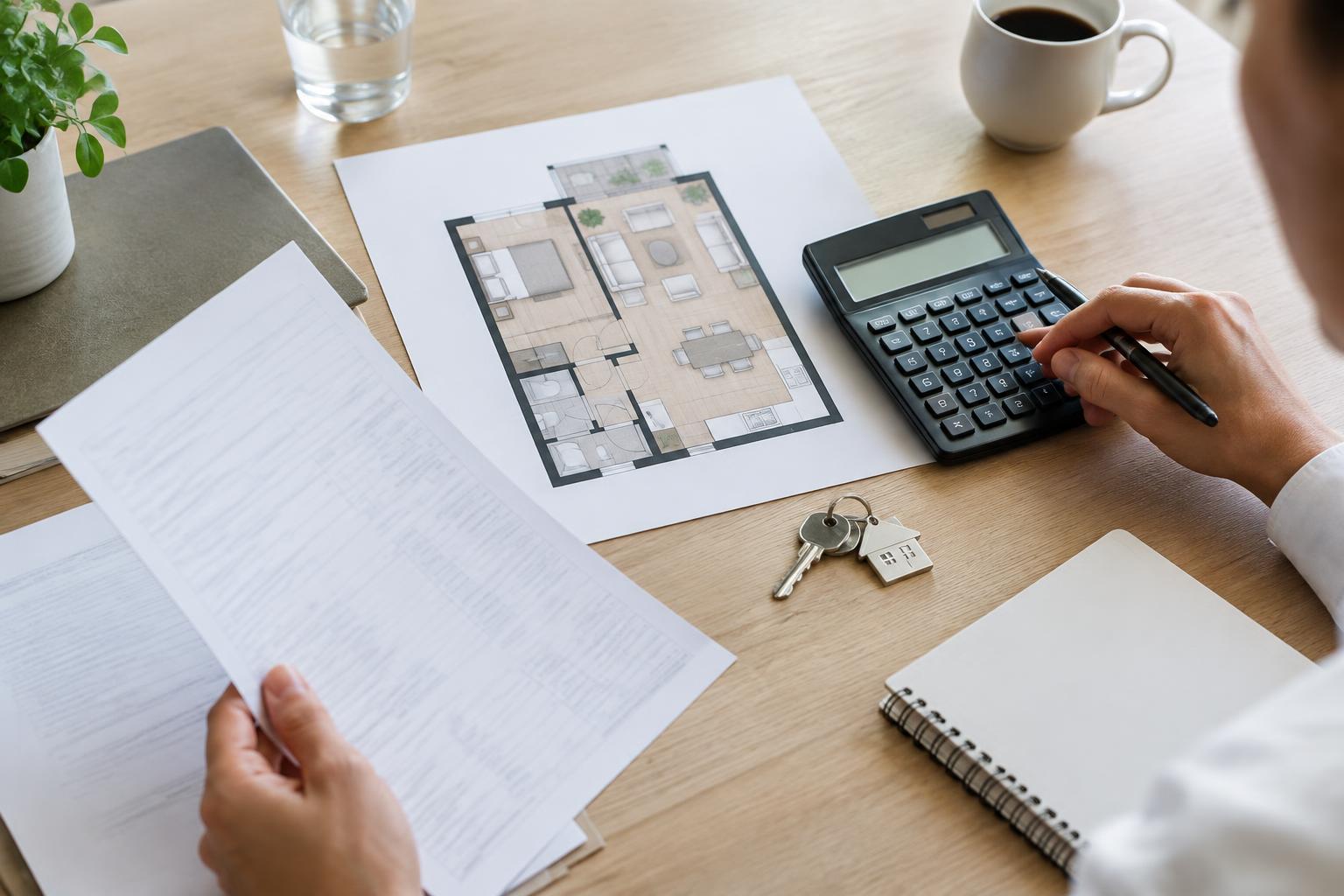
Take Daniel, 41, single, an industrial mechanic with a master craftsman qualification and taxable income of €60,000. He buys a tenanted 65 m² flat, built in 1965, for €100,685. This corresponds to the 2025 average price for flats built between 1946 and 1978 (€1,549/m²). The rent of €6.28/m² is the rent-index figure for this flat with floor coverings, a balcony, central heating and thermally insulating windows. The name is fictional, and the figures are an illustrative calculation, not a forecast.
| Purchase price (65 m² × €1,549/m²) | €100,685 |
|---|---|
| North Rhine-Westphalia property transfer tax, 6.5% | €6,545 |
| Notary and land registry fees (including a land charge [Grundschuld] of €100,685) | €2,204 |
| Ancillary purchase costs paid from equity | €8,749 |
| Loan (purchase price) | €100,685 |
| Interest 3.8% and principal repayment [Tilgung] 1.5% (assumed) | €5,336 a year |
| per year | per month | |
|---|---|---|
| Rent excluding service charges [Nettokaltmiete] (€6.28/m², rent index 2025) | €4,898 | €408 |
| Interest | −€3,826 | −€319 |
| Principal repayment | −€1,510 | −€126 |
| Costs not recoverable from tenants (management, reserve fund, assumed) | −€1,320 | −€110 |
| Cash flow before tax | −€1,758 | −€146 |
| Depreciation [Abschreibung] of 2% on the building component (80%, assumed) | €1,740 | €145 |
| Rental loss (rent − interest − costs − depreciation) | −€1,988 | −€166 |
| Tax saving (2026 tax schedule, excluding church tax) | +€760 | +€63 |
| Cash flow after tax | −€998 | −€83 |
Daniel contributes around €83 a month after tax. Principal repayments account for €126 a month; excluding these, there would be a surplus of around €43. In this Herne example, the rent therefore covers interest and running costs as long as the flat remains let and no major repairs are needed.
That is precisely the uncertainty with a building from the 1960s. A monthly allowance of €110 for management and the reserve fund is rather tight if the roof, windows or heating need attention. Read the minutes of recent owners’ meetings and check the size of the maintenance reserve [Erhaltungsrücklage]. Our article on taxing rental income explains how rental income is taxed.
The asking rent of €7.68/m² is not a reliable benchmark for a flat from the 1960s. It is around 22% above the rent-index figure and therefore outside its range. In a city with many long-term vacancies, you should budget for tenant turnover rather than base your calculation on advertised rents.
For comparison: a new-build flat in Herne
New builds are rare in Herne. In 2025, the valuation committee analysed only 11 sales of newly built flats, at an average price of €3,269/m² and an average size of 129 m². New-build prices fell by around 8% compared with the previous year. For Daniel, we calculate a 45 m² flat at this average price. We assume rent of €9.06/m²: the rent-index figure for 40 to 55 m² flats in the newest construction category, 2015 to 2021, with the usual supplements, including improved accessibility. The rent index allows higher rents for flats built from 2022 onwards. In any event, new-build flats first let after 1 October 2014 would be permanently exempt from a rent brake (Section 556f BGB).
| per year | per month | |
|---|---|---|
| Rent excluding service charges (€9.06/m², derived by us from the rent index) | €4,892 | €408 |
| Interest 3.8% | −€5,590 | −€466 |
| Principal repayment 1.5% | −€2,207 | −€184 |
| Costs not recoverable from tenants (assumed) | −€648 | −€54 |
| Cash flow before tax | −€3,552 | −€296 |
| Declining-balance depreciation [degressive Abschreibung] of 5% on the building component (80%) | €6,344 | €529 |
| Tax saving (2026 tax schedule) | +€2,865 | +€239 |
| Cash flow after tax | −€687 | −€57 |
The difference is primarily tax-related. Before tax, Daniel’s monthly shortfall of −€296 for the new build is twice that of the existing flat; after tax, the two are almost level (−€57 versus −€83). The new build’s gross yield of 3.3% is significantly lower than the existing flat’s 4.9%, but fewer repairs are generally needed in the early years. As declining-balance depreciation falls each year, the tax benefit diminishes over time.
Additional special depreciation [Sonderabschreibung] under Section 7b EStG may also be available if, among other conditions, the property meets the Efficiency House 40 standard with QNG certification, construction costs do not exceed €5,200 per m² and no more than €4,000 per m² is used as the assessment base. This is not included in our calculation. Our article on special depreciation and declining-balance depreciation explains how the two interact; you can calculate your own depreciation using the depreciation calculator.
08Opportunities and risks in Herne
There are demonstrable points in Herne’s favour. Purchase prices are low and even fell slightly in 2025; using average figures, rent covers interest and operating costs. The new qualified rent index makes the calculation verifiable. Herne is gaining residents from the rest of Germany, and IT.NRW expects an almost stable population through to 2050.
There are equally clear counterpoints:
- Unemployment rate of 12.2%: Missed rent payments and tenant turnover are more likely, and some rents are constrained by reasonable-cost limits.
- Long-term vacancies: At the time of the census, over half of vacant homes had been empty for a year or more.
- Old housing stock: Many buildings date from before 1970 and need work on roofs, façades, windows and heating.
- Limited purchasing power: Disposable income per resident was low, at around €22,100 in 2023.
- High purchase costs: Property transfer tax of 6.5% plus notary fees, adding up to almost 9% for low-priced properties.
- Very few new builds: Only 11 new-build sales in 2025, leaving the new-build comparison based on a small sample.
- You want to start with limited equity and hold a flat without a large monthly contribution.
- You carefully review service charges [Hausgeld], the reserve fund and owners’ meeting minutes.
- You have a reserve for vacancies and special levies [Sonderumlagen].
- You assess the rent against the rent index rather than the advertisement.
- You want a flat that requires no attention from you.
- You depend on rents above the rent index.
- You have no reserve for refurbishment work in the building.
- You depend on a particular increase in property value.
Our article on buying a flat as an investment explains the general advantages and disadvantages of this type of property investment.
09More locations
More cities in North Rhine-Westphalia: Overview of North Rhine-Westphalia · Aachen · Bergisch Gladbach · Bielefeld · Bocholt · Bochum · Bonn · Bottrop · Dortmund · Duisburg · Düsseldorf · Essen · Gelsenkirchen · Gütersloh · Hagen · Hamm · Iserlohn · Krefeld · Cologne · Leverkusen · Moers · Mönchengladbach · Mülheim an der Ruhr · Münster · Neuss · Oberhausen · Paderborn · Recklinghausen · Remscheid · Rheine · Siegen · Solingen · Troisdorf · Witten · Wuppertal
Compare all locations: Where is property investment worthwhile? City comparison 2026 · Which federal state is suitable? All 16 compared
FAQFrequently asked questions
Is a flat in Herne worthwhile as an investment?
Using average figures, a tenanted existing flat in Herne almost pays for itself. In our example, you contribute around €83 a month after tax, while €126 goes towards principal repayment. In return, you face higher risks of missed rent payments, vacancies and refurbishment costs than in more expensive cities.
What rental yield can you expect in Herne?
Around 4.9 to 5.1% gross when calculated using the rent index and the valuation committee’s purchase prices. Using the asking rent of €7.68/m² would produce around 6%, but this rent is rarely achievable for older flats.
How much does a flat cost in Herne?
In 2025, resale flats built between 1946 and 1978 cost an average of €1,549/m², while those built between 1979 and 2000 cost around €1,874/m². Newly built flats averaged €3,269/m², although this was based on only 11 sales.
Does Herne have a rent brake?
No. Herne is not included in North Rhine-Westphalia’s Tenant Protection Ordinance. The general cap on rent increases of 20% over three years applies, and rents may only be increased up to the local comparable rent.
Does Herne have a rent index?
Yes. The city’s first qualified rent index has been in force since 1 January 2025 and is valid until 31 December 2026. It uses base rates according to year of construction and size, with fixed supplements for features such as a balcony, floor coverings and residential location.
Which districts in Herne are of interest to property investors?
That depends on your target tenants. Wanne and Herne-Mitte offer many small flats near railway stations, while Herne-Süd and Sodingen appeal more to families and are more expensive. Horsthausen is the cheapest. There are no official average prices by district, only model values for the reference value zones.
How high are ancillary purchase costs in Herne?
North Rhine-Westphalia charges 6.5% property transfer tax. Including financing-related charges, notary and land registry fees are just over 2% for lower purchase prices. For a purchase price of €100,685, costs without an estate agent are around €8,750, or 8.7%.
10Further reading
- Buying a flat as an investment: advantages and disadvantages
- Taxing rental income
- Notary fees when buying property
- Special depreciation and declining-balance depreciation
- Rental yield calculator
- Purchase costs calculator
- Property transfer tax in North Rhine-Westphalia
11Sources
All sources accessed on 19 October 2026.
- Property valuation committee for the City of Herne, Property market report 2026 (reporting period 2025), sections 3.4, 6.1.1 to 6.1.5
- City of Herne, Qualified rent index 2025, valid from 1 January 2025 to 31 December 2026, tables 1 to 9
- IT.NRW on behalf of MWIKE NRW, Population projection for North Rhine-Westphalia 2024 to 2050/2070
- Federal Statistical Office, municipal directory, municipalities as at 31 December 2015 and 31 December 2025
- Federal and state statistical offices, 2022 Census (reference date 15 May 2022): Regional table of buildings and dwellings and Regional table of households
- Federal Employment Agency, Municipal data on employees subject to social insurance contributions by place of residence and workplace, reference date 30 June 2025
- BBSR and Federal Employment Agency via Deutschlandatlas, data tables (asking rents 2025, unemployment rate 2025, net migration 2024, minimum-income benefits 2024, disposable income 2023; as at 25 September 2026)
- NRW state government, NRW Tenant Protection Ordinance (MietSchVO NRW), GV. NRW. 2025 p. 111, amended by GV. NRW. 2025 p. 848 (list of municipalities, Herne not included)
- North Rhine-Westphalia property transfer tax of 6.5%, Act of 25 July 2011 (GV. NRW. p. 389), as amended on 18 December 2014 (GV. NRW. p. 954)
- Section 556d BGB, Section 556f BGB, Section 558 BGB, Section 558d BGB, Section 32a EStG (2026 tax schedule), Section 7 EStG (subsections 4 and 5a), Section 7b EStG, Section 34 GNotKG (Table B)
- All illustrative calculations, purchase price multipliers and yields: our own calculations, as at 19 October 2026
Note: This page provides general information and does not constitute investment, tax or legal advice. All figures are either illustrative calculations with stated assumptions or official figures with their relevant dates, as at 19 October 2026.
Writes about Investment properties, Purchase decisions and Financial viability.
Herbert has invested in property himself since 2023 and has worked in the property industry since 2024. His advice combines an investor’s perspective with clear explanations and an open assessment of opportunities and risks.
This guide does not replace tax or legal advice. All figures are example calculations with disclosed assumptions.